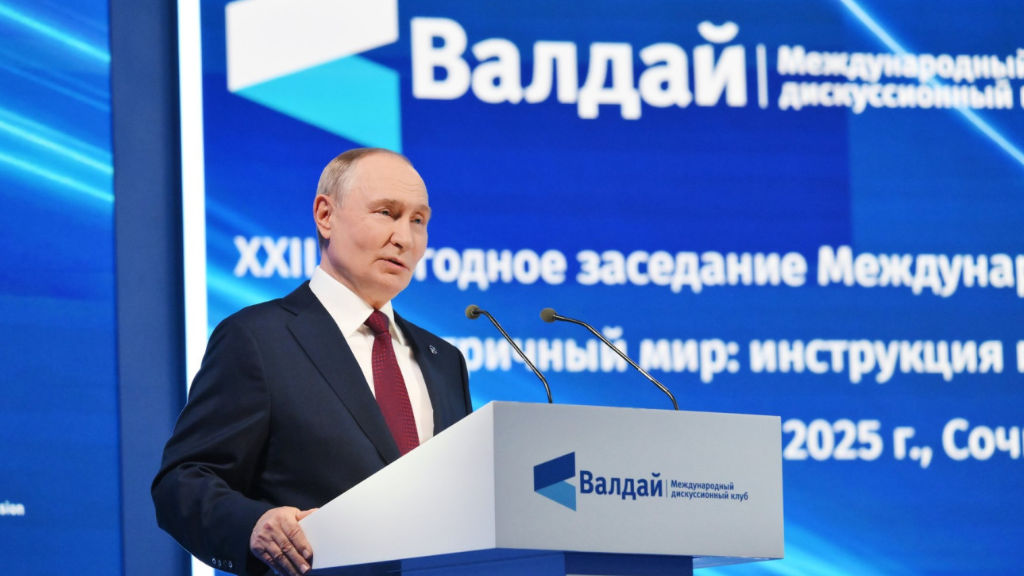
The Russian President, Vladimir Putin, has conducted his annual Q&A session at the Valdai Club, which was themed this year as “The Polycentric World: Instructions for Use.” In it, Putin touches on numerous academic issues to explain the changes global society is going through, why this is happening and the potential for reform and global development. He also discusses Russia’s slowly developing relations with the United States, the fragmentation of Europe, as well as the battlefield situation and detailed analysis of the Ukraine conflict.
He discusses the proposed use of Tomahawk missiles against Russia, the seizure of oil tankers by the French Navy, and relations with China and India. It is a multi-faceted session of note to all interested in the Russia-Global development space, with specific implications for Europe.
The session was moderated by Fyodor Lukyanov, Research Director of the Foundation for Development and Support of the Valdai International Discussion Club. His questions are prefixed FL, Putin’s answers as VP, our analysis as RPA, and questions asked as Q.
FL: “Mr. President, thank you very much for once again finding time to join us. The Valdai Club enjoys this great privilege of meeting with you for 23 consecutive years to discuss the most topical issues. I believe that no one else is that lucky.
This meeting of the Valdai Club was titled “The Polycentric World: Instructions for Use.” We are attempting to move from merely understanding and describing this new world to practical matters: that is, comprehending how to live in it, since it is not yet entirely clear.
We may consider ourselves advanced users, but we are still only users of this world. You, however, are at least a mechanic and perhaps even an engineer of this very polycentric world order, so we eagerly await some guidelines for use from you.”
VP: “Let me offer my view on what is happening in the world, the role of our country in it, and how we see its development prospects.
We have noted repeatedly that we are living in an era when everything is changing, and very rapidly at that; I would even say radically. Of course, none of us can fully foresee the future. However, that does not absolve us of the responsibility to be prepared for it. As time and recent events have shown, we must be ready for anything. In such periods of history, everyone bears a special responsibility for their own destiny, for the fate of their country, and for the world at large. The stakes today are extremely high.
The subject of a multipolar, polycentric world has long been on the agenda, but now it requires special attention. The multipolarity that has already emerged is shaping the framework within which the states act. Let me try to explain what makes the present situation unique.
First, today’s world offers a much more open – indeed, one might say creative – space for foreign policy. Nothing is predetermined; developments can take different directions. Much depends on the precision, accuracy, consistency and thoughtfulness of the actions of each participant in international communication. Yet in this vast space it is also easy to get lost and lose one’s bearings, which, as we can see, happens quite often.
Second, multipolarity space is highly dynamic. As I have said, change occurs rapidly, sometimes suddenly, almost overnight. It is difficult to prepare for it and often impossible to predict. One must be ready to react immediately, in real time, as they say.
Third, and of particular importance, is that fact that this new space is more democratic. It opens opportunities and pathways for a wide range of political and economic players. Never before have so many countries had the ability or ambition to influence the most significant regional and global processes.”
RPA: Russia is actually leading the way in this. The Russian Foreign Minister, Sergey Lavrov, held a remarkable 23 bilateral meetings in New York as part of the United Nations General Assembly last week. In contrast, the European Commission held nine.
VP: “The cultural, historical, and civilizational specificities of different countries now play a greater role than ever before. It is necessary to seek points of contact and convergence of interests. No one is willing to play by the rules set by someone else, somewhere far away – as a very well-known chansonnier sang in our country, “Beyond the Mists,” or beyond the oceans, as it were.
In this regard, the fifth point: any decisions are possible only on the basis of agreements that satisfy all interested parties or the overwhelming majority. Otherwise, there will be no viable solution at all, only loud phrases and a fruitless game of ambitions. To achieve results, harmony and balance are essential.
Finally, the opportunities and dangers of a multipolar world are inseparable from one another. Naturally, the weakening of the dictate that characterised the previous period and the expansion of freedom for all is undeniably a positive development. At the same time, under such conditions, it is much more difficult to find and establish this very solid balance, which in itself is an obvious and extreme risk.
This situation, which I have tried to outline briefly, is a qualitatively new phenomenon. International relations are undergoing a radical transformation. Paradoxically, multipolarity has become a direct consequence of attempts to establish and preserve global hegemony, a response by the international system and history itself to the obsessive desire to arrange everyone into a single hierarchy, with Western countries at the top. The failure of such an endeavour was only a matter of time, something we have always spoken about. By historical standards, it happened fairly quickly.
Thirty-five years ago, when the confrontation of the Cold War seemed to be ending, we hoped for the dawn of an era of genuine cooperation. It seemed that there were no longer ideological or other obstacles that would hinder the joint resolution of problems common to humanity or the regulation and resolution of inevitable disputes and conflicts on the basis of mutual respect and consideration of each other’s interests.
Allow me a brief historical digression. Russia, striving to eliminate the grounds for bloc confrontation and to create a common space of security, twice declared even its readiness to join NATO. Initially this was done in 1954, during the Soviet era. The second time was during the visit of US President Bill Clinton to Moscow in 2000 – when we also discussed this topic with him.
On both occasions, we were refused outright. I reiterate: we were ready for joint work, for non-linear steps in the sphere of security and global stability. But our Western colleagues were not prepared to free themselves from the shackles of geopolitical and historical stereotypes, from a simplified, schematic view of the world.
I also spoke publicly about this when I discussed it with Mr Clinton, with President Clinton. He said, “You know, it’s interesting. I think it’s possible.” And then in the evening he said, “I consulted with my people – it’s not feasible, not feasible now.” I replied “When will it be feasible?” And that was it, it all slipped away.
In short, we had a genuine chance to move international relations in a different, more positive direction. Yet, alas, a different approach prevailed. Western countries succumbed to the temptation of absolute power. It was indeed a powerful temptation – and resisting it would have required historical vision and a good background, intellectual and historical background. It seems that those who made decisions at that time simply lacked both.”
RPA: Putin’s anecdote about Russia joining NATO indicates that at the time, there were vested interests in the United States that wanted to prolong the Cold War into a new phase, which continues today. It is also of note that President Clinton appeared to defer to other, unnamed individuals when floating the proposal. That suggests that the President of the United States is not the ultimate US authority.
VP: “The United States and its Western allies reached the peak of their powers at the end of the 20th century. But there has never been, nor will there ever be, a force capable of ruling the world, dictating how everyone must act, how to live, even how to breathe. Such attempts have been made, but every one of them has failed.
However, we must recognise that many found that so-called liberal world order acceptable and even convenient. An hierarchy severely limits opportunities for those not perched at the top of the pyramid. But those at the bottom are relieved of responsibility: the rules are simple: accept the terms, fit into the system, receive your share, however modest, and be content. Others would think and decide for you.
No matter what anyone says now, no matter how some try to disguise the reality – that is how it was.
However, arrogance crept in and saw themselves entitled to lecture the rest of the world. Others were content to play along with the powerful as obedient bargaining chips, eager to avoid unnecessary trouble in exchange for a modest but guaranteed bonus. There are still many such politicians of this type in Europe today.”
RPA: The recent capitulation by the European Union in signing a trade agreement with the United States that imposed a 15% tariff on most EU imports into the United States, but a zero tariff on US imports into the EU, is illustrative.
VP: “Those who dared object and tried to defend their own interests, rights, and views, were at best dismissed as eccentrics and told, in effect: “You will not succeed, so give up and accept that compared to our power, you are a nonentity.” As for the truly stubborn, they were “educated” by the self-proclaimed global leaders, who no longer even bothered to hide their intent. The message was clear: resistance was pointless.
But this did not bring anything good. Not a single global problem was resolved. On the contrary, new ones are constantly multiplying. Institutions of global governance created in an earlier era either ceased to function or lost much of their effectiveness. And no matter how much strength or resources one state, or even a group of states, may accumulate, power always has its limits.”
RPA: Putin is referring here to various UN institutions such as the World Bank, World Trade Organisation and World Health Organisation amongst others that are now completely bypassed by both the United States and European Union. What should have been safety check structures against excesses and combined cooperation to deal with global problems are routinely ignored. As examples, their funding of global institutions is being reduced, while the United States is withdrawing from the WHO.
VP: “There is a saying in Russia: “There’s no counter to a crowbar, except another crowbar,” meaning, you don’t bring a knife to a gunfight, but another gun. And that “other gun” can always be found. This is the very essence of world affairs: a counterforce always emerges. Attempts to control everything inevitably generate tension, undermining stability at home and prompting ordinary people to ask a very fair question of their governments: “Why do we need all this?”
I once heard something similar from our American colleagues, who said: “We gained the whole world, but lost America.” I can only ask: Was it worth it? And did you truly gain anything at all?”
RPA: There are numerous social indicators pointing to a decline in US society. Deaths due to firearms incidents are currently 4.42 per 1000 in the US, in Russia this is less than 0.01. The US reports 41.4 rapes per 1000 of population, in Russia it is 4.8. The United States has 6 times more the registered opiate users than Russia, while in economics, the US debt to GDP is now 125% and in Russia about 20%.
VP: “A clear rejection of the excessive ambitions of the political elite of the leading Western European nations has emerged and is mounting among the societies in those countries. Public opinion indicates this across the board. The Western establishment does not want to cede power, dares to directly deceive its own citizens, escalates the situation internationally, resorts to all sorts of tricks inside their countries – increasingly on the fringes of the law or even beyond it.
However, perpetual turning democratic and electoral procedures into a farce and manipulating the will of the people is not going to work out. Like it was in Romania, for instance. This is happening in many countries. In some of them, the authorities are trying to ban their political opponents who are gaining greater legitimacy and greater voter trust. We know this from our own experience back in the Soviet Union. Do you remember Vladimir Vysotsky’s songs: “Even the military parade was cancelled! They will ban all and everyone soon!” But it doesn’t work, bans don’t work.
Meanwhile, the will of the people, the will of the citizens in those countries is clear and simple – let the countries’ leaders deal with the citizens’ problems, take care of their safety and quality of life, and do not chase chimeras. The United States, where people’s demands have led to a sufficiently radical change in the political vector, is a case in point. And we can say that examples are known to be contagious for other countries.”
RPA: The elections in Moldova and this weekend’s protests in Georgia are cases in point. The pro-EU Moldovan government banned all opposition parties, while the Georgia protests were an attempted coup to overthrow an elected, pro-Russia government.
VP: “The subordination of the majority to the minority inherent in international relations during the period of Western domination, is giving way to a multilateral and more cooperative approach. It is based on agreements of the leading players and consideration of everyone’s interests. This does not guarantee harmony and absolute absence of conflicts. National interests never fully overlap, and the entire history of international relations is a struggle to attain this.
Nevertheless, the fundamentally new global atmosphere in which the tone is increasingly being set by the countries of the Global Majority, holds out a promise that all actors will somehow have to take into account each other’s interests when looking for solutions to regional and global issues. After all, no one can achieve their goals all by themselves, in isolation from others. Despite escalating conflicts, the crisis of the previous model of globalisation and the fragmentation of the global economy, the world remains integral, interconnected, and interdependent.”
RPA: Putin is saying here that the global move towards multipolarity will ultimately succeed.
VP: “We know this from our own experience. You know how much efforts our opponents have taken in recent years in order to push Russia out of the global system and drive us into political, cultural, informational isolation and economic autarky. By the number and scope of punitive measures imposed on us, which they ashamedly call “sanctions,” Russia has become the absolute record-holder of sanctions, and even more restrictions of every kind imaginable.
So what? Did they achieve their goal? I think it goes without saying for everyone present here: these efforts have completely failed. Russia has demonstrated to the world the highest degree of resilience, the ability to withstand the most powerful external pressure that could have broken not just one country but an entire coalition of states. And in this regard, we feel a legitimate pride. Pride for Russia, for our citizens, and for our Armed Forces.”
RPA: Russia has been subjected to 26,655 sanctions, has been disconnected from the global financial system, had its Western exports significantly reduced, and another US$335 billion in overseas financial assets frozen. Russia has also been subjected to a military expenditure of US$380 billion spent by the West on Ukraine to fight it. While there have been problems, on the whole Russia has absorbed this and maintained a GDP growth rate currently higher than many European economies.
VP: “But I would like to speak about something deeper. It turns out that the very global system they wanted to expel us from simply refuses to let Russia go. Because it needs Russia as an essential part of the global balance: not only because of our territory, our population, our defence, technological and industrial potential, or our mineral wealth – although, of course, all of these are critically important factors.
But above everything else, the global balance cannot be built without Russia: neither the economic balance nor the strategic balance, nor the cultural or logistical one. None of this can be achieved without Russia. I believe those who tried to destroy all of this have begun to realise it. Some, however, still try stubbornly to achieve their goal: to inflict, as they say, a “strategic defeat” on Russia.
Well, if they cannot see that this plan is doomed to fail and persist, I still hope that life itself will teach a lesson even to the most stubborn of them. They’ve made a lot of noise many times, threatening us with a complete blockade. They’ve even said openly, without hesitation, that they want to make the Russian people suffer. That’s the word they chose. They’ve drawn up plans, each more fantastical than the last one. I think the time has come to calm down, to take a look around, to get their bearings, and to start building relations in a completely different way.”
RPA: Clearly, the West’s attempts to prevent Russia from carrying out its ‘Special Military Operation’ have failed. The SMO is still ongoing, while Western plans to counter this remain fixed as before: more sanctions – without any new ideas to reach any conclusion.
VP: “We also understand that the polycentric world is highly dynamic. It appears fragile and unstable because it is impossible to permanently fix the state of affairs or determine the balance of power for the long term. After all, there are many participants in these processes, and their forces are asymmetrical and complexly composed. Each has its own advantageous aspects and competitive strengths, which in every case create a unique combination and composition.
Today’s world is an exceptionally complex, multifaceted system. To properly describe and comprehend it, simple laws of logic, cause-and-effect relationships, and the patterns arising from them are insufficient. What is needed here is a philosophy of complexity – something akin to quantum mechanics, which is wiser and, in some ways, more complex than classical physics.
Yet it is precisely due to this complexity of the world that the overall capacity for agreement, in my view, nevertheless tends to increase. After all, linear unilateral solutions are impossible, while nonlinear and multilateral solutions require very serious, professional, impartial, creative, and at times unconventional diplomacy.
Therefore, I am convinced that we will witness a kind of renaissance, a revival of high diplomatic art. Its essence lies in the ability to engage in dialogue and reach agreements – both with neighbours and like-minded partners, and – no less important but more challenging – with opponents.”
RPA: We are reminded of the recent words of NATO’s Secretary-General, Marc Rutte, who last week dismissed Sergey Lavrov, the Russian Foreign Minister as ‘Having been in that position since the time of Jesus Christ and who always says the same thing.” In fact, Lavrov has been in the role for 25 years, meaning he has vast experience, while his statements on Russian Foreign Policy are consistent. Western politicians are often personally rude about their Russian counterparts, however in contrast the Russian side tends not resort to personal insults.
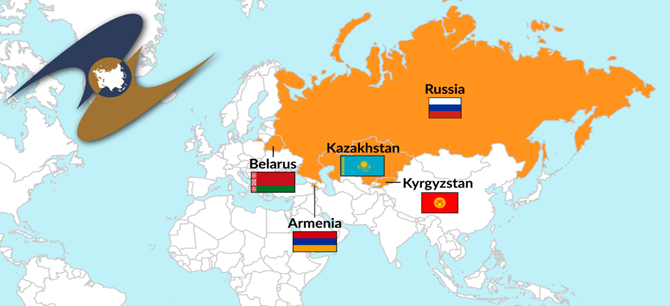
VP: “It is precisely in this spirit – the spirit of 21st century diplomacy – that new institutions are developing. These include the expanding BRICS community, organisations of major regions such as the Shanghai Cooperation Organisation, the Eurasian Economic Union, and more compact yet no less important regional associations. Many such groups are emerging worldwide – I will not list them all, as you are aware of them.”
RPA: This is a reference to the many regional trade blocs that have surfaced over the past two decades, with some of the most important being Mercosur (Latin America), the Gulf Cooperation Council (Middle East), ASEAN (Southeast Asia), SAARC (South Asia), the African Union, and numerous smaller regional blocs. Russia actively seeks engagement with all of them as a key part of its Foreign Policy Strategy.
VP: “All these new structures are different, but they are united by one crucial quality: they do not operate on the principle of hierarchy or subordination to a single dominant power. They are not against anyone; they are for themselves. Let me reiterate: the modern world needs agreements, not the imposition of anyone’s will. Hegemony – of any kind – simply cannot and will not cope with the scale of the challenges.
Ensuring international security under these circumstances is an extremely urgent issue with many variables. The growing number of players with different goals, political cultures, and distinctive traditions create a complex global environment that makes developing approaches to ensuring security a much more tangled and difficult task to tackle. At the same time, it opens up new opportunities for all of us.
Bloc-based ambitions pre-programmed to exacerbate confrontation have, without a doubt, become a meaningless anachronism. We see, for example, how diligently our European neighbours are trying to patch up and plaster over the cracks running through the European Union. Yet, the opposing elite want to overcome division and shore up the shaky unity they once used to boast of, not by effectively addressing domestic issues, but by inflating the image of an enemy. It is an old trick, but the point is that people in those countries see and understand everything. That is why they take to the streets despite the external escalation and the ongoing search for an enemy.”
RPA: Putin here illustrating the divisions between countries such as Hungary and Slovakia, with democratically elected Prime Ministers, objecting to be ruled over by the European Commission.
VP: “They are recreating an image of an old enemy, one created centuries ago – Russia. Most people in Europe find it hard to understand why they should be so afraid of Russia that in order to oppose it they must tighten their belts even more, abandon their own interests, just give them up, and pursue policies that are clearly detrimental to themselves. Yet, the ruling elites of united Europe continue to whip up hysteria. They claim that war with the Russians is almost at the doorstep. They repeat this nonsense, this mantra, over and over again.
Frankly, when I sometimes watch and listen to what they are saying, I think they cannot possibly believe this. They cannot believe when they are saying that Russia is about to attack NATO. It is simply impossible to believe that. And yet they are making their own people believe it. So, what kind of people are they? They are either entirely incompetent, if they genuinely believe it, because believing such nonsense is just inconceivable, or simply dishonest, because they do not believe it themselves but are trying to convince their citizens that this is true. What other options are there?
Frankly, I am tempted to say: calm down, sleep peacefully, and deal with your own problems. Look at what is happening in the streets of European cities, what is going on with the economy, the industry, European culture and identity, massive debts and the growing crisis of social security systems, uncontrolled migration, and rampant violence – including political violence – the radicalisation of leftist, ultra-liberal, racist, and other marginal groups.
Take note of how Europe is sliding to the periphery of global competition. We know perfectly well how groundless are the threats about Russia’s so-called aggressive plans with which Europe frightens itself. I have just mentioned this. But self-suggestion is a dangerous thing. And we simply cannot ignore what is happening; we have no right to do so, for the sake of our own security, to reiterate, for the sake of our defence and safety.
That is why we are closely monitoring the growing militarisation of Europe. Is it just rhetoric, or is it time for us to respond? Germany is saying its army must once again become the strongest in Europe. Well, alright, we are listening carefully and following everything to see what exactly is meant by that.
I believe no one has any doubt that Russia’s response will not be long in coming. To put it mildly, the reply to these threats will be highly convincing. And it will indeed be a reply – we ourselves have never initiated military confrontation. It is senseless, unnecessary, and simply absurd; it distracts from real problems and challenges. Sooner or later, societies will inevitably hold their leaders and elites to account for ignoring their hopes, aspirations, and needs.”
RPA: This section of Putin’s comments has been reported in Western media, and especially in Europe, as being threatening towards it. However, it should be noted that it is the European Union, which has a combined 3,611km border with Russia and Belarus, that has recently committed to increasing its share of GDP on defense against Russia to 5%. That amounts to over €900 billion and effectively triples the EU military spend against Russia. It had already risen by 30% since the SMO began in 2022. As Putin points out, this is EU expenditure aimed against Russia, while Russia’s focus is not against the EU but on securing Ukraine. However, Russia will also need to respond to Europe’s military spending. It appears absurd, yet is true, that when one side (EU) increases its military budget, then the other side (Russia) says it will have to respond, that Moscow is then presented as the aggressor.
VP: “However, if anyone still feels tempted to challenge us militarily – as we say in Russia, freedom is for the free – let them try. Russia has proven time and again: when threats arise to our security, to the peace and tranquillity of our citizens, to our sovereignty and the very foundations of our statehood, we respond swiftly.
There is no need for provocation. There has not been a single instance where this ultimately ended well for the provocateur. And no exceptions should be expected in the future – there will be none.
Our history has demonstrated that weakness is unacceptable, as it creates temptation – the illusion that force can be used to settle any issue with us. Russia will never show weakness or indecision. Let this be remembered by those who resent the very fact of our existence, those who nurture dreams of inflicting upon us this so-called strategic defeat. By the way, many of those who actively spoke of this, as we say in Russia, “Some are no longer here, and others are far away.” Where are these figures now?”
RPA: Putin is making both historic and contemporary references here. These include the French invasion of Russia, which ended in Napoleon’s defeat, the ultimate loss of his entire army, and resulted in his overthrow back in France. Then there is Nazi Germany’s invasion of Russia, which opened up an ill-advised second front against Hitler and arguably led to the defeat of Germany and its allies in World War 2. In asking the question “Where are they now?” Putin is referring to the likes of Boris Johnson, the then UK Prime Minister who allegedly asked Ukraine to fight Russia instead of signing a Peace Agreement that had already been initialed by Zelensky’s team in 2022.
VP: “There are so many objective problems in the world – stemming from natural, technological, or social factors – that expending energy and resources on artificial, often fabricated contradictions is impermissible, wasteful, and simply foolish.
International security has now become such a multifaceted and indivisible phenomenon that no geopolitical value-based division can fracture it. Only meticulous, comprehensive work involving diverse partners and grounded in creative approaches can solve the complex equations of 21st-century security. Within this framework, there are no more or less important or crucial elements – everything must be addressed holistically.”
RPA: Putin saying that everyone should work together as regards security – not against each other. A point that was not picked up in European media.
VP: “Russia has consistently championed – and continues to champion – the principle of indivisible security. I have said it many times: the security of some cannot be ensured at the expense of others. Otherwise, there is no security at all – for anyone.”
RPA: This statement, which Putin has made many times, is often thrown back at him as concerns the situation in Ukraine. However, the issue is more complex than a simple ‘Russian invasion’. The residents of Ukraine’s Donbass region declared independence from Ukraine in 2014, with Kiev responding by attacking them. That ran as an effective civil war until 2022 when Russia entered the scene to stop it. Western politicians either ignore or are ignorant of the initial causes of the situation in Ukraine and do not take into account the wishes of the people in either Crimea (who voted to join Russia) or Donbass (who had initially voted for independence).
VP: “Establishing this security principle has proven unsuccessful. The euphoria and unchecked thirst for power among those who saw themselves as victors after the Cold War – as I have repeatedly stated – led to attempts to impose unilateral, subjective notions of security upon everyone.
This became the true root cause of not only the Ukrainian conflict but also many other acute crises of the late 20th century and the first decade of the 21st century. As a result, no one today feels truly secure. It is time to return to fundamentals and correct past mistakes.
However, indivisible security today, compared to the late 1980s and early 1990s, is an even more complex phenomenon. It is no longer solely about military and political balance and mutual interest considerations.
The safety of humanity depends on its ability to respond to challenges posed by natural disasters, man-made catastrophes, technological development, and rapid social, demographic, and informational processes.
All this is interconnected and changes occur largely by themselves, frequently, and unpredictably, following their own internal logic and rules, and sometimes, I will dare say, even beyond the people’s will and expectations.
Humanity risks becoming superfluous in such a situation, just an observer over the processes that it will never be able to control. What is this if not a system-wide challenge for all of us and an opportunity for all of us to work together constructively?”
RPA: Putin again stressing the need for countries to work together, not against each other. This is in contrast to European media responses to Putin’s comments, which regard his words as threats. See here, here and here as examples.
VP: “There are no ready answers here, but I think that solution to global challenges requires, first, an approach free from an ideological bias and didactic pathos, in the manner of “Now I will tell you what to do.” Second, it is important to understand that this is a truly common, indivisible matter requiring joint efforts of all counties and nations.
Each culture and civilisation should make its contribution because no one knows the right answer separately. It may only be generated through a joint constructive search, through combining – not separating – efforts and national experience of various countries.
Let me repeat once again: conflicts and collisions of interests have been and, of course, will remain forever – the question is how to resolve them. A polycentric world, as I have already said today, is a return to the classical diplomacy, when settlement needs attention, mutual respect but not coercion.
Classical diplomacy was capable of taking into account the positions of different international actors, the complexity of the “concert” made up of the voices of different powers. Still, at a certain stage it was replaced by the Western-kind diplomacy of monologues, endless preaching and orders. Instead of resolving conflicts, certain parties began to push through their own selfish interests, considering the interests of everyone else unworthy of attention.
No wonder that instead of settlement, conflicts were only further exacerbated up to the point of their transition to a bloody armed phase leading to a humanitarian disaster. Acting like this means a failure to resolve any conflict. Examples over the past 30 years are countless.
One of them is the Palestinian-Israeli conflict, which cannot be settled following the recipes of the lopsided Western diplomacy grossly ignoring the history, traditions, identity and culture of the peoples living there. Neither does it help to stabilise the situation in the Middle East. Instead, the situation is, on the contrary, rapidly degrading. Now we are getting acquainted in greater detail with President Trump’s initiatives. It seems to me that some light at the end of the tunnel may still appear in this case.
The Ukraine tragedy is a horrifying example as well. It is a pain for Ukrainians and Russians, for all of us. The reasons for the Ukraine conflict are known to anyone who has taken the trouble to look into the background of its current, most acute phase. I will not go over them again. I am sure everyone in this audience is well aware of them and of my stance on this issue, which I have articulated many times.”
RPA: Putin here is directly linking 21st century conflicts to a lack of Western diplomacy, and the trend to encourage dispute settlement by immediately calling for military action, leading up to the current conflict in Ukraine. It should be noted that Putin has labeled the conflict as ‘horrifying’. These are not the words of a war-monger.
VP: “Something else is also known well. Those who encouraged, incited, and armed Ukraine, who goaded it into antagonising Russia, who for decades nurtured rampant nationalism and neo-Nazism in that country, did not care about Russia’s or, for that matter, Ukraine’s interests. They do not feel anything for the Ukrainian people. For them – globalists and expansionists in the West and their minions in Kiev – they are expendable material. The results of such reckless adventurism are in plain sight.
Another question arises: could it have turned out differently? We also know, and I return to what President Trump said. He said that if he had been in office back then, this could have been avoided. I agree with that. Indeed, it could have been avoided if our work with the Biden administration had been organised differently; if Ukraine had not been turned into a destructive weapon in someone else’s hands; if NATO had not been used for this purpose as it advanced to our borders; and if Ukraine had ultimately preserved its independence, its genuine sovereignty.”
RPA: Putin saying that had Trump been US President, the Ukraine conflict would have been resolved with a diplomatic, as opposed to military solution, and would have been to Ukraine’s benefit.
VP: “There is one more issue. How should bilateral Russian-Ukrainian issues – which were the natural outcome of the breakup of a vast country and of complex geopolitical transformations – have been resolved? I believe that the dissolution of the Soviet Union was linked to the position of Russia’s then leadership, which sought to rid itself of ideological confrontation in hopes that now, with communism gone, we will be brothers. Nothing of the sort followed. Other factors in the form of geopolitical interests came into play. It turned out that ideological differences were not the real issue.”
RPA: Putin stating that the Cold War was really about preventing Russia from reaching its potential as opposed to a battle against communism. That same scenario is being played out today in the form of Western sanctions and tariffs.
VP: “So, how should such problems be resolved in a polycentric world? How would the situation in Ukraine have been addressed? I think that if there had been multipolarity, different sides would have tried the Ukraine conflict on for size, so to speak. They would have measured it against their own potential hotbeds of tension and fractures in their own regions. In that case, a collective solution would have been far more responsible and balanced.
The settlement would have relied on the understanding that all participants in this challenging situation have their own interests grounded in objective and subjective circumstances which simply cannot be ignored. The desire of all countries to ensure security and progress is legitimate. Without a doubt, this applies to Ukraine, Russia, and all our neighbours. The countries of the region should have the leading voice in shaping a regional system. They have the greatest chance of agreeing on a model of interaction that is acceptable to everyone, because the matter concerns them directly. It represents their vital interest.
For other countries, the situation in Ukraine is merely a playing card in a different, much larger, game, a game of their own, which usually has little to do with the actual problems of the countries involved, including Ukraine. It is merely an excuse and a means to achieve their own geopolitical goals, to expand their area of control, and to make some money off the war. That is why they brought NATO infrastructure right up to our doorstep, and have for years been looking with a straight face at the tragedy of Donbass, and at what was essentially a genocide and extermination of the Russian people on our own historic land, a process that began in 2014 on the heels of a bloody coup in Ukraine.
In contrast to such conduct demonstrated by Europe and, until recently, by the United States under the previous administration, stand the actions of countries belonging to the global majority. They refuse to take sides and genuinely strive to help establish a just peace. We are grateful to all states that have sincerely exerted efforts in recent years to find a way out of the situation. These include our partners – the BRICS founders: China, India, Brazil and South Africa. This includes Belarus and, incidentally, North Korea. These are our friends in the Arab and Islamic world – above all, Saudi Arabia, the United Arab Emirates, Qatar, Egypt, Turkiye and Iran. In Europe, these include Serbia, Hungary and Slovakia. And there are many such countries across Africa and Latin America.
Regrettably, hostilities have not yet ceased. However, the responsibility for this lies not with the majority for failing to stop them, but with the minority, primarily Europe, which continually escalates the conflict – and in my view, no other objective is even discernible there today.”
RPA: Putin laying the blame for the Ukraine situation firmly with Europe.
VP: “Nevertheless, I believe goodwill will prevail, and in this regard, there is not the slightest doubt: I believe changes are occurring in Ukraine as well, albeit gradually – we see this. However much people’s minds may have been manipulated, shifts are nevertheless taking place in public consciousness, and indeed across the overwhelming majority of nations worldwide.”
RPA: The recent protests in Kiev against the government are illustrative.
VP: “In fact, the phenomenon of the global majority is a new development in international affairs. I would like to say a few words on this matter as well. What is its essence? The overwhelming majority of states worldwide are oriented towards pursuing their own civilisational interests, chief among which is their balanced, progressive development. This would seem natural – it has always been so. But in previous eras, the understanding of these very interests was often distorted by unhealthy ambitions, selfishness, and the influence of expansionist ideology.
Today, most countries and peoples – precisely this global majority – recognise their true interests. Crucially, they now feel the strength and confidence to defend these interests against external pressures – and I will add that in advancing and upholding their own interests, they are prepared to work alongside partners, thereby transforming international relations, diplomacy, and integration into sources of their own growth, progress, and development. Relations within the global majority represent a prototype of the political practices essential and effective in a polycentric world.
This is pragmatism and realism – a rejection of bloc philosophy, an absence of rigid, externally imposed obligations or models featuring senior and junior partners. Finally, it is the ability to reconcile interests that seldom fully align yet rarely fundamentally contradict one another. The absence of antagonism becomes the guiding principle.”
RPA: The BRICS and BRICS+ groups are good examples of this. They are not dominated by any one member, and work together to find common ground, to assist each other. A startling recent example of this has been with both Brazil and South Africa, when faced with high US tariffs on their imported products, being almost immediately able to discuss these issues with other BRICS members. With their huge consumer populations, China, India and to some extent Russia were able to absorb the Brazilian and South African agricultural production originally destined for the United States and divert them to their own markets in decision-making processes that took less than 2 weeks.
VP: “A new wave of decolonisation is rising now, as former colonies are acquiring, in addition to statehood, also political, economic, cultural and world outlook sovereignty.
One more date is important in this respect. We have recently celebrated the 80th anniversary of the United Nations Organisation. It is not just a universal and the most representative political organisation in the world but also a symbol of the spirit of cooperation, alliance and even combat fraternity, which helped us join forces in the first half of the past century in the struggle against the worst evil in history – a merciless machine of extermination and enslavement.
The decisive role in our common victory over Nazism, which we are proud of, was played by the Soviet Union, of course. A glance at the number of casualties for each member of the anti-Hitler coalition clearly proves this.
The UN is the legacy of victory in the Second World War, and, so far, the most successful experience of creating an international organisation aimed at solving current global problems.
It is often said now that the UN system has been paralysed and is going through a crisis. This has become a cliché. Some even claim that it has outlived itself and should be radically reformed, at the very least. Yes, there are many, very many shortcomings in the UN’s operations. Yet there is nothing better than the UN so far, and we must admit this.
Actually, the problem is not with the UN, which has vast potential. The problem lies in how we, the united nations that have been disunited, are using this potential.
There is no doubt that the UN has to deal with challenges. Like any other organisation, it should adapt to the changing realities. However, it is extremely important to preserve the fundamental essence of the UN during its reform and upgrade, not just the essence that was embedded in it at its inception but also the essence it has acquired in the complicated process of its development.
It is worth recalling in this connection that the number of UN member states has increased almost fourfold since 1945. Over the past decades, the organisation that was established at the initiative of several major countries has not just expanded but also absorbed many different cultures and political traditions, acquiring diversity and becoming a truly multipolar structure long before the world became multipolar. The potential of the UN system has only started unfolding, and I am confident that this process will be completed very quickly in the nascent new era.
In other words, the Global Majority countries now constitute an overwhelming majority at the UN, and its structure and governing bodies should therefore be adjusted to this fact, which will also be much more in keeping with the basic principles of democracy.”
RPA: Putin talking up the potential of the United Nations, and Russia’s belief in the UN, at a time when the Western nations actively ignore its protocols and are attempting to diminish its importance. This represents Russia’s desire to engage with and to participate with the global community, not to be isolated from it.
VP: “Today there is no consensus on how the world should be organised, on what principles it should rest in the years and decades ahead. We have entered a long period of searching, often moving by trial and error. When a new, stable system will finally take shape – and what its framework will look like – remains unknown. We must be ready for the fact that, for a considerable time, social, political and economic development will be unpredictable, sometimes even turbulent.
To stay on course and not lose our bearings, everyone needs a firm foundation. In our view, this foundation is, above all, the values that have matured over centuries within national cultures. Culture and history, ethical and religious norms, geography and space – these are the key elements that shape civilisations and enduring communities. They define national identity, values, and traditions, providing the compass that helps us withstand the storms of international life.
Traditions are always unique; each nation has its own. Respect for traditions is the first and most important condition for stable international relations and for resolving emerging challenges.
The world has already lived through attempts at unification, at imposing so-called universal models that clashed with the cultural and ethical traditions of most peoples. The Soviet Union once made this mistake by imposing its political system – we know this, and, frankly, I do not think anyone would argue. Later the United States took up that baton, and Europe, too, tried. In both cases, this failed. What is superficial, artificial, imposed from outside cannot last. And those who respect their own traditions, as a rule, do not encroach on those of others.”
RPA: Putin addressing the mistakes made during the Soviet era and implying that Russia has long learned from and moved on from that period. This is in contrast to several EU member states, specifically Estonia, Latvia, Lithuania and Poland, and numerous Western media commentators who continue to act as if the contemporary Russian Federation is the same as the USSR.
VP: “Today, against the backdrop of international instability, special importance is attached to each nation’s own foundations of development: those that do not depend on external turbulence. We see countries and peoples turning to these roots. And this is happening not only in the Global Majority, but also within Western societies. When everyone focuses on their own development without chasing unnecessary ambitions, it becomes much easier to find common ground with others.
As an example, we can look to the recent experience of interaction between Russia and the United States. As you know, our countries have many disagreements; our views on many of the world’s problems differ. But this is nothing out of the ordinary for major powers; in fact, it is absolutely natural. What matters is how we resolve these disagreements, and whether we can settle them peacefully.”
RPA: Putin again stressing that differences of opinion between nations are quite normal. What is not normal is when ignoring these differences results in almost immediate military action, as has been the case this year concerning Iran in addition to Syria and Palestine. Putin is calling for a return to diplomatic skills not military interventions to resolve issues.
VP: “The current White House administration is very straightforward about its interests, stating what it wants directly – even bluntly at times, but without unnecessary hypocrisy. It is always preferable to be clear about what the other party wants and what they are trying to achieve. It is better than trying to guess the real meaning behind a long string of equivocations, ambiguous language and vague hints.
We can see that the current US administration is guided primarily by its own national interests – as it understands them. And I believe this is a rational approach.
But Russia is also entitled to be guided by its own national interests. One of which is the restoration of full-diplomatic relations with the United States. Regardless of our disagreements, if two parties treat each other with respect, then their negotiations – even the most challenging, stubborn bargaining – will still be aimed at finding common ground. And that means mutually acceptable solutions can ultimately be achieved.”
RPA: Putin pointing out that Moscow wants full diplomatic relations with Washington. What is interesting in this is that he does not mention Brussels or London. This implies that Moscow regards them as secondary actors.
VP: “Multipolarity and polycentrism are not just concepts; they are a reality that is here to stay. How soon and how effectively we can build a sustainable world system within this framework now depends on each of us. This new international order, this new model, can only be built through universal efforts, a collective endeavor in which everyone participates. Let me be clear: the era when a select group of the strongest powers could decide for the rest of the world is gone, and it is gone forever.”
RPA: Putin again pushing the issue that the multipolar society has already arrived. Again, there is the implication that Russia and the ‘Global Majority’ are ahead of the game here, that the European Union is not, and that the United States remains somewhat on the fence.
VP: “This is a point best remembered by those who feel nostalgia for the colonial era, when it was common to divide peoples into those who were equal and those who were, to use Orwell’s famous phrase, “more equal than others.” We are all familiar with that quote. Russia has never entertained this racist theory, never shared this attitude towards other peoples and cultures, and we never will.”
RPA: There is some irony here. Orwell’s ‘Animal Farm’ novel was originally written
As a critique against communism and especially that developed by the USSR and China. Today that critique is being seen as more applicable to the West.
Illustrating this, a recent study by Neoman show that the cities with the most surveillance cameras per capita are in democratic countries, with the top three being Washington DC, Stockholm, and Seoul.
VP: “Russia stands for diversity, for polyphony – for a true symphony of human values. The world, as I am certain you will agree, is a dull and colourless place when it is monotonous. Russia has had a very turbulent and difficult past. Our very statehood was forged through the continual overcoming of colossal historical challenges.
I do not mean to suggest that other states developed in hothouse conditions – of course not. Yet, Russia’s experience is unique in many ways, as is the country it has created. Let me be clear: this is not a claim to exceptionalism or superiority; it is simply a statement of fact. Russia is a distinctive country.
We have gone through numerous tumultuous upheavals, each of which has given the world food for thought on a diverse range of issues, both negative and positive. But it is precisely this historical baggage that has left us better prepared for the complex, non-linear and ambiguous global situation in which we all now find ourselves.
Through all its trials, Russia has proved one thing: it was, is, and always will be. We understand that its role in the world is changing, but it invariably remains a force without which true harmony and balance are difficult – and often impossible – to achieve. This is a proven fact, confirmed by history and time. It is an unconditional fact.”
RPA: Illustrating this, Russia has over 190 ethnic groups, and possesses distinctive regions, ranging from Jewish, Buddhist and Muslim as well as Orthodox Christians. That is does not suffer from integration issues is a lesson that could well be absorbed by Europe in particular.
VP: “In today’s multipolar world, that very harmony and balance can only be achieved through a joint, common effort. I want to assure you today that Russia is ready for this work.”
RPA: Putin saying that Russia is already and wishes to be part of a truly global community based in a polycentric, or multipolar basis.
FL: “Mr. Putin, thank you very much for such an extensive…..”
VP: “Have I worn you out? Sorry!”
FL: “Not at all, you have only just begun. (Laughter.) You have immediately set the bar for our discussion very high, so we will seize on many of the themes you have raised.
As a truly polycentric, multipolar world is still only beginning to be described, as you noted, it is so complex that we can only grasp parts of it, like in an old parable where everyone touches a part of the elephant and thinks it is the whole, but in reality it is just one part.”
VP: “These are not just words. I was speaking from practice. I am often faced with very specific issues that need to be addressed in one part of the world or another. In the past, during the Soviet Union, it was one bloc versus another: you agreed within your bloc, and off you went.
More than once I have had to weigh a decision – to do this or that. But my next thought was: no, I can’t do that because it will affect someone; it would be better to do something else. But then: no, that would hurt someone else. That is the reality. There were a few cases where I decided that we won’t do anything at all. Because the damage from acting would be greater than from simply showing restraint and patience.
This is the reality of today. I did not invent anything – it is just how things are in real life, in practice.”
FL: “Did you play chess at school?”
VP: “Yes, I liked chess.”
FL: “Then I will continue from what you just said about practice. It is true: it is not only the theory that is changing, but also practical actions on the international stage can no longer be what they once were.
In previous decades many relied on institutions – international organisations, structures within states – that were set up to deal with certain challenges.
Now, as many experts noted at Valdai over the past few days, these institutions for various reasons are either weakening or losing their effectiveness altogether. This means that far greater responsibility falls on leaders themselves than in the past. So my question to you: do you ever feel like Alexander I at the Congress of Vienna, personally negotiating the shape of the new world order – just you, alone?”
VP: “No, I do not. Alexander I was an Emperor; I am a President, elected by the people for a specific term. That is a big difference. That’s my first point.
Second, Alexander I united Europe by force, defeating an enemy that had invaded our territory. We remember what he did – the Congress of Vienna, and so on. As for where the world went after that, let historians judge. It is debatable: should monarchies have been restored everywhere, as if trying to turn the wheel of history back a little? Or would it not have been better to look at emerging trends and lead the way forward instead? That is just by way of comment – apropos, as they say – not directly related to your question.
Regarding modern institutions, what is the problem, after all? They experienced degradation precisely during the period when certain countries, or the collective West, sought to exploit the post-Cold War situation by declaring themselves victors. In this context, they began imposing their will on everyone – this is the first point. Second, all others gradually, at first mutedly, then more actively, began to resist this.
During the initial period, after the Soviet Union ceased to exist, Western structures inserted a significant number of their own personnel into old frameworks. All these personnel, strictly following instructions, acted precisely as they were directed by their Washington bosses, behaving, frankly speaking, very crudely, disregarding everything and everyone.
This led to Russia, among others, ceasing altogether to engage with these institutions, believing that nothing could be achieved there. What was the OSCE created for? To resolve complex situations in Europe. And what did it all boil down to? The entire activity of the OSCE reduced to becoming a platform for discussing, for example, human rights in the post-Soviet space.”
RPA: Putin dismissing the somewhat cheeky notion that he wishes to project himself as an Emperor of a New World Order. Western critics of multipolarity often suggest such a world would be led by either Putin or China’s Xi Jinping and that the West would become ruled by autocrats. In actuality, the autocrats are currently in power in the European Commission.
VP: “Yes, there are plenty of problems. But are there not many in Western Europe? Look, it seems to me, just recently, even the US State Department noted that human rights issues have emerged in Britain.
However, these problems did not just emerge; they have always existed. These international organisations simply began professionally focusing on Russia and the post-Soviet space. But that was not their intended purpose. And this is the case across many areas.
Therefore, they have largely lost their original meaning – the meaning they had when they were created in the previous system, when there was the Soviet Union, the Eastern bloc and the Western bloc. That is why they degraded. Not because they were poorly structured, but because they ceased performing the roles for which they were created.
Yet there is and was no alternative to seeking consensus-based solutions. Incidentally, we gradually came to realise that we needed to create institutions where issues are resolved not as our Western colleagues attempted to resolve them, but genuinely based on consensus, genuinely based on aligning positions. This is how the SCO – the Shanghai Cooperation Organisation – emerged.”
RPA: The Shanghai Cooperation Organisation is a multi-faceted security bloc originally designed to counter the rise of Islamic fundamentalism in Central Asia. Today it provides security, anti-terror and anti-drugs operations throughout the Eurasian region and beyond. Details are here. The West generally regards it as a threat and has compared it to a ‘rogue NATO.’
VP: “What did the SCO originally grow out of? Out of the need to regulate border relations between countries – former Soviet republics and the People’s Republic of China. It worked very well, indeed. We began expanding its scope of activity. And it succeeded!
This is how BRICS emerged, when the Prime Minister of India and the President of the People’s Republic of China were my guests, and I proposed meeting as a trio – this was in St Petersburg. RIC emerged – Russia, India, China. We agreed that: we would meet; and we would expand this platform for our foreign ministers to work. And it succeeded!
Why? Because all participants immediately saw, despite some rough edges between them, that these were good platforms – there was no desire to push oneself forward, to advance one’s own interests at any cost. Instead, everyone understood that balance must be sought.
Soon after, Brazil and South Africa asked to join – and BRICS emerged. These are natural partners, united by a common idea of how to build relations to find mutually acceptable solutions. They began gathering within the organisation.
The same began happening worldwide, as I mentioned earlier regarding regional organisations. Look at how the authority of these organisations is growing. This is the key to ensuring that the new complex multipolar world nevertheless has a chance to be stable.”
RPA: Putin using the example of the SCO and BRICS as cooperative collaborations as opposed to confrontational organisations such as NATO.
FL: “You have just now used a clear and popular metaphor about might being right unless there is a stronger might. It can also be applied to institutions, because when institutions are ineffective, you have to resort to might, that is, military force, which has again come to the fore in international relations.
It is often discussed, and we at the Valdai forum had a section that addressed this issue – the character of a new war, modern war. It has clearly changed. What can you, as supreme commander-in-chief and a political leader, say about changes in the character of war?”
VP: “This is a highly specific and extremely important question.
First, there have always been non-military methods of dealing with military matters, but they are acquiring a new meaning and producing new effects with the development of technology. What I mean is information attacks and attempts to influence and corrupt the political mindset of the potential opponent.
I have recently been told about the revival of an old Russian tradition, where young women go to parties, including in bars and clubs, wearing traditional Russian clothes and headdresses. You know, this makes me happy. Why? Because it means that our enemies have not attained their goal, despite all the attempts to corrupt Russian society from within, and even that the effect is the opposite of what they expected.”
RPA: The Russian national identity is very strong, and may be rather more resilient than specific European identities, mainly due to the collective struggles as well as sheer numbers. The EU’s smaller populations, such as the Baltics states and Ukraine, demonstrate an identity insecurity by banning languages (such as Russian) and heavily promoting an ‘us versus them’ attitude. Meanwhile, within the European Commission, there is alarm that a “European’ identity has not developed. There are signs that a longer term aim is to reduce recognition of national identity within the EU to be replaced by a commonality, although resistance to this will be intense. Nonetheless, the development of a common enemy such as Russia does help unite a Europe whose main cultural distinction is in fact its diversity.
VP: “It is very good that our young people have this defence against attempts to influence the public mindset from within. It is proof of the maturity and strength of the Russian society. But this is only one side of the coin. The other is the attempts to damage our economy, financial sector and so on, which is extremely dangerous.
As for the purely military component, there are many new elements related to technological development. These are unmanned vehicles that can operate in three domains – air, land, and sea. They include unmanned boats, unmanned ground vehicles, and unmanned aerial vehicles – drones.
All of them have a dual use. This is extremely important; it is one of the special modern features. Many technologies that are being used in combat have dual uses. Take the unmanned aerial vehicles, which can be used in medicine and to deliver food or other useful cargo everywhere, including during hostilities.
This calls for developing other systems as well, such as intelligence and electronic warfare systems. This is changing the tactics of warfare. Many things are changing on the battlefield. There is no use for Guderian’s wedge formations or Rybalko’s charges, which were carried out during World War II. Tanks are being used completely differently now, not to charge through enemy defences but to support the infantry, which is being done from covered positions. This is necessary too, but it is a different method.
But the most remarkable issue is the sheer swiftness of change. Technological paradigms can shift in a month, sometimes in a week. I have said this many times. Suppose we deploy a key innovation, such as high-precision weapons, including long-range systems, which are a vital component of modern warfare – and it suddenly grows less effective.
Why? Because the adversary has deployed even newer electronic warfare systems. They have analysed our tactics and adapted their response. Consequently, we now need to find an antidote within a matter of days, or a week at most. This is happening with stunning regularity, and it has profound practical implications, from the battlefield itself to our research centres. This is the reality of modern armed conflict: a process of continuous upgrade.”
RPA: Putin discussing the technological advances of modern battlefield warfare.
VP: “Everything changes, except for one thing: the bravery, courage, and heroism of the Russian soldier. It is our immense source of pride. And when I say ‘Russian,’ I am not speaking solely of ethnicity or even the passport one holds. Our soldiers themselves have embraced this idea. Today, every one of them, regardless of religion or ethnic background, says with pride: “I am a Russian soldier.” And they are.
Why is this? I would like to answer by turning to Peter the Great. What was his definition? Who, in his eyes, was a Russian? For those who know the quote, you will recognise it. For those who do not, I will share it with you now. Peter the Great said: “He is Russian who loves and serves Russia.”
RPA: Putin effectively saying that being Russian is a state of mind.
FL: You spoke about the swiftness of change, and indeed, the pace is staggering, both in the military and civilian spheres. It seems clear that this accelerated reality is what will define the coming years and decades.
This brings to mind the criticism we faced more than three years ago, at the start of the special military operation. At that time, critics argued that Russia and its army were lagging behind in certain areas – and many of our less than successful steps were directly linked to that.
This leads me to two key questions. First, in your view, have we since managed to close that gap?
And second, since we speak of the Russian soldier, what is your assessment of the current situation on the frontlines?”
VP: “First, let us be clear: it was not merely a ‘lag.’ There were entire fields where our knowledge was simply non-existent. The issue was not that we lacked the time to develop certain capabilities. The issue was that we were completely unaware that such capabilities were even possible.
Second, we are fighting this war and producing our own military equipment. But on the other side of the line, we are effectively at war with the collective might of NATO. They are no longer even hiding this fact. We see this in the direct involvement of NATO instructors and representatives from Western countries in the hostilities. A command centre has been established in Europe for the purpose of coordinating their war effort: providing the Armed Forces of Ukraine with intelligence, satellite imagery, weapons, and training. These foreign personnel are not only involved in training; they are directly participating in operational planning and combat operations themselves.”
RPA: Putin saying that Russia is effectively at war with NATO rather than Ukraine, and that foreign (non-Ukrainian) participation is common.
VP: “This presents a serious challenge for us. But the Russian army, the Russian state, and our defence industry have rapidly adapted.
I am convinced that today, the Russian army is the most combat-ready army in the world. This holds true in terms of personnel training, technical capabilities, and our ability to both deploy and continuously upgrade them. It is true regarding our capacity to supply new weapons systems to the frontline, and even in the sophistication of our operational tactics. This, I believe, is the definitive answer to your question.”
FL: “The United States have recently renamed their Department of Defence as the Department of War. Superficially, it may seem the same, but as they say, there is nuance. Do you believe names carry substantive significance?”
VP: “One could say no, but equally, one might observe that “as you name the ship, so shall it sail.” There is likely some meaning in this, and the Department of War does sound rather aggressive. Ours is the Ministry of Defence – this has always been our position, remains so, and will continue to be. We harbour no aggressive intentions towards third countries. Our Ministry of Defence exists solely to safeguard the security of the Russian state and the peoples of the Russian Federation.”
FL: “Yet Trump taunts Russia as a ‘paper tiger’ – what about that?”
VP: “Russia as a ‘paper tiger’. As I have said, Russia has not been fighting the Armed Forces of Ukraine or Ukraine itself these past years, but effectively the entire NATO bloc.
Regarding your question about developments along the line of contact – I will return to these “tigers” shortly.
Presently, across virtually the entire line of contact, our forces are advancing with confidence. To begin from the north: the North Group of Forces – in the Kharkov Region, the town of Volchansk, and in the Sumy Region, the residential community of Yunakovka – have recently been brought under our control. Half of Volchansk has been secured – the remaining portion will inevitably follow shortly, as our fighters complete the operation. A security zone is being established methodically and according to plan.
The West Group of Forces has largely secured Kupyansk – a significant population centre (not fully, but two-thirds of the city). The central district is already ours, with engagements continuing in the southern sector. Another substantial town, Kirovsk, is now entirely under our control.
The South Group of Forces has entered Konstantinovka – a key defensive line comprising Konstantinovka, Slavyansk, and Kramatorsk. These fortifications were developed by the AFU over more than a decade with the assistance of Western specialists. Yet our troops have now penetrated these defences, with combat ongoing there. The same applies to Seversk, another major community where hostilities are underway.
The Centre Group of Forces continues effective operations, having entered Krasnoarmeysk – from the southern approach, if I recall correctly – with fighting now occurring within the town. I will refrain from excessive detail, not least because I have no desire to inform our adversary – paradoxical as that may sound. Why? Because they are in disarray, scarcely comprehending the situation themselves. Providing them additional clarity serves no purpose. Rest assured, our personnel are executing their duties with confidence.
As for the East Group of Forces: it is progressing decisively through the northern Zaporozhye Region and partially into the Dnepropetrovsk Region at a rapid pace.
The Dnieper Group of Forces likewise operates with full assurance. Approximately… Almost 100 percent of the Lugansk Region is ours – the enemy retains perhaps 0.13 percent. In the Donetsk Region, they control marginally over 19 percent. In the Zaporozhye and Kherson regions, this figure stands at roughly 24–25 percent, respectively. Everywhere, Russian forces – I emphasise – maintain undisputed strategic initiative.
Yet if we are combating the entire NATO alliance, advancing thus with unwavering confidence, and are deemed a ‘paper tiger’ – what does that make NATO itself? What manner of entity is it then? But never mind that. What matters most is to have confidence in ourselves – and we do.”
RPA: Trump’s now somewhat infamous comment rebounds on him, as Russia’s ‘paper tiger’, according to Putin’s examples, is currently defeating NATO in Ukraine and continues to make advances.
FL: “There are paper cut-out toys for children – paper tigers. You can present one to President Trump when you meet next time.”
VP: No, we have our own relationship, and we know what presents to give each other. You know, we have a very calm attitude towards this.
I do not know in what context that phrase was said; maybe it was said ironically. You see, there are some elements… So, he told his staff that Russia is a paper tiger. What action could follow next? Actions could be taken to deal with that “paper tiger.” But nothing like this is happening in reality.
What is the current problem? They are sending enough weapons to the Armed Forces of Ukraine, as many as Ukraine needs. In September, the AFU’s losses amounted to about 44,700 people, nearly half of them irretrievable losses. In the same period, they forcibly mobilised slightly more than 18,000 people. Approximately 14,500 people have returned to the army from hospitals. If we add up these figures and subtract the total from the number of casualties, we will see that Ukraine lost 11,000 in one month. In other words, the number of its troops on the frontline was not replenished and is decreasing.
If we look at the figures from January to August, approximately 150,000 Ukrainians have deserted from the army. Over the same period, 160,000 people have been mobilised into the army, but 150,000 deserters is too many. Taken together with increasing losses, even though the figure was higher the previous month, this means that the only solution is to lower the mobilisation age. But this will not produce the desired result either.
Russian and, incidentally, Western experts believe that this will hardly have a positive effect because they have no time to train the conscripts. Our forces are advancing every day. They have no time to become entrenched or train their new personnel, and they are also losing more servicemen than they can replenish on the battlefield. That is what matters.
Therefore, the Kiev leaders should think more seriously about reaching an agreement. We have said this many times, offering them the opportunity to do so.”
FL: “Does Russia have enough personnel for everything?”
VP: “Yes, we do. First, we also sustain losses, regrettably, but they are several times smaller than the AFU’s losses.
And then, there is a difference. Our men volunteer for military service. They are actually volunteers. We are not conducting a sweeping mobilisation, let alone a forced one, unlike the Kiev regime. This is objective data, confirmed by Western experts: There were 150,000 deserters from the AFU from January to August this year. What is the reason?
People have been seized in the street, and now they are deserting from the army, and rightfully so. Moreover, I am urging them to desert. We also call on them to surrender, which is difficult to do because those who try to surrender are shot by Ukrainian anti-retreat or barrier units or killed by drones. And drones are often operated by mercenaries from other countries who kill Ukrainians because they do not care about them. As for the Ukrainian army, it is a simple army made up of workers and farmers. The elite is not fighting; it is only sending its own citizens to the slaughter. That is why there are so many deserters.
We also have deserters, which is normal for armed conflicts. Some people leave their units without permission. But there are few of them, really few, compared to the other side, where desertion has become a massive issue. That is the problem. They can lower the mobilisation age to 21 or even 18 years, but this will not resolve the problem, and they must accept this. I hope the Kiev regime’s leaders will come to see this and will find the strength to sit down at the negotiating table.”
RPA: Stark statistics from Putin as concerns battlefield losses and the problems within the Ukrainian military. Putin urges Kiev to negotiate peace.
At this point the session was opened up to Q&A from the audience.
Q: “This topic was briefly touched upon in your earlier comments, but I would like to seek clarification. Amid the fundamental changes that have occurred in recent years, has anything genuinely surprised you? For instance, the sheer fervour with which many Europeans have pursued confrontation with us, and how some have ceased to feel ashamed of their participation in Hitler’s coalition.
After all, there are developments that were hard to imagine until recently. Was there genuinely an element of surprise – how could this happen? You noted that in today’s world, one must be prepared for anything, as anything can occur – yet until recently, there seemed to be greater predictability. So, amidst this rapid pace of change, was there anything that truly astonished you?”
VP: “On the whole, broadly speaking, no, nothing particularly surprised me, as I had foreseen much of what would unfold. Nevertheless, what did astonish me was this readiness – even eagerness – to revise everything that had been positive in the past.
Consider this: at first, very cautiously, with probing, the West began equating Stalin’s regime with the fascist regime in Germany – the Nazi regime, Hitler’s regime – placing them on the same level. I observed all this clearly; I was watching. They began dredging up the Molotov-Ribbentrop Pact, while forgetting about the Munich Betrayal of 1938, as though it never happened, as though the Prime Minister of Great Britain did not return to London after the Munich meeting and wave the agreement with Hitler from the aircraft steps – “We’ve signed a deal with Hitler!” – brandishing it – “I’ve brought peace!” Yet even then, there were those in Britain who declared: “Now war is inevitable” – that was Churchill. Chamberlain said: “I’ve brought peace.” Churchill retorted: “Now war is inevitable.” Those assessments were made even then.
They said: the Molotov-Ribbentrop Pact – an atrocity, colluding with Hitler, the Soviet Union conspired with Hitler. Well, but you yourselves had conspired with Hitler shortly before and carved up Czechoslovakia. As though that never occurred. Propagandistically – yes, one can hammer these false equivalences into people’s heads, but in essence, we know how it truly was. That was the first act of the Ballet de la Merlaison.
Then matters escalated. They began not merely equating Stalin’s and Hitler’s regimes – they attempted to erase the very outcomes of the Nuremberg Trials. Bizarre, given that these were participants in a shared struggle, and the Nuremberg Trials were collective, held precisely so that nothing similar would recur. Yet they began doing that. They started tearing down monuments to Soviet soldiers and so forth, those who fought against Nazism.
I understand the ideological underpinnings here. I have previously stated that when the Soviet Union imposed its political system on Eastern Europe – yes, all this is clear. But the people who fought Nazism, who gave their lives – what have they to do with it? They were not leading Stalin’s regime, they made no political decisions, they simply laid down their lives on the altar of Victory over Nazism. They began this – and then further, and further.
Yet this did still surprise me – that there seems no limit, purely, I assure you, because this concerns Russia, and the desire to somehow marginalise it.
What do I wish to convey? On my desk at home lies a volume of Pushkin. I occasionally enjoy immersing myself in it when I have five spare minutes. It is intrinsically interesting, pleasant to read, and moreover, I relish delving into that atmosphere, sensing how people lived back then, what inspired them, and what they thought.
Just yesterday, I opened it, leafed through, and came across a poem. We all know – the Russians here certainly do – Mikhail Lermontov’s “Borodino”
RPA: Putin recites the poem.
VP: “Everything is articulated here. Once again, I am convinced that Alexander Pushkin is our everything. That was written in 1831.
You see, Russia’s very existence displeases many, and all wish to partake in this historic endeavor – inflicting a “strategic defeat” upon us and profiting thereby: taking a bite here, a bite there. But that will not happen.”
RPA: Kaja Kallas, the Vice-President of the European Commission and responsible for its foreign policy has recently stated that the European Union and NATO needed to inflict a ‘strategic defeat’ upon Russia and that the country should be broken up into smaller nations.
FL: I wish to note a highly significant parallel. Poland’s President Nawrocki literally said – I believe just the day before yesterday in an interview that he regularly “converses” with General Piłsudski, discussing matters, including relations with Russia. Whereas you – with Pushkin. It seems somewhat discordant.
RPA: The Polish General Pilsudski died in 1935, with the current Polish President recently saying he talks with his ghost.
VP: “You know, Piłsudski was such a figure – he harboured hostility towards Russia, and so forth – and under his leadership, guided by his ideas, Poland committed many errors prior to the Second World War. After all, Germany proposed resolving the Danzig and Danzig Corridor matters peacefully – Poland’s leadership at the time categorically refused and ultimately became Nazism’s first victim.
Poland then refused to allow the Soviet Union to assist Czechoslovakia. The Soviet Union was prepared to do so; documents in our archives attest to this. When notes were sent to Poland, Poland declared it would never permit Russian troops passage to aid Czechoslovakia, and that should Soviet aircraft fly over, Poland would shoot them down. In the end, it became Nazism’s first victim.
If today’s highest-ranking political family in Poland also remembers this, comprehending all the complexities and vicissitudes of historical epochs and bearing it in mind while consulting Piłsudski, and heeds these mistakes – then that would indeed be no bad thing.”
Q: “We are all saddened because during the last two years we’ve seen genocide in Gaza, and the pain and suffering of women and children being torn apart day and night. Recently we saw President Trump gave a peace proposal that looked more like a submission and capitulation. And especially introducing someone like Blair with his history is insult to injury. I was wondering what do you think the Russian Federation can do to bring an end to this misery, which has really darkened the days of everyone? Thank you.”
VP: “The situation in Gaza is one of the most tragic events in recent history. It is also well known that the UN Secretary-General Antonio Guterres has publicly admitted – and he often reflects Western views – that Gaza has become the largest children’s cemetery in the world. What could be more tragic? What could be more painful?
Now, regarding President Trump’s proposal on Gaza – you may find this surprising, but Russia is ready to support it, provided, that it truly leads to the ultimate goal we have always spoken about. We must thoroughly examine the proposals made.
Since 1948 – and later in 1974, when the relevant UN Security Council resolution was adopted – Russia has consistently supported the creation of two states: Israel and a Palestinian state. I believe this is the only key to a final, lasting solution to the Palestinian–Israeli conflict.
As far as I understand – I have not looked through the proposal carefully yet – it suggests creating an international administration to govern Palestine for some time, or more precisely, the Gaza Strip. It is proposed that Mr Blair would head it. Now, he is not known as a great peacemaker. But I know him personally.
But what would I like to add? He is a man with strong personal views, but he is also an experienced politician. Overall, if his knowledge and experience are directed towards peace, then yes, of course, he could play a positive role.
However, several questions naturally arise. First: how long would this international administration operate? How, and to whom, would power then be transferred? As I understand it, this plan foresees the possibility of eventually transferring power to a Palestinian administration.
I believe it would be best to transfer control directly to President Abbas and the current Palestinian administration. Perhaps they may face difficulties in addressing security matters. But as I heard from colleagues today, this plan also envisages that the power transfer may involve local militia groups in order to ensure security. Is that bad? In my opinion, this could be a good solution.
Let me repeat: we must understand how long this international administration will be in force. What is the timeframe for the transfer of civilian authority? No less important are security issues. I believe that this deserves support.
On one hand, we are talking about the release of all hostages held by Hamas, and on the other – the release of a significant number of Palestinians from Israeli prisons. It must also be made clear: how many Palestinians, who exactly, and in what timeframe this exchange would take place.
And, of course, the most important issue: how does Palestine itself view this proposal? This is absolutely essential. Here, the opinion of the region and the entire Islamic world matters, but most of all Palestine itself and the Palestinians, including Hamas. There are different attitudes toward Hamas, and we also have our own position and contacts with them. It is important for us that both Hamas and the Palestinian Authority support such an initiative.
All these questions require thorough and careful study. But if this plan is implemented, it would indeed represent a significant step towards settling the conflict. Still, I want to stress once again: the conflict can only be fundamentally resolved through the creation of a Palestinian state.
Of course, Israel’s position will be crucial here. We do not yet know how it has reacted. Frankly, I have not seen any public statements yet; I simply have not had time to look. But what really matters is not public rhetoric, but how the Israeli leadership reacts to this and whether it is ready to implement what is being proposed by the US President.
There are many questions here. But overall, if all these positive elements I have mentioned come together, it could become a real breakthrough. Such a breakthrough would be very positive.
Let me repeat this for the third time: the creation of a Palestinian state is the cornerstone of any comprehensive settlement.”
RPA: Putin explaining Russia’s views on the Israel-Palestine conflict and solution to it in great detail. We omitted the comment about meeting Blair in his pyjamas as superflous.
FL: “Mr President, were you surprised when a couple of weeks ago a US ally, Israel, attacked another US ally, Qatar? Or is that just considered normal now?”
VP: “Yes, I was surprised. (Putin throws up his hands in exasperation.)
Q: “I want to start with a thank you that will lead to the question. I used to work for Senator Biden and Leon Panetta in the United States of America, and I came forward about some things and corruption in 2020, and I was targeted by the Biden regime to the point where I had to flee.
Margarita Simonyan, who is a hero to me, helped me and Masha, Maria Boutina, get through. And I was able to get political asylum thanks to you. And with your collective effort, you saved my life.
So thank you. I was a target, and my life was in immediate danger. What I can say about Russia is, люблю Россию (I love Russia). I have found it to be beautiful. The propaganda in the West was wrong about Russia. I love Moscow. The people have been very warm and welcoming. It’s efficient, and for the first time, I feel safe, and I feel more free.
I work for RT and I’ve really enjoyed it. I’m given a lot of creative freedom to work in my sphere in geopolitical analysis. And so thank you to the Valdai Club for recognising my intellectual pursuits. I appreciate you. So this is my question. I have met other Westerners that have come here for sanctuary to Russia, also for economic reasons and for shared values.
How do you feel about watching this stream of Westerners coming in asking to live in Russia, and will it be easier to get Russian citizenship? And you gave me, by presidential decree, Russian citizenship, which is a tremendous responsibility and honour. So, I am Russian. Thank you very much.”
VP: “You have mentioned shared values. And how do we treat those people who come here from Western countries, want to live here, and share these values with us? You know, our political culture has always had both positive and controversial aspects.
In the identity documents of subjects of the Russian Empire, there was no line for “Nationality.” It simply was not there. In the Soviet passport it appeared, but in the Russian passport – it was not there. And what was there? “Religion.” There was a common value, a religious value, an affiliation with Eastern Christianity – with Orthodoxy, faith. There were other values as well, but this was the defining one: what values do you share?
That is why today, it makes no difference to us whether a person comes from the East, the West, the South, or the North. If they share our values, they are our people. That is how we see you, and that is why you feel the attitude towards yourself. And that is how I see it as well.
As for administrative and legal procedures, we have taken the necessary decisions to make it easier for people who wish to live in Russia, to tie their lives to our country, even if only for some years, for a longer period, to do so. These measures reduce administrative barriers.
I cannot say that we are seeing an enormous influx. Still, it amounts to thousands of people. I think around 2,000 applications have been submitted, 1,800 or so, and about 1,500 approved. And the flow continues.
Indeed, people are coming, motivated not so much by political reasons, but rather by values. Especially from European countries, because what I would call “gender terrorism” against children there does not sit well with many people, and they are looking for safe havens. They come to us, and God grant them success. We will support them as far as we can.
You also said – I made a note – “I love Russia,” “I love Moscow.” Well, we have much in common, because I also love Moscow. That is the basis we will build on.”
FL: “From a native of St Petersburg, of Leningrad, that means a lot.”
VP: “A revolutionary development.”
FL: As a follow-up to this issue: a couple of months ago, we heard some truly surprising news: an American citizen named Michael Gloss, the son of a Deputy Director of the CIA, who was fighting on our side, was killed at the frontline in Donbass. His American nationality was unusual enough to attract attention, let alone his family background. Before this story became public, were you aware of his presence?
VP: “No, I was not. I first learned about it when the draft executive order awarding him the Order of Courage crossed my desk. And I must confess, I was quite taken aback. Upon inquiry, it emerged that both his parents were far from ordinary. His mother is, in fact, a serving Deputy Director of the CIA, and his father is a Navy veteran who, I believe, now heads a major Pentagon contractor. This is, as you can imagine, anything but an ordinary American family. And again, I had no prior knowledge of any of this.
Anyway, as one of our colleagues just said here, describing her views and why she was here – her story and motives in fact echoed those of Michael Gloss. What did he do? He never told his parents where he was going. He had simply told them he was going travelling. His journey took him to Turkiye, and then on to Russia. Once in Moscow, he went directly to a military enlistment office and stated that he shared the values Russia is defending.
He said he wanted to defend human rights: the right to one’s language, religion, and so on. He was a human rights activist, and since Russia was fighting for those very values, he was prepared to defend them with a weapon in his hands. After completing a special training course, he was enlisted – not just into the Armed Forces, but into an elite unit, the Airborne Forces.
He served in an assault unit and fought on the frontline. He fought with valour, and was seriously wounded when a shell hit his armoured personnel carrier. He and another Russian comrade-in-arms were both badly wounded in the blast. A third Russian soldier, despite sustaining burns to 25 percent of his own body, pulled them from the burning wreckage and dragged them to a wooded area.
Just imagine the scene: this young man – he was only 22, I think – while bleeding from his own wounds, was trying to help his wounded Russian comrade. Tragically, they were spotted by a Ukrainian drone, which then dropped a bomb. Both were killed.
I believe that such individuals truly form the core of the MAGA movement, which supports President Trump. Why? Because they stand for the same values Michael Gloss supported. This is who they are. And this is who he was.
The US anthem speaks of “the land of the free and the home of the brave,” does it not? He was a brave man in the truest sense – he proved it with his deeds and, ultimately, with his life. A significant part of the American people can, and I believe should, be proud of a man like him.
I presented his order to Mr Witkoff. I had asked Michael’s comrades-in-arms to attend the ceremony, and they did. We were also joined by the Commander of the Airborne Forces, his brigade commander, his company commander, and by the soldier who pulled him from the burning vehicle, the one who himself sustained grave injuries, with burns. I should note, that soldier has since recovered from his wounds and has returned to the front. That is the calibre of the people we have fighting for us.
Most recently, on the initiative of the Donetsk People’s Republic’s leadership, a school in Donbass has been named after the two fallen soldiers – the American and the Russian. It is a school that specialises in the in-depth study of the English language. We will, of course, ensure it is maintained to a high standard, as we are committed to doing for all schools across Donbass. This is a priority for us.
This is the kind of man Michael Gloss was. Let me say again: both his family and his country – or at least that part of it which shares his convictions – can be truly proud of him.
And in a broader sense, he embodies what I mentioned earlier when speaking about people of different nationalities who consider themselves Russian soldiers. He was an American by birth, but he was a Russian soldier.”
RPA: An interesting and heartfelt anecdote about how Russia views individuals and appreciates those who stand up for the country and its values.
Q: “You mentioned attempts to expel Russia from the global system. I would add: from global markets. In recent weeks, calls from Washington to China, India, and other countries – accompanied by pressure – have grown increasingly vocal, urging these nations to cease purchasing Russian raw materials and energy resources.
At the same time, you have also spoken about the importance of uniting, rather than separating, efforts, including the experience of cooperation between Russia and the US, and the need to restore full-fledged relations.
This week, to the surprise of many analysts and observers who do not engage with nuclear energy on a daily basis, statistics were published showing that Russia remains the largest supplier of enriched uranium for nuclear fuel to the United States.
Given the current format and level of bilateral Russian-American relations in the political domain, how do you assess the prospects for cooperation between Russia and the United States in enriched uranium supplies, and in nuclear energy more broadly?”
VP: “I will address these potential tariff restrictions on trade between the United States and our trading partners – China, India, and several other states.
We know that there are advisers within the US administration who believe this constitutes sound economic policy. Concurrently, there are experts in the United States who doubt this, and many of our own specialists share these doubts regarding its potential benefits.
What is the issue? It undoubtedly exists. Suppose elevated tariffs are imposed on goods from countries with which Russia trades energy commodities – oil, gas, and so forth. What would this lead to? It would result in fewer goods – let us say, Chinese goods – entering the US market, thereby driving up prices there. Alternatively, these Chinese goods might be rerouted through third or fourth countries, which would also raise prices due to emerging shortages and more expensive logistics. Should this occur and prices escalate, the Federal Reserve System would then be forced to maintain high interest rates or increase them to curb inflation, ultimately slowing the US economy itself.
This is not a matter of politics; it is purely economic calculus. Many of our experts believe this is precisely what will happen. The same applies to India and goods produced there. There is no difference whatsoever compared to Chinese goods.
Thus, the benefits for the US are far from evident. As for the countries targeted by these threats – take India, for example: if India were to reject our energy commodities, it would incur measurable losses, estimated variously. Some suggest these could amount to U$9–10 billion if they comply. Conversely, if they refuse, sanctions in the form of higher tariffs would be imposed also resulting in comparable losses. Why, then, should they comply, especially when facing substantial domestic political costs? The people of a country like India will scrutinize their leadership’s decisions closely and will never tolerate humiliation from anyone. Moreover, I know Prime Minister Modi; he would never take such steps himself. There is simply no economic rationale for it.
As for, let us say, uranium – what is it, really? In this case, uranium is a fuel, an energy resource for nuclear power plants. In that sense, it is no different from oil, gas, fuel oil, or coal, because it too is an energy source that generates electricity. What is the difference? None at all. The United States does, in fact, buy uranium from us.
You asked: why does the United States buy it, while, at the same time, trying to prevent others from purchasing our energy resources? The answer is simple, and it was given to us long ago in Latin. We all know the saying: Quod licet Iovi, non licet bovi – what is permitted to Jupiter is not permitted to an ox. That is the essence of it.
But neither China nor India – despite the fact that cow is sacred in India – wants to be the ox here. There are politicians, especially in Europe, who are willing to be an ox, a goat, even a ram. We will not name names, but this certainly does not apply to China, India, or other large, medium, or even small countries that respect themselves and refuse to be humiliated.
As for the uranium trade, yes, it continues. The United States is one of the largest producers and consumers of nuclear energy. If I recall correctly, they have about 54 nuclear power plants and around 90 reactor units. I believe nuclear energy accounts for roughly 18.7% of the United States total energy mix. In Russia, we have fewer reactors, and produce less, but the share of nuclear energy in our mix is similar: about 18.5%. Naturally, given the scale of their nuclear industry, the United States requires large amounts of fuel.
We are not even the largest supplier. The largest supplier is an American-European company which covers about 60% of the US demand for uranium and nuclear fuel. Russia is the second-largest supplier, providing around 25%.
Last year – I do not remember the exact figures in volume or percentage points, but I do remember the earnings – we earned close to US$800 million. Over the first half of this year, uranium sales to the United States exceeded US$800 million. By the end of 2025, the figure will likely be close to US$1.2 billion.
We have an overall idea of how much can be earned next year based on current requests; right now, we’re expecting the earnings over US$800 million. So, this work continues. Why? Because it is profitable. The Americans buy our uranium because it is beneficial for them. And rightfully so. We, in turn, are ready to continue these supplies reliably.
This is an important point. Why? If we focus purely on the energy agenda, you will see that Europe’s rejection of Russian gas has already resulted in higher prices. As a result, the production of mineral fertilisers in Europe, which requires a lot of gas, has become unprofitable, forcing factories to close.
Fertiliser prices went up, which, in turn, affected agriculture, drove up food prices and, finally, affected people’s solvency. That has directly impacted people’s standard of living. That is why they are taking to the streets.”
FL: “Mr President, let me stay on the nuclear topic for a moment. A lot has been written recently, particularly last week, about the situation at the Zaporozhye Nuclear Power Plant, and an alleged threat of a major accident that could affect all the surrounding regions. What is happening there?”
VP: “What is happening is the same as before. Fighters on the Ukrainian side are attempting to strike the perimeter of the nuclear power plant. Thank God it has not come to strikes on the plant itself. There were a few strikes on the training centre.
A few days ago, just before Mr Grossi came to Russia, there was an artillery strike on power transmission towers, they fell, and now the Zaporozhye Nuclear Power Plant is being supplied with electricity by generators, and the supply is reliable. But the question is how to repair those networks. The difficulty, as you understand, is that these sites lie within range of Ukrainian artillery; they are shelling those areas and effectively prevent our repair crews from approaching them. And yet the same stories are spread that we are the ones doing it. Mr Grossi has been there; IAEA staff are present – they see everything but keep silent about what is actually occurring. They see what is happening. Are we supposed to have struck it ourselves from the Ukrainian side? It’s nonsense.
This is a dangerous game. People on the other side should also understand: if they play with this so recklessly, they have operating NPPs on their side, too – so what would prevent us from responding in kind? They should think about that. That is the first point.
Second: under Ukrainian administration the plant employed around 10,000 people. That was a Soviet-style approach, because the station carried a whole social infrastructure. Today more than 4,500 people work at the plant, and only about 250 of them came from other Russian regions. The rest are people who have always worked there. Always. Some people left; nobody forced anyone to stay or forced anyone out. People chose to remain and live there as before and continue to work. All of this is happening in full view of IAEA observers stationed there: they are present at the plant and see it all.
So that is the situation. Overall, it is under control. We are taking measures related to the physical protection of the plant and of the spent fuel. It is a difficult situation.
I should add that Ukrainian sabotage and reconnaissance groups have repeatedly attempted similar actions in recent months and even last year: they blew up high-voltage transmission lines at the Kursk Nuclear Power Plant and the Smolensk Nuclear Power Plant, sneaking in through the forests to do it. Our specialists repaired those lines very quickly.
What is happening now at the Zaporozhye Nuclear Power Plant is no different from the actions of those reconnaissance and sabotage groups – in essence, terrorist groups. It is a very dangerous practice that should stop. I hope the people involved get that message.”
FL: “So, Grossi knows what is going on there?”
VP: “He knows very well. They sit there at the plant and see a shell land. Are we supposed to have crossed into Ukrainian territory and shelled ourselves? It’s absurd and devoid of common sense.”
Q: “I am from Hungary, which is now often referred to as the EU’s black sheep. During the past few days, we have been talking about the current developments, whether the West is ready for reforms, and about its place in the new world order. We also talked about the sad shape of the EU and Europe.
I share this view, and many in Hungary think so too, wondering what would happen to the EU. It is not clear if the EU will survive or if its future is gloomy. Many think that the integration of Ukraine would be the last nail in the EU’s coffin.
What do you think? Do you share the view that the EU is in a deep crisis? What is your take on this situation?
As for whether Ukraine will become an EU member, you have recently said that Russia would not be against this. Many of us are baffled, because I understand that Ukraine’s accession would weaken the EU, which will benefit many, of course. But if the EU or Europe become too weak, this will pose a risk or danger to the Eurasian space. This is my first point.
Second, the EU looks increasingly more like NATO lately. This is quite obvious if we look at its attitude to the Ukrainian crisis. As I see it, Ukraine will become the punch fist of the West, the punch fist and the army of the EU. In this case, if Ukraine becomes an EU member, this may even be a threat to Russia. What do you think about this?”
VP: “To begin with, the EU has been developing primarily as an economic community since the time of its founding fathers, as we remember this, since the European Coal and Steel Community and so on.
I have already told the following story in public. In 1993, I was in Hamburg together with then St Petersburg Mayor Anatoly Sobchak who had a meeting with then Chancellor Helmut Kohl. Mr Kohl said that if Europe wanted to remain one of independent centres of the global civilisation, it should be with Russia, and that Russia should by all means go together with the EU, with Europe, and they would powerfully complement each other, especially since they actually stand on the common basis of traditional values, which were respected in Europe back then.
What can I say about the current situation? I can only offer a general view. I have already presented it, and mentioned Pushkin while doing so. But the EU is a powerful association with large, or even huge potential. It is a powerful centre of our civilisation, but it is also a waning centre. I believe this is obvious.
And the reason is not just that Germany, the engine of the European economy, has been stagnating for the past few years and is not expected to overcome stagnation next year either. And it is not that the French economy is facing huge problems, with a budget deficit and a growing debt. The thing is that the fundamental issues related to European identity are disappearing. This is the matter. They are being eroded from within; the uncontrolled migration is doing this.
I will not go into details now; you know these matters better than I do. Should Europe evolve into a quasi-state entity, or remain a Europe of nations, a Europe as an independent state? That is not for us to decide; it is an internal European debate. Nevertheless, one way or another, a certain framework of values must endure. Because if that critical framework, that foundation, is lost, then the Europe we all once loved so much will be lost with it.
You know, we have a substantial liberal community here in Russia – from creative and intellectual circles. We have many thinkers we call ‘Westernisers,’ who believe Russia’s path should bring it closer to the West.
Yet even these individuals have been telling me: “The Europe we loved no longer exists.” They are, in the truest sense of the word, European intellectuals. Some of them spend half the year living over there in Europe, and they all say the same thing: the Europe we so cherished is finished; it is gone.
What do they mean, above all? They are referring to the erosion of those very value benchmarks, that foundational framework. If this erosion continues, then Europe, as I said, risks becoming a fading centre, gradually shrinking and fading. This, in turn, leads to economic problems. And if the current course persists, the situation is unlikely to improve.
Why is this? Because it results in a loss of value sovereignty. And once that sovereignty is lost, economic troubles inevitably follow. The logic is clear, is it not? Consider our discussion on uranium – an energy carrier, in fact – which Russia continues to export to the United States, while gas and oil supplies to Europe are blocked. Why, when it is economically efficient? The answer is sanctions, driven by political ideas. What ideas? Dozens of them, which inevitably arise when you shift focus away from your national interests. But if you remain focused on national interests and sovereignty, there is no rational reason to reject such trade. Once sovereignty is lost, everything else begins to crumble.
We see nationally-oriented political forces gaining momentum across Europe – in France and in Germany. I will not delve into specifics. Hungary, of course, under Viktor Orban, has long championed this stance. I cannot say for certain, as I do not follow Hungary’s domestic politics closely, but I believe the majority of Hungarians wish to remain Hungarian, and will therefore support Orban. If they did not wish to remain Hungarian, they would support von der Leyen. But then, ultimately, they would all become ‘von der Leyens.’
My point is this: if these political forces in Europe continue to gain strength, then Europe will be reborn. But this does not depend on us; it depends on Europe itself.”
RPA: Putin illustrates the choices that Europe needs to make: does it want to continue being a collective of diverse nations – or does it wish to become a region of identical ‘von der Leyens’.
FL: “Mr President, an oil tanker was reportedly seized the other day off the French coast. The French displayed their sovereignty. Naturally, they are linking this incident with Russia, one way or another, although the tanker is flying another flag. What do you think of this?”
VP: “This is piracy. I know about this incident. The tanker was seized in neutral waters without any reason whatsoever. They were probably looking for some military consignments, including drones, or something like that. They found nothing, as the ship carried no such items. Indeed, the tanker was sailing under the flag of a third country and was operated by an international crew.
First, I do not know how this can be linked with Russia, but I know that this fact did take place. What is this all about? Is this really important for France? Yes, it is important. Do you know why? Considering the difficult situation for the ruling French elite, they have no other way of distracting the attention of the population, French citizens, from complicated and hard-to-resolve problems in the French Republic itself.
As I have already said in my remarks, they want very much to transfer the tension from inside the country to the external contour, to excite some other forces, other countries, in particular Russia, to provoke us into some vigorous actions and to tell the people of France that they should rally around their leader who will lead them to victory, like Napoleon. That’s the whole point.”
RPA: French investigations – which were carried out illegally – ultimately determined that there were no drones or other weapons on board and that the majority of the crew were Chinese. The French President Macron stated that the intent was to disrupt deliveries of oil from Russia regardless of the legality of the vessels operations.
Q: You have made two very important official visits over the past six weeks: first, the Russian-American summit in Alaska, and second, the SCO summit followed by a parade in Beijing.
I would very much like to hear about the concrete results and significance of these two very important visits. Do you see any mutual influence or interconnection between them that can help us move forward on the path to normalising the international situation?
VP: Regarding the visit to Alaska, when we met there, President Trump and I hardly touched on bilateral or other issues. The focus was exclusively on the possibilities and ways to resolve the Ukrainian crisis. I think that was overall a good thing. I have known President Trump for a long time. He may come across as a bit abrupt – everyone can see that – but, interestingly enough, he is a person who knows how to listen. He listens, he hears, and he responds. That makes him a comfortable conversational partner. The fact that we attempted to explore potential solutions to the Ukrainian crisis is, in my view, positive in itself.
Second, one way or another, the discussion in this case, albeit superficially, was about restoring Russian-American relations, which are not just at an impasse, but at their lowest point in history.
I believe that the very fact of our meeting, the very fact that the visit took place – and I am grateful to the President for how he organised it – all signify that it is time to think about restoring bilateral relations. I believe this is good for everyone: for us bilaterally, and for the entire international community.
Now, regarding the visit to China. I had detailed discussions with my friend, President Xi Jinping – and I truly consider President Xi a friend of mine, as we have very trust-based personal relations. In private, he told me directly: “In China, we welcome the restoration and normalisation of Russian-American relations. If we can play any role in facilitating this process, we will do everything possible.”
The visit to the People’s Republic of China – it was, of course, far more extensive in nature. Why? Well, firstly, because we were jointly marking the end of the Second World War. Through this shared struggle – Russia primarily in the fight against Nazism, and later together in the struggle against Japanese militarism – Russia and China made an enormous contribution. I have already spoken about this; one need only look at the colossal human sacrifices Russia and China made upon the altar of this victory. That is the first point.
Secondly. This, of course, from our side – just as from China’s side when the President attended the Victory Day celebrations on May 9 in Russia – signifies that we remain true to the spirit of that alliance. This is extremely important. Therefore, I believe that in this sense, the visit to China was of a global, fundamental scope, and it naturally allowed us, on the sidelines of these events, to discuss the global situation, synchronize our positions, and talk about the development of bilateral relations in the economic, humanitarian, cultural, and education spheres.”
RPA: This is a reference to the Shanghai Cooperation Organisation Heads of State summit in Tianjin. We discussed the President Putin’s visit to China and the speech he made at the time here.
VP: “We have decided to declare the coming year and the subsequent one as the Years of Education. What does this truly signify? It shows that we wish to work – and will work – with young people. This is a look towards the future. In this sense, it was undoubtedly a very important visit.
Certain initiatives by President Xi Jinping on global governance, for example, align closely with our ideas on Eurasian security. It was highly important to synchronize our positions on these issues, truly global in nature – both bilateral and global. Therefore, I highly assess the results. This, in my view, was yet another positive step forward in the development of our relations.”
FL: “It seems to me you are the first world leader to describe President Trump as a comfortable interlocutor. People say anything about him – but never that.”
VP: “You know, I speak sincerely. As I mentioned, he enjoys grandstanding, in my opinion, but also poses questions sharply. He defends his national interests as he defines them. Sometimes it is better to hear a direct position than ambiguities that are difficult to decipher. But I want to reiterate – this is not just empty pleasantries. We spoke for – how long was it? – about an hour and a half. I presented my position, he listened attentively, without interrupting. I listened to him carefully, too. We exchanged views on complex issues. I will not go into detail – but he would say: listen, this will be difficult to achieve. I would reply: yes, indeed. Do you understand? We began discussing specifics. We discussed them. I want this to be clear: we engaged in discussion. It was not a case of one side declaring: I believe you must do this, or you must do that – “take your hat off”, so to speak. Do you understand? That did not happen.
Of course, it is important for this to reach logical conclusions, achieve results – that is true. But it is a complex process. As I said earlier: achieving a balance of interests, reaching consensus, is difficult. But if we approach it and achieve it through discussion, these become substantial agreements – ones we can hope will endure.”
FL: Did you tell Trump anything about Ukraine’s history?
VP: No. We spoke openly and honestly about potential settlement options. What will come of it – I do not know. But we are prepared to continue this discussion.
We felt comfortable in Alaska. Orthodoxy is still alive there, with Orthodox churches and people attending services. The liturgy is held in English, and then, on festive occasions, when the service in English ends, the priest turns to the congregation and says in Russian, “Happy holiday!” And everyone replies, “Happy holiday!” That is wonderful.”
Q: “Mr President, in your speech you mentioned economic sanctions against Russia. Indeed, their amount is unprecedented. You have also just spoken of Orthodox churches. Patriarch Kirill has also been placed under restrictive measures by certain countries.
Our economy has held firm and shown a high degree of resilience to sanctions. Both our adversaries and our friends have been surprised by this resilience. But it seems we will have to live under sanctions for years and perhaps decades, if not longer.
How would you assess their impact on our economy? And what must be done to ensure its long-term stability for many years to come?”
VP: “As I said earlier, we have travelled a difficult and challenging path of development, growth, and the strengthening of our independence and sovereignty; in this case, our economic and financial sovereignty.
What have we achieved, and what has changed? First, we have significantly reshaped our main trade and economic partnerships. We have reorganised logistics to work with these partners. We have created our own payment systems. All of this functions successfully.
Of course, this alone is not enough in today’s world. We now need to focus on addressing other issues. The most important of these is the further diversification of our economy. We must make it more advanced, more high-tech. We need to transform the structure of the labour market and the payment system there.
What do I mean? As I have said, we must make the economy more technology-driven; raise productivity, which will lead to highly qualified specialists receiving higher wages. That is the first priority.
Second, we must also focus on people with low incomes. Why? Because this is not only a matter of social or political importance, but also an economic one. When people with low incomes earn more, they spend that money primarily on domestically produced goods. This means our domestic market grows as well, which is essential.
We absolutely must take further efforts to strengthen our financial system. To do so, two priorities stand out.
First, we need to further reinforce macroeconomic stability and bring inflation down while striving to maintain positive economic growth. Over the past couple of years, our economy has grown by 4.1% and 4.3% respectively, well above the global average.
However, at the end of last year, we acknowledged that in order to combat inflation, we would need to sacrifice these record-high growth rates. The Central Bank responded by raising the key interest rate, a move that obviously affects the economy as a whole. While I hope this does not lead to a full economic slowdown, we are going to implement targeted cooling measures. We have to sacrifice these growth rates to restore vital macroeconomic indicators that ensure the overall health of the economy. The Government’s recent decisions on taxation that involve a 2% increase in VAT have been already made public. It is essential that these changes do not lead to an expansion of the shadow economy.
All of this represents our primary near-term objectives. There also are fundamental factors regarding our economic situation, namely, a relatively low national debt and a modest budget deficit projected at 2.6% this year and 1.6% next year. At least these are our planned figures. That said, the state debt remains below 20% of GDP.
All of this gives us reason to believe that even though the Government’s decision on the VAT increase will inevitably affect economic growth due to greater tax burden – and we are well aware of that – it will also allow the Central Bank to find better flexibility when making well-balanced decisions on macroeconomic issues and managing the key interest rate, while the Government will make proper decisions on budget expenditure and maintain basic parameters while creating conditions for long-term development.
In summary, these factors indicate that we have navigated a highly challenging period, and give us the confidence that we not only endured this stage but are now well-positioned to move forward. I am confident that this will be the case.”
Q: “I am a historian from Belgrade, Serbia. My question is: What do you think about the attempts to make a colour revolution in Serbia?”
VP: “I agree with President Vucic, and our intelligence services confirm this: certain Western centres are indeed attempting to organise a colour revolution – in this case, in Serbia.
There are always people, especially young people, who are not fully aware of the actual problems and the roots of these problems, or the possible consequences of illegal power changes, including those brought about by colour revolutions.
Everyone knows well what the colour revolution in Ukraine led to. A colour revolution is an unconstitutional and illegal seizure of power. That is what it is, to put it bluntly. As a rule, it never leads to anything good. It is always better to stay within the framework of the fundamental law, within the constitution.
It is always easiest to influence young people, and shaping their consciousness is the easiest. That is why I mentioned our own young men and women who proudly appear in public wearing kokoshniks or other Russian symbols. This sense of pride is the key to a society’s success: this is how it defends itself against external, especially negative, influences.
And the young people in Serbia – even those who take to the streets – are, by and large, patriots. We must not forget that. Dialogue with them is necessary, and I believe President Vucic is trying to do just that. But they must also remember that they are, first and foremost, patriots.
They must never forget the suffering endured by the Serbian people before, during and after the World War I, and in the lead-up to World War II and during it. The Serbian people went through immense hardship. Those who are now pushing young people onto the streets want the Serbian people to continue suffering, just like some want the Russian people to suffer, and they even say so openly. Perhaps in Serbia, those who incite unrest may not say it out loud, but they are certainly thinking it.
They make promises that if they go out onto the streets now and overthrow someone, then everything will be alright. But no one ever explains how or when it will be alright, or how and what cost everything will suddenly become better. Those who provoke such events never say this. As a rule, it all ends in the opposite of what the organisers expect.
I believe that if a normal constructive dialogue is maintained with these young people, it will be possible to reach an understanding with them, because they are, above all, patriots – and they must realise what is truly better for their country: such revolutionary upheavals or evolutionary change – with their participation, of course. But essentially, this is none of our business. It is an internal matter of Serbia.”
FL: “Do you have good relations with President Vucic? There were some complaints about our Serbian colleagues.”
VP: “I have good relations with everyone, including President Vucic”.
Q: I am a doctoral student at Beijing Language and Culture University. I would like to return to the topic of your visit to China.
There has been a great deal of discussion surrounding the recent announcement that China has introduced a visa-free regime for Russian citizens. In fact, the impact is already noticeable in Beijing, with the new wave of visitors.
How do you view this development? Is Russia considering introducing a reciprocal visa-free arrangement for Chinese citizens? And what outcomes do you anticipate as a result of this move?”
VP: “As regards reciprocal steps, I mentioned in Beijing that we will respond in kind. I have recently discussed this with our Foreign Minister. We will certainly follow through.
China’s announcement of visa-free entry for Russian citizens came as a surprise; it was a personal initiative by the Chinese president, and a very welcome one.
What are the expected outcomes? I believe they will be overwhelmingly positive, because this means the foundation of strong interstate relations is being built at the human level. The number of Russians travelling to China for tourism, research, and education will increase exponentially, and the same will happen in the opposite direction.
Most importantly, this is about Russian and Chinese tourists experiencing each other’s countries firsthand. Basically, you know, these are essential steps; we fully support them and will make every effort to facilitate this process.”
Q: Mr President, we are keenly looking forward to your visit to India in December. What would be the strategic focus of your visit to India? How will it result in deepening the bilateral relations, and also collaboration regionally and internationally?”
VP: “We have been maintaining a special relationship with India since the Soviet era, after all, when the Indian people fought for their independence. They remember, know and appreciate this in India, while we praise them for keeping this memory alive in India. And our relations are developing; soon we will mark 15 years since signing the statement establishing a special strategic privileged partnership between our countries.
This is a reality. In fact, Russia and India have never had any problems or tensions between them, never. Prime Minister Modi is a very prudent and wise leader. Of course, national interests are his priority. And people in India know this very well.
The main thing for us now is to establish effective and mutually beneficial trade and economic ties. Our trade with India has reached about US$63 billion. How many people live in India? Its population is one and a half billion, while Belarus has a population of ten million. But our trade with Belarus is equal to US$50 billion, and India has US$63 billion. Clearly, this fails to match our potential and capabilities. This is a total mismatch.
In this regard, we need to address several objectives to unlock our potential and benefit from the opportunities we have. Resolving the logistics issue tops this list, of course. The second task consists of dealing with the issues of financing and the processing of transactions. There is something to work on and we have everything it takes to fulfil this objective.
This can also be done using the BRICS instruments, and on a bilateral basis using rupees, using third country currencies or electronic settlements. However, these are the main things to be discussed. We have a trade imbalance with India, and we know it, we see it. And together with our Indian friends and partners, we are thinking about how to improve this trade.
Quite recently, literally several days ago, I issued another instruction to the Government, to our co-chairman of the Intergovernmental Commission, Mr Manturov, to work with his colleagues in the Government on exploring all the possible options for expanding our trade and economic ties. And the Russian Government is working on this, and we are going to propose to our Indian friends the corresponding joint steps to this effect.
As for the political relations and our contacts on the international stage, we have always coordinated our actions. We certainly hear and keep in mind the respective positions of our countries on various major issues. Our foreign ministries are working closely together.
The same applies to the humanitarian area. We still have quite many students studying in Russia. We like Indian cinema, as I have already mentioned. We are probably the only country in the world, apart from India, that has a special channel showing Indian films day and night on a permanent basis.
We developed a high level of trust in the defence sector too. Together, we make several advanced promising weapons. This serves as yet another example demonstrating the kind of trust our countries have developed in their relations.
And, honestly speaking, I am also looking forward to this trip in early December, I am waiting for a meeting with my friend and our reliable partner, Prime Minister Modi.”
RPA: We provided a detailed update on the current extent of Russia-India trade and investment here.
Q: “Recently, there has been public discussion in the West of two serious potential escalations: the supply of Tomahawk cruise missiles to Ukraine and the potential seizure of ships with Russian cargoes on the high seas, not just in ports and territorial waters. Could you give us your view of the dangers of this and perhaps say something about how Russia would respond? Thank you.”
VP: “This is something dangerous. Regarding the Tomahawks, this is a very powerful weapon, even if, truth be said, it is not exactly up to date, but it is still a formidable weapon that does pose a threat.
Of course, this will do nothing to change or affect in any way the situation on the battlefield. As I have already said, no matter how many drones you give to Ukraine, and no matter how many seemingly impregnable defence lines they create using these drones, the fundamental issue for the Armed Forces of Ukraine is that as long as they have staffing shortages, there is no one to fight these battles. Do you understand this?
I referred to the way combat tactics have evolved with the introduction of new technology. But just look as what our television networks have been reporting on the way our troops have been advancing their positions. Of course, this does take time. There are advances, even if they move forward by groups of two or three, there are still advances. The electronic warfare systems have been quite effective in jamming these drones to enable our troops to advance. The situation here is quite similar.
They already had the ATACMS systems. What has come out of it? Russia’s air defence systems adapted to these weapons. This is a hypersonic weapon, but we started intercepting them despite this fact. Can the Tomahawks do us any harm? They can. We will intercept them and improve our air defences.
Will this damage our relations considering that we have finally started seeing light at the end of tunnel? Of course, this would be detrimental to our relations. How can it be otherwise? You cannot use the Tomahawks without the US military personnel’s direct involvement. This would signal the advent of a totally new stage in this escalation, including in terms of Russia’s relations with the United States.
As for seizing ships, how could this possibly have any positive bearing? This is akin to piracy. And what do you do with pirates? You eliminate them. How can you deal with pirates in any other way? This does not mean that a war will ravage the entire World Ocean, but this would of course substantially heighten the risk of clashes.
Judging by the recent example of France, that this is what is happening. I believe that today, this effort to ramp up tension and increase the level of escalation is primarily driven by the attempts to distract people in their own countries from the snowballing challenges the countries doing this have been facing domestically. They want us to retaliate – this is what they are waiting for, as I have been saying all along.
This would instantly change the political focus by enabling them to cry wolf and claim that they are under attack. “Who is after you?” – “The horrifying Russia! Everyone must close ranks and coalesce around their political leaders.” This is the main objective, and people in these countries must know that this is what they are after – they want to mislead their people, to defraud them and prevent them from taking part in protests rallies, including from taking into the streets, while also suppressing civic engagement while retaining their grip on power.
Still, people in these countries must understand that this is a risky game. They are being pushed towards escalation and possibly towards large-scale armed conflicts. I would advise against moving in this direction.”
RPA: These comments were perceived in European media as threatening Europe, whereas in fact the issue relates to Tomahawk missiles being used against Russia.
FL: “Mr. President, you have been referring to Europe as an example of using outside threats for achieving internal consolidation. Yet, in the United States, we have also recently witnessed a high-profile political assassination, which was viewed as resulting from social polarisation and as exposing an internal conflict. It looks like they are also eager to exploit outside threats for the same purpose?”
VP: “You know, this is a disgusting atrocity, especially since it unfolded in real time and we could all see the way it happened. Indeed, what a disgusting and horrifying thing to see. First and foremost, of course, I offer my condolences to the family of Mr Charlie Kirk and the people who knew him. We sympathise and feel for you.
Moreover, he defended these very traditional values, which, by the way, Michael Gloss came to defend with arms in hand and sacrificed his life for this. He has laid down his life while fighting for these values as a Russian soldier, while Kirk sacrificed his life over there, in the United States, all while fighting for the same values. What is the difference? It makes little, if any, difference, in fact. By the way, Kirk’s followers in the United States must know that here in Russia, we have Americans who are fighting just as hard and are just as willing to sacrifice their lives for this cause, and they do it.
What has happened is a sign of a deep-running social divide. In the United States, I think, there is no need to whip up the situation externally, because the country’s political leadership is trying to bring order internally. And now I don’t want to give any comments, since this is none of our business, but to my mind the United States has gone down this path.
Although, what you have said and the question from your colleague about the new high-precision long-range weapon systems is also a way to somehow distract the attention from domestic challenges. But what I can see now is that the US leadership is currently inclined to pursue a different policy, specifically by focusing on the achievement of their national development goals.”
Q: “My question is about Finland and Sweden having joined NATO. It changes the geopolitical landscape of Europe, and I was wondering how Russia interprets this. That is, the High North as well as the situation in the Baltic Sea, and perhaps specifically the pressure that Kaliningrad is coming under, and how Russia might respond to this.”
VP: “Regarding the Navy, this can cause conflicts – this was my message. I would like to refrain from elaborating too much on this point or to provide fodder for those who want us to respond in a harsh and violent manner. If I do elaborate on this point by spelling out specifically what we intend to do, they would instantly cry wolf by saying that Russia is professing threats and claiming that they have been warning about it all along. This would serve as a trigger for achieving their end goal, which consists of throwing a veil over their domestic challenges by placing external threats into the spotlight.
Make no mistake, we will respond. We are not the ones detaining foreign Navy ships, while someone is trying to prevent us from doing this. They keep talking about the so-called shadow fleet and introduced this term. But can you tell me what this notion of a shadow fleet means? Can anyone here tell me? I have no doubt that the answer is negative, because there is no such thing as a shadow fleet in the international law of the sea. This means that these actions are not rooted in law. Those who are trying to do this must be aware of this fact. This is my first point.
My second point, to answer your first question, deals with Finland and Sweden becoming NATO members. But this was not a smart move in any way. After all, we did not have any issues with Sweden and even less so with Finland. In fact, there were no issues in our relations with Finland to begin with. You know that people were free to use rubles when shopping at the downtown department stores in Helsinki. Even three years ago, people could easily travel to Helsinki, walk in a store, take rubles from their wallets and pay for their purchases. Just as simple as that. Moreover, in Finland’s border regions all the signs and labels were in Russian. People there were eager to hire those who could speak Russian to work in hotels and trade centres, since there were so many tourists there, and our people used to buy real estate there.
It could be that certain nationalist-minded forces in these countries could suspect or fear these developments by presenting them as Russia’s tacit infiltration. But we live in an interdependent world. If you do not like something, if you see this as a threat, you can take economic or administrative measures to impose restrictions for real property buyers or the movement of people. There is hardly any issue that cannot be resolved this way. That said, joining NATO, which is a bloc with an aggressive policy towards Russia, – why would they do that? What are they seeking to protect? What kind of interests do Finland and Sweden need to protect? Did Russia plan to invade Helsinki or Stockholm? Russia settled all its scores with Sweden in the Battle of Poltava. (ed: in 1709).
This happened a long time ago, and we do not have any outstanding issues. There was Charles XII, a very controversial figure, who headed Sweden, and it remains unclear who killed him… Some believe that his own men killed him because they got fed up with his relentless military campaigns and attempts to draw Türkiye into yet another war against Russia. But this has long since become a thing of the past. In fact, this happened several centuries ago.
What is Finland’s problem? Do you know what the problem is? There are no problems whatsoever. We resolved all our issues and signed all the treaties based on the outcomes of World War II. Why did they do that? Did they want their share of the pie in case of Russia’s strategic defeat or to grab something that belongs to us? I could have used a specific gesture once again, but with ladies present in this room I cannot allow myself to do it.”
Comment: Putin gives coherent, detailed responses to a variety of questions and statements about the state of relations with the European Union, updates on the Ukrainian battlefield, and relations with the United States as well as China and India. Clearly, he is hopeful of some renewed relationship with the US, although President Trump also has to maneuver his own political base to make a rapprochement with Russia more acceptable. This is why it appears that he is prepared to let the conflict continue as a result – almost certainly a collapse of the Ukrainian front line – will present an opportunity to do so without being seen to have directly intervened.
Putin is quite clear that Europe’s problems with Russia date back to the end of World War Two and the Cold War and have not yet been adequately resolved, in part as he feels that Europe still remains beholden to the conflict while Russia has moved on. It also appears that Europe – Brussels and London – are becoming, in Moscow’s eyes, bit-part players in a gradual turn to what Valdai term a ‘Polycentric’ world, or the ‘Multipolar World Order’.
Finally, as an aside, Putin still has the opportunity to make a couple of weak jokes, quotes a Pushkin poem, and discusses human rights in some detail. His attendance at the Valdai club lasted several hours. We have yet to see any European politician subjected to such a demanding and intense session in discussing geopolitical changes. At present, that wind of change is yet to manifest itself suggesting that the current situation may still have a few years left to play out – a collapse of Ukraine not withstanding – before any meaningful dialogue resumes between Russia and Europe. But it may between Russia and the United States.
Further Reading
President Putin’s Valdai Speech: Details & Analysis
 Русский