Russia has stated that countries that maintain friendly relations with Moscow are interested in using Russia’s low-orbit satellite constellation to have Internet access as an alternative to Elon Musk’s Starlink network, according to Russia’s Digital Development Minister, Maksut Shadayev.
Russia’s OJSC Bureau 1440 is currently building a low-orbit satellite constellation, involving 292 spacecraft to provide broadband Internet access. These should be in orbit by 2027 and be able to provide fast and cheap Internet access throughout Russia in addition to providing global coverage.
Shadayev said that “The availability of services is determined by local regulations. For instance, as you know, Starlink is not available in our country. Therefore, we’re conducting major consultations with friendly countries, and all of them are very much interested in having our constellation at least as an alternative to Starlink. We think it will have great export potential.”
The construction of such a satellite system in Russia solves the problem of providing fast and cheap internet connection all over Russia – and parts of the country are very remote having 11 time zones – and would also make internet connectivity available on board moving objects, such as trains, aircraft, and so on.
It’s interesting – even laughable – to note how the Western media describe problems in the West as ‘Global’ issues, whereas in fact they are often referring to matters related solely to the United States and Europe. It begs the question of how realistic their knowledge of how the global trade and geopolitical system now actually works. An example of this apparent grandeur that “Global” means “The West” are reports concerning upcoming ‘global’ supply chain problems, with many Western sources and Governments using the global term to describe serious problems in current supply chains affecting purely their own markets.
However, these problems also illustrate the wisdom of Russia’s Pivot to Asia, and the backfiring of Western sanctions upon the country. We describe the current supply chain issues – and the potential solutions – in this article.
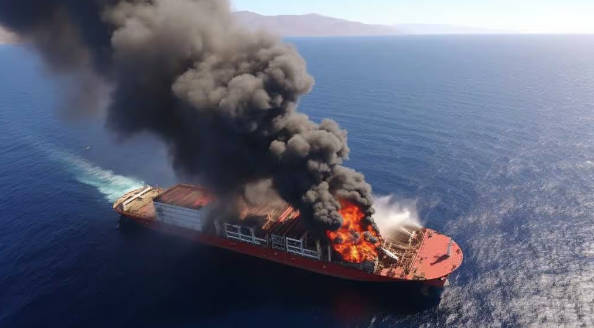
What is occurring is that key traditional (Western) Christmas supply chains – a period of intense activity for shippers and logistics companies – have come under extreme pressure just as demand and supply reaches its annual peak. Several bottlenecks have arisen at the same time to create significant headaches. Shippers are facing a myriad of issues, from the conflict in the Middle East and drought in Central America to strike action in the United States, and companies are finding it more difficult – and more expensive – to transport supplies. How bad is the West’s supply chain squeeze? And what could be done about it?
The Red Sea and Suez Canal
A primary cause is the Israeli conflict in the Middle East and the impact on the movement of trade through the Red Sea. Traffic has plummeted by two-thirds through the key shipping route since attacks on vessels by Houthi rebels, aimed primarily at Western ships with the Houthi’s wanting to illustrate both who is in de facto control of the passage, and demonstrate support for Palestine. Prior to this, the Red Sea route accounted for 40% of all Asian supplies to Europe (including 20% of its oil and gas needs). That has been reduced to a supply chain now servicing just 13% of Europe’s normal demand.
This bottleneck is not just limited to supply issues, as it has also impacted on the costs. Instead of the Red Sea route, shippers must now traverse the Horn of Africa, which adds ten days longer to the supply chain, and increases fuel, insurance and operating expenses amounting to US$500,000 per one way trip (US$1 million for the return to Asia). Many companies, including major shipping firms such as Maersk, have all but abandoned the route. For those that remain, according to Xeneta, spot rates for 40ft shipping containers moving between Asia and Europe via the Red Sea now stand at US$8,587 per container – 468% higher than in December 2023.
Now, a new flare-up of tensions between Israel and the Middle East – the Lebanon and Iran have both been targeted by Tel Aviv – is a significant escalation and can be expected to result in further Red Sea shipping disengagement meaning that even the remaining 13% of vessels serving the European markets may now dwindle to zero.
It has escaped many, however the Suez Canal and Red Sea shipping lanes, so long a route both created by and protected by European powers, have also undergone a shift in their geopolitical management. Egypt is a full BRICS member, with Saudi Arabia all but the same, while neighbouring Sudan and Yemen have also expressed interest in joining. All are now firmly in Russia’s orbit, while China also has a significant say, in trade terms, about the future for Red Sea transits. This means that in resolving the Middle Eastern crisis and rescuing the Red Sea route, Moscow, Tehran and Beijing, rather than Brussels and Washington, have emerged as the most influential power brokers as to the future of this supply chain. Yet even then, the Red Sea is not the most convenient solution – it is facing significant competition.
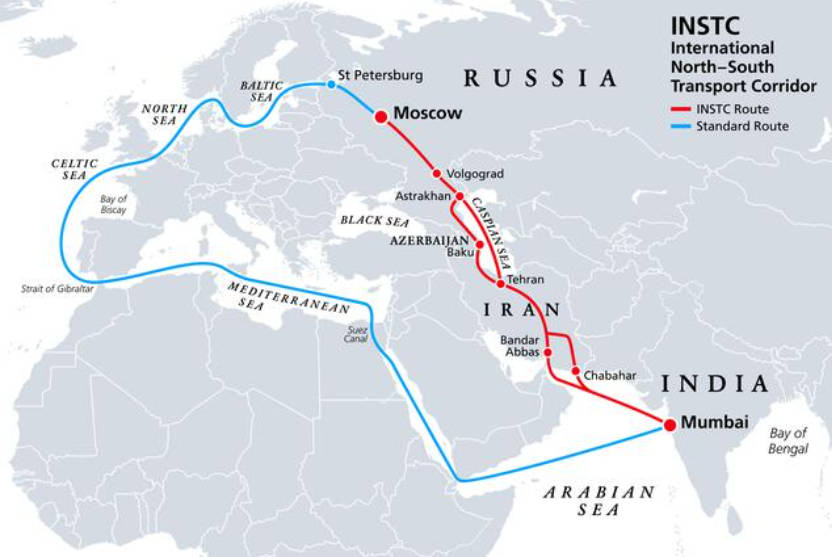
The International North-South Transportation Corridor (INSTC)
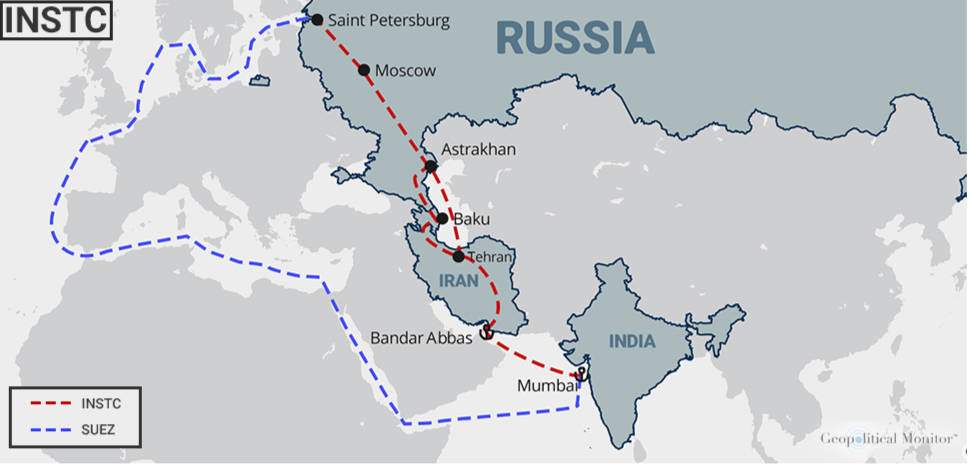
The Red Sea and Suez Canal disruptions – and Europe’s supply chain woes – are not just limited to the Israeli conflict. The route also faces significant competition from the International North-South Corridor (INSTC). This multi modal route avoids the Red Sea altogether and uses the Caspian Sea as its maritime corridor. It has regional access to South Asia via Iran’s Persian Gulf Ports (Iran’s Chabahar Port to India’s Mumbai Port is just 3 days sailing, with Pakistan also joining the project) while it also provides access to Europe via Azerbaijan’s Baku Port, and via road and rail to Turkiye and Georgia’s Black Sea Ports. From there, ships could theoretically reach EU ports in Bulgaria and Romania. Ukraine’s Black Sea Ports to Europe are now blockaded – and in a conflict zone – rendering them inaccessible. Goods could also reach Europe overland from Russia’s Caspian Sea Ports at Astrakhan – except that the EU has banned nearly all inbound goods from its borders with Russia and Belarus.
However, the INSTC and Black Sea routes to Europe have also become problematic in several different ways. Firstly, the supporting INSTC infrastructure has not yet been fully completed and it has bottlenecks of its own, both across Iran and from Azerbaijan through the Caucasus to Black Sea. These won’t be fully resolved until 2030 and possibly longer (although the Russian section is being fast tracked). The EU ports at Constanta (Romania) and Varna (Bulgaria) have been under-invested and are not at their capacity potential. Suggested Chinese BRI investment into them has been rebuffed. In addition, the European Union has imposed significant sanctions upon Iran, barring its logistics companies from any engagement. Sanctions imposed upon Iran have cut off an important supply chain to Asia.
Secondly, insurance costs for Black Sea shipping have increased due to the Ukraine conflict, further rendering the route less viable. Thirdly, and with rather more profound, longer term implications, Azerbaijan is also in Russia’s orbit and plans to join the BRICS, while Georgia has also recently moved to a more pro-Russian stance – a development that Brussels has responded to with the threat of sanctions and visa-restrictions against Georgian nationals.
Finally, there is the EU’s relationship with Turkiye, another key component for Brussels in its supply chain alternatives. Turkiye has been an EU candidate member since 1987 with little to no progress made. Although, in common with most EU members, it is a member of NATO, Ankara has been making very strong hints that it will join the BRICS group instead. If so, this will also impact Turkish trade with its supply chains moving to markets where it feels more welcome.
These developments collectively mean that the EU has effectively negotiated itself out of any Asian connectivity from the Caspian routes – which also include markets in Kazakhstan and Uzbekistan, both of which have preferential trade agreements with the EU, but which are now likely to see this potential significantly diminished. Crucially, this also cuts the EU off from nearly all its overland trade with China – its second largest trade partner and forcing it to rely solely on maritime routes instead.
Russia meanwhile remains well connected with Asia via both the INSTC – which is set to expand its capacity in coming years, and overland direct and via Kazakhstan to China. It is currently involved in double-tracking the Trans-Siberian railway, building a second, more northern railway in the BAM route, and is investing significant amounts of money in developing its Far Eastern sea ports. Examples are here, here, here and here
The Panama Canal
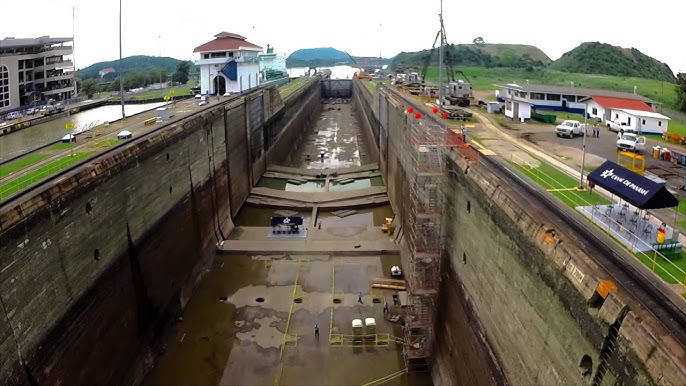
In more bad news for Western supply chains, traffic through the Panama Canal has dropped by 45% after drought has forced its operator to limit the number of ships that can travel through it. With this reduced volume almost certainly a result of global warming, the Panama Canal was responsible for handling 40% of all United States shipping, which is also an important artery for EU energy and agriculture supplies. This has also resulted in longer routes via Chile’s Cape Horn, adding 14,000 nautical miles from San Francisco’s port to New York and even further onto Europe. That adds about four weeks to the overall transit at an additional cost of roughly US$4.2 million per vessel. Clearly, with the Panama Canal problem unlikely to be resolved, the European markets will be effectively cut off from the West coast of the United States, with pan-American road and rail haulage the only other viable solution. That is a 2,300km journey of about 5 days and also involves a far more complicated loading of vessels in New York. This adds an estimated 40% more in costs.
This is not a problem facing Russia. It can reach Latin American East coast markets from its Baltic Sea Ports, and is actively investing to increase capacity at its major export hubs near St. Petersburg. Brazil is already a full member of BRICS, while other LatAm east coast countries such as Cuba, Honduras, and Venezuela have also made official requests to join and are close to Moscow.
For the Latin American west coast, Russia services these from its Pacific coast ports, most notably Vladivostok, with several adjacent ports also being expanded. LatAm west coast countries that have applied to join BRICS include Nicaragua, El Salvador, Colombia, Ecuador, Peru and Bolivia (which is inland but accessible via Peru).
Back to Europe though, and the Panama Canal problems are not the only issue its supply chains are facing when it comes to supplies from North and South America.
US East Coast Port Strikes
More European trade disruption has occurred following the port workers’ strikes on the east coast of the United States. On Tuesday (October 1), nearly 50,000 members of the International Longshoremen’s Association (ISL) went on strike, affecting 14 ports across the east coast of the US. The ISL President, Harold Daggett, has stated to the US government – words that will also chill the UK and EU – that “I will cripple you – and you have no idea of what that means.” Average prices for shipping one container to Europe from the US east coast immediately rose to US$2,861 from US$1,836. The strike has now been resolved and workers returned, however in backing down to the ISL, the US government has also made it vulnerable to similar attempts to coerce it for additional demands. Future strikes cannot therefore be ruled out, additionally implying that US-Europe trade is now controlled by the ISL and potential for making demands.
Interestingly, the strike was partially as a result of the planned introduction of digital technologies designed to make the port processing more efficient, again suggesting that US ports are falling behind their Russia and Asian equivalents. World Bank data indicates that no US ports are in the global top 50 in terms of effectiveness, measured as productivity versus cost. Labour Unions are permitted in Russia, China and most Asian countries; however regulations are in place that criminalise industrial action in critical infrastructure, including port operations. Although this situation has been resolved for now, the fact that a Union, rather than the US government can dictate trade terms should be a concern for European importers.
Cost Impacts
The price for oil has risen to US$76 a barrel on Wednesday (October 2), from US$71 at the start of the week. Some analysts believe it could break US$80 within days. There is also a threat to Iran’s crude output by an Israeli retaliation against its oil infrastructure. Goldman Sachs estimates Iran can produce 1m barrels of oil a day, but there could be further disruption to supplies if problems with key shipping routes through the Red Sea affect crude exports from the wider Middle East region. An interruption of oil trade through the strait of Hormuz, a narrow waterway at the mouth of the Persian Gulf, would result in a “large oil price spike”.
This impacts Russia positively as its revenues as a major oil producer would increase, and Europe negatively as its manufacturing and consumer costs would increase. Carmakers such as Volvo and Tesla have already had to suspend production lines because of a lack of parts as a result of the disruption.
Continued problems in all these cases will ultimately hit the Western consumer, and especially in Europe, as the United States has its own oil reserves. What is likely to happen in Europe are winter price increases, product availability problems, and inflation, pushing up the price of everything from food to household energy bills.
Russia’s Solutions
Russia is making longer term plans to get around the US and European woes. Its trade with the United States and Canada is minimal in any event – less than US$20 billion with the US (three-quarters of which were Russian exports) and less than US$400 million with Canada. In short, what happens with US supply chains has little impact on the Russian economy.
Instead, it has focused largely on developing supply chains and markets in Asia and has been investing significantly in increasing these further. This includes substantial, road, rail and seaport developments both inside Russia as well as its gateways to the East – its land border crossings with its eastern partners are all undergoing significant capacity upgrades. It is notable that Russia is doing this while the EU has been retrenching from the China market in particular.
Some of these solutions could benefit Europe. Chief amongst these are the Northern Sea Route, which just saw a record-breaking transit time of 21 days from St. Petersburg to Shanghai.
Russia is also upgrading its numerous arctic ports and connecting them to its massive river system – Russia has 200,000km of navigable waterways compared to 41,000 in the EU. The difference is that Russia is investing in these and upgrading capacity. There are in fact 28,000km of waterways that connect Russia and the EU – with these due to be part of the UNECE European Agreement on Main Inland Waterways of International Importance. However, the project has been indefinitely postponed by Brussels due to the EU closing its borders with Russia.
Russia is also actively seeking new emerging markets. We have already discussed the inroads it is making in Latin America, however it is also expanding into entire continents where European powers are now departing. A major example is Africa, where numerous ex-British and French colonies have become close to Moscow and are now developing trade ties with Russia as opposed to the EU and UK. Several of these have also declared an intent to join BRICS, including Algeria, Angola, Cameroon, the Central African Republic, Congo, the Democratic Republic of Congo, Equatorial Guinea, Ghana, Libya, Morocco, Nigeria, Senegal, Sudan, South Sudan, Tunisia, Uganda and Zimbabwe. Egypt, Ethiopia and South Africa are already full BRICS members, meaning 20 of the 54 African nations are BRICS positive, while Russia’s direct relations with Burkino Faso, Mali, Niger, Sao Tome have also developed in highly positive terms as Russia is assisting with regional security problems. This also has implications for Europe. Niger was an important source of raw uranium powering France’s nuclear industry. Those contracts have been cancelled with Rosatom now in primary position to help the country develop its nuclear industry and export that energy across the Sahel. The European influence in Africa is significantly waning.
It is a similar story in the Middle East. Iran and the UAE are both full BRICS members, while Saudi Arabia still has to formally ratify its membership – which it may delay while the Israel conflict remains active. Elsewhere, Bahrain, Iraq, Kuwait, Syria and Yemen have all declared interest in joining BRICS as has Palestine – which could, if accepted signal a real intent towards resolving the Israeli issue.
Clearly, despite sanctions, Russia’s global trade and supply chains are undergoing significant developmental changes in a way in which Europe’s are not – having apparently placed all its bets on Ukraine. It also implies that Europe will find itself left behind – having jumped from ‘over exposure’ to Russia and China, it now looks increasingly over exposed and reliant upon the United States. The problems of this strategy are becoming increasingly apparent.
The EU’s GDP growth forecast for 2024 is just 1%. In Russia, it is 3.9% and in China 5%. Asia overall is averaging about 6%. In hindsight, the EU’s pivot to the West doesn’t appear to be quite as full of development promise as Russia’s Pivot to Asia has been – and achieved while under an astonishing 22,230 sanctions imposed by the West since 2022 to prevent it.
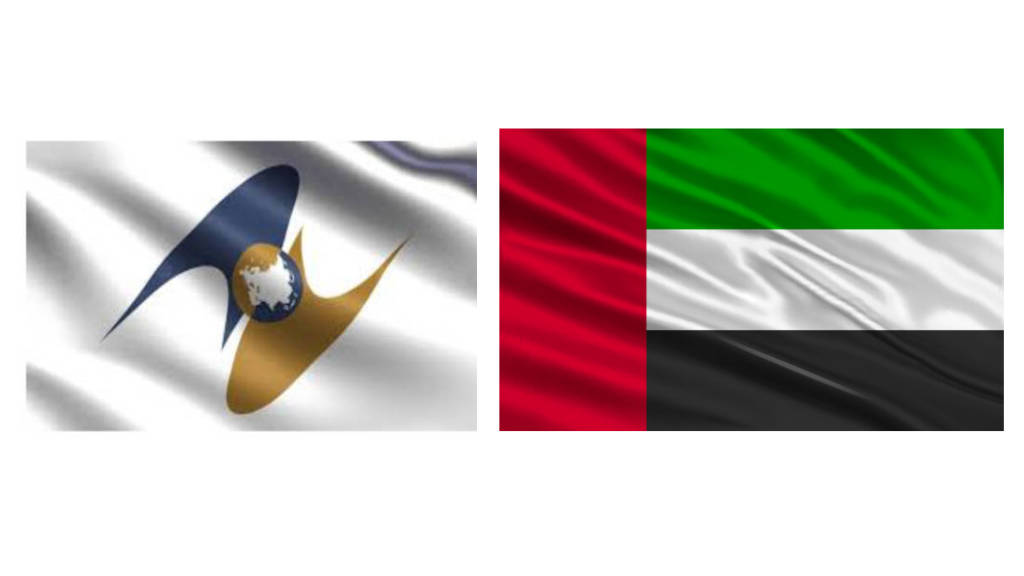
The United Arab Emirates (UAE) and the members of the Eurasian Economic Union (EAEU) may conclude negotiations on setting a free trade zone by the BRICS summit set for October 22-24 in Kazan, according to Andrei Slepnyov, the Eurasian Economic Commission Trade Minister.
He has stated that “With the UAE, we are at the finalization stage. There’s every chance that we’ll be able to do it quickly and that the agreements might well be finalized at the BRICS summit. I wouldn’t rule that out. But this concerns not only the commission but also our member states, but the timeframe is realistic.”
Other members of the EAEU include Armenia, Belarus, Kazakhstan, Kyrgyzstan and Russia. UAE investors recently purchased the Belarus subsidiary of the Raiffeisen Bank.
Slepnyov also said that free trade talks between the EAEU and Indonesia are also at the final stage, saying that “As for Indonesia, we’re close to the finish here, the part of the way we have yet to cover is slightly longer here [than in the talks with the UAE], although basic clauses of both treaties have already been agreed upon. In particular, the parties are continuing to discuss details regarding certain commodity items and prospects for slashing duties on them to zero as part of mutual trade.”
A new terminal for transhipment of various cargoes, including containers and grain, will be built in the port of Posyet in Primorsky Krai. Russia’s VTB bank are to finance the project, with a total investment of about ₽10 billion (US$106 million).
The corresponding agreement was signed during the recent Eastern Economic Forum in Vladivostok.
VTB stated that “We have opened a credit line to International Marine Transhipment Terminal (MMPT) for the implementation of an infrastructure development project in the Posyet seaport. With the support of the bank, a new terminal with a capacity of 8 million tonnes will be built in the village of Slavyanka. The terminal will be designed for sea transhipment of general, container and grain cargoes in all directions export, import and transit. The complex will also include a one-time storage elevator with a load of 30 thousand tonnes of grain.”
VTB board member Ruslan Eremenko said that “The development of transport and logistics infrastructure in the region is one of the priorities within the framework of the economic turn to the East. We see high investment activity of the Primorsky port workers and help in the implementation of projects to expand and modernise capacities. “We have already started a large-scale modernisation of the terminal in Slavyanka. We plan to significantly expand the mooring front, dredge the water area, and increase the length of the railway tracks. The warehouse complex will be updated and expanded, and modern port equipment will be installed. This will allow receiving and servicing large-tonnage vessels, create the basis for further development of the port and increase cargo traffic along the Primorsky International Transport Corridor.”
The International Marine Transhipment Terminal operates in Slavyanka, Primorsky Krai, within the boundaries of the Posyet seaport, which is an ice-free port on the Possiet Bay, about 200km south of Vladivostok and near to the Chinese border. Posyet port itself is part of the Primorsky International Transport Corridor, has access to the Trans-Siberian Railway, federal and regional highways, and services cargo to China and the Korean Peninsula. It is important for North China, as its Heilongjiang and Jilin Provinces, which include important industrial cities such as Harbin, Changchun and Jilin City are land-locked and need overland access to Russia’s Far Eastern Ports.
The Primorsky International Transport Corridor (PITC) is considered an important component for connecting the Eurasian Economic Union (EAEU) markets and China’s Belt and Road Initiative. Its development will change the existing transportation and port networks among neighboring countries and regions. Reaching as far as Dalian (Port Arthur) in China, it is envisaged that when the Northern Sea Route becomes more viable from about 2035, Russia and Chinese Far East ports will capture more than 60% of the international market in Northeast China and European trade.
Uzbekistan is completing the procedure to join the Eurasian Development Bank (EDB), Prime Minister Abdulla Aripov said at a meeting of the Eurasian Intergovernmental Council in Yerevan.
The EDB is an international development bank with charter capital of US$7 billion. Russia, Armenia, Belarus, Kazakhstan, Kyrgyzstan, and Tajikistan are the bank’s shareholders. Uzbekistan’s decision to participate – it will invest and acquire 10% of the banks equity – is another step towards it joining the Eurasian Economic Union (EAEU) a Free Trade group that also includes all the EDB members bar Tajikistan. Uzbekistan is currently an observer state in the Eurasian Economic Union (EAEU) and has been discussing full membership.
EDB Governor Nikolai Podguzov, speaking during the bank’s annual meeting in Almaty in June said that the legal issues of Uzbekistan’s accession to the EDB would be settled by the end of this year.
The EDB was founded in 2006 and is headquartered in Almaty, Kazakhstan. It has a branch in St. Petersburg and representative offices in Astana, Bishkek, Dushanbe, Yerevan, Minsk, and Moscow.
EDB Methodology and Projects
The EDB’s mission is to promote market economies and economic growth in its member states and help expand trade and other economic ties between them by means of investment. This includes financing investment projects that improve living standards and develop the business and financial environment in the recipient countries by lending to state or private enterprises, public-private partnerships (PPPs), equity participation, issuing guarantees, financing private investment funds, and providing loans to commercial banks for corporate on-lending.
The Bank also implements digital transformation projects in the EAEU+ and provides financing to banks, companies, and enterprises by investing in new and ongoing projects and supporting investment projects in the pipeline. The EDB’s portfolio mainly consists of projects in transport infrastructure, digital systems, green energy, agriculture, manufacturing, and mechanical engineering. Examples of projects that have been implemented with the EDB’s participation and financing include the following:
Reconstruction of the Almaty Airport terminal and Ring Road (Kazakhstan);
Construction of the Central Ring Road in Moscow;
Complete replacement of passenger railcars for Armenia’s national railway carrier;
Financing the Russian-Kyrgyz Development Fund’s targeted programmes;
Construction of the Polotsk Hydropower Plant on the Western Dvina River in Belarus) amongst numerous others.
EDB Development Strategy to 2026
The bank launched a development strategy for 2022–2026 and set out several objectives:
Strengthening the Bank’s integration role in the EAEU+, and increasing the banks total investment to US$10.9 billion;
Implementing and investing in integration mega-projects in transport infrastructure and logistics, food security, water and energy: the Eurasian Transport Corridor, the Eurasian Commodity Distribution System, and the Central Asian Water and Energy Complex;
Developing the EDB’s digital projects by focusing on support for the digital agendas of the Bank’s member countries to promote their digital transformation;
Promoting the UN Sustainable Development Goals and ESG approaches in the Bank’s corporate governance, and increasing financing for the Bank’s green and social projects;
Enhancing operations in the EDB’s minority shareholders. Five-year strategies have been developed for each of the Bank’s member states, tailored to their economic and investment profiles. EBD investments in Armenia, Kyrgyzstan, and Tajikistan are expected to reach US$500 million by 2026.
EDB Think Tank
The Bank’s own research activities have made it a reputable think tank. The EDB is involved in major research and applied projects; prepares reports and recommendations on regional economic integration for member governments; regularly hosts conferences and round table discussions; and publishes sector- and theme-specific reviews, macroeconomic papers analysing economic developments in and forecasts for the region, as well as information on regional integration, development bank activities, and investment project financing in the EAEU+.
In 2021, the EDB research team published the following studies: The International North–South Transport Corridor: Promoting Eurasia’s Intra- and Transcontinental Connectivity; EDB Monitoring of Mutual Investments for the twelve CIS countries and Georgia; Investment in the Water and Energy Complex of Central Asia; and Uzbekistan and the EAEU: Prospects and Potential Impact of Economic Integration.
Sanctions & Credit Ratings
As a side note, although the EDB has not been sanctioned, Western ratings agencies have suspended ratings for the EDB. An example is the statement issued by S&P here.
The suspension of such ratings interferes with a banks ability to raise capital or investment from capital markets and could impact on interest rates from its own investors. Readers may decide whether or not decisions such as S&P’s are purely financial, or politically motivated.
Such actions are one of the reasons why the BRICS group has stated it intends to discuss the establishment of alternative credit ratings agencies and will do so at the upcoming annual Heads of State meetings later this month in Kazan.
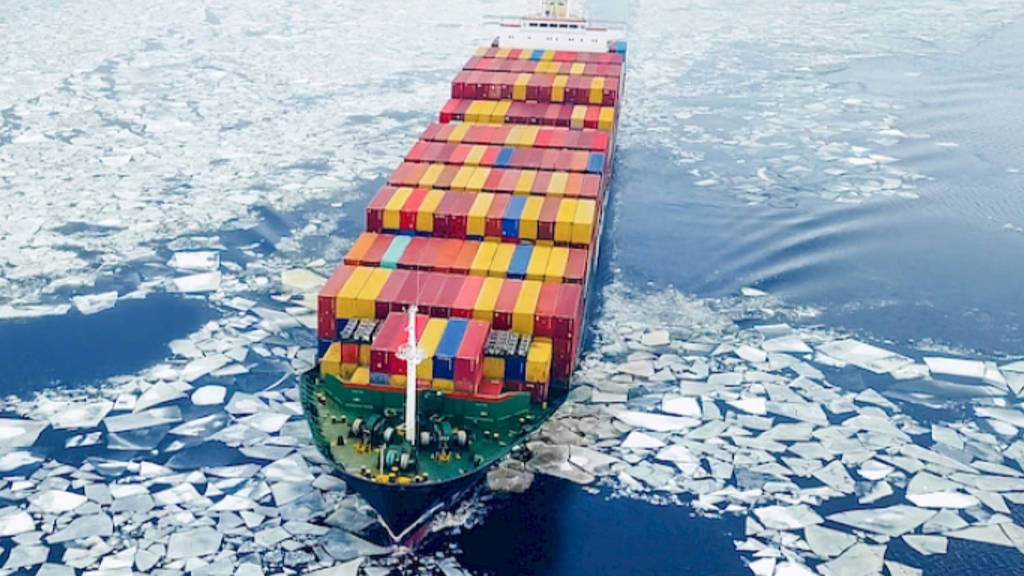
The Panamax container ship Flying Fish 1 has just completed its journey along the Northern Sea Route, navigating its way from St. Petersburg to Shanghai in 21 days at an average speed of 16 knots or about 30 kilometers per hour. What makes this voyage significant for the global shipping world and supply chain logistics is that navigating the traditional way through the Suez Canal would have taken two weeks longer. This achievement is now clearly feasible for objective comparison between the two routes.
The ship had originally departed from Istanbul en route via the Baltic Sea to and from St.Petersburg, sailed around the Norwegian coast and then across the Russian Arctic Ocean to Shanghai. The St.Petersburg-Shanghai leg took three weeks. According to Unctad, Panamax vessels currently cost an average of US$10,150 per day, meaning the NSR route was US$142,000 less expensive than the Suez alternative.
Data on the ship’s class, location, speed, flag and destination were recorded by Russia’s SITRO-AIS satellite constellation and transferred to the Russian cloud service for maritime traffic tracking.
The SiAIS tracking system was developed in Moscow by Russia’s Sistema Holdings. The system monitors and collects information from and about 10,000 seaports and 570,000 vessels worldwide. The constellation satellites receive and process several million datum message updates per day. The system is about to become more powerful as several dozen additional satellites are now being prepared for launch by the year end.
The Flying Fish 1 is registered in Panama and operated by EZ Safetrans Logistics based in Hong Kong. It arrived in Shanghai on September 26. The ship, capable of carrying 4,890 containers, marks a new standard for Arctic shipping, with previous ships holding only 1,500-2,000 containers. It did not require icebreaker support.
This route is part of a broader trend, with up to 20 Arctic transits between Russian and Chinese ports taking place this year. According to forecasts by Rosatom the route will see 270m tons of cargo in 2035. Generally, a Panamax vessel ranges from 50,000 to 80,000 deadweight tons (DWTs), implying that Russia predicts between 3,850 and 5,400 Panamax vessels using the route annually within a decade, providing cost savings over the Suez Canal route of between US$546 million and US$767 million per annum.
It doesn’t get much further into the Global South than Antarctica, and Russia and China are in talks over joint drilling of the Gamburtsev Mountain Range in the middle of the continent, the Russian Federal Agency for Mineral Resources (Rosnedra) has stated.
Last month, the Chinese cities of Beijing and Changchun hosted international conferences on Antarctic exploration, which were attended, among others, by specialists from VNII Okeangeologia, part of Russia’s Rosnedra. They discussed a Russian-Chinese project to drill in Antarctica and future cooperation plans. In particular, they analyzed plans on geophysical surveying of a well on Princess Elizabeth Land during the 2024-2025 season.
In addition, a proposal was made for a Russian-Chinese project to drill the Gamburtsev Mountains in central Antarctica, with Rosnedra saying that “By the scientific results which could be obtained during the drilling, this project could be called one of the most advanced industry projects of our time.”
The project will be research driven and exploratory in nature, drilling will be conducted to further study the mineral composition of this region of Antarctica.
The Gamburtsev Mountains are a subglacial mountain range located in East Antarctica, near Dome A, close to the South Pole of Inaccessibility. The mountains were discovered by the 3rd Soviet Antarctic Expedition in 1958 and named in honor of the Soviet geophysicist and academician Grigory Alexandrovich Gamburtsev. The formation is 1200-1300 km long and 200-500 km wide. The highest known heights are 2990 meters and 3390 meters. The height of the ice cover is not less than 600 meters, there are areas where the ice thickness is more than 4 km. The size of the Gamburtseva Mountains corresponds approximately to the European Alps. The Gamburtsev Mountains were first formed more than 1 billion years ago during the formation of the supercontinent Rodinia as a result of the collision of ancient continents.
Kazakhstan and Mongolia plan to build a new highway between the two countries through Russia, pending approval from the Russian authorities, according to the Kazakh Transport Ministry. The route will connect the Kazakh cities of Ust-Kamenogorsk and Ridder, as well as Tuekta in Russia’s Altai Republic, leading to the Mongolian border at Khyagt and the highway to Ulaan Baatar.
The Kazakh section of the route, 189 km from Ust-Kamenogorsk to the Russian border, has already been built. Most of the route will be in Russia, and if the Russian authorities agree to the project, the total distance from the Kazakh to Mongolian border will be 837 km. At present, the available routes are 1,604km. The new highway would also serve as a potential overland route between Astana, Kazakhstan’s capital, and Ulaan Baatar, Mongolia’s capital. It would also help establish Tuekta as a Russian intermediary hub between the two.
In July this year, the Presidents of Kazakhstan and Mongolia discussed the road project as part of efforts to improve transportation links between their countries, as it is expected to significantly shorten travel time, enhance transport connections between Kazakhstan and Mongolia, and strengthen economic and cultural ties. The key to the route is approval and funding by the Republic of Altai government and possibly the Russian central government.
Mongolia is currently negotiating a Free Trade Agreement with the Eurasian Economic Union, which includes Kazakhstan and Russia and is scheduled to be finalized in December.
The Belarusian Foreign Minister, Maksim Ryzhenkov has said that the BRICS group could add at least ten new members at the forthcoming annual meeting later this month.
Belarus is hoping to be among them, while Ryzhenkov stated that “The first wave of enlargement, as we all expect – those who have submitted such applications – will take place at the Kazan summit. Russia is formulating the list of these countries that will be in this wave of enlargement.”
The upcoming BRICS summit is to be held from October 22-24 and will see Russian President Putin joined by other heads of State, including China’s Xi Jinping, India’s Narendra Modi, Brazil’s Lula da Silva and South Africa’s Cyril Ramaphosa. Also attending will be Egypt’s Abdel Fattah El-Sisi, Iran’s Masoud Pezeshkian, Ethiopia’s Sahle-Work Zewde and the UAE’s Sheikh Mohamed bin Zayed bin Sultan Al Nahyan.
According to theEuropean Parliament, these full BRICS members account for 37.3% of global GDP, compared with about 30% for the G7.
The 2024 New BRICS Membership Candidates
Earlier this month, Belarusian Deputy Foreign Minister Sergey Lukashevich said his country is a primary BRICS candidate, along with Algeria, Bangladesh, Bahrain, Bolivia, Venezuela, Vietnam, Cuba, Honduras, Indonesia, Kazakhstan, Kuwait, Morocco, Nigeria, Palestine, Saudi Arabia, Senegal, Thailand, and Turkiye.
The Turkish Speaker of Parliament, Numan Kurtulmus, stated just last week that he hoped that Turkiye’s membership would happen as soon as possible – a very major hint that this may be about to occur.
If so, Turkiye would send a strong message to the European Union that it has ultimately decided that its longer-term trade interests lie elsewhere. Turkiye has been an EU applicant since 1987. Turkiye’s membership of NATO may also be questioned, and certainly within Europe, whose current mentality would find it hard to reconcile Turkey’s membership of a group including Russia with European security.
According to Russian President Vladimir Putin, speaking at senior level BRICS meeting in September, 34 countries have applied to join BRICS. Apart from the countries the Belarusian Deputy Foreign Minister identified above, these also include Angola, Cameroon, the Central African Republic, Congo, the Democratic Republic of Congo, Equatorial Guinea, Ghana, Libya, Sudan, South Sudan, Tunisia, Uganda and Zimbabwe in Africa, Afghanistan, Azerbaijan, Iraq, Kuwait, Laos, Malaysia, Myanmar, Pakistan, Sri Lanka, Syria and Yemen in Asia, and Columbia, Ecuador, El Salvador, Nicaragua, Peru and Venezuela. Palestine has also made a request to join the group.
The Russian Foreign Minister, Sergey Lavrov, had stated earlier this year that BRICS may not add additional members until all members were satisfied with the economic and trade credentials of prospective members, believed to be at India’s request to slow expansion down and impose a stricter selection methodology. However, given the rapidly changing geopolitical situation, both Moscow and Beijing are believed to be in favour of a faster expansion rate.
Still, India’s point is valid, and may result in the announcement of a two tier structure, full BRICS membership and a ‘Friends of BRICS’ group which are recognised as later potential members. It should be noted that membership of BRICS usually comes with some fiscal contributions and responsibilities – taking an equity position in the BRICS New Development Bank for example. That may be too early a commitment for some of the candidate nations.
Nevertheless, the BRICS group does appear poised to launch a serious and significant challenge to the West as a collaborative group this month, with the potential for announcements concerning their continued use of the US dollar in trade, and an overall move away from the US-controlled SWIFT global financial settlements system. As the New York based Nasdaq stock exchange stated last month, if enough countries move away from US dollar use in their bilateral trade, it is likely to have serious consequences for the US dollar and euro in global trade.
A further expanded BRICS would also start to seriously change global supply chains and trade flows as member countries begin to enhance and prioritize intra-BRICS trade as opposed to the stricter, often regarded as unfair, regulatory requirements imposed on their trade rights by the United States and European Union.
For the latest intelligence about the BRICS, please see our BRICS-specific archives here.
Russia’s Prime Minister, Mikhail Mishustin met with Iranian President Masoud Pezeshkian and Vice President Mohammad Reza Aref in Tehran on September 30 (Monday), with the discussions coming as fears grow of a Middle-East war.
However, the talks, at least officially, focused on bilateral cooperation between the two nations, the expansion and diversification of trade, as well as work on major investment projects.
Mishustin said that “Russia is genuinely interested in taking our cooperation to a higher level, giving it a new meaningful implementation. Issues on the bilateral agenda were discussed. But today these issues already go far beyond the ties between Russia and Iran, since, to a large extent, they determine how relations will be built in the conditions of the formation of a new world order.”
The scope of the discussions reached beyond the bilateral ties, with the participation of the two countries in major multinational projects being on the agenda.
Western countries have accused Iran of supplying military drones to Russia for use in Ukraine in exchange for nuclear power technology, feared to also be capable for use in weapons. Both sides deny this. Both have also been extensively sanctioned by the West and disconnected from the SWIFT financial settlements system.
Regardless, Mishustin’s visit is the first-ever official trip of a head of the Russian government to Iran. The two sides discussed strengthening cooperation in Eurasia, including the development and expansion of the International North-South Transport Corridor, which runs through both Russia and Iran. That route, although not fully completed, provides Russia with export access to the Middle East, East Africa and South Asia.
Mishustin said that “We consider logistics and transportation infrastructure as the most promising sphere. Russia and Iran have great transit potential both in the Caspian region and in Eurasia. We are actively developing international corridors: the International North-South Transport Corridor connects Russia’s Baltic and northern ports with Iranian ones in the Persian Gulf and in the Indian Ocean, it provides all Eurasian states with direct access to the rapidly growing markets of the Asia-Pacific region and Africa.”
The trip comes just two weeks after the secretary of Russia’s Security Council and former defense minister, Sergey Shoigu, also visited Iran. During his visit, Shoigu met with Pezeshkian and other top officials for talks that reportedly revolved around carrying out large joint projects in fields involving transport, energy, industry, and agriculture.
Russia and Iran have also been discussing a major bilateral agreement, although delays have occurred with the death of the former Iranian President Ebrahim Raisi in an aircraft crash earlier this year. This agreement would replace a 10-year deal signed in 2001, which has been extended several times. The new pact is to have a 20-year duration and be more ambitious in terms of military, economic, and political cooperation. In February this year, Russian Deputy Prime Minister Alexander Novak and Iran’s Oil Minister Javad Owj signed 15 memoranda of understanding during a meeting of the Iran-Russia Joint Economic Commission in Tehran. This new round of discussions can be expected to have continued their dialogue as concerns a new agreement, which could amount to hundreds of billions of dollars in value spread over the next two decades. Russia-Iran 2023 bilateral trade reached about US$5 billion.
In December 2023, the Eurasian Economic Union (EAEU) countries signed a Free Trade Agreement with Iran, which replaced the temporary pact that had been in effect since 2019. Russia ratified the agreement in May 2024 and, according to Deputy Prime Minister Alexei Overchuk, it should enter into force in early 2025. Russia and Iran are also members of BRICS and the Shanghai Cooperation Organization.
According to the Iranian government, President Pezeshkian will hold talks with his Russian counterpart Vladimir Putin during his visit to the BRICS summit in Kazan this month. This will be the Iranian leader’s first visit to the Russian Federation since the elections.
In the context of the formation of a new world order, it should be noted that Iran has significant energy reserves: it ranks third in the world in terms of proven oil reserves and second in terms of natural gas reserves. Iran accounts for 24% of the Middle East’s oil reserves and 12% of the world’s volumes.
Russia’s Foreign Minister Sergey Lavrov has been in New York attending the annual UN General Assembly. During the UN events, several other bilateral meetings were held as numerous countries wish to discuss current affairs with Moscow. Lavrov subsequently met with Bakhtiyor Saidov, the Foreign Minister of Uzbekistan.
The ministers discussed current issues on the agenda of bilateral relations, including the preparation of events within the framework of interstate dialogue, as well as exchanging views on global and regional matters.
Lavrov and Saidov reaffirmed their commitment to consistent joint efforts to strengthen the comprehensive strategic partnership and allied relations between Russia and Uzbekistan in accordance with the agreements reached by their Presidents.
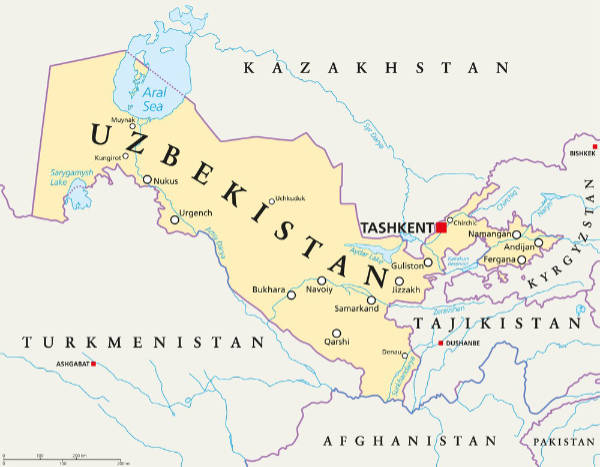
Russia and Uzbekistan have had historically close ties, with economic and geopolitical rationale pushing the two countries to seek closer ties. For Russia, Uzbekistan arguably has the most strategic location in the Central Asian region, as the country shares borders with all Central Asian states (Kazakhstan, Kyrgyzstan, Tajikistan, and Turkmenistan) in addition to Afghanistan, and sits on a large part of the agriculturally rich Fergana Valley, with a sizable population as well as oil and natural gas deposits.
However, Uzbekistan’s strategic location and resources have enabled it to resist Moscow’s pressure to enlist Tashkent into both the CSTO and the EAEU, although it does have a position as an observer state to the latter. Although Russia’s trade and economic ties have experienced significant shifts following the Ukraine conflict, this has nevertheless positively influenced Moscow-Tashkent ties, as is reflected in the growing dynamics in trade, investment, and cultural ties.
Bilateral Trade
Russia returned to a prominent place in the list of Uzbekistan’s main foreign trade partners in 2022, with trade turnover between the countries increasing by 23% compared to 2021 – up to US$9.28 billion (18.6% of Uzbekistan’s total foreign trade turnover). It is also growing; 2023 bilateral trade turnover reached just under US$10 billion.
Russian exports to Uzbekistan mostly consist of industrial products (42.3% of total supplies of manufactured goods to Uzbekistan), machinery and transport equipment (6.5%), and food products. Other exported merchandise include metals, food products and agricultural raw materials, wood and pulp and paper products, various chemical and mineral products, precious metals, and stones.
Uzbekistan’s Agricultural Economic Indicators
Uzbekistan’s economy is mainly dependent on agricultural production. Since most of its population lives in rural areas, employment in the agricultural sector is high, influencing the structure of the country’s foreign trade. A look at Uzbekistan’s export capacity to Russia shows that it mainly consists of agricultural and food products. Other merchandise are food products and agricultural raw materials, chemical industry products, machinery equipment and vehicles, precious metals and stones, clothing, and clothing accessories, of knitted or crocheted kinds, copper, and zinc.
Yet despite Uzbekistan’s strong position in the agricultural sphere. Russia, as an agricultural giant in its own right, has now evolved into Uzbekistan’s net supplier of agricultural and food products. This shift has been caused by a variety of reasons, such as Russia’s development of its own agricultural base to add to Uzbekistan’s structural production problems.
Another more significant reason is the creation of the Eurasian Economic Union (EAEU). The fact that Uzbekistan sends fewer agricultural products to Russia doesn’t necessarily mean that the country’s production is lagging behind. Uzbekistan exports a significant amount of agricultural merchandise to Kazakhstan, another member of the EAEU.
Nonetheless, Uzbekistan remains a target for Moscow to entice into the EAEU, and with food security and military security and investment – especially as regards Afghanistan – on the agenda, it may only be a matter of time before Uzbekistan becomes more deeply involved in EAEU trade.

 Русский