News

Russia Continues To Pay Eurobond Dividends Despite Sanctions

Published on April 5, 2024

The Russian Finance Ministry has transferred ₽7.8 billion (US$84.4 million) to the National Settlement Depository (NSD) to pay a coupon yield on sovereign Eurobonds maturing in 2042, the ministry said. NSD, the payment agent, has received the funds.

A Eurobond is a bond issued offshore by governments or corporates denominated in a currency other than that of the issuer’s country. Eurobonds are usually long-term debt instruments. Eurobonds are important because they help organizations raise capital while having the flexibility to issue them in another currency. Eurobond refers only to the fact the bond is issued outside of the borders of the currency’s home country; it doesn’t mean the bond was issued in Europe.

However, sanctions imposed by the West have prevented Russia making payments to Eurobond yields in Euros.  Nevertheless, the Russian Ministry of Finance has been making all payments on sovereign Russian Eurobonds in Rubles since June 2022, and has not defaulted on its obligations.

Further Reading 

Russia’s Foreign Debt Decreased Again In 2023

Threat Of US Secondary Financial Sanctions Hits Personal MIR Card Use

Published on April 4, 2024

The United States has imposed sanctions against Russia’s JSC NSPK, the operator of MIR payment cards. These act as a Russian form of Visa and Mastercard and allow card holders the ability to access ATM machines, pay for goods in stores and conduct transactions.

The latest countries to be targeted by US secondary sanctions are Armenia, Kazakhstan and Kyrgyzstan, who all received notice that the US would impose sanctions on their banking sectors if they continued to allow access to Russia’s MIR cards. Armenia suspended MIR card access on March 30, while Kazakhstan and Kyrgyzstan will suspend use on Friday (April 5). MIR card users will no longer be able to make non-cash payments at point-of-sale terminals, to withdraw cash from ATMs, to transfer from card to card, or to make internet payments.

Belarus and Tajikistan have also been placed under US pressure to follow suit.

The moves hit private sector individuals, many of them migrant workers who travel to Russia for casual work. It also impacts small businesses who trade with Russia. All the countries concerned have long-standing trade agreements with Moscow. Visa, Mastercard and American Express withdrew from the Russian market in 2022.

The moves however does not impact MIR card use within Russia, nor will it affect inter-bank transfers. It is still possible to transfer money online via direct bank transfers between Russia and the affected nations.

Olga Skorobogatova, the deputy Chair of the Bank of Russia, said that the regulator was working on solving the problem. The Central Bank is studying the possibilities of expanding the ATM networks of Russian banks’ subsidiaries and using the Faster Payments System (SBP) instead of the SPFS network in other countries.

Russia Expects Manufacturing Growth At 5% During 2024

Published on April 3, 2024

Denis Manturov, the Russian Industry and Trade Ministry expects manufacturing output could grow at least 5% if current trends persist in 2024, he said to the State Duma on Wednesday (April 3).

“Everything will depend on many factors, including monetary policy, but given the results we see in the first two months, I think that by the end of the year this should be at least 5% in the manufacturing industry.”

The Russian Federal State Statistics Service (Rosstat) has said manufacturing sector output grew 7.5% year-on-year in January, accelerating to 13.5% in February. Manufacturing grew 7.5% in 2023.

Russia’s Purchasing Managers Index (PMI) is current the highest in Europe as its manufacturing sector expanded at the fastest rate in nearly 18 years in March, a S&P Global report showed on Monday, as new export business grew for the first time in five months. The S&P Global Purchasing Managers’ Index (PMI) for Russian manufacturing rose to 55.7 in March from 54.7 in February, moving further above the 50 marks that separates expansion from contraction to its highest reading since August 2006.

The sector’s revival has largely depended on domestic demand because Western markets have withdrawn from Russia. Moscow is spending particularly heavily on manufacturing, pouring cash into the defence sector to ramp up military production. The defence industry spurred sharper than forecast growth in industrial production in February, data showed last week. However, it’s not just the so-called ‘war economy’ that has spurred Russian growth – new export orders increased for the first time since last October.

“Greater foreign client demand reportedly stemmed from expansion into new export markets and new client wins,” S&P Global said in a statement, also pointing to the knock-on effect on employment. “Firms raised employment at the quickest rate since November 2000 and saw a notable pick-up in input buying amid efforts to rebuild stocks.”

Vendor performance declined further in March, S&P Global said, with logistics delays and slower deliveries via rail transportation the key factors driving the deterioration. But that relative blip did not stop firms from registering their strongest degree of confidence in output expectations for five years. “Optimism in Russia is linked to hopes of further upticks in customer demand, as well as investment in new product lines and machinery to improve efficiency,” S&P Global said.

Russia’s PMI index ranking at 55.7 compares with Germany’s at 42.5, France at 45 and the UK at 50.3. A figure above 50 is an expansion, below aa contraction.

Embellishment: The Art Of Spotting Media Disinformation Tactics

Published on April 3, 2024

The rise of AI in media usage and amongst the tactics and mechanisms used to constantly paint a specific persuasive – often political or opinionated message to the mass population is the use of lexicological embellishment. For this, we should be grateful to the journalistic guidelines espoused by the great Ernest Hemingway, who cautioned against the over-use of words. “My aim is to put down on paper what I see and what I feel in the best and simplest way.”  In short, that means cutting out the superfluous. The reason is that firstly, additional text is simply redundant, and secondly, using it can betray an unwanted – or deliberate – political bias.

These basic instructions are clear. But, as was also mentioned by the US Senator for California Hiram W Johnson, in 1917, “The first casualty when war comes is truth.”

So how can these two truths be reconciled? One calls for simplistic honesty, the other recognises that becomes unattainable during times of conflict.

A Built-In, Shockproof, Shit Detector

Hemingway also said that his reporting (he was a war correspondent during the Spanish civil war) included “a built-in, shockproof, shit detector.” This, and his comments about brevity in reporting the facts – at least for the reader – come in useful in determining journalism and reporting that is either at best poorly written, or at worst, designed to embellish, typically in today’s purposes to continue negative connotations. We will use reporting about the Ukraine conflict as examples:

“Russia’s illegal invasion of Ukraine”

The superfluous word here is ‘illegal’. All invasions are illegal. Adding the “illegal” doubles the intensity of the occasion beyond the actual meaning – and embellishes it. This means that the writer concerned is overstating the reality. Quite apart from the issue of whether an invasion took place or not, this then deliberately illegitimizes the underlying reason why.

“The autocratic President of Russia”

Here, the word ‘autocratic’ is superfluous. He is either President of Russia or he is not. Placing the word ‘autocratic’ in the sentence is a strong pointer to that whatever else is said, the viewpoints almost certainly carry some bias as opposed to being entirely factual.

“He said, without evidence, that…”

The two offending words here are ‘without evidence’. Inserting these words changes the reporting dynamic from what was actually said, to being an opinion piece, second hand related to what was said. This is doubly problematic, first, because it is grammatically incorrect, and secondly, deliberately suggests an untruth. The reporter here cannot know whether the person they are quoting has evidence or not. In fact, in many criminal or serious statements, evidence is specifically withheld from journalists as it may compromise investigations. However, this does not mean evidence does not exist.

Other Tactics

Allegations

“The US unveils sanctions over alleged exports”

Here we get into more difficult territory. While the statement is true, there is another agenda here. Most readers will skim over the word “alleged” yet the sentence belies an apparent truth, that according to this sentence, the US has imposed sanctions on exports without any evidence, based purely on allegations. To determine the true meaning of an article written like this means continuing with the narrative. It also means that there is another story in plain sight: the US not abiding by international laws or WTO regulations. That’s designed either because AI isn’t so smart as to telling falsehoods, or the US wants to illustrate it can issue sanctions unilaterally. Curiously, a statement that tells the truth can in fact be the most subversive in what it implies.

Echo Experts

An echo expert is when disinformation sources cite each other to provide credibility for their claims. The United States and Europe for example routinely cite one another’s newspapers.

Summary

Whether AI is used to make news or not, the embellishment tactic in journalism is a key method in which readers can spot, as Hemingway described, as ‘bullshit’. Its use doesn’t necessarily mean that the article is incorrect – it could simply be down to poor journalism, which itself could be an indicator of AI use as well as lazy standards. On the other hand, if the article in question continues to embellish, or place emphasis where none is required, the chances of it being written with a desire to subvert free-thinking and promote the inability to make unbiased opinions is enhanced.

You can check whether accounts, anecdotal or scientific, have been verified by other reliable sources. Google the name. Check expertise status, source validity and interpretation of research. Remember, one story or interpretation is not necessarily representative. To embellish or not to embellish has become a lexographical tool in the battle for free media. Readers can make their own minds up as to the main offenders – but do watch out for it when seeking the truth.

Russia’s Foreign Debt Decreased Again In 2023

Published on April 2, 2024

Russia’s foreign debt, already amongst the lowest of developed nations, is continuing to be reduced as a matter of  government policy. Its entities have been steadily reducing the amount of money they owe to foreign lenders, according to the latest official data.

The Russian regulator and central bank, the Bank of Russia announced that national external debt dropped by nearly a fifth last year, reaching its lowest point in over a decade. It said that on January 1 this year, “the external debt of the Russian Federation amounted to US$316.8 billion, having decreased by US$68.2 billion, (17.7%) over the course of 2023.”

External debt is the portion of a country’s national debt borrowed by the state and by private businesses from overseas lenders such as banks, the IMF, foreign companies and other creditors.

The amount owed by Russia’s central bank and other banks remained virtually unchanged at US$94.7 billion, while government debt was reduced by 29%, from US$46.1 billion to US$32.7 billion. Other sectors of the economy reduced their overall external debt by 22.6% to US$189.4 billion, the report says.

The regulator also noted that the debt burden on the Russian economy has decreased as the ratio of external debt to GDP fell to 15.8% last year.

According to Bank of Russia, the current level of external debt is at its lowest in a decade.

President Vladimir Putin said in December that Russian companies were dutifully repaying all loans taken from foreign financial institutions, often ahead of schedule.

Russia’s foreign debt reached a historic high of over US$700 billion in 2014. The liabilities began a relatively steady decline since then, due to Western sanctions imposed in 2014 over the Crimean reunification and to the withdrawal of capital by non-residents. The new sanctions campaign unleashed by the West against Moscow since 2022 has further accelerated foreign-debt decline.

To compare, by the end of 2023, the German foreign debt is at about US$6,385.3 billion, UK foreign debt is about US$9,031 billion being about twenty times and thirty times more than Russia’s debt respectively. The United States foreign debt is currently running at record highs of about US$25,649.6 billion.

Serbia Considers Joining BRICS

Published on April 2, 2024

Serbian President Aleksandar Vucic has said he may attend the 2024 BRICS summit planned to be held in Kazan in October. As chair of BRICS for 2024, Russia is hosting the group’s annual summit, with the event comprising over 200 political, economic, and public forums. The exact dates of the summit have yet to be announced.

Last year, a group of Serbian MPs proposed joining BRICS instead of the EU, arguing that the organization would provide better prospects for the country. Serbia applied for EU membership in 2009 and was granted candidate status in 2012. However, its application has stalled over the bloc’s demands for “the normalization” of Serbia’s relations with the breakaway province of Kosovo. The Movement of Socialists, which acts as a junior partner to the ruling Serbian Progressive Party, has accused Brussels of using “political blackmail” in an effort to force Serbia to give up its territory.

Serbian lawmakers concluded that “Serbia’s so-called European path has a clear alternative embodied in BRICS” while recommending public dialogue on the matter. Republika Srpska, the Serb half of Bosnia-Herzegovina, has also expressed a desire to join BRICS, arguing that it is a clear alternative to the EU.

“Since Brussels keeps making new and vague demands, I think Bosnia-Herzegovina should apply to BRICS. I believe it would be admitted faster,” President Milorad Dodik said last August.

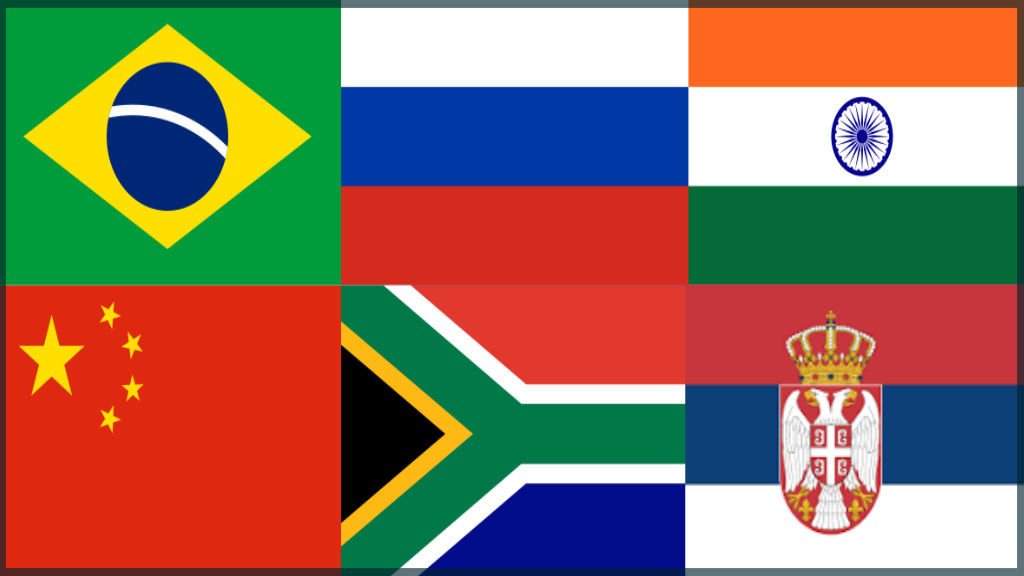
The BRICS group of major emerging economies was created in 2006 by Brazil, Russia, India, and China, with South Africa joining in 2010. Egypt, Ethiopia, Iran, Saudi Arabia, and the UAE become full-fledged members in January 2024, while dozens of other countries have reportedly expressed an interest in joining.

Serbia has a Free Trade Agreement with the Eurasian Economic Union (EAEU) while mistrust of the European Union and NATO is high. NATO bombed Belgrade in 1999 during the wars that eventually divided Yugoslavia up into different entities: Bosnia & Herzegovina, Croatia, Kosovo, Macedonia, Montenegro, Serbia, and Slovenia. The Serbian part of the Yugoslav collective had been dominant, but with the breakup of the country Serbia lost its Adriatic coastline. Over 2,000 civilians died in NATO’s bombing of Belgrade, which also demolished the Chinese Embassy and killed three Chinese staff.

Serbia has a Free Trade Agreement with China, while Serbia’s trade with India is also growing.

Serbia-Russia bilateral trade was worth US$2.9 billion in 2023.

Russian Manufacturers Beginning To Replace Chinese Vendors In Russian Market Supply Chains

Published on April 2, 2024

Russian current SME demand for intermediary agents to work with counterparties from China is growing at a record pace and includes a whole range of services – from searching for manufacturers of goods in demand in Russia, their delivery to setting up payment processes. The popularity of intermediaries has begun to increase as Chinese banks have begun to limit transactions with Russian businesses. There is no shortage yet of such agents – supply is growing even faster than demand. But this trend does show signs of coming to an end.

From March 2023 to March 2024, the demand of Russian small and medium-sized businesses for the services of intermediaries helping to purchase goods in China, arrange their delivery and make mutual settlements with manufacturers increased by 97%, and the supply of such services – by 112%.

The most noticeable increase in demand is observed in Kazan (x 6.4), Krasnoyarsk (up 156%), Ufa (up by 128%), Rostov-on-Don (127%), Moscow – (96%) and St. Petersburg (by 92%) .

Requests for organizing cargo transportation from China have also increased. In the country as a whole, demand for the service increased by 20% year-on-year, but in individual cities it reached record levels, for example, in Rostov-on-Don (an increase of 212%), Omsk (by 174%) and Nizhny Novgorod (by 164%).

The demand of small and medium-sized businesses to work with counterparties from China fits into the general environment. According to Infoline-Analytics, trade turnover between Russia and China at the end of 2023 generally increased by 26.3%, to US$240.11 billion. China’s exports to Russia increased by 46.9%, to US$110.97 billion, while imports from Russia increased by 12.7%, to US$129.14 billion.

China accounts for a significant share of supplies of autos, consumer goods, electronics and components for Russian importers, states Mikhail Burmistrov, the General Director of Infoline-Analytics. The Russian offices of retailer Leroy Merlin notes that about 20% of imported goods in categories such as power tools, lighting, and garden equipment are made in China.

Nadezhda Vinogradova, head of seller research at Data Insight, believes that the growth in demand for intermediaries and delivery from China is influenced by an increase in the number of sellers on the largest marketplaces – and these are, as a rule, representatives of small and medium-sized businesses.

Yulia Shlenskaya, the president of customs broker KBT, connects this with the search for alternatives and analogues of European goods in Asian markets. According to Data Insight estimates, at the end of 2023, about 450,000 sellers were selling their goods on Wildberries and Ozon, and by the end of 2024 this is expected to reach 700,000.

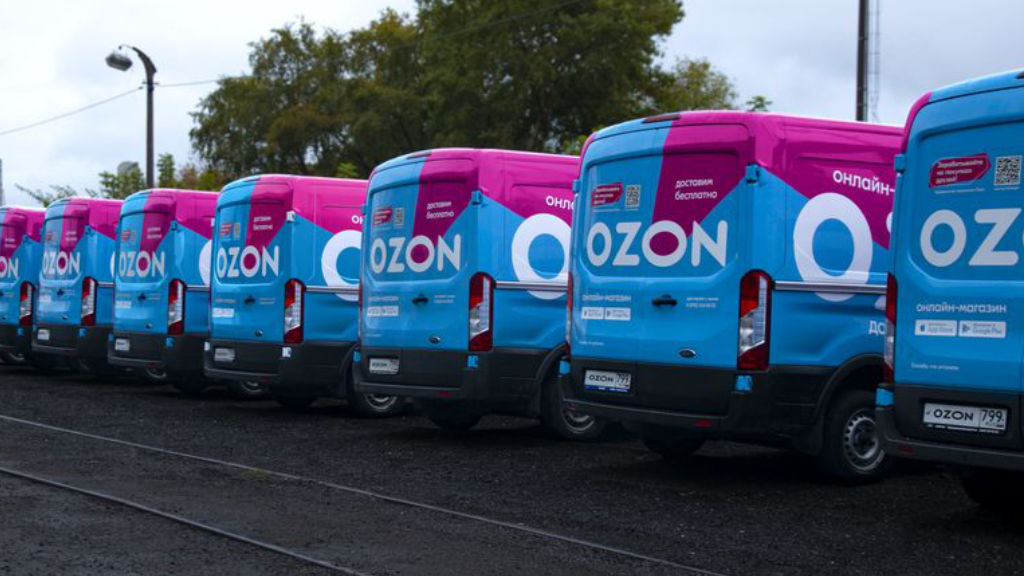
Ozon, often known as “Russia’s Amazon” calculated that in 2023 their sellers delivered five times more orders from China and Turkiye to Russia Federation than in 2022, and their turnover tripled. The company adds that in 65% of cases, goods from these countries are purchased by residents of small Russian cities, for whom price is much more important than delivery time.

At the same time, problems arise when working with counterparties from China; for example, Chinese banks currently do not accept transfers in RMB Yuan from Russian bank accounts, according to Artem Vaskanyan, the Deputy General Director of NC Logistics. This, according to him, has aroused the interest of the same sellers working on marketplaces in intermediary services when working with manufacturers from China.

In the current situation, intermediaries have to look for alternative ways to transfer money, thereby increasing the cost of goods and services.

Yulia Shlenskaya adds that delays in payment by importers lead to pauses in delivery requests. Nevertheless, China remains one of the most accessible countries for searching and purchasing goods, and the possibility of ordering from there through intermediaries further simplifies business processes, Nadezhda Vinogradova believes. Leroy Merlin, however, believes that in the next two to three years the share of the same Chinese goods in the DIY segment will “rapidly decline due to import substitution programs of retailers.” Now the share of local goods in the Russian network already exceeds 70%. 

Russia’s Pivot To Asia Interviewed By World Geostrategic Insights

Published on April 1, 2024

Russia’s Pivot To Asia has been asked for comments by World Geostrategic Insights for what it terms “Russia’s shift to the global south.” In four detailed and highly complex questions – we provide the answers about issues concerning Russia’s identity, the prospects for a “Greater Eurasia”, Russia’s relationship with China, and the impact of sanctions upon Russian businesses.

Highlights:

“Arguably the most important aspect of Russia’s Pivot to Asia has been the insistence on Russian self-reliance in its manufacturing sector. That is now a State decree.”

“Russia’s new Foreign Policy is specific, it wants to develop economic and trade ties with South Asia’s ASEAN trade bloc, Latin America’s Mercosur, the African trade blocs and members of the Belt & Road Initiative. Then there is the BRICS.”

“The relationship between China and Russia is pragmatic. Both are nuclear powers, while China has pressures that are different to Russia’s as well. Beijing needs to keep 1.4 billion people happy. Russia is a major key to that – and Beijing knows it.” 

“What is in a Volgabus? Sure, some of the parts will be Russian, and some Chinese. It’s important to refer again to Russia’s need to localise critical components. So increasingly parts in all products will be Russian. But others will be Chinese, or in future years Indian or Indonesian or Turkish, even South American, or African.” 

To read the full interview, click here

Eurasian Economic Union Wants More Cooperation With Shanghai Cooperation Organisation

Published on April 1, 2024

The Eurasian Economic Union (EAEU) considers broader cooperation with the Shanghai Cooperation Organization (SCO) as a crucial avenue of its activities, Eurasian Economic Commission Board Chairman Bakytzhan Sagintayev has said, speaking at a CIS international economic forum in Moscow.

“Broader cooperation with the SCO is a key avenue for us. The EAEU and the SCO have set up an institutional basis for interaction, signed a memorandum, and are finalizing a plan of events for 2024-2025 towards implementing the memorandum, and its regulating bodies have arranged a systemic dialogue.”

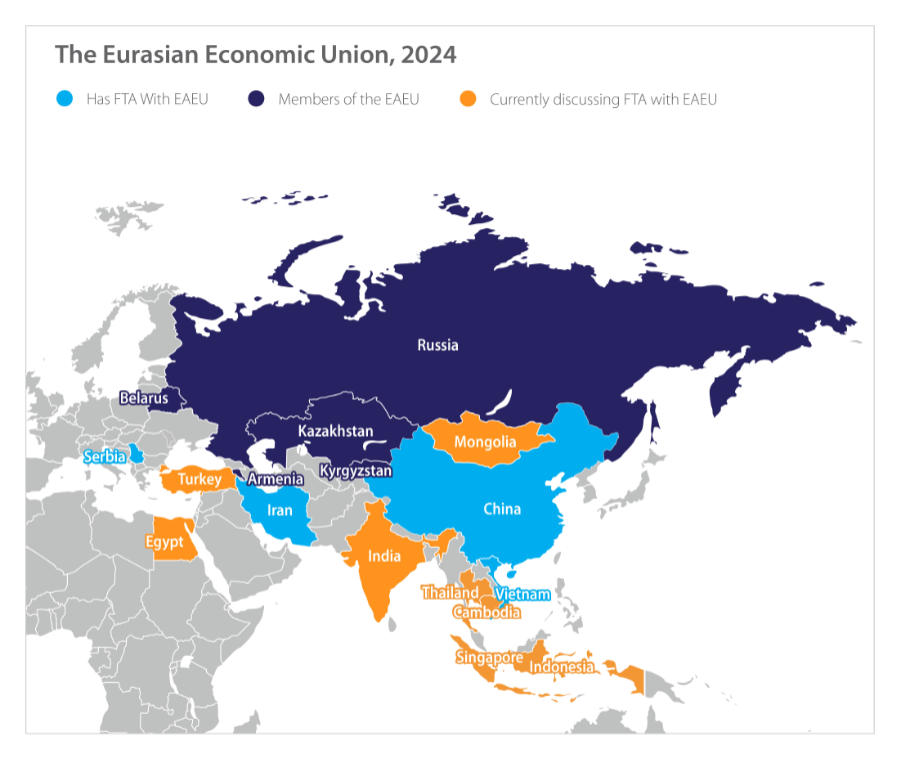
The EAEU includes Russia along with Armenia, Belarus, Kazakhstan, and Kyrgyzstan. It is a free trade bloc and fills the geographic space between Eastern Europe and Western China. It also has trade agreements with China, Iran, Serbia, and Vietnam with several others pending, including with India and several ASEAN countries.  

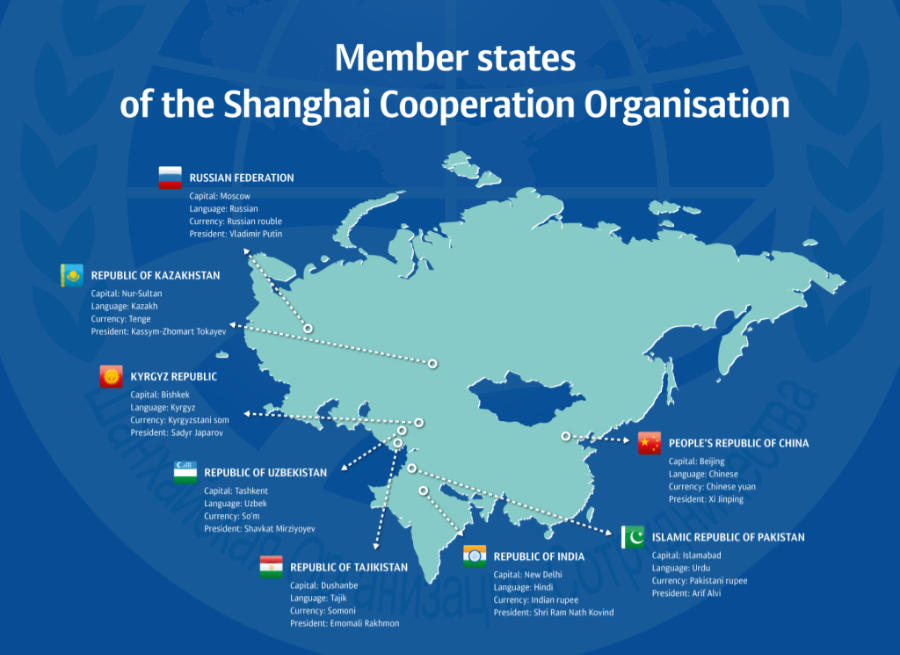
The SCO includes eight countries as full members: India, Kazakhstan, China, Kyrgyzstan, Russia, Pakistan, Tajikistan and Uzbekistan; four countries — Afghanistan, Belarus, Iran and Mongolia — with observer status with the SCO, and six countries — Azerbaijan, Armenia, Cambodia, Nepal, Turkey and Sri Lanka — with dialogue partner status. The SCO remit differs from the EAEU in that in addition to trade, its mandate also includes security and Eurasian issues such as climate change, infrastructure, scientific and cultural exchanges.

We explained both the EAEU and SCO, as well as commented on their joint relations in Chapter 12 of our “Russia’s Pivot to Asia 2024” PDF, which can be downloaded on a complimentary basis here.

The EAEU is interacting with SCO countries not so much in a dialogue format as primarily in the form of trade agreements, Sagintayev said. “For instance, the EAEU and its member states have concluded a trade and economic cooperation agreement with China. A free trade agreement has been signed with Iran.” Sagintayev said.

The EAEU is consistently building infrastructure for a dialogue with key players in the Greater Eurasian area, he added. “The development of a systemic dialogue with the SCO, ASEAN, BRICS countries, and other countries and associations concerned in the context of greater Eurasian partnership is among the priorities of the union’s international affairs as stipulated in its principal strategic high-level documents.” Discussions between the EAEU and SCO members appear in part to be leading to the eventual creation of a Free Trade bloc including members of both, although it may be some time before it manifests itself. However the countries involved are increasingly wary of a Western exclusive approach when it comes to trade relations and the threats of sanctions. An EAEU/SCO bloc would likely reject such an approach amongst its own members.

Northern Sea Route To See Record Shipping Volumes During 2024

Published on March 31, 2024

Russia’s Rosatom state nuclear energy corporation expects record volumes of traffic along the Northern Sea Route (NSR) during 2024, CEO Alexei Likhachev said during last weeks ‘Developing the Northern Sea Route: Results for 2023’, and ‘Plans up to 2035’ meetings.

Likhachev also said that the volume of transportation currently significantly exceeds the figures for the same period last year.

According to Likhachev, a year ago, when a steady cargo turnover of 33-34 million tonnes was reported on the NSR, the annual plan of 36 million tonnes “seemed like a record high,” but now this figure has been surpassed as well. He added that it was possible not only to fulfill this record plan, but also “to start rolling out the eastern route.”

Russian President Vladimir Putin had set the task of increasing cargo turnover on the Northern Sea Route to 80 million tonnes in 2024. Over the past few years, a number of government decisions have been made to boost hydrocarbon projects along the NSR, as well as to develop the infrastructure and fleet there. This includes a plan to develop the Northern Sea Route through 2035 with total funding of almost ₽1.8 trillion (US$19.5 billion). 

The NSR, which is 30% shorter than the route through the Suez Canal, could become a new international transportation alternative, and Russia is ready for an international partnership to develop the route.

The boundaries of the NSR are defined by the Code of Merchant Shipping: from the Novaya Zemlya archipelago in the west to Cape Dezhnev in Chukotka. There is extensive coverage of the Northern Sea Route development in Chapter 13 of our complimentary ‘Russia’s Pivot to Asia’ 2024 PDF. That can be downloaded for free here. 

Further Reading:

Greater Tumen Initiative Plans Regional Eco-Tourism Development

Published on March 31, 2024

The Changbai Mountains on the border of China and Korea

The four countries participating in the Greater Tumen Initiative have agreed to come up with a joint collection of promising eco-tourism routes, and there are plans to issue it in 2024, the press service for the Russian Economic Development Ministry has said. Nikita Kondratyev, director of the Department of Multilateral Economic Cooperation and Special Projects, commented that “It is planned that the collection will be issued in 2024. It will include some 50 eco-tourism routes on the territory of Russia, China, Mongolia, and Korea.”

The collection will be distributed among representatives of the tourist businesses of the participating countries and clients of tourist agencies, the ministry said.

The development of these eco routes will speed up the promotion of domestic tourism potential with an emphasis on Siberia and the Far East and will boost awareness among the tourist community of prospective and already existing eco-tourism projects in Northeast Asia.

The Greater Tumen Initiative is a mechanism of intergovernmental cooperation in Northeast Asia supported by the United Nations Development Program which comprises China, South Korea, Mongolia, and Russia.

Related Reading

The Greater Tumen Initiative Tourism Guide