News

All BRICS Nations Are Piloting Digital Currencies But USD Likely To Remain Dominant  

Published on March 25, 2024

An Atlantic Council study published on Thursday showed that 134 countries, or 98% of the global Gross Domestic Product (GDP), are currently exploring the launch of a central bank digital currency (CBDC). This number has surged from just 35 since May 2020. The development is significant as it seems to predict an almost universal move away from the US dollar.

Currently, 68 countries are in advanced stages of exploration, which includes development, pilot, and launch phases.  All five BRICS nations, Brazil, Russia, India, China, and South Africa are in advanced stages, while Australia, Japan, South Korea and Turkiye, are all at trial stage.

In contrast, advancements in a retail CBDC have halted in the United States. The Federal Reserve Chair Jerome Powell recently conveyed to the Senate Banking Committee that the Fed currently has no immediate intentions to introduce such a currency in the US. “People don’t need to worry about a central bank digital currency. Nothing like that is remotely close to happening anytime soon,” he said.

Lawmakers have expressed concerns about US citizens’ privacy, which has hindered efforts to introduce the digital dollar. Curiously the use of the US dollar as a global reserve currency has also hindered its suitability as a CBDC. It is far too complex to introduce such a currency mechanism into the global markets, a problem that also exists for the Euro. 

China’s Digital Yuan (e-CNY) stands out as the largest CBDC pilot globally. With its widespread adoption, the e-CNY has reached 260 million wallets across 25 cities in the country.

As of now, only three countries have successfully launched a CBDC: the Bahamas, Jamaica, and Nigeria. The Eastern Caribbean Currency Union, comprising 8 countries, encountered technical issues with its DCash initiative and consequently suspended its availability. The union is now in the process of developing a new pilot program.

While Brazil, Russia, India, China, and South Africa are still in the pilot phase of development, new BRICS members such as Saudi Arabia, Iran, and the UAE are also investigating cross-border wholesale CBDCs. Notably, BRICS has been actively promoting the development of an alternative payment system to the dollar since last year. There has been a notable increase in wholesale CBDC developments involving BRICS nations. Currently, 13 cross-border wholesale CBDC projects are underway, with mBridge, which links China, Thailand, the UAE, and Hong Kong, is set to enter a new phase, expanding to a further 11 additional countries during 2024.

CBDCs as an alternative to fiat currencies are a bit of a misnomer as the basic reasoning behind CBDCs is that they are 100% reflective of each of their traditional centralized fiat currencies, only expressed in digital format. There are theoretical advantages in trading through the use of CBDCs insofar as there are fewer regulatory gates established at this time. Nonetheless, all central banks in every country that eventually releases a representative CBDC cannot allow it to operate on global markets in a decentralized and uncontrolled manner, like Ethereum or Bitcoin, or their offshoot non-centralized stablecoins. The central banks still retain the right to add or discard zeroes in their currency’s value, be they CBDC or not.

This is one of the key reasons decentralized Cryptocurrencies such as those that are ETH or BTC-based have an advantage over fiat and CBDCs over the long term, and why there is so much traditional resistance to them among governments and central banks worldwide.

There are valid reasons, despite politicization, debt degradation, and devaluation of the US Dollar, that it is still the most utilized currency in the world. It possesses the historically evolved depth of its many derivatives and instruments, the sheer variety of liquid choices to pick from with the USD in global markets. Therefore, despite the hype, it will be a difficult path say for BRICS, even with each of the sovereign countries represented issuing their CBDCs to achieve significant traction.

One possible way would be to negotiate within the BRIC member nations a single, unified CBDC that is buttressed by the security assurances of the underlying countries, preferably partially backed with relevant commodities such as oil, gold, or similar, with an undertaking to allow free and unencumbered trade and remain unpoliticized. While this may sound improbable, this solution may well enable the formation of the needed alternative depth and liquidity needed to claim a share of the global currency market away from the USD.
Russian Economy At Investment Grade: Central Bank

Published on March 24, 2024

The Russian economy is in the investment phase of growth, with investment activity at a record level and imports of investment goods are growing, according to Central Bank of Russia (CBR) Governor Elvira Nabiullina. She made the comments following a meeting of the regulator’s board, at which it held the key interest rate at 16%.

Nabiullina stated that “After a slight deceleration at the end of 2023, according to our estimates, the growth of economic activity has sped up again, primarily in household consumption. Growth in retail is a sign of elevated consumer demand. Consumer sentiment is close to record highs. Households’ propensity to make large purchases has been increasing since December. We never observed such trends during the previous periods of considerable monetary policy tightening. Investment activity has hit a record high.”

“Although we have not yet received Q1 2024 data, this is evident from indirect indicators. The output of investment goods has reached historically high levels. The import of investment goods has been expanding. Finally, our regional branches report a higher percentage of companies that have increased their production targets. The economy is in the investment phase of growth, which is one of the manifestations of the structural transformation. All this supports high business activity. The Business Climate Index rose to its 12-year maximum. Such a significant increase is associated with the fact that the economy is using almost all production capacities and labour resources.”

Russia’s PMI index for February 2024 reached 54.7. To compare, the German PMI index for February was 41.6, in France 47.8, and the United Kingdom at 47.9. Figures below 50 represent a manufacturing contraction, figures above an expansion.

According to S&P Global, the reading pointed to the fastest expansion in Russia since January 2017, and was supported by faster rises in new orders, a renewed increase in employment, and a further uptick in input buying. Output expanded the most since March 2019, while employment returned to growth, with the pace of job creation solid overall. Meanwhile, backlogs of work contracted at a strong rate, with the pace of contraction being faster than the series average.

Meanwhile, vendor performance deteriorated further amid logistics issues and some material shortages. On prices, input cost inflation accelerated due to higher transportation, supplier, and raw material costs. Meantime, output cost inflation eased to an eight-month low amid efforts to spur new sales. Lastly, sentiment improved to a seven-month high amid plans to invest and hopes of further expansions in new orders.

Prospects For BRICS Under Russia’s 2024 Chairmanship

Published on March 24, 2024

The influential World Geostrategic Insights (WGI) forum has provided an interview with US-Russia expert Paul Goncharoff concerning Russia taking the Chairmanship for the BRICS group for 2024. The WGI also namechecked our own new Russia’s Pivot To Asia guide, which contains extensive chapters and details of the prospects for BRICS 2024. It can be downloaded for free.  

The BRICS now includes Brazil, Russia, India, China, and South Africa, and were joined from 1st January 2024 by Egypt, Ethiopia, Iran, Saudi Arabia and the UAE. The main point about the expansion of BRICS is the trade and development potential that it brings. With the bloc now expanded to ten members, this increases the overall geographic reach of the BRICS to 83 countries by dint of their respective additional free trade agreements with other countries. In total, these 83 nations now represent a group with an overall combined GDP (PPP) in excess of US$92 trillion.

The 2024 BRICS summit will be held in September, in Kazan. 

To summarise what we said about BRICS 2024 under Russia’s leadership, the WGI interview can be viewed here.

Gazprom Starts Connecting Strategic Asian Gas Pipelines

Published on March 24, 2024

Russian energy giant Gazprom has begun work aimed at linking the country’s gas pipelines into a nationwide gas transportation system, the company has announced on its official Telegram channel.

 According to the announcement, the company launched construction of the 800km Belogorsk-Khabarovsk section of a new pipeline in Russia’s Far East, which will eventually connect the Power of Siberia and the Sakhalin-Khabarovsk-Vladivostok gas routes. The pipeline will be integrated in what is called the Eastern Gas Supply System, to which Gazprom plans to link existing gas infrastructure in the Western part of the country.

“This will provide additional reliability and flexibility of gas supplies to domestic consumers and will open up new opportunities for the gasification of the regions of Siberia and the Far East,” the company said.

Apart from domestic supplies, the Power of Siberia pipeline provides Russian gas to China under a 30-year agreement. Linking the pipeline with the shelf off Sakhalin Island, a major source of gas, could allow Russia to further boost gas exports to China. Last November, China National Petroleum Corporation (CNPC) Vice President Xie Jun revealed that it was already working with Gazprom on the Far Eastern route project, which involves constructing a cross-border section across the Ussuri River between the Sakhalin-Khabarovsk-Vladivostok pipeline and the Chinese city of Hulin. Gazprom has also been planning to supply gas to China via the new Power of Siberia 2 pipeline through Mongolia. That conduit is planned to allow for the delivery to China of up to 50 billion cubic meters of gas annually, sourcing natural gas from Russia’s Yamal Peninsula. That resource previously served the EU market. Beijing and Moscow are currently evaluating economic studies on the project with a decision expected later this year.

Russian Tourist Visits To Egypt Hit Record High In 2023

Published on March 23, 2024

With the European Union fully suspending the visa-facilitation agreement between the European Union and Russia as part of sanctions in 2022, and European airlines no longer providing direct flights, alternative destinations for Russian nationals replacing European destinations are now in vogue. That trend can be seen in the tourist traffic from Russia to Egypt, which surged to over 35% to 1.28 million trips in 2023, according to Amr El Kady, the CEO of the Egyptian Tourism Authority. He was speaking at the MITT international tourism exhibition in Moscow.

El Kady stated that more than 1.28 million tourists from Russia visited Egypt in 2023, 35.4% more than in 2022, making Russians the second most frequent visitors to the country after the Germans. Egypt’s top five tourist sources included visitors from Saudi Arabia, Italy, and the United Kingdom.

Egypt saw a record number of tourists in 2023. The country had 14.9 million visitors in 2023, well above the figure of 4.9 million in 2021 and more than the previous record of 14.7 million seen in 2010. El Kady stated that this trend is expected to continue in 2024, given that the number of tourists that visited Egypt in the first 50 days of the year was up 8% from a year earlier. This upward trend will include still more Russian visitors as they bypass Europe and take advantage of a 2024 expansion in Russia-Egypt flights by Egypt Air, Aeroflot, Rossiya Airlines and others.

Russian tourist arrivals to the EU dropped by 90% between 2021 and 2022, with Russian visitors to Paris, a previously popular destination, decreasing by 95.8% according to France 24.

Russian tourists travelling overseas in 2023 (not including travel to ex-Soviet countries) reached 14 million, an increase of 27.6% over 2022, meaning this is a growth market.

Russian tourists replaced European destinations with the following, in order of popularity, according to Russian FSB immigration data: 

CountryRussian Tourists (millions)Percentage Increase 
Turkiye6.3+20.7%
UAE1.7+42.5%
Thailand1.48+240.6%
Egypt1.28+35.4%
China0.966+ 420%
Maldives0.209+3.6%
Sri Lanka0.197+116.4%
Cuba0.185+240%
Indonesia (Bali)0.160+115%

Of these countries, all are in the process of further deepening trade and investment ties with Russia. Egypt and the UAE are now members of the BRICS group, with China a founding member. Turkiye, Indonesia, and Thailand are expected to join shortly, while Turkiye, Thailand, Egypt, Indonesia and Cuba are also negotiating free trade agreements with the EAEU.

According to Future Market Insights, the Russian outbound tourism market reached US$27.1 billion in value in 2022. Sales in the market are expected to grow at a robust 9.4% per annum from now to 2032.

FRIDAY BIZARRE

Published on March 22, 2024

Our Look Back At Some Of The Weeks Most Bizarre Russo Political Moments

Democracy Rules, OK!  

With the Russian elections over, the London-based real estate agency, in the (democratic) United Kingdom have fired a Russian employee for voting. The London real estate brokerage Egre announced her sacking after complaints from a Ukrainian activist, who argued that she should be punished for voting for Russian President Vladimir Putin. Yulia Vorobyova was dismissed from her job after casting her vote at the Russian Embassy.

We Want Chocolate Gelato!

The 68- year-old Italian pop singer Pupo has been banned from holding a planned concert of his music in Lithuania and declared an ‘undesirable person’ after he performed at a concert in Moscow.  Pupo – real name Enzo Ghinazzi – has been performing in the country and the Soviet Union for 40 years. His best-known hit in Russia is the politically undesirable and socially subversive “Gelato Al Cioccolato” (Chocolate Gelato) which can be seen here. That idiocy aside, Vilnius’s decision has implications for the future freedom of travel for EU nationals within the EU itself. 

Free Money! Free Money! Free Money!    

German Chancellor Olaf Scholz declared that dividends earned from Russia’s frozen dividends in Europe “Don’t belong to anyone”. That is totally the opposite to what the Deutsche Bundesbank seems to think, who pay interest at rates at 8% to their customers with money on deposit with them.    

More Free Money!

Ukrainian President Zelensky commented on Donald Trump’s statement about providing loans to Ukraine as all being in the small print. “We’ll see if there are any clauses about us not having to repay these loans. If there are, that’s acceptable.” Maybe Zelensky should open an account with the National Bank of Ukraine, and read their small print – they charge interest rates of 15%. The thought occurs to us that it’d be a bit of a money earner to borrow from the US then dump it into a savings account in Kiev and live off the difference.

Absolutely Fabulous Dahling!  

Ukraine’s former infrastructure minister, Vladimir Omelyan, has suggested that Ukraine can repay its debts to the West if it wins the “war with Russia” by taking over Russia’s resources and repaying its debt by sending Russian natural resources for its support. “If we win, you will be paid back in Russian oil, gas, diamonds and furs” he told Politico. It is uncertain how the European non-profit PETA (People for the Ethical Treatment of Animals) have viewed this proposal.

Diplomacy: The Art of Telling People To Go To Hell So They Enjoy The Journey 

Aleksey Danilov, the secretary of Ukraine’s National Security and Defence Council, referenced Li Hui, the Chinese Special Representative for Eurasian Affairs after the diplomat visited Kiev to discuss a proposed Peace Conference to be held in Switzerland.  Li had previously served as the Chinese Ambassador to Russia and Kazakhstan, and as Chinese Vice Minister of Foreign Affairs. Danilov called him a “prick” on national TV on Wednesday.

Ee-Aye-Adio We’re Going To Win The League!

The “Football Federation of Russia” – a European title officially bestowed upon a national team who everyone else refers to as “Russia” and whose name exemplifies European bureaucracy at its best (using twenty-six letters when just six would suffice) beat Serbia 4-0 this week. Sendings off, penalties, disallowed goals, a sell-out crowd – its just the sort of thing UEFA TV ratings want to see on the pitch. But you can’t. Except for here.    

USA! USA! USA!   

The “Russian Olympic Committee” – another unwieldy name imposed upon what everyone else refers to as “Russia” (23 letters instead of 6) has had its ‘quota’ of athletes allowed to participate at this years summer Olympics in Paris set at just 55. The United States has been allowed to send 500. Even the Russian Olympic Committee (Russian) members that can participate will only be referred to as “Individual Neutral Athletes” which will be an amazing crowd pleasing chant around the Stade de France at the 100 meters sprint finals. Russians are also forbidden to participate in team events and can only participate in individual competitions.

Meanwhile, the current Olympic Gold Champion Men’s Wrestler Musa Evloev, has been banned from defending his title and attending the Paris games by the IOC after he was photographed standing next to a “No to Nazism” poster. You couldn’t make this up.

Food For Thought

A couple of recommendations from RPA readers to share:

Keep Safe.
And have a great weekend!
Russia’s Pivot To Asia

Russia Targets 160 New Arctic Class Ships For Northern Sea Route By 2030

Published on March 22, 2024

Rosatom, Russia’s nuclear powered icebreaker manufacturer, sees a need for 160 high-ice-class vessels to operate on the Northern Sea Route (NSR) by 2030 to export products from Arctic projects, according to a presentation by Vyacheslav Ruksha, Deputy General Director of Rosatom and Director of the NSR Directorate. Russia is the only country with a fleet of nuclear-powered icebreakers.

Ruksha made the comments during an expert council session on the Northern Sea Route in the State Duma. According to the presentation, for cargo transportation along the NSR, the estimated need for the additional fleet for coastal navigation is estimated at 50 vessels of the Arc 4-7 ice classes. These ships are equipped with cargo cranes for cargo operations on non-equipped shorelines.

Another 10 universal vessels (up to 25,000 tonnes) of Arc 5 ice class are needed for “northern supply”. These ships can provide year-round operations in ice to 120 cm (1.2 meters) thick.

The bulk carrier segment will require 3 medium-tonnage vessels (up to 40,000 tonnes) of Arc 4 class and 25 large-tonnage bulk carriers (up to 100,000 tonnes) of Arc 5 class.  Arc-4 and Arc-5 class vessels can handle ice in excess of 120cm thick, including older pack ice. 

The demand for Arc 7 class container ships by 2030 is estimated at 15 vessels, including 9 vessels with container capacity of up to 5,000 TEU and 6 vessels of medium tonnage (up to 700 TEU). These vessels are for summer use and capable of handling ice to 100cm thick.

The tanker fleet for LNG and gas condensate transportation along the NSR in 2023 consisted of 17 vessels, and by 2030 the fleet demand in this segment is estimated at 39 vessels.

In addition, 11 oil tankers of large tonnage (up to 120,000 tonnes) must be built. As at 2023, the NSR’s oil transportation fleet consists of 7 medium-tonnage oil tankers up to 40,000 tonnes. Currently, 30 vessels are operating on the NSR, 33 vessels are under construction, and 97 vessels must be built by 2030. The majority of these constructions will be handled by Russian shipyards.

Houthi Red Sea Attacks: “We Will Not Target Russian or Chinese Shipping”

Published on March 22, 2024

The Norwegian tanker Front Altair after a Houthi Red Sea attack  

The Yemen-based Houthi militants have told Russia and China that their ships can sail freely through the Red Sea and Gulf of Aden without fear of being attacked. An understanding was reached during talks in Oman involving Russian and Chinese diplomats and senior Houthi political figures.

The Houthi rebels have carried out dozens of drone and missile attacks on commercial vessels traversing the Red Sea, disrupting shipping traffic through one of the world’s most important maritime corridors. As a result, many major shipping companies have stopped using the Suez Canal and are instead redirecting ships around the Cape of Good Hope in Southern Africa.

The Houthis have been attacking ships they believe to be linked to Israel in what they claim is a show of “solidarity” with the Palestinian people in light of the war in Gaza. After the US and the UK conducted air strikes on Houthi facilities in Yemen, the group said it would now also attack ships affiliated with both nations. In exchange for promising safe passage for Russian and Chinese ships, the Houthis want the two countries to provide political support for the rebel group in international bodies such as the UN Security Council.

A senior Houthi political leader, Ali Alqhoom, declared recently on X that the group’s goal is “Sinking America, Britain and the West in the swamp of the Red Sea.” Last week, the Houthis’ leader, Abdul Malik Al-Houthi, vowed to expand the campaign to the Indian Ocean and hit vessels traveling around South Africa. British and American owned ships have already been sunk by the Houthi’s in the Red Sea, while European owned vessels have also been attacked. The issue is also affecting container throughput into Israel – its Eilat Port is having to lay off 50% of its employees as shipping dries up.  Attacks on vessels in the Red Sea region have resulted in decreased traffic transiting the Suez Canal, a vital route between Asia and Europe that ordinarily handles about 15% of global maritime trade. Instead, Western owned shipping must travel around the African Cape, adding 4,000km and a further 15 days to the journey and significant adding to consumer prices in Europe. The deal with the Houthi’s will have the effect of making Chinese and Russian goods more competitive in both delivery times and costs.

Russia Has Doubled Its Oil Exports to Africa in 18 Months

Published on March 21, 2024

Moscow has increased exports of petroleum products to African countries in recent years, despite Western sanctions, Russian Foreign Minister Sergei Lavrov has said. He made the statement in an interview for a documentary project on oil that was published on the Foreign Ministry’s website on March 21.

He said that “We have doubled the export of petroleum products (to Africa) over the past year and a half.” And said that there is “no fear” about upsetting Tehran, which also exports oil to the region and is a close partner with Moscow. Tehran produced 2.99 million barrels of oil per day in 2023, 440,000 more than in the previous year, according to the International Energy Agency (EIA). Lavrov stated that Moscow is not in competition with other top oil-producing and exporting nations.

“Within the framework of OPEC+, of which both Iran and Russia are members, there is a clear understanding of how to negotiate and seek compromises. This scheme has been working for many years. No one is at a loss, no one is offended.” Lavrov said.

Russia sharply increased its energy exports to Asia and Africa last year after the EU, which had accounted for more than 60% of Moscow’s energy exports, stopped accepting the country’s oil transported by sea. China and India have emerged as major buyers of Russian crude after Moscow redirected its cargoes from Europe to the east in response to Western sanctions.

In July 2023, Russian Energy Minister Nikolai Shulginov estimated that Moscow would supply approximately 20 million tons of oil and petroleum products to African countries by the end of 2023.

Earlier this year, Reuters reported that Ghana, Libya, Tunisia, and Togo all posted more than 100% annual growth in Russian oil imports in 2023. Morocco, Senegal, and Nigeria – with the latter being one of Africa’s top oil producers and exporters – all saw significant increases in Russian oil imports last year, according to Kpler data.

Russia, EAEU Discuss Priority Trade Developments

Published on March 21, 2024

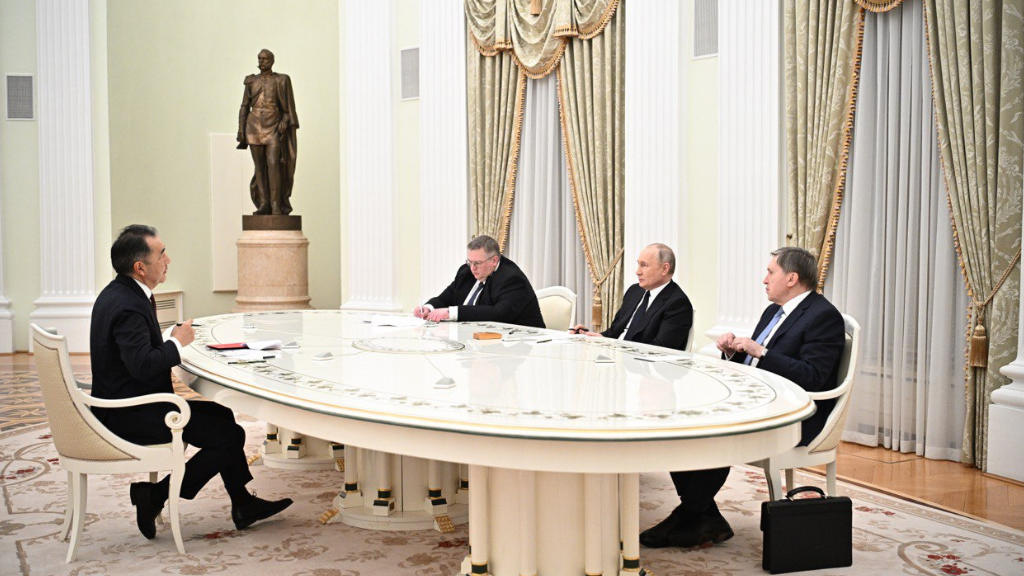
Bakytzhan Sagintayev, the Chairman of the Board of the Eurasian Economic Commission (EEC) and President of Russia Vladimir Putin met during negotiations on March 19 in Moscow. The EEC is the regulatory body for the Eurasian Economic Union (EAEU) which includes Russia along with Armenia, Belarus, Kazakhstan, and Kyrgyzstan. It fits the geographic space between Eastern Europe and Western China and is a vital conduit for Europe-Asian trade. Sagintayev and Putin discussed a number of issues on the Eurasian integration agenda.

Sagintayev reported on the key achievements of the EAEU over the past ten years. It was noted that mutual trade between the member states almost doubled, and foreign trade increased by 60%. The Eurasian Economic Union’s GDP increased by 3.8% over the past year alone, reaching US$2.4 trillion. Most macroeconomic indicators show growth.

The parties discussed the main tasks of the Commission’s future activities. One of the priorities will be the implementation of a new strategic document for the medium-term (until 2030) and long-term (until 2045) development of the Eurasian Economic Union – “The Eurasian Economic Path Declaration.” Sagintayev announced the start of negotiations with the EAEU states to discuss plans for the implementation of strategic initiatives.

Among the important prospects for the development of the EAEU and the work of the Commission is the digitalisation of the economy. The parties are unanimous that digital technologies and the implementation of relevant reforms will help to qualitatively change the economic situation. Other key areas include the development of cooperation ties and the formation of regional value chains, improvement of transport infrastructure and logistics, and the creation of a unified effective risk management system in terms of customs control.

During the meeting, a detailed exchange of views also took place on the issue of developing cooperation between the Eurasian “five” and third countries and strengthening the position of the EAEU in the international arena. The EAEU already has Free Trade Agreements with Iran, Serbia, and Vietnam and a flexible deal with China. Others are pending, including with India and the ASEAN nations.

The EAEU priority is the development of interaction with leading regional associations the SCO, ASEAN, the African Union, BRICS, the Pacific Alliance, the Andean Community, relevant UN structures and the Organisation itself, as well as with countries such as China, Iran, Vietnam, Serbia, Indonesia, Saudi Arabia, Egypt, and the UAE amongst others.

In 2024, the Eurasian Economic Union celebrates its tenth anniversary. A tenth anniversary EAEU summit will be held on May 8 in Moscow. Who attends from non-members and existing trade partners will provide clues as to additional potential future Free Trade Agreements with the EAEU nations. 

Russian Crude Oil Exports To Asia Increase  

Published on March 21, 2024

Data from the International Energy Agency (IEA) reveals that the European Union’s embargo on the purchase, import and transfer of Russian crude oil at the end of 2022 has had almost no impact on the total volume of Russian oil exports. As the following chart shows, this is due to other countries filling in the vacuum, largely driven by China and India, which increased their imports by 21% and 111% respectively. Turkiye, as well as a number of countries in both Africa and the Middle East, also imported more Russian oil.

During 2023, most EU member states imposed sanctions on Russia’s energy sector, including an embargo on oil. However, a number of EU states that are particularly dependent on Russia’s supplies were exempt from the ban, explaining why Russian oil was still being exported to the EU in 2023.