Russia and Ecuador have been at some loggerheads concerning Russian imports of Ecuadorean bananas, with complaints concerning quality issues ongoing between the two countries. Ecuador is Russia’s largest supplier of the fruit, with exports to Russia reaching about 1.4 million tonnes worth over US$1 billion annually.
To help resolve the situation, Ecuador is now prepared to accept Russian specialists for inspecting banana cultivation enterprises, according to Ecuadorian Agriculture and Livestock Minister Franklin Danilo Palacios Marquez.
Russia’s Federal Service for Veterinary and Phytosanitary Surveillance (Rosselkhoznadzor) has since stated that “Senor Palacios expressed readiness to receive Russian specialists for inspecting Ecuadorian banana cultivation enterprises and fish production facilities.” Palacios serves as a co-chair of the Russian-Ecuadorian intergovernmental commission on trade and economic cooperation, along with Sergei Dankvert, the head of Rosselkhoznadzor, who also stated that “We have agreed to hold technical negotiations regarding inspections. The Ecuadorian side gave assurances that they would shortly provide lists of companies interested in supplying their products to Russia.”
Rosselkhoznadzor specialists first raised concerns about Ecuadorian bananas in late April this year, after the discovery of a dangerous plant pest, the polyphagous humpback fly, in imported bananas from Ecuador, and remained dissatisfied with the results of inspections of banana suppliers, stating at the time that “the Ecuadorian side needs to systematize the number of exporters and provide us with a list.”
Ecuador ranked second in trade turnover with Russia among Latin American countries last year. Key Russian exports included fertilizers and oil and petroleum products, while imports consisted of Ecuadorian agricultural products, including bananas, flowers, and shrimp. Imports of Ecuadorian cocoa beans to Russia also increased 40-fold to 4,700 tonnes last year.
The next meeting of the Russian-Ecuadorian intergovernmental commission will be held on October 7-8, 2025, in Moscow.
The Ukrainian President, Volodymyr Zelensky, has insisted that several regions of Ukraine are not to be negotiated over, and remain Ukrainian under Ukraine’s constitution. We examine these areas and provide a practical status overview of each of them.
Donetsk People’s Republic
The Donetsk People’s Republic, (DPR), also referred to as Donechchyna, covers some 26,517 km2 and has a population of about 4 million. From its creation in 1938 until November 1961, it bore the name Stalino Oblast, in honour of Joseph Stalin. The capital city is also named Donetsk. About 70% of what was the Ukrainian Donetsk Oblast is currently under Russian military control. The region provided about 10% of Ukraine’s GDP in 2013.
The DPR proclaimed independence from Ukraine in 2014, following a disputed referendum, while Russia annexed it to become part of the Russian Federation in 2022.
Donetsk has a well-developed coal, finished steel, coke, cast iron and steel production industry, with ferrous metallurgy, and the fuel and power sectors also dominating economy. It also produces a significant amount of agricultural produce, dominated by sugar beet, potato and sunflower production. The area is also rich in fertile black earth.
It also has a developed transport infrastructure, including the Donetsk railway, Mariupol Port, Donetsk airport, and passenger airports in Mariupol. Reserves include 25 billion tons of coal, rock salt, lime carbonate, potassium, mercury, asbestos, and graphite.
Much of the DPR infrastructure – apart from the frontlines – has been connected to Russia, including telecommunications, internet, finance, banking and energy supplies. Pensions and related expenses have been provided by the Russian state since 2014 after Kiev ceased making these payments, while the Russian ruble has replaced the Ukrainian hryvnia as the official currency. The current Head of DPR is Denis Pushilin, who heads the Donetsk parliament and the People’s Council as a Federal State of Russia.
Kherson Oblast
Kherson is located north of Crimea and is divided by the Dnipro River, however numerous bridges across the Dnipro has been destroyed, separating the two sides. Russian forces currently occupy the eastern bank, including the capital city, also known as Kherson, and occupy about 75% of what was the Ukrainian oblast, or about 21,345 km2 of territory. As at 2018, it provided about 1.6% of Ukraine’s total GDP.
Kherson Oblast was annexed by Russia in 2022. It has an estimated population of about 1 million, although some have relocated to Russia.
Kherson is well known for its agricultural industry and especially its summer fruits, with these now exported to Russia. It also has an important shipbuilding industry, known for producing dredgers. Like Donetsk, much of the region’s infrastructure has now been connected to Russia, including telecommunications, internet, finance, banking and other social supply needs. The Russian ruble has replaced the Ukrainian hryvnia as the regional currency apart from the 25% still held by Ukrainian forces. Kherson citizens on the Russian side have been issued with Russian passports and are financially supported by Moscow in terms of pensions and other socially-related payments.
Kherson has a Russian government structure in place, with Vladimir Saldo the Governor and Andrey Alekseyenko the Prime Minister.
Luhansk People’s Republic
The Luhansk People’s Republic (LPR) covers some 26,700 km2 and has a population of slightly more than 2 million. The capital city is also named Luhansk. Just 1% of what was the Ukrainian Luhansk Oblast currently remains under Ukrainian control. It had provided just 1.4% of Ukraine’s total GDP in 2013, being the lowest regional performer in Ukraine at that time.
The LPR proclaimed independence from Ukraine in 2014, following a disputed referendum, while Russia annexed it to become part of the Russian Federation in 2022.
It is the easternmost part of what was the Ukrainian Luhansk Oblast, with this being established in 1938, as Voroshilovgrad Oblast until 1991, taking the Luhansk name thereafter.
Luhansk is a major coal-producing region, which forms the basis for much of its economy. It possesses large reserves of anthracite, the highest and cleanest grade. Other industries in the Luhansk region include blast-furnace and steel-making equipment, railway freight-cars, metal-cutting machine-tools, tunnelling machines, agricultural harvesters and ploughing systems, railway tracks, mining cars, electric locomotives, military vehicles, tractors and excavators. Luhansk also produces consumer goods such as washing-machines, refrigerators, freezers, TV sets, leather footwear, and toilet soap.
All of Luhansk’s infrastructure has been connected to Russia, including telecommunications, internet, finance, banking and other social supply needs. The Russian ruble has replaced the Ukrainian hryvnia as the regional currency, while Luhansk citizens have been issued with Russian passports and are financially supported by Moscow in terms of pensions and other socially-related payments. Ukraine ceased making these contributions in 2014.
The Luhansk People’s Republic head is Leonid Pasechnik, while Sergey Kozlov is the Prime Minister.
Zaporizhzhia Oblast
Zaporizhzhia Oblast is in south-west Russia; and covers an area of 27,183 km2 with a population of about 1.6 million. About 75% of what was the Ukrainian Zaporizhzhia Oblast is now under Russian control. The historic capital is the city of Zaporizhzhia, which is still under Ukrainian control, with Russia managing its territorial gains in the Oblast from the city of Melitopol. The region is an important economic contributor in industry and agriculture, contributing about 4.4% of the total Ukrainian GDP up to 2016.
Zaporizhzhia Oblast was annexed by Russia in 2022. It is the site of the Zaporizhzhia Nuclear Power Plant, the largest in Europe, which Russia has subsequently taken offline while the conflict persists and to avoid any disasters.
Most of Zaporizhzhia’s infrastructure has been connected to Russia, including telecommunications, internet, finance, banking and other social supply needs. The Russian ruble has replaced the Ukrainian hryvnia as the regional currency, while citizens in the Russian-controlled areas have been issued with Russian passports and are financially supported by Moscow in terms of pensions and other socially-related payments. Ukraine ceased making these contributions in 2014.
The Zaporizhzhia Oblast Governor is Yevgeny Balitsky. He was previously a was a People’s Deputy of Ukraine; and has been described as ‘treasonous’ by Kiev.
Other Ukrainian Regions
Kharkiv Oblast
Russian controls an estimated 20% of Kharkiv Oblast, a region with an overall total of 31,400 km2 and population of about 2.5 million.
Sumy Oblast
5% of Sumy Oblast is currently under Russian control, a region of 23,834 km2 and a total population of about 1 million.
Mykolaiv Oblast
Russia currently controls an estimated 4% of Mykolaiv Oblast, which has a total area of 24,598 km2 and a population of about 1 million.
Dnipropetrovsk Oblast
About 2% of the Oblast is also under Russian control. The Oblast has an area of 31,974 km2 and a total population of about 3 million. It is Ukraine’s most economically productive region.
Russian control over parts of these additional four Oblasts collectively amounts to about 5,314 km2 of territory and an estimated 1.2 million inhabitants. Apart from gains in Kharkiv, it is these areas that may make up part of the territory that US President Trump has suggested be ‘swapped’ and conceded by Russia as Ukrainian, along with possibly the west bank of the Dnipro River in Kherson and parts of Zaporizhzhia. However, at the present time, Russia continues to gain territory in the regions mentioned, suggesting that unless significant western financial and financial support are provided, in the absence of any peace agreement, more of Ukraine’s land mass will come under Russian control.
Constitutional & Economic Issues
Kiev currently claims that these regions cannot be considered as anything other than part of Ukraine as they are identified as such in the Ukrainian constitution. However, the Donetsk and Luhansk regions (collectively known as the Donbass) declared independence in Kiev local referendums in 2014 and ceased being administered or financially supported by Kiev from that time.
While Kiev claims the referendums were illegal, discontinuing its fiscal support to them suggests a considered decision to effectively withdraw. This renders current Ukrainian claims as somewhat unrealistic. They were subsequently both annexed by Russia in 2022 along with the Kherson and Zaporizhzhia Oblasts, with Russia also now claiming them as part of the Russian constitution. These four main regions have also now become extensively, if not totally integrated into the Russian Federation, with crucially, economic and financial support to their citizens being provided by Moscow, not Kiev.
How the new shape of Ukraine will evolve remains as yet uncertain, however a fundamental decision-based line would appear to involve which country is providing regional financial support to the impacted incumbent regional citizens – and which is not.
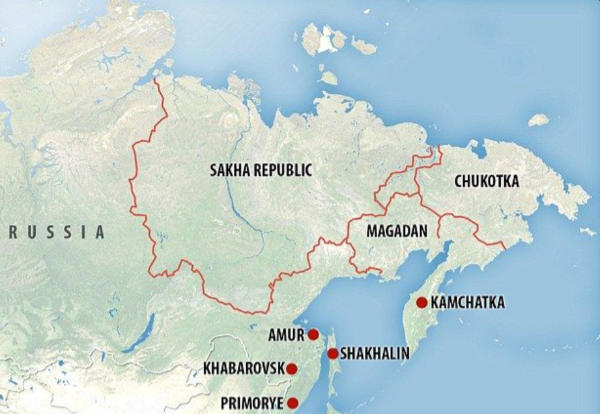
The Russian President, Vladimir Putin, used his trip to Alaska to meet US President Trump to additionally visit the Russian Far East regions of Magadan and Chukotka. (We commented on the Putin/Trump summit exclusively on our X account here). These regions are the farthest east of the entire Russian landmass, while overall the Russian Far East economy has been booming and is now responsible for attracting about 30% of Russia’s total inbound foreign investment, mainly on infrastructure investment capital from China.
Magadan
Putin stopped off at Magadan on his way to Alaska, being the capital city of the Magadan Oblast in the Far East. The city has a population of about 100,000, while Magadan port is the second largest seaport in the Russian Northeast.
Putin met with regional Governor Sergei Nosov and visited a fish oil processing plant, a sports complex and a cultural centre, and also laid flowers at a memorial to the World War II-era Alaska-Siberia air route, a symbol of Soviet-American wartime cooperation. The local economy is based on some gold mining and fisheries, with the fish oil plant being operated by Omega-Sea – a unique fish oil processing and refining plant that produces encapsulated high-concentration Omega-3 products. This is Russia’s first facility manufacturing re-esterified triglyceride (rTG), utilising premium sardines and herring sourced from the Sea of Okhotsk.
There is currently no operating railway in Magadan. However, Russian Railways are considering the possibility of building a railway from the Nizhny Bestyakh of the Amur-Yakutsk railway to Magadan by 2035, which will contribute to the development of an area with huge mineral deposits. Magadan is also the home of the Magadan/Sokol Flight Information Region (FIR) and Magadan Oceanic FIR, which controls the northeastern part of Russia and its Arctic airspace. Westbound transpacific flights from North America to Asia use these FIRs.
Chukotka
Following his visit to the United States, Vladimir Putin arrived in Anadyr, the capital of Chukotka Oblast, where he held a working meeting with the region’s Governor, Vladislav Kuznetsov. Chukotka is the easternmost federal subject of Russia and has a maritime border on the Bering Strait with Alaska to the east. Anadyr is the largest town and the capital and the easternmost settlement to have town status in Russia. It is the closest point from Russia to the United States, just 88.5 kilometres distant, and is the only part of Russia in the Western Hemisphere. The population is about 55,000.
Chukotka has large reserves of oil, natural gas, coal, gold, and tungsten, which are slowly being mined, but much of the rural population survives on subsistence reindeer herding, whale hunting, and fishing. The urban population is employed in mining, administration, construction, cultural work, education, medicine, and other occupations.
Kuznetsov reported that Chukotka’s economic performance has been robust. In the Russian Far East, it ranks second in terms of industrial output and fourth in terms of fixed capital investment, with the number of new SMEs growing. In agriculture, hothouses have been modernised, which will make it possible to produce 30% more vegetables compared to 2023. Having built three new poultry farms, the region now completely meets its demand in eggs.
Extraction of mineral resources has been increasing, making Chukotka the fourth largest mineral-producing region in the Far Eastern Federal District, while social indicators are among the best in Russia. Chukotka ranks sixth in the annual ranking of Russian regions in terms of investment appeal. Chukotka has three preferential special economic zones.
Mineral production is growing, making Chukotka the fourth largest in the Far Eastern Federal District, and its social indicators are among the best in Russia. Chukotka ranks sixth in the annual rating of Russian regions in terms of investment attractiveness. This is a unique region, as only here there are three preferential regimes at once: the Chukotka Advanced Development Territory (ADT), the Free Port of Vladivostok (FPV) and the Arctic Zone of the Russian Federation (AZRF). Depending on the type of activity and the favorable conditions offered by the state, an investor can choose the most suitable option for him/her.
The Chukotka Autonomous District is home to one of the world’s richest mining provinces, the Baim copper porphyry area, which includes 13 deposits with a resource potential of 23 million tons of copper, as well as gold, molybdenum and silver resources. In 2018, at the Eastern Economic Forum, Vladimir Putin gave the go-ahead for the development of the Baim ore zone. The Baimsky mining and processing plant (MPP) is Russia’s first copper ore mining facility that will utilize drone technology and the Internet of Things. Rosatom is building four modernized floating power units (FPU) to supply power to the Baimsky mining combine. The first two are planned to be connected to the grid by 2028, another one to be put into operation by 2029, and a fourth, standby replacement power unit to be connected to the grid by 2031. Providing energy to one of the world’s largest deposits will increase copper production in Russia by 25%. In addition, a major project to develop the Pyrkakai Stockworks deposit – the Pyrkakai Mining and Metallurgical Combine – will make Russia an exporter of tin. Construction of the combine is scheduled to begin in 2025, and its launch with a design capacity of 6,000 tons of tin per year is scheduled for 2030.
Kuznetsov also reported that master plans have been developed for the main towns of Chukotka’s Anadyr region, with Egvekinot, Pevek and Bilibino, are home to 82% of the population. There are plans to build numerous social infrastructure facilities, including a sports centre, swimming pool, creative industries centre, local theatre and opera house, as well as medical and water-treatment facilities.
Kuznetsov also recalled the presidential decision to order hovercraft for Chukotka to improve transport, stating that these are already operational. Work is also underway to expand accessibility in logistics since the region lacks permanent automobile roads and has no railways. The main transport is aviation. Four new helicopters have been added in the past two years, with two more to arrive in September.
The Governor also reported on the way the region has been working on communications issues. It is working together with the Ministry of Digital Development to create a cable internet network. A fibre-optic communications line in the Anadyr agglomeration has been laid under the sea with plans to connect it to Yakutia.
The heads of government of Eurasian Economic Union (EAEU) countries have approved a program for developing trading on a Common Commodity Exchange, according to the Eurasian Economic Commission (EEC). The EAEU includes Russia along with Armenia, Belarus, Kazakhstan, and Kyrgyzstan. It has numerous free trade agreements with other countries, including Iran and Vietnam.
The EEC stated that “The agreement consists of four sections and includes general provisions, a system of measures, implementation mechanisms, and resource provision. The program envisions three stages—developing documents for forming the common exchange market, implementing pilot projects and conducting simulated trading, and launching full-scale operation of the exchange market by 2029.”
The program includes 14 measures, including developing and adopting an international treaty on forming the common commodity exchange market, agreements between trading organizers and infrastructure organizations, acts of EAEU governing bodies, and protocols between trading organizers.
Common commodities generally refer to either ‘hard’ commodities, which are mined or extracted from the earth, or ‘soft commodities,’ which are agricultural products such as corn and livestock. They typically include:
Energy: crude oil, natural gas, and heating oil
Precious metals: gold, silver, and platinum
Base metals: copper, aluminum, and zinc
Agricultural commodities: corn, soybeans, and wheat
Livestock: cattle, hogs, and poultry
Such an exchange would probably be based in Kazakhstan and would boost intra-EAEU trade while also allowing some measures of financial protection for EAEU farmers and agricultural producers, as futures contracts can help protect well-being in the event of harvest problems while also regulating produce quality. There have also been discussions about potentially developing a similar BRICS Commodity Exchange.
Russia is carrying out survey work for the construction of the Rasht-Astara railway on land plots already purchased by the Iranian government, Deputy Prime Minister Alexei Overchuk has stated.
The purchase of the remaining land was the subject of negotiations during the meeting between Russian Prime Minister Mikhail Mishustin and Iranian First Vice President Mohammad Reza Aref in Cholpon-Ata, Kyrgyzstan.
Overchuk said, “We discussed the details of the railway’s construction on the Rasht-Astara section and how the land acquisition is progressing there.” We have already started work there, with technical surveys underway on the land plots purchased by the Iranian government.”
The 164 km Rasht-Astara railway is a vital part of the International North-South Transport Corridor (INSTC), and delays in its completion are hindering the smooth transit of goods from Russia via Iran to the Middle East and South Asia.
A new Russian presidential decree, signed by Vladimir Putin, providing investment guarantees for new investments by non-residents has generated substantial interest, including from investors in unfriendly countries, according to Russian Deputy Finance Minister Alexei Moiseyev.
On July 1, President Vladimir Putin signed decree no. 436 on “Additional Guarantees for Foreign Investors’ Rights”. It stipulates the conditions under which foreign investors may invest in Russia without having to allow for Russian counter-sanctions decrees that placed restrictions for companies from unfriendly countries. It also allows them to purchase Russian securities without prior approval of regulators.
It specifies that when making investments, foreign investors will transfer funds (in rubles or foreign currency) to “Type In” accounts. The decree is designed to encourage foreign investment by reducing the barriers and complexities associated with counter-sanctions.
These investors will have access to deposits in Russian banks, securities trading, primary IPOs, and derivative market instruments.
Moiseyev commented, “I view all this with enthusiasm. There’s already significant interest—people are calling and asking how it works. Several well-known individuals from major investment companies and funds have called to inquire. I’ve also heard that they are already setting up funds to pool these kinds of investments. So, there’s significant verbal interest. We’ll see how it translates into foreign investment, but the verbal interest is substantial.”
An estimated 11% of foreign investors exited the Russian market in 2022 due to sanctions and political pressure. However, despite a drop in GDP in 2023, the Russian economy has weathered this initial storm and is now growing. A complete restructuring of supply chains and the economic base has also created significant new opportunities in Russia, with numerous foreign investors keen to take advantage of this new Russian growth wave.
Russia’s Rusal, the country’s largest aluminium producer, has completed the first stage of a deal to buy a stake in Indian alumina refinery Pioneer Aluminium Industries, acquiring a 26% interest for US$243.75 million. Rusal reported the deal in its most recent financial statement. The company is the world’s second largest aluminium manufacturer, accounting for almost 9% of the world’s primary aluminium output and 9% of the world’s alumina production.
The purchase value is subject to further adjustments provided for in the share-purchase agreement, while the full agreement states that Rusal is acquiring the interest in Pioneer’s share capital in three stages up to 50%.
Pioneer Aluminium owns and operates a metallurgical-grade alumina refinery located in Andhra Pradesh with a production capacity of 1.5 million tonnes.
Rusal stated that “It is our intention to supply bauxite to and to receive alumina from the Plant pro rata to the respective shareholdings.”
Prior to the deal with Rusal, Pioneer Aluminium had two large shareholders: Penna Group with 68% and Rescom Group, which owned 26% through its investment division, KCap Holdings.
Due to sanctions and the nature of unfriendly countries, Rusal lost access to Alcoa’s alumina suppliesfrom Australia in 2022, which had accounted for about 40% of its alumina consumption. Since then, Rusal has been forced to buy more than a third of the alumina it needs on world markets at exchange prices. Rusal’s expenses on buying alumina rose 18% to US$2.7 billion in the first half of 2025.
To cater for the loss of Australian supplies, Rusal acquired a 30% stake in Chinese alumina producer Hebei Wenfeng New Materials (HWNM) for US$316 million in 2014, giving it a proportionate share of the plant’s production. This enabled Rusal to access 1.4 million tonnes of alumina per year, comparable to the amount it was buying on the open market. Rusal said the HWNM deal would secure it access to alumina supplies at competitive prices. It also meant that Australia lost a major supply sales contract in selling supplies to Russia to their Chinese competitors. In the longer term, Australia’s actions against Rusal have strengthened the Russian entities operations as Rusal have diversified and now partially own part of their required supply chains, cutting Australian industry completely out of the picture.
Russia’s Ural Automobile Plant, based in Chelyabinsk, has begun constructing a new foundry complex with an investment of ₽9.5 billion (US$118.8 million), according to the Russian Industrial Development Fund (IDF). The fund provided the plant with a ₽5 billion preferential loan for implementing the project, with the foundation stone laying ceremony held last week. The news is significant as it illustrates Russia’s continuing moves to reduce reliance on overseas suppliers and to better develop its own component manufacturing industries.
The Ural Automobile Plant is a major manufacturer of trucks in Russia, specializing in all-wheel drive trucks with a carrying capacity ranging from 4 to 20 tons. They produce various truck models, including those with 4×4, 6×6, and 8×8 wheel arrangements, as well as road trucks with 4×2, 6×4, and 8×4 configurations. The plant also manufactures shift buses and cargo-passenger vehicles based on their all-wheel drive trucks. In recent years, the plant has seen a significant increase in production, with a 45% rise in car production in 2023, reaching 14,270 units. The plant increased its daily assembly rate to 78 trucks per day by the end of 2023, up from 50 in 2022.
It is planned that the new shop, with an area of 46,000 square meters, will produce up to 45,000 tonnes of cast iron castings per year. They will be used as blanks for drive axles and other automotive components for trucks and special equipment.
Ural Automobile Plant CEO Pavel Yakovlev stated, “Creating additional foundry production capacities is aimed at solving several tasks. First, it is about mastering the production of casting blanks for localized parts of Ural vehicles’ new axles. Second, we plan to fully cover our own needs in cast iron casting. And, of course, we will work for third-party customers.”
Old foundry buildings at the industrial site have been dismantled, design work has been completed, and contracts with contractors have been signed. Production is scheduled to start in early 2027.
Russia’s Segezha Group in Siberia has doubled its wood pellet production year-on-year to 61,000 tonnes in January-June 2025, the group has stated.
The company has almost tripled its pellet sales to 70,600 tonnes in H1, up from 25,200 tonnes in H1 2024. The main purchaser was South Korea, to which the company supplied more than 80% of the total products, considerably more than the 22,400 tonnes exported in 2024.
The products were manufactured at the Lesosibirsky LDK N1 timber processing complex in Krasnoyarsk and TimberTrans and Tairiku-Igirma Group (TIG) in Irkutsk. Lesosibirsky LDK N1 accounted for 45% of the total pellet produced, TIG for 29%, and TimberTrans for 26%.
Dmitry Beresnev, Segezha’s Deputy President of Commercial Operations, said that “From the beginning of the heating season in the second half of 2025, pellet sales on the domestic market are expected to increase, and so too are exports to key foreign markets. We plan to expand our client base and diversify our product portfolio and have high hopes for the prospect of exporting Russian pellets to China.”
Oleg Shubin, a director of Segezha’s timber processing division, said, “The company is gradually stepping up pellet production through the active work of our plants in the Krasnoyarsk territory and the Irkutsk region, Segezha Group’s key pellet producers. Starting from August 1, we have resumed the production of pellets at the Novoyeniseysk LHK timber and chemical complex [in the Krasnoyarsk territory], which will boost combined production and sales indicators for 2025 by over 20,000 tonnes.”
The company sold over 14,000 tonnes of pellets on the domestic market in H1 2025, a five-fold increase year-on-year. 10,300 tonnes of products from Lesosibirsky LDK N1 made up the majority of these sales.
Pellets are used in heating, with demand especially high during the winter months. The biomass pellet market in South Korea is showing significant growth thanks to active government support for bioenergy. South Korea’s Renewable Portfolio Standard (RPS) requires energy companies to transition to renewable energy sources, leading to an increase in wood pellet imports. In the residential sector, wood pellets are widely used in pellet stoves and heaters and are an inexpensive and low-emission heating solution. South Korea’s wood pellet market is influenced by government policies, including subsidies for renewable energy and the pricing of Renewable Energy Certificates (RECs).
South Korea has gradually warmed up to using Russian products again after a period of engaging with sanctions against Moscow.
Russia’s Federal Tax Service (FTS) has contributed 7% more taxes in 7M 2025, rising by ₽2.4 trillion (US$30 billion) more than the same period last year, according to FTS CEO Daniil Yegorov. Tax payments to the federal budget rose 5%. Non-oil revenues administered by the FTS increased 27% YoY (by ₽2 trillion, or US$25 billion) to reach ₽9.5 trillion (US$119.2 billion).
Yegorov said at a meeting with Russian President Vladimir Putin that “in terms of industries, the results from our manufacturing industry are good; the financial sector, the construction sector, trade, and the IT sector also made the top five in terms of contributions.”
He also said that the tax service was prepared for the changes made in 2025 to tax administration. “In terms of income tax, we have fully moved to a new system, a so-called progressive scale. We have created a system of deductions that is now valid for up to 12 days for people across all deduction categories. We have increased the amount of allowable tax deductions, which 15 million Russians will be able to access, totalling about ₽35 billion (US$439 million). The whole system is also working well.”
Yegorov said that all of the data necessary for calculating the social tax payments to be introduced for families with children had been tested with the insurance fund and that the payments would be accessible from next year based on income from the current period.
He also said that taxpayers using the simplified taxation system with income exceeding ₽60 million (US$753,000) had begun to pay VAT from the beginning of 2025. VAT is 20% in Russia, and improving its collection has resulted in the recent positive fiscal dynamics.
Due to the government’s concerns that not all taxpayers would have time to prepare for this and submit their financial statements on time, fines were waived and account transactions suspended for those who failed to do so. “However, there were 180,000 taxpayers in the first quarter; only 2% did not submit financial statements, and we are already working with them to rectify this. Overall, the whole system has worked out excellently.”
In July, the FTS was authorized to conduct analyses of organizations’ financial and economic activity. In connection with this, it developed a risk assessment service with over 50 parameters. Yegorov said, “We have created a system which will allow for the mutual assessment of counterparties. That means that the FTS can request data on anyone from the tax service and pass this on to a counterparty so that they can see what financial state they are in.” This is a Russian version of credit scoring.
Russia’s economy is also diversifying, with non-oil and gas revenues increasing by 14% year-on-year in January-July, amounting to ₽14.8 trillion (US$185.7 billion), while the collection of applicable VAT in Russia grew by 6.9% over the same period.
Russia’s tax collection and the levels of corruption and non-compliance were a problem until 2022. Since then the system has been tightened with more money circulating around the Russian national tax system, ensuring eligible taxpayers contribute, allowing better distribution of benefits where required, and creating a fairer system while also contributing to Russia’s fiscal bottom line revenues.
Russia’s oil export revenues in July rose 7% with a value of just under US$1 billion compared to June, reaching US$14.3 billion, according to International Energy Association (IEA) calculations. This is despite the European Union attempting to impose an oil cap on July 18, which proved ineffective as the oil export revenue growth was driven by higher prices and increased demand. There is also evidence that EU oil supplies from Russia via India were merely diverted to supplies from Turkiye. Russia sells its crude oil to refiners in both countries.
Physical export volumes in July increased 1.4% month-on-month to 7.3 million barrels per day, matching the export volume from a year earlier.
Crude oil shipments remained nearly unchanged in July, up by 20,000 bpd versus June, totaling 4.6 million bpd, or 80,000 bpd higher than a year ago, while petroleum product exports grew 2% to 2.6 million bpd, or 80,000 bpd lower than a year ago.
According to IEA estimates, China reduced oil imports from Russia 300,000 bpd month-on-month and 600,000 bpd year-on-year to 1.8 million bpd in July. India reduced imports from Russia by 400,000 bpd MoM and 500,000 bpd YoY to 1.4 million bpd. However, Turkiye increased them by 100,000 bpd MoM and 100,000 bpd YoY to 1 million bpd, while deliveries to undisclosed destinations were 1 million bpd higher MoM in July at 1.3 million bpd—there were almost no such deliveries last year.
Despite continuing efforts, the EU has been largely ineffective in reducing the income Russia generates from its oil exports and is itself part of the problem as it purchases Russian oil from third-party countries instead. According to the Center for Research on Energy and Clean Air, About 50% of Russian oil exports in July were transported by G7 tankers. The G7 includes Canada, France, Germany, Italy, Japan, the United Kingdom, and the United States, plus the European Union. Of these, the European Union members are by far the largest purchasers of Russian oil—provided they abide by the EU-imposed price cap. Since January 2025, the G7 share in Russian oil transport has increased from 36% to 55% of its total crude oil exports, purchased mainly either from India or Turkiye.

 Русский