Russia has significant potential to increase agricultural exports to Saudi Arabia, with the total export potential of Russian agricultural products to the country estimated at US$1.4 billion by 2030, according to Ilya Ilyushin, Head of the Agroexport Federal Center. He was speaking at the Russian-Saudi GRAS Agro-Industrial Forum in Moscow on June 30.
The GRAS Forum is the first-of-its-kind platform bringing together Russian and Saudi interests in food security, technology exchange, and strategic partnership.
Ilyushin said “The greatest Russian export growth potential to Saudi Arabia is in grains and legumes, meat, and oil and fat products. Realizing this potential requires developing sustainable business ties between the two countries.”
Saudi Arabia primarily imports grains, sunflower oil, poultry, and beef from Russia, while Russia’s imports from the Kingdom consist mainly of shrimp, dates, and beverages.
Last year, Russian exports of barley and poultry doubled, beef shipments rose 47%, processed poultry product exports increased 52%, and chocolate confectionery exports grew 1.7-fold. However, wheat exports declined 10%, sunflower oil fell 20%, and chickpeas dropped 25%.
Russia has significant potential to expand grain and legume exports, Ilyushin said. In the 2024-2025 agricultural year (ending June 30, 2025), Russia supplied nearly 3.3 million tonnes worth over US$700 million to the kingdom. Wheat accounted for 61% of the exports’ value, barley for 38%.
Saudi Arabia also represents an important market for Russian meat exporters. Over the past five years, Russian meat exports to the country grew sixfold, reaching 83,000 tons in 2024. Chicken comprised 80% of shipments, and beef 20%.
Ilyushin commented “We also see good potential to develop mutton exports. 2025 continues to show steady growth in meat exports. January-May poultry shipments doubled, beef rose 14%, and processed poultry products increased 1.5-fold.”
He also identified untapped potential in dairy products, fish and seafood, confectionery, and non-alcoholic beverages.
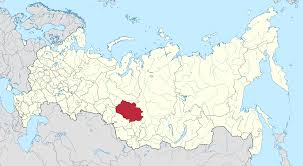
China’s Xinjiang Sanbao Industrial Group is to purchase the bankrupt Tomskgeoneftegaz LLC, a small oil production company in the Tomsk region, for about ₽4 billion (US$51.2 million). Sanbao’s investments are expected to partially cover creditor claims after reaching a deal with the main creditor, the Kazakhstan collection agency Eagle LLP.
According to its website, Xinjiang Sanbao was established in 1992 and operates across the energy, chemicals, agriculture, and logistics sectors. The group implements projects in Central Asia with subsidiaries in Kazakhstan and Uzbekistan and participates in China’s Belt and Road Initiative. Its total import-export volume stands at US$12 billion.
Tomskgeoneftegaz holds licenses for the Kontorovichskoye and Sokonvarskoye fields in the Tomsk region. It was projected that in 2024, following additional exploration and field geophysical surveys, oil production (without investment in new well construction) would reach 46,200 tonnes solely through implementing measures aimed at enhancing reservoir recovery rates. With planned investments, the Kontorovichskoye field’s output should reach 77,000 tonnes in 2025. It is planned that production will eventually grow to 396,800 tons. The Tomsk region is in Western Siberia, north of Kazakhstan.
In early 2023, the Tomsk Regional Arbitration Court declared Tomskgeoneftegaz bankrupt and initiated bankruptcy proceedings. The creditors’ register included claims from Kazakhstan’s Halyk Bank for ₽3.35 billion, its now-former subsidiary Moskommertsbank for ₽270.6 million, as well as claims from Kazakhstan’s Temco Energy Group totaling ₽120.3 million. Halyk Bank and Moskommertsbank later transferred their claims to Eagle LLP.
Creditors also included the Tomsk Federal Tax Service and Temco Energy Group, although these liabilities were excluded from the settlement agreement.
Tomskgeoneftegaz had produced 16,220 tons of oil and gas condensate as recently as January-June 2020. Sanbao Industrial Group’s acquisition appears to have been a relative bargain, with Tomskgeoneftegaz being valued at about 10% of the mining licenses it holds, although it also appears Sanbao will also have to make significant investments to see these become profitable.
Tomsk city consumes more electric energy than it produces, with Sanbao possibly eyeing the acquisition as a way to insert itself into regional power supplies.
Sberbank Insurance has obtained accreditation in India, according to its CEO Mikhail Volkov. He said that “As a universal insurance company, Sberbank Insurance seeks business development opportunities wherever possible. There are needs that stakeholders expect us to fulfill, such as products required for international trade operations. This isn’t a quick process. It involves complex, specialized types of insurance. Sberbank has reached sufficient maturity to meet the criteria demanded by both government and businesses in this sphere.”
He added, “We recently received accreditation in India. This represents a promising direction given the high volume of trade with Russia. Sberbank Group holds a competitive advantage—its own Indian banking subsidiary. This provides a strong operational foothold, making us probably the only insurer currently with resolved payment settlement capabilities in India.”
In 2024, bilateral trade between Russia and India reached a record high of about US$68 billion, with plans to reach US$100 billion by 2030.
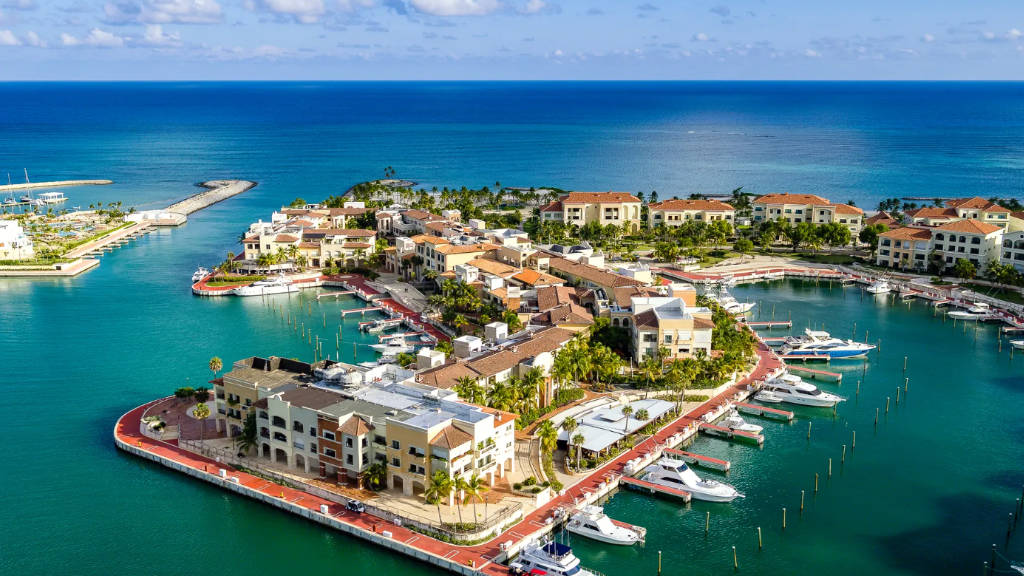
Flights between Russia and the Dominican Republic may resume in the upcoming winter season “if the necessary agreements are reached,” reports the Russian Ministry of Transport. This issue was discussed during a meeting between Deputy Foreign Minister for Economic Affairs and International Cooperation Hugo Rivera and Dominican Republic Ambassador to Russia Alejandro Arias Sarzuela with Russian Deputy Transport Minister Vladimir Poteshkin at the Federal Air Transport Agency (Rosaviatsia).
The ministry said that “Alejandro Arias Zarzuela, the ambassador of the Dominican Republic to Russia, has highlighted the high interest in resuming these flights and noted that Russian tourists will be very welcome at the republic’s resorts. The Transport Ministry and Rosaviatsiya stand ready to provide all-round assistance in this matter.”
Air traffic between Russia and the Dominican Republic was suspended due to unprecedented sanctions restrictions against Russian air carriers. In March 2022, it was reported that Azur Air and Nordwind had completely ceased flights to the DR. Before the COVID-19 pandemic, the Dominican Republic was the most popular Caribbean destination in the Russian market, with passenger traffic exceeding 400,000 people.
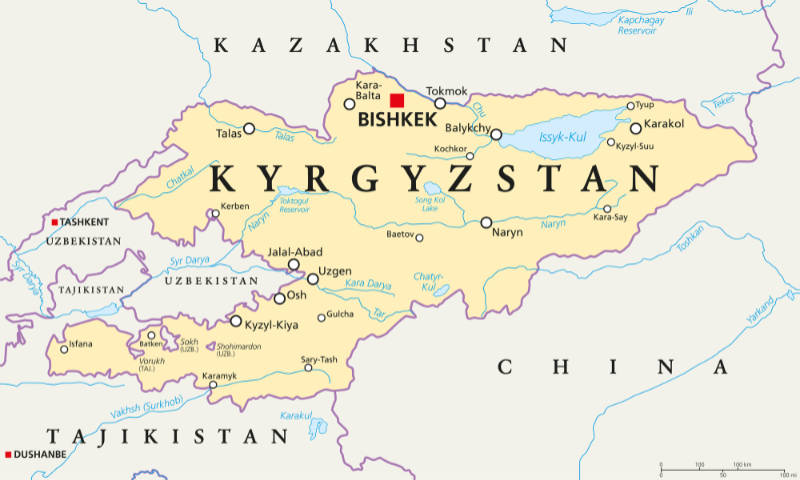
The Russian Foreign Minister, Sergey Lavrov, has been on an official visit to Kyrgyzstan to meet with the Kyrgyz President Sadyr Japarov and Foreign Minister Jeenbek Kulubayev. He arrived at Cholpon-Ata, a resort town on the northern shore of Lake Issyk-Kul, where bilateral meetings were held, and the Council of Foreign Ministers of the Collective Security Treaty Organization are convening.
The meetings with Kyrgyz officials focused on cooperation in political, trade, economic, military-technical, cultural, humanitarian and other areas in the context of expansion of multifaceted Russian-Kyrgyz ties. They also discussed the most pressing issues on the regional and global agenda and ways to develop Eurasian integration.
Lavrov subsequently made a statement concerning Russian-Kyrgyz relations and developments as follows: “I have met with Foreign Minister of Kyrgyzstan Jeenbek Kulubaev, for substantive narrow-format discussions followed by a meeting with the participation of the delegation members. We had an in-depth discussion of the entire range of Russian-Kyrgyz interaction in the context of the goals set by the presidents and outlined plans for expanding it.
We reviewed trade, economic, and investment cooperation, in which Russia is among Kyrgyzstan’s leading partners. As of late 2024, growth exceeded 22% and trade in 2024 grew significantly to US$4 billion. Our respective Presidents have set the goal of taking this figure to US$5 billion.
We noted in particular that the share of national currencies in payments for mutual export and import transactions has reached 98% of all bilateral trade. Russian direct investment in Kyrgyzstan is growing, with Russia being one of the leading investors in the economy of Kyrgyzstan.
We talked about the important coordinating role of the Intergovernmental Russian-Kyrgyz Commission on Trade, Economic, Scientific, Technical, and Humanitarian Cooperation. Its 26th session will be held in Kyrgyzstan this year.
We discussed enhancing cooperation in the humanitarian sphere, primarily education. Both sides emphasised the importance of launching a major joint project initiated by the presidents to build nine comprehensive schools in Kyrgyzstan with instruction provided in Russian. The project will be funded from the Russian budget. We reiterated mutual commitment to the earliest possible modernisation of the Kyrgyz-Russian Slavic University named after first President of the Russian Federation Boris Yeltsin, including the construction of a new campus. The actual work will start soon.
We discussed labour migration as well. Many widely attended and substantive meetings on this matter have been held over the past couple of weeks, including the Deputy Foreign Minister of Kyrgyzstan’s visit to Russia to participate in substantive consultations with the participation of the Interior Ministry, the Foreign Ministry, the Ministry of Education, and the Ministry of Digital Development of Russia.
We attach great importance to making sure that foreign citizens residing in our country comply with the rules of stay and take timely actions to keep in line with the regulations governing their legal status based on the relevant EAEU provisions and Russia’s domestic regulations outlined in the Presidential Executive Order, which entered into force in January 2025.”
As Lavrov pointed out, Russia has recently amended its immigration laws and tightened various loopholes. This has created some initial confusion amongst the Kyrgyz labour force, which traditionally sends annual labour to Russia to assist with the harvest as well as being a source for longer term roles such as taxi drivers and cooks and so on. Russia is a key destination for Kyrgyz migrant workers, with remittances from workers abroad making up a significant portion of Kyrgyzstan’s GDP. About 1 million Kyrgyz nationals work in Russia.
Kyrgyzstan is actively engaged in several free trade agreements to enhance its economic integration. It is a member of the Eurasian Economic Union (EAEU), which allows for the elimination of tariffs and trade barriers among member states. In June 2024, Kyrgyzstan ratified a trade agreement with Iran to bolster trade relations. Additionally, Kyrgyzstan benefits from the Generalized Scheme of Preferences Plus (GSP+), providing tariff-free access to the EU market for over two-thirds of its products, which has been instrumental in boosting exports. The Enhanced Partnership and Cooperation Agreement (EPCA) signed with the EU in June 2024 aims to strengthen bilateral cooperation in trade, governance, and environmental protection. Russian online retail investors such as Wildberries and Ozon has also established operations in Kyrgyzstan to help facilitate China trade.
With a population of approximately 7.2 million, Kyrgyzstan’s GDP (PPP) stands at around US$48.1 billion, GDP per capita (PPP) at US$6,790, with a projected GDP growth for 2025 at 6.8%.
Regarding bilateral trade with Russia, in 2021 it stood at US$2.49 billion, US$3.4 billion in 2022, and US$3 billion in 2023. In 2024, the total trade turnover exceeded US$4 billion, reflecting a significant rise, as both countries aim for a mutual trade target of US$5 billion.
With the pending Eurasian Economic Union – Mongolia Free Trade Agreement shortly to come into effect, another vehicle checkpoint is being upgraded on the Russia-Mongolia border, this one being at Tashanta, on the border of the Altai Republic with Tsagaannuur in Mongolia.
The border crossing is part of the AH4 international highway, and will be able to receive up to 1,000 vehicles per day. However, it is expected to begin its immediate modernisation from next year. However, special equipment will be installed at the checkpoint, by this autumn, allowing the reduction of customs inspection of trucks to 10 minutes. In addition, the inspection pits and the inspection ramp will be repaired this year, and a modern sanitary and quarantine control post will be set up.
Numerous modular units will be placed in the Tashanta checkpoint, including rooms for entry and exit control, in-depth inspection of cargo transport, and separate buildings for Rospotrebnadzor services, including equipment for sanitary and quarantine control.
This will triple the capacity of the border crossing. Similar reconstruction work is already being carried out on the Mongolian side (at the adjacent Tsagan-Nur checkpoint). Both border crossings will complete their renovations next year.
The Tashanta/Tsagan-Nur checkpoint is part of the AH4 international highway is used as a transit corridor for cargo exchange between Russia and China. To develop this logistics route, the Tsagaannuur Free Economic Zone has also been created on the Mongolian side. This zone, in Mongolia’s Bayan-Ulgii province covers 708.4 hectares, with 115 hectares already taken up by import-export and related businesses.
The Eurasian Economic Union and Mongolia are also in discussions about extending the high-speed Agro-Express rail service to Mongolia, which carries perishable fruits and vegetables and will provide competition to Mongolian consumers from what at present are almost exclusively Chinese imports.
Russia and Turkiye plan to strengthen bilateral cooperation in agriculture with the aim of increasing and diversifying Russian-Turkish trade in agricultural products, according to a protocol from the Russian-Turkish intergovernmental commission meeting held last Friday (June 27).
The meeting assessed the work of the executive committee on bilateral agriculture. Sunflower oil, wheat bran, sunflower meal, and cake currently dominate Russia’s exports to Turkiye, according to information from the Agroexport federal center.
Trade in agricultural products between Russia and Turkiye amounted to around US$5.3 billion in 2024. Russia exported US$3.4 billion worth of products to Turkiye and imported US$1.9 billion worth from the country.
Russian Agricultural Exports To Turkiye
Turkey is a major importer of Russian wheat. According to estimates, Russia accounts for about 74% of all wheat imports into the country. Turkey is also one of the key importers of Russian sunflower oil and other sunflower products (sunflower meal/cake is used in Turkey as feed for livestock). In addition, Russia supplies Turkey with corn, barley, rapeseed and rapeseed oil, soybean meal and wheat bran, frozen fish (pollock, herring, mackerel), crustaceans, and honey.
Turkish Agricultural Exports to Russia
Turkish agricultural exports to Russia are concentrated in the categories of “edible fruits, nuts, citrus peel, melons,” which accounts for about 65% of the total volume of supplies. This includes citrus fruits (oranges, mandarins, lemons, grapefruits), grapes, apples, pears, stone fruits such as apricots, peaches, plums, and cherries, nuts (hazelnuts and pistachios), as well as seasonal supplies of watermelons and melons.
There have been some quality concerns with some imports from Turkiye but these appear to have been cleared up.
Turkiye’s overall bilateral trade with Russia has seen fluctuations, growing from US$33 billion in 2021 to US$68 billion in 2022 before declining to US$57 billion in 2023. Trade stabilized at US$56 billion in 2024, with Russia being Turkiye’s second-largest trade partner after China.
Turkiye is a BRICS partner nation. Both Russia and Turkiye have committed to increasing bilateral trade to US$100 billion by 2030.
Russia is interested in increasing regular liquefied natural gas supplies to Turkiye and is prepared to participate in joint investment projects to develop the gas market there, according to an intergovernmental commission meeting between the two countries. Russian Deputy Prime Minister Alexander Novak has stated that Turkiye had LNG terminals receiving products from all over the world and could also receive Russian LNG.
The parties noted the stability of Russian oil supply to Turkiye. The two sides discuss cooperation between Russian and Turkish companies in petroleum trade products as well as the production and distribution of lubricants.
Both have agreed to promote projects and collaboration opportunities between their respective oil companies, including joint projects in third countries. They also addressed the importance of improving the conditions for partnerships in boosting trade and investment.
“Turkey is among the three largest foreign trade partners of Russia. Bilateral trade turnover has increased 2.3 times in five years. I am confident that we will be able to maintain the positive dynamics in the future and focus on creating favorable conditions for increasing the volume of Russian-Turkish trade turnover, as well as on implementing existing projects and launching new ones. We note with satisfaction the successful cooperation in the energy sector, which is a strategic area of our interaction, including the peaceful use of nuclear energy. The realization of the flagship project on the construction of Akkuyu NPP in Turkey continues. We are ready to implement projects of a promising agenda in any mutually beneficial format,” Alexander Novak said.
The Eurasian Agro-Express service, which was originally designed to service the Chinese markets and Southeast Asian markets with high-speed deliveries of perishable goods from Russia and the Eurasian Economic Union, could be extended.
Andrei Slepnev, the Minister for trade at the Eurasian Economic Commission (EEC), stated at the fourth Eurasian Economic Forum in Minsk on Friday (June 27) that “The project initially focused on Southeast Asia and the Chinese market, but today its map is expanding. Practical work has begun on the North-South corridor – a promising direction for agricultural products. This refers to Iran as well as other countries in the region. For example, it would be interesting to include the United Arab Emirates in the Eurasian Agro-Express project. Work is also underway with Mongolia – a close partner of the Eurasian Economic Union and a transit country towards China.”
The Mongolia route would provide competition for the Mongolian consumer market, which is mainly served by China. Products would originate from Russia and Kazakhstan.
Looking towards the Middle East, the EEC have already held negotiations with Iran in March as part of the Eurasian Agro-Express project, with Vladimir Serpikov, the director of the EEC Trade Policy Department, saying “We proposed with Iran the formation of green corridor principles for transit shipments under the project, increasing the cargo base along the Iran-EAEU route, and raising awareness among Iran’s business community about the project and its opportunities.”
The extension of this route can then feed other Middle Eastern destinations and provide competition for local markets. Products from this route would come mainly from EAEU members Armenia, Belarus and Russia.
The EEC and Iran have agreed to consider these issues at meetings of the transport and transit cooperation subcommittee, which will be established as part of implementing the complete Iran-EAEU free trade agreement, which is still undergoing some tweaks despite being effectively in force.
The initiative to implement the Eurasian Agro-Express project for accelerated rail and multimodal transport was approved by the Eurasian Intergovernmental Council in February 2022. The intent is to develop regular mutual supplies of agricultural products and food, as well as export shipments to Asian and European destinations. In February 2023, the Intergovernmental Council expanded the project to include International North-South Transport Corridor (INSTC) routes.
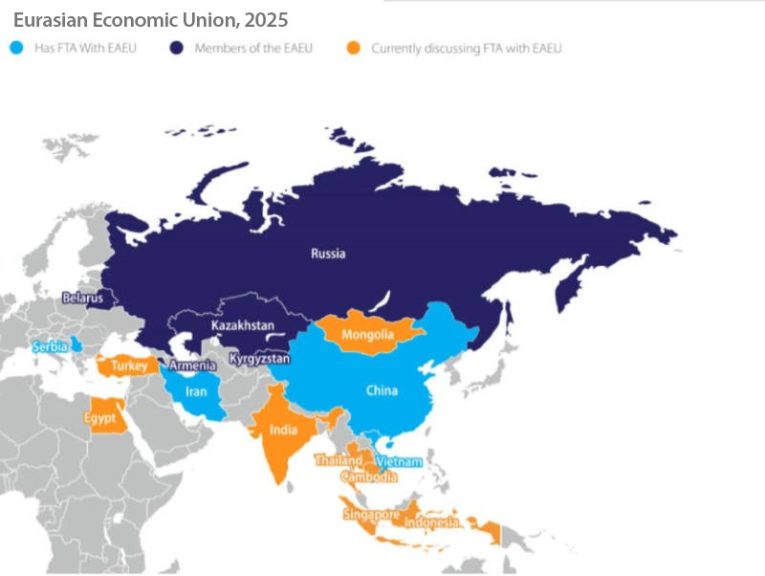
The Eurasian Economic Union includes Armenia, Belarus, Kazakhstan, Kyrgyzstan and Russia and fills a geographic space between Eastern Europe and Western China. It is a Free Trade bloc and also has free trade agreements with China, Iran, and Vietnam, while Mongolia is about to agree a deal, with India and Indonesia expected to do the same later in the year.
Over three years of implementation, the project has transported over 1.5 million tonnes of perishable cargo, more than half of which was refrigerated. That will now increase.
Russia and Malaysia have agreed to expand cooperation on the use of nuclear energy, state nuclear corporation Rosatom announced, following high-level talks in Moscow on Friday (June 27). The meeting was attended by Rosatom CEO Aleksey Likhachev and Malaysian Deputy Prime Minister Fadillah Yusof.
The discussions focused on the use of Rosatom’s Nuclear Power Plant (NPP) technologies.
Fadillah, who is also Malaysia’s Energy Transition and Water Transformation Minister, said, “We value our collaboration and aim for a long-term strategic partnership based on mutual trust and shared objectives.”
Likhachev said Malaysia is interested in Russian floating nuclear power stations, following Malaysian Prime Minister Anwar Ibrahim’s visit to Russia last month. He stated that “We offered Malaysia the entire spectrum: large and small stations, both land-based and floating. For various reasons, the Malaysians are choosing floating nuclear power plants with a capacity of 100 MW each. They can be created here in Russia and brought there fully operational.”
During their current visit, the Malaysian delegation toured the Leningrad Nuclear Power Plant in St. Petersburg, one of Rosatom’s largest facilities, to observe Russia’s latest nuclear technologies and safety standards. They also visited the ATOM Pavilion at Moscow’s VDNKh—the country’s key nuclear science education hub, featuring more than 1,700 interactive exhibits.
Fadillah called the experience “eye-opening,” praising the pavilion as both a display of innovation and a center of historical awareness. He later wrote, “This visit reinforced my belief that technology, when guided by knowledge, values, and responsibility, can be a powerful driver for a future that is sustainable, innovative, and globally competitive.”
Malaysia’s neighbor, Indonesia, has also recently signed cooperation agreements with Russia over floating NPP. Both are members of ASEAN, while Indonesia is a full member of BRICS and is poised to sign a free trade agreement with the Eurasian Economic Union. Malaysia has also applied to join the BRICS group.
During his 5-day visit, Fadillah also held a bilateral meeting in Moscow with Russian Deputy Prime Minister Aleksey Overchuk.
Russia’s Yadran Group, an investor in Mali’s gold mining industry, laid the cornerstone for a new gold refinery in Bamako on June 16. Construction is scheduled to be completed in 18 months, after which the refinery will go into operation and gradually achieve a design capacity of 100 tonnes of gold per annum in the first phase, with the option for expanding this to 200 tonnes per year.
Yadran Group said most of the gold ore will come from Malian mining companies, although the possibility of sourcing gold from other countries in Africa’s Sahel region is also being considered. The project operator is Soroma SA, which is 62% owned by the Malian government. The other 38% of shares are controlled by Yadran Group and its strategic partners.
Mali’s Ministry of Mines has said that the refinery project is the result of cooperation between Mali and Russia through Yadran and a Swiss investment company. Mali is one of the largest gold producers in Africa.
Yadran Group’s main business is the production, refining, and sales of crude oil and oil products and the processing of oil waste. The group also includes a biopolymer plant, a dairy plant, and a construction company that specializes in civil construction and building facilities for the oil and gas sector.
The Bamako gold refinery Russia’s Yadran Group is constructing is being built to meet the standards needed to qualify for Good Delivery status. Good Delivery gold refers to gold bars that achieve the strict quality and specifications established by theLondon Bullion Market Association (LBMA) Good Delivery List. This set of standards outlines requirements that gold and silver bars must meet in order to be accepted for delivery in the London bullion market.
Yadran has stated that “The goal of the project is full compliance with the standards needed to obtain Good Delivery status. We are incorporating all technological and organizational solutions, taking into account the requirements for this type of certification. This issue is one of our priorities.”

 Русский