Sierra Leone’s government is prepared to grant Russian fishing operators an annual catch quota of 40,000 tons, along with investment incentives aimed at boosting bilateral cooperation in the aquaculture sector, according to the Russian Federal Agency for Fisheries (Rosrybolovstvo).
The agency said the move was discussed during the inaugural session of the Russian-Sierra Leone Fisheries Commission held in Freetown, the capital of the West African country.
Rosrybolovstvo said that “Sierra Leone is interested in attracting up to 20 Russian vessels to work in its exclusive economic zone.” Scientists from the two countries previously conducted marine biology research to assess the biomass and distribution of small pelagic fish species as part of the Great African Expedition launched by Rosrybolovstvo last August.
The two sides are expected to launch detailed negotiations on operations in Sierra Leonean waters once research data is processed and interest by fishing companies in specific fish stocks and other marine resources is evaluated.
Rosrybolovstvo also noted that Sierra Leone is interested in cooperation with Russia in the development of its port infrastructure and modernization of its fishing fleet, in attracting Russian investments for the creation of onshore refrigeration facilities, improvement of the control and supervision systems, port infrastructure, modernization of its artisanal fleet based on composite materials, production of fishing gear and the development of aquaculture.
Russia’s engagement in Africa has intensified in recent years, with several nations seeking joint projects with Moscow in defense, energy, education, and trade. The Kremlin has declared strengthening ties with the continent a top foreign-policy priority.
In January, Russian Foreign Ministry spokeswoman Maria Zakharova confirmed plans for new embassies to be established in several African nations, including Sierra Leone. For now, the Consulate General in Freetown remains Russia’s primary diplomatic representation in the country.
Thus far, Sierra Leone’s bilateral trade with Russia has been limited, amounting to US$3 million in 2024. However, in June last year, Russian companies, including aluminum giant Rusal and diamond producer Alrosa, entered negotiations with Sierra Leone for bauxite mining and diamond operations.
In May, Russian Foreign Minister Sergey Lavrov said at a press conference following talks with Sierra Leone Foreign Minister Timothy Kabba that Russia and Sierra Leone were negotiating the signing of a package of cooperation documents that would soon be finalized. These developments suggest the potential for enhanced economic ties between the two nations in the future, while there are also opportunities in mining, agriculture, fishing, processing, and subsoil exploitation.
The Eurasian Economic Union (EAEU) has achieved success in the main performance indicators but fallen short of about 20 crucial targets in its 2025 development strategy; over the next decade, the union should, at a minimum, double its share in the global GDP, Belarusian President Alexander Lukashenko has said. He was speaking at the 2025 Eurasian Economic Commission Forum annual meetings currently being held in Minsk. Russian President Putin is also attending.
The EAEU includes Belarus, as well as Armenia, Kazakhstan, Kyrgyzstan, and Russia. Should the EAEU double its GDP over the next decade, this would imply a steady 5% per annum (compounded) growth rate and an eventual gross GDP of US$5.2 trillion. The 2024 EAEU growth rate was 4%.
Lukashenko said, “The EAEU has already stepped over the ten-year line since its creation. Our bloc defied its skeptics by proving capable of finding mutually acceptable decisions and work compromises. The EAEU is not just functioning; it has also been successful in the main parameters. Over the past ten years, trade between its member states has more than doubled, and external trade has increased by 37%. The union’s combined GDP rose by nearly 18%; industrial production, by 30%; agricultural output, by 25%; cargo traffic, by 10%; and investments, by more than 40%. The level of unemployment has halved and is now at 2.8%.”
Lukashenko added that the EAEU accounts for one-fifth of the world’s population and is the largest bloc by area, containing a quarter of all proven types of fossil fuels, he said. The EAEU is the world’s number one for oil production and ranks second for gas and mineral production, third for wheat, potato, and agricultural production, and for the length of our railroads.
Lukashenko also said, “But on no account must we rest on our laurels. For all this, our union’s GDP is still a mere 4% of the world’s. What does it mean? The potential of our integrated union is not being used in full. And over the next ten years we must, at a minimum, double this figure by lending a new impetus to our integration.”
Although Lukashenko has set a high growth target for the coming ten years, there are significant upcoming developments that imply his reasoning is sound. Iran has just started in May 2025 the free trade agreement with the EAEU, while Mongolia and the UAE are about to. Also upcoming are anticipated FTA agreements with Indiaand Indonesiawith others also in the pipeline.
Russia’s Energy Minister, Sergei Tsivilev, has met with Wang Hongzhi, the head of China’s National Energy Administration, at a meeting for energy ministers from the Shanghai Cooperation Organization (SCO) member states and discussed current issues around bilateral collaboration in fuel and energy as well as promoting fair energy access throughout the world.
Tsivilev and Wang discussed LNG and natural gas exports, the development of gas transportation infrastructure and joint energy projects, and expanding oil and coal partnerships.
Russia’s Energy Ministry stated that “The parties also discussed coordinating the formation of the joint Russian-Chinese Energy Strategy to 2050. Among other points, this document will stipulate the establishment of infrastructure allowing both countries to conduct more effective interactions in fuel and energy at all stages, from production and field development to transportation.”
Tsivilev added, “We see this as a plan for interaction in the fuel and energy industries, encompassing energy security, uninterrupted energy supply, technological advancement, the exchange of knowledge, personnel training, and the environment.”
The 2050 timeframe allows not just Russia and China, but also members of the SCO to coordinate and plan the anticipated energy needs and to formulate budgets for infrastructure to enable this to happen. It is a 25-year-long plan. The SCO also includes as full members Belarus, India, Iran, Kazakhstan, Kyrgyzstan, Pakistan, Tajikistan, and Uzbekistan. These full members possess approximately 20% of the world’s oil reserves and 44% of its natural gas reserves.
In addition to this, Mongolia and Afghanistan are observer nations to the SCO, while Armenia, Azerbaijan, Bahrain, Cambodia, Egypt, Kuwait, Maldives, Myanmar, Qatar, Saudi Arabia, Sri Lanka, Turkiye, and the UAE are all SCO dialogue partners. Collectively, these countries possess an additional 22% of global oil and 21% of global gas reserves, with the bulk of this being held in Kuwait, Qatar, Saudi Arabia, and the UAE.
Full membership of the SCO can be expected to evolve over the coming years.
Russia’s Agroexport has been holdings meetings in Manila with the Philippines Association of Millers and Feed Manufacturers (PAMFI), the Bureau of Crop Production and Marketing, and leading Philippine companies that import and process grain. The meetings were attended by Agroexport CEO Ilya Ilyushin, Chairman of the Board of Directors of the BIO-TON agricultural corporation, member of the board of the Union of Grain Exporters and Producers Eduard Zernin, Russian trade representative in the Republic of the Philippines Artem Tsinamdzgvishvili, and representative of the Russian Ministry of Agriculture in the Republic of the Philippines Alexander Syrtsev.
At these discussions, the Russian delegation spoke about the current state of Russia’s grain complex and its export potential, principles of working with foreign buyers, phytosanitary control, storage infrastructure and logistics. Issues related to insurance and payments were discussed in detail. The parties considered the possibility of expanding contacts, including through exhibitions and industry events.
The Philippines is one of the largest grain importers in Southeast Asia. According to ITC Trade Map, in 2024, the country purchased more than 13.5 million tonnes of grain on foreign markets, including almost 6.8 million tonnes of wheat. Between 2018 and 2020, Russia actively exported wheat to the Philippines, but during the COVID-19 pandemic, deliveries were suspended due to disruptions in the logistics chain. Russia is now looking to reinvigorate these supplies.
Ilyushin said that “Wheat is one of the top three products imported by the Philippines. Russia, in turn, is the leader in wheat supplies to the world market. We are ready to provide the growing population of the Philippines with high-quality wheat at competitive prices and become a reliable partner for the long term”.
Meetings were also held with the leadership of the Philippine Association of Meat Processors (PAMPI). This association, unites producers of processed meat products and related suppliers. In the spring of 2025, the Philippine market was opened to supplies of beef and cattle by-products from Russia, as well as animal feed. The two parties discussed the Philippines consumer market for meat products and the capabilities of Russian exporters.
The Philippines is a member of ASEAN and also a signatory to the Regional Comprehensive Economic Partnership (RCEP), which also includes Australia, China, Japan, South Korea, and New Zealand. Trade in goods and services, investment, intellectual property, e-commerce, competition, small and medium-sized businesses, and government procurement are all covered by the RCEP agreement.
The Philippines has a population of slightly over 109 million. It has a GDP (PPP) of US$1.4 trillion, a GDP per capita (PPP) of US$12,191, and an anticipated 2025 GDP growth according to the World Bank will be approximately 5.3%.
Bilateral trade amounted to $1.16 billion in 2021 and has since declined slightly, mainly because the Philippines is discouraged from developing trade with Russia by the United States, with which Manila maintains good relations, especially with regard to alleged maritime security threats from China. The new president who replaced Duterte in 2022, the pro-American Ferdinand Marcos Jr., shifted the Philippines’ foreign policy towards the United States during his tenure, moving away from Manila’s emerging warming relations with both Moscow and Beijing. Russia-Philippines bilateral trade during 2024 is believed to have reached about US$600-700 million.
That said, in October 2023, the two countries convened the 3rd Joint Commission on Trade and Economic Cooperation (JCTEC) and focused on strengthening cooperation in key sectors such as mining, automotive, pharmaceuticals, and agriculture.
Tourism has traditionally been a strong area of cooperation between the two countries: in 2006, the Philippines and Russia signed a tourism agreement, and since 2013, Russian citizens have been able to visit the Philippines without a visa for up to 30 days. At the same time, Philippine tour operators are currently interested not only in developing tourist flows from Russia to the Philippines, but also in the opposite direction. In the spring of 2024, direct regular flights from Irkutsk to Manila were launched.
Since 2017, Russia’s non-energy exports to the Philippines have been growing: in 2021, oil accounted for only about 6% of total exports. In the same year, food supplies from Russia increased more than eightfold compared to 2016, reaching a peak in 2018 (more than 26% of total exports). However, raw materials continue to dominate Russia’s exports to the Philippines, although the share of the non-raw materials sector is gradually increasing.
Until 2022, the lion’s share of Philippines exports to Russia (more than 80%) was accounted for by electronic industry products with the country among the top ten largest exporters of microelectronics and semiconductors to Russia.
In May 2023, companies receiving electronic products were subject to sanctions by the US Department of the Treasury for participating in the supply chain of the Russian defence industry. Currently, the Philippines mainly exports agricultural products, in particular exotic fruits: mangoes, bananas, pineapples, as well as coffee and coconut oil.
Russia, Belarus, and Kazakhstan have launched two pilot projects in the railway and agricultural engineering sectors with the help of a new Eurasian Economic Union (EAEU) funding mechanism, according to Gohar Barseghyan, the Eurasian Economic Commission (EEC) Industry and Agroindustry Minister. He was speaking at the 2025 Eurasian Economic Forum in Minsk.
Barseghyan said that “The EAEU has launched a new funding mechanism for cooperative projects. This is a real support measure for industrial cooperation. The first two projects to have been granted approval are in the railway and agricultural engineering sectors in Russia and Kazakhstan, with the participation of Belarusian companies.”
She said that the EEC was reviewing five more new international projects involving EAEU member states. “This includes the railway engineering sector, as this is a very important area for all states, as well as elevator equipment manufacturing, light industry, and others. The new mechanism is in the interests of businesses.” The EAEU includes Armenia, Belarus, Kazakhstan, Kyrgyzstan, and Russia.
Barseghyan added that “It is essential that we use this first trial to find new support measures and make decisions on them, because all EAEU states really need this. In today’s world, the situation changes very quickly, and it is only together that we can overcome new challenges—first and foremost, by developing industrial cooperation.”
Barseghyan also said that the EEC was creating an internet portal dedicated to industry, where information on needs and opportunities in each EAEU state will be posted. This should expand business partnerships and industrial cooperation within the EAEU.
The Russian Foreign Minister, Sergey Lavrov, has met with Thongsavanh Phomvihane, the new Laos Foreign Minister, in Moscow.
Lavrov welcomed him by saying, “You are a frequent visitor to our country: last May, you attended the festivities marking the 80th anniversary of the Victory as a special representative of the President of the Lao PDR, and in 2024, you participated in the inaugural forum of the international socio-political movement For the Freedom of Nations in Vladivostok. We greatly appreciate this and trust that your extensive and distinguished experience in fostering relations with Russia will serve you well in your new role as head of the Lao Ministry of Foreign Affairs. As a fellow alumnus of our university, you are deeply familiar with our country’s history, language, and culture. I have no doubt that you will uphold continuity and advance progress in our bilateral strategic partnership”.
Following the meetings, Lavrov provided a bilateral update, saying, “We welcomed the high intensity of inter-parliamentary and inter-party dialogue, as well as delegation exchanges between Russia and Laos across various ministries, agencies, and business circles. We noted the ongoing relevance of strengthening defense and security ties, as well as expanding cooperation between law enforcement agencies. We reiterated our willingness to enhance the legal framework of our relations.
Bilateral trade is significantly up even though the absolute figures still fall short of our expectations and are well below what our two countries can do. Considering this, we discussed in detail ways to expand cooperation in energy (including hydropower and peaceful nuclear energy), outer space exploration, transport, logistics, ICT, healthcare and epidemiological safety, as well as finance and banking.
Concrete plans are available in all the above areas. We agreed to speed up their implementation and to facilitate the activities of the Russian-Laos Intergovernmental Commission on Trade, Economic, and Scientific and Technical Cooperation. The 18th session of the commission will take place in Russia before the year is out. The previous session was held in Vientiane.
We reviewed a list of documents currently in the works, which is fairly long, and work on each of them must be sped up. We share this understanding and will push these processes forward.
We placed great emphasis on fostering region-to-region ties. St. Petersburg and Vientiane are twin cities. Moscow and Vientiane are working under a five-year cooperation plan. Tyumen is part of the region-to-region cooperation as well.
Cultural and humanitarian exchanges are ongoing, including joint educational initiatives such as supporting the Russian language in Laos, for which we are sincerely grateful to our friends. Plans are in place to expand these efforts.
We will continue to provide scholarships for Lao citizens under the Russian government quota, which covers both civilian and specialized fields under the Defense Ministry and the Interior Ministry’s programs.
Once again, we reaffirmed our overlapping positions on most pressing international issues. Russia and Laos advocate for a just, democratic, sustainable, and multipolar world order based on respect for all principles of the UN Charter, starting with the sovereign equality of all states.
We will continue coordinating our actions at the UN, particularly within the promising framework of the Group of Friends in Defense of the UN Charter—an initiative launched by Venezuela in 2021, of which our countries are participants.
Specifically, we attribute great importance to advancing within this group and at the UN General Assembly initiatives concerning the fight against unilateral illegal coercive measures and countering modern neocolonial practices. The General Assembly has earlier adopted a resolution on this matter. We will work to specify the tasks outlined in these decisions.
We will continue working together in the Asia-Pacific region, and, in this context, we will strengthen dialogue-based partnerships between Russia and ASEAN. We firmly support ASEAN’s central role in regional security and cooperation architecture in Southeast Asia. Together with our Laotian friends and other ASEAN members, we are exploring initiatives advanced by President Vladimir Putin, including the Greater Eurasian Partnership and the creation of Eurasian security architecture.”
Laos is strategically situated in Southeast Asia, and although it does not enjoy sea access, it nevertheless links several regional ASEAN countries.
About 85% of its population work in agriculture, with 90% of the arable land being planted for rice. Peanuts, cotton, tea, tobacco, corn, sweet potatoes, and sugarcane are also grown. Technically, the Lao industry lacks adequate equipment. Mining is the most advanced. The primary sources of GDP are the exploitation of gypsum, copper, tin, gold, and oil. Agricultural products and natural resources make up the bulk of Laos’ exports. The main exports are wood, clothing, coffee, electricity, metals, corn and rubber. The main imports are telecommunications equipment, trucks, metal structures, rolled metal products and hydraulic turbines.
Through its membership in ASEAN, Laos increasingly trades with its ASEAN neighbors as well as China. The Council of the Eurasian Economic Commission (EEC) granted Laos the status of a user country of the unified system of tariff preferences of the EAEU with 0% of the base rate of import duty. Laos has also been given Generalized System of Preference (GSP) status by multiple countries, including Belarus and Russia, while Kyrgyzstan also grant Laos goods tariff-free protection. In 2016, a Trade and Investment Framework Agreement was struck between the United States and Laos. It also has additional bilateral agreements with Argentina, India, Kuwait, Mongolia, North Korea, and Turkiye. In January 2022, Laos became a member of the Regional Comprehensive Economic Partnership (RCEP).
Laos has an area of 236,800 sq km and a population of 7.7 million. It has a GDP (PPP) of US$79 billion, a GDP per capita (PPP) of US$10,112, and an expected 2025 GDP growth of 3.5%.
Trade between Russia and Laos reached US$41.6 million in 2021. However, like neighboring Cambodia, bilateral trade has decreased mainly due to sanctions, the complexities of reaching the Laotian markets, and Russia’s trade emphasis concentrating on China and Vietnam.
Current Russia-Laos bilateral trade is small at about US$5 million; however, the two countries have long diplomatic ties going back to the Cold War era. Laos does pick up some manufacturing investments from neighboring countries such as Thailand and China, and it also has a developing tourism industry. What trade there is typically energy produced from Russia and agricultural products such as fruits from Laos. That said, 2025 trade year-to-date is showing significant increases, most notably in Russian exports.
The country is also mountainous, which has created additional connectivity issues. Last year, Russian Transport Minister Roman Starovoit held talks with a delegation from Laos that participated in the BRICS conference in Kazan. It was assumed that Russian Railways would be able to provide rolling stock to a country that seeks to improve rail links with China. There may be opportunities for Russian Railways to provide rolling stock. FESCO has also been involvedin setting up Russia-Laos supply chains.
Both the Russian and Laotian central banks are in discussions to involve the potential use of Russian MIR cards in Laos and to formalize ruble-kip trading, moving to sovereign currency use in trade relations. Although the trade dynamics are small, there are opportunities in the tourism sector for Russian nationals as well as smaller trade possibilities.
India has purchased 80% of Russia’s seaborne Urals crude exports this year, with two private refineries increasingly buying more of this variety, according to data analytics provider Kpler.
Indian conglomerates Reliance Industries and Nayara Energy have bought 45% of the Urals crude imported into the country, with India purchasing 231 million barrels of Urals crude this year, according to Kpler. Both Reliance’s and Nayara’s Russian oil purchases witnessed a significant jump in 2025.
Reliance Industriesbecame the world’s largest buyer of Russian oil this year, buying 77 million barrels of Urals crude in 2025. Reliance, which is owned by Indian billionaire Mukesh Ambani, signed a ten-year deal with Rosneft in December 2024 for 500,000 barrels of crude per day (bpd), worth around US$13 billion annually, marking the largest energy deal between Moscow and New Delhi.
Nayara Energyhas part-Russian ownership. In 2017, Rosneft Group led a consortium to buy a 98% stake in Essar Oil for US$12.9 billion. The company was later restructured as Nayara Energy, with Rosneft keeping a 49.13% stake. Around 72% of its oil imports consisted of Russian crude, a significant increase from 27% just three years ago.
Russia has been India’s largest oil supplier since the Ukraine conflict began in 2022. In May this year, India’s imports of Russian crude oil reached around 1.8 million bpd, the highest level in ten months, according to Kpler data. The surge in imports in May has helped Moscow solidify its position as a major oil supplier to the world’s most populous country.
Industry watchers attribute India’s frenetic buying of Russian crude to the volatile situation in the Middle East. Tehran, which controls the Strait of Hormuz, a major oil shipping route that accounts for 20% of the global oil supply, threatened to close the waterwayin the wake of the US attacks on three of its nuclear installations last week. While a ceasefire is now in place, tensions between Iran, Israel, and the United States remain tense. New Delhi has said it would be able to offset the effects of the Strait of Hormuz being closed off.
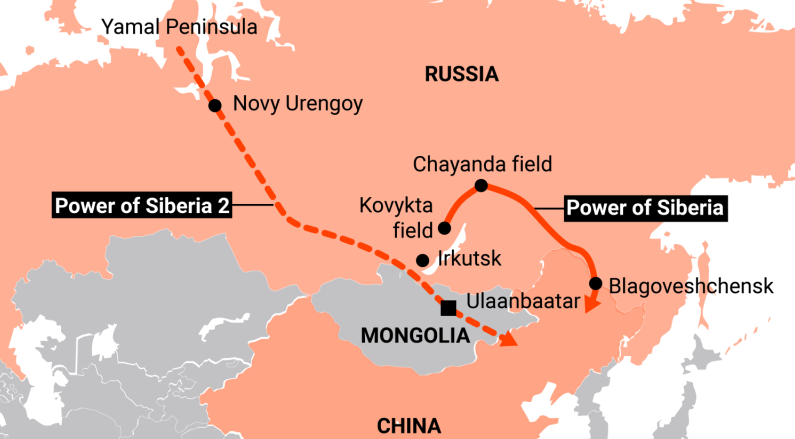
China’s interest in the construction of Russia’s proposed Power of Siberia 2 pipeline, which would deliver gas via Mongolia, has intensified following the outbreak of the conflict between Iran and Israel, according to sources in Beijing.
The planned pipeline would allow up to 50 billion cubic meters (bcm) of natural gas to be delivered annually from the Russian Arctic to China via Mongolia.
Political sources in China have said that the recent Iran-Israel conflict has raised concerns within the Chinese government about the reliability of oil and gas supplies from the Middle East, prompting policymakers to explore alternative energy sources.
China imports about 30% of its gas as LNG from Qatar and the UAE through the Strait of Hormuz—a route for about 20% of the world’s oil—which Iran has threatened to close in response to the US strikes.
Chinese “teapot” refineries have also grown reliant on discounted Iranian crude, with analysts estimating that over 90% of Tehran’s oil exports now go to China—despite US sanctions aimed at curbing the country’s oil sales abroad.
Wei Xiong, head of China gas research at Rystad, said, “The escalation of the Middle East tensions underscores the severe consequences of a potential blockade in the Strait of Hormuz. A blockade of the chokepoint could trigger a major shift in Beijing’s LNG supply, with China moving from being over-contracted to a supply deficit.”
Although a ceasefire is currently in place, the recent conflict has prompted Beijing to seek alternative energy sources, according to analysts and officials. China is also looking to increase oil imports from Russia, which already supplies about a fifth of its crude oil. Moscow is keen to oblige as it seeks to diversify its energy export markets amid Western sanctions and reduced European demand.
The Power of Siberia 2 pipeline is seen in Beijing as a strategic move to further diversify supplies and strengthen energy security in the face of rising geopolitical uncertainty.
Aleksander Gabuev, the director of the Carnegie Russia Eurasia Center, stated that “The volatility and unpredictability of the military situation have shown the Chinese leadership that a stable land-based pipeline supply has geopolitical benefits. Russia could benefit from that.”
China is seeking closer ties with Russia as the White House signals efforts to drive a wedge between the two nations, according to sources familiar with Beijing’s policymaking. Economic cooperation has continued to grow despite sweeping Western sanctions, with bilateral trade reaching a record US$245 billion in 2024.
Chinese meat importers have begun favoring Russian products, considering them more cost-effective and of higher quality than competitors, according to the Russian Agroexport federal center, in discussions during the Russian export business mission in Chengdu, China.
Yongli Sun, of Beijing Hopewise International Trading, began importing Russian meat in 2024. He said that initial meetings with Russian exporters took place in April last year, and since then over 10,000 tons of pork and beef have been imported. After conducting market research, Sun said that “Our analysis showed that Russian meat is cheaper, yet better in quality and popular among consumers. The entire supply chain is also fully established.” He added that Hotel, Restaurant, and Catering (HoReCa) sector buyers in China now specifically prefer Russian meat.
Sichuan Rong Ou Yuan Trade, which operates in Chengdu’s free trade zone, imports chicken parts from Russia, including chicken feet. These products are supplied to factories and wholesalers and also processed at their own facility. “To develop our company, we want to expand our procurement sources,” the company’s CEO, Hu Yue, said.
Some Chinese companies are only planning now to start working with Russian partners. There are several examples, such as Mi Yang, the co-founder and CEO of Shanghai Wewin Supply Chain Technology, who said the company currently imports beef from New Zealand, Australia, and South America. During the current business mission, negotiations were held with a Russian producer to supply Russian meat to Chinese food service establishments.
Techlex Foods Group (Tieqilishi Food) Vice President Edison Liu expressed interest in importing pork, chicken feet and wings, and feed. The Chengdu-based conglomerate operates in feed production, livestock farming, and food processing and is ready to work with Russian suppliers.
Ilya Ilyushin, the head of the Agroexport mission to Chengdu, said that China currently accounts for one-third of Russian meat export revenue. “Last year, Russia supplied over US$560 million worth of meat to China, and this year the figure will be higher. As of June this year, Russian meat exports to China have grown 42% in value terms compared to the same period last year.”
China is expected to maintain its leading position among buyers of Russian meat through 2030.
Vladivostok Marine Fishing Port (Vladmorrybport), a stevedoring company at Vladivostok, in the Russian Far East, has begun servicing a regular container service operated by FAST Shipping Line with the Chinese port of Qingdao, the company has said, stating, “Vladmorrybport received the first vessel, Gang Tong 19, on June 17. It is planned that the line will make two voyages per month, which should ensure an increase in supplies of Chinese food products to the Russian market.”
Vladmorrybport operates 11 docks at the Port of Vladivostok that have the capacity to handle 7.5 million tons of various types of cargo per year, including about 620,000 tons of fish products and 500,000 TEU of containerized cargo. The Vladmorrybport Group includes the stevedoring company, as well as refrigerated facilities in Vladivostok, Nakhodka, and Moscow.
Qingdao is a major seaport and naval base, as well as a commercial and financial center, and is known for its fishing industry. It was a German treaty port during the Chinese imperial era.
Colombia has confirmed it has joined the New Development Bank (NDB), the financial investment arm of the BRICS group. Colombia had requested membership in the NDB in May of this year, amid tensions with the United States over President Trump’s tariff war and Colombia’s joining China’s Belt and Road Initiative.
Colombia’s Minister of Foreign Affairs, Laura Sarabia, said, “I welcome the news, which transcends financial matters and broadens our horizons. Colombia officially joins the BRICS bank led by Dilma Rousseff following the request made by President Gustavo Petro in Shanghai. We continue forging new paths toward opportunities for the country.”
However, although Colombia can access resources and financing for diverse projects financed by BRICS, it is not a member of the BRICS bloc itself. In this regard, Colombia’s relationship with the BRICS bank will mirror the one it currently has with the Inter-American Development Bank (IDB)
Since Donald Trump’s arrival as the U.S. President, the Colombian government has emphasized the need to diversify its trade alliances. This shift responds to the isolationist stance of the United States, Colombia’s traditional commercial partner. Relations between Presidents Donald Trump and Gustavo Petro are not positive, with Colombia facing additional tariffs on exports to the US.
The NDB aims to reduce dependence on the U.S. dollar in international financing and promote local currencies in loans. In a context of increasing multipolarity, the BRICS—representing nearly 32% of global GDP and over 40% of the planet’s population—are positioning themselves as a counterweight to the traditional financial order.
With Colombia’s entry into this entity, the expansion of the bloc and its bank could reinforce this trend, boosting the Global South’s influence in the world economy.
With a population of approximately 52.9 million, Colombia’s GDP (PPP) stands at around US$1.130 trillion, and its GDP per capita (PPP) is US$20,470. The country’s GDP growth for 2025 is projected to be 2.0%.
Last year, Colombia-Russian bilateral trade reached about US$450 million. Colombia exported agricultural products, including beef (the Russian market is the largest in the world for Colombian beef), tropical fruits, coffee, cocoa, and flowers. Recently, chocolate and textiles have become an important part of Colombia’s exports to Russia, which mainly exports chemical products (primarily fertilizers, which account for three-quarters of the total trade volume), metals and metal products, various equipment and machinery, and petroleum products to Colombia.

 Русский