The Russian Foreign Minister, Sergey Lavrov, has been on an official visit to Ashgabat, Turkmenistan, where he was received by President of Turkmenistan Serdar Berdimuhamedov and held talks with Deputy Prime Minister and Minister of Foreign Affairs of Turkmenistan Rashid Meredov.
They discussed key issues of Russia-Turkmenistan relations and reaffirmed their intent to implement joint economic and humanitarian projects, interaction within the framework of the Intergovernmental Russia-Turkmenistan Commission on Economic Cooperation, and specific aspects of regional security.
They agreed to continue close coordination within the CIS, the Caspian Five, the Central Asia+Russia format, and at the United Nations. They also stated the identity or closeness of their positions as regards current issues on the regional and international agendas.
Lavrov and Meredov signed a Program of Cooperation between the foreign ministries of the two countries for 2025−2026.
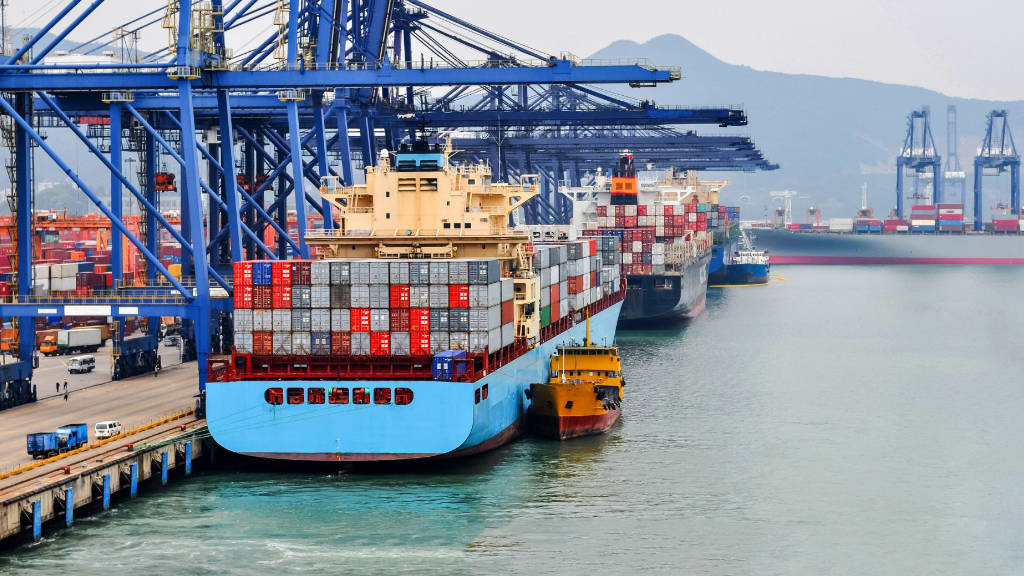
Turkmenistan is strategically positioned along the “Middle Corridor,” which serves as a crucial trade route between East and West, with the country becoming a crucial part of the International North-South Transport Corridor. Its Turkmenbashi Port on the Caspian Sea is significant and can develop as a key alternative route into Central Asia.
Turkmenistan’s economy is largely driven by its vast natural resources, with a strong emphasis on energy and agriculture. With the world’s fourth-largest natural gas reserves and significant oil resources, it relies heavily on these industries. The government is encouraging foreign investment in these sectors as well as renewable energy, particularly solar and wind. Agriculture also plays a vital role, with cotton being a staple, along with wheat, vegetables, fruits, and livestock products for domestic use and export.
Turkmenistan is not highly active in free trade agreements but participates in various economic cooperation frameworks. It has a Trade and Investment Framework Agreement (TIFA) with the United States and Central Asian countries like Kazakhstan, Uzbekistan, Tajikistan, and Kyrgyzstan, aiming to boost trade and investment in the region. Turkmenistan also participates with the Commonwealth of Independent States (CIS) and has a bilateral investment treaty with Russia. In 2024, Turkmenistan signed a deal with Uzbekistan to create a free trade zone in the Shavat-Dashoguz region, promoting cross-border trade with favorable customs and infrastructure.
With a population of 7.5 million and a GDP (PPP) of US$131.7 billion, Turkmenistan’s GDP per capita (PPP) stands at US$19,728. The country is expecting to see a GDP growth rate of 6.5% for 2025.
Regarding bilateral trade with Russia, the turnover increased from US$865 million in 2021 to US$1.6 billion in 2022 and an estimated US$1.8 billion in 2024. Bilateral trade thus far during 2025 has increased by 58%. The overall trend in Turkmenistan-Russia bilateral trade is likely to further improve as logistics connectivity, infrastructure projects, and the potential for transit trade become operational.
Russia’s TMH Energy Solutions, or TMH ES, part of Transmashholding, will supply a batch of diesel generators to the El Dabaa Nuclear Power Plant, currently under construction in Egypt, according to CEO Andrei Vasiliev.
He said that “diesel generating backup is an important part of ensuring any nuclear power plant can be used safely, and El Dabaa is no exception. We are providing the El Dabaa NPP with diesel generators, which we have produced ourselves. The contract that we signed covers four units, and we will begin delivering them at the end of this year. The generators and auxiliary systems are currently in the active stage of production.”
Vasiliev said that 20 diesel generators would be installed at El Dabaa NPP under the contract, with five at each of its four units, and added, “We supply equipment not only to El Dabaa NPP but also to a whole range of other power plants that are being built, and we are constantly interacting with clients connected with Rosatom’s new sites. One project in Kazakhstan attracted our interest, and we have signed an agreement on it with Rosatom, as with all of Rosatom’s prospective projects.”
TMH Energy Solutions is a center for the development and production of both individual components and all-in-one solutions across all transport categories, including rail, wheel, and water transport, as well as stationary power supply facilities for use as principal energy sources and reserves. The company also develops solutions for transport hybridization and exploration of promising types of fuel, including gas and hydrogen.
The intergovernmental agreement on the construction of El Dabaa NPP, the first nuclear power plant in Egypt, was concluded in November 2015, and the engineering, procurement, and construction (EPC) contract was signed in 2016. The design for the power station includes four 1200-MW power units with VVER-1200 reactors. Rosatom Group plans to commission the first unit in 2028.
The Russian State Duma has ratified an agreement with the United Arab Emirates to avoid double taxation of income and capital and prevent tax evasion. The government introduced the bill, No. 930586-8, on May 29.
This new agreement replaces an earlier 2011 agreement which applied only to the income of state-owned investment funds.
An explanatory note to the bill says that the new agreement aims to ensure that the same profit of an individual or an entity from Russia and the UAE is taxed only once, and states “For the purpose of ensuring stable development of the economy of the Russian Federation, the development and expansion of external trade, economic and investment ties, an active process is under way today to redirect Russian business to the markets of Asia and Middle East countries. The UAE plays a particular role in broadening economic ties of the Russian Federation in the Middle East region.”
The agreement applies to profit tax, personal income tax and corporate and individual property tax in Russia, and to income and corporate taxes in the UAE. The mechanism for avoiding double taxation is based on mutual offset, where taxes paid in one country will be taken into account when calculating tax liabilities in the other country, but they cannot be higher than the tax paid in the country of tax residency under national legislation.
Dividends, interest and royalties will be taxed at 10% and will be exempt from tax if paid to the other country or its financial and investment institutions.
The agreement also paves the way for expanded exchanges of information on taxes, including bank information. A special point of the agreement does restrict the sides’ rights to apply their own national legislation to hydrocarbon revenues.
The new agreement will enter into force on January 1, 2026 following ratification by both countries with the UAE parliament still to vote on the issue. The 2011 agreement will cease to apply once the new one goes into effect.
The Central Bank of Russia has proposed to the Russian State Duma that the largest “systemically important” Russian banks must provide their clients with the option to use digital rubles from September 1, 2026. This is a pushback from the previously agreed-upondeadline of July 1 this year.
The bank has instructed Russian retail companies with annual revenues exceeding ₽120 million (US$1.53 million) to also adapt and provide infrastructure for handling digital ruble transactions and have this up and running by the same date.
The Central Bank classifies 11 credit institutions as systemically important banks. These are Sberbank, VTB, Alfa-Bank, T-Bank, Russian Agricultural Bank, Gazprombank, Sovcombank, PSB, Moscow Credit Bank, Raiffeisenbank, and UniCredit Bank, as well as Ozon Bank, the Ural Bank for Reconstruction and Development, Bank Saint Petersburg, Pochta Bank, the Russian National Commercial Bank, and the Russian Standard Bank.
Other banks with a universal license, as well as their corporate clients with annual revenue exceeding ₽30 million (US$384,000), will have until September 1, 2027, to adjust their systems. Smaller banks and merchants with annual revenue below this will be required to work with the digital ruble starting September 1, 2028. This obligation will not apply to small retail outlets with annual revenue of less than ₽5 million (US$64,000).
The bank said that “The new timeline was established following discussions with market participants and relevant ministries. It accounts for the time needed by banks and retailers to adapt their systems.”
Payments using digital rubles will be processed through a universal QR code system developed by the National Payment Card System (NPCS). All banks must complete technical preparations to support this system by September 1, 2026.
The NPCS universal QR code enables acceptance of all payment types, including banks’ pay services, the Faster Payments System (FPS), installment services, and the digital ruble. It is also available across the entire network of banks and merchants operating through the FPS. This reduces the integration costs.
The digital ruble represents a third form of Russia’s national currency, which the Central Bank plans to issue alongside existing cash and non-cash forms. The regulator has been conducting a pilot with real digital rubles since August 15, 2023.
The Central Bank’s proposals, which have been submitted to the State Duma. The regulator published them after President Vladimir Putin called on the Central Bank and the government to accelerate the mass adoption of the digital ruble and finalize its rollout timeline earlier this month.
Russian rapeseed oil has gained increasing popularity in the Chinese market and now accounts for over half of China’s imports of this product, according to Dmitry Kurbatov, Director of International Trade at Forward East Group. He was speaking at a Russian export business mission in Chengdu, China.
Kurbatov said, “Chengdu is the global capital of rapeseed oil. Russian rapeseed oil now holds over 50% of China’s import market.” Russia supplied 1.09 million tons of rapeseed oil, over 700,000 tons of sunflower oil, 132,000 tons of soybean oil, and 6,000 tons of flaxseed oil to China in 2024. Kurbatov said that in addition to vegetable oils, other promising export categories include meal, beet pulp, fishmeal, and barley feed flour.
Noting that oil and fat products constitute a significant share of Russian agricultural exports to China, Pavel Zarkov, the investment director at Russia’s Sodruzhestvo Group, said that with projected growth in oilseed harvests in Russia, there is potential to expand trade in this segment. “Sodruzhestvo’s production potential for key products includes 3 million tonnes of rapeseed meal, 2.5 million tonnes of rapeseed oil, and 1.5 million tonnes of soybean oil.” The group is currently implementing a project in the Amur region to build an oil extraction plant, which will provide an additional 200,000 tons of vegetable oils annually to Chinese partners.
Hong Wei, the head of the Trade and Transport Department at the Jiangsu Provincial Foreign Trade Corporation, said that the development of new logistics routes will thus facilitate trade. New supply chains are being established, including direct rail routes to Chengdu.
Chengdu, the capital of Sichuan province, has become a gateway for other Russian exports to China, particularly meat products, thanks to express container trains. Natalya Bartnovskaya, Business Development Director at the Cherkizovo Group, said that “Reduced delivery times create new opportunities and expand access not only to Sichuan’s large market but also to neighboring provinces.”
Sichuan has a population of 84 million and borders Chongqing municipality, Gansu, Guizhou, Shaanxi, Tibet, Qinghai, and Yunnan. These have an additional, collective population of 192 million consumers.
David Cheng, the vice president of the China Chamber of Commerce for Import and Export of Foodstuffs and Local Livestock Products, noted the growth in pea and cereal trade. Russian suppliers are displacing exporters from other countries in several categories.
For example, China opened its market to Russian peas in 2022, and exports have exceeded 2 million tons since 2023. From January to May 2025, shipments grew 31% year-on-year.
Another example is oats. While China previously imported them mainly from Australia, Russian oat flakes now hold half of the import market.
Ilya Ilyushin, head of the Agroexport federal center stated that Russia supplied US$6.4 billion worth of agricultural products to China in 2024. This year, exports could exceed US$7 billion, with the potential to reach US$11 billion by 2030 through increased vegetable oil shipments and expanded meat, dairy, and food product categories.
Russia’s PhosAgro boosted fertilizer exports 10% year-on-year to 4.3 million tonnes in January-May 2025, CEO Mikhail Rybnikov has said. He was speaking at the St. Petersburg International Economic Forum and stated, “After fully covering the needs of Russian farmers, we increased exports by approximately 10%, or 400,000 tonnes, to 4.3 million tonnes in the first five months of 2025. This includes almost 1 million tons supplied to India compared to 700,000 tons the previous year, and exports to Africa also grew by a third.”
He also said that supply to the Russian domestic market was following the same trends as last year. “We are not seeing any reduction in consumption. The overwhelming majority of agricultural companies have an annual purchasing plan and annual fertilizer budget. We don’t expect purchasing to decrease before the end of this year.”
He said that the increase in EU import duties on fertilizers from Russia and Belarus, starting on July 1, would cause market prices to rise. “On the U.S. market, when they brought in import duties for Russian products, prices rose US$100 above global prices at one stage. The same thing will happen on the European market, which is also in need of urgently reorganizing its logistics. Alternative suppliers will also probably raise prices. At first, this will all be paid for by European farmers—or the state, if it grants subsidies to farmers—and then after that they will have to try and find ways to cope.”
He said that Europe had been decreasing fertilizer consumption for many years. “This compromises the quality of wheat and means that Europe may gradually move from being an exporter to being an importer of wheat.”
He said that if exporting to the European market ceases to be worthwhile for PhosAgro due to increased import tariffs, the company would redirect these products to more marginal markets. “We work on the basis of where the best margins are. If European markets decline, then we will move on to the markets with the best returns, whether that is Africa, Brazil, or India. We also have high hopes for the development of the Russian market in the future. The Agriculture Ministry plans growth in fertilizer consumption from 5.5 million tonnes to 8 million tonnes by 2030.”
Rybnikov added that “Fertilizer prices are currently growing across the world due to European tariffs, the situation in the Middle East, and decreased stocks in India. Diammonium phosphate prices were previously forecast in the region of US$500 per ton, but this has now risen above US$700 per ton. If we look at America, CFR prices are above US$800 per ton. And they are approaching the same level in India due to low stocks.”
Rybnikov also said that urea prices had grown from US$350 per ton to US$450 per ton last week due to the situation in Iran.
The world’s largest fertilizer producers, based on export value and production volume, are Russia, China, and Canada. Other significant producers include the United States, Morocco, Saudi Arabia, and India. In 2023, Russia’s fertilizer exports were valued at US$15.3 billion, with China second at US$10.9 billion and Canada third with US$10.4 billion.
President Putin has engaged in a lengthy, moderated Q&A session, with Nadim Koteich, of Sky News Arabia the moderator at the SPIEF 2025 event. Questions were direct and included involved answers from Putin about the concept of developing a multipolar global society, in-depth discussions about the Israel-Iran conflict, the Ukraine conflict, and issues pertaining to foreign investment and clarity on the much discussed ‘buy-back’ clauses.
This is what they had to say.
Multipolarity
NK: “The overarching theme of this years’ SPIEF forum is “Shared Values in a Multipolar World”. This is a very high ambitions’ ceiling. What does Russia bring to the table on that regard?”
VP: “I attempted to convey this in my speech. It seems to me that everything that Russia is doing is aimed at uniting the efforts of all our partners, friends, and everybody who wants to work with Russia to address these global civilisational challenges.
Above all, we seek to make global development balanced and consistent with the interests of as many countries as possible, to shape a multipolar world order where members of the international community would agree with each other and create tools enabling them to find solutions even in most complex conditions – solutions that would benefit everybody rather than certain groups or associations, military or economic blocs.”
NK: “Mr President, this effort to build a multipolar world seems like more of a resistance of an existing order, rather than a genuine, consistent, coherent effort to create a multipolar world that you’re talking about. Is it an objective-driven effort or it’s only resisting current unfavourable kind of order?”
VP: “To my mind – and I have already spoken about it on various platforms in the past – changes are occurring regardless of whether we facilitate these changes or not. These are objective global development trends.
I also stated that changes in the world are of a fundamental nature, occurring due to the emergence of new economic leaders. Look how the so-called G7’s share in the global economy has shrunk in recent years. It continues to shrink year after year. And look how the share of BRICS countries is growing.
This is an objective process, independent of any clashes or acute armed conflicts worldwide. This process has continued for decades. And when they claim that Russia has only recently pivoted toward relations with the Global South and Asia – well, this is incorrect. We made this decision long ago, in alignment with persisting global and objective trends.
Africa will soon have a population of 2.5 billion. You know, this is a hard fact. It will happen and nothing can stop it. What will all these countries, peoples and continents strive to do? To improve the well-being of their peoples. They will definitely strive to increase their economic and humanitarian potential. These are inevitable things that are happening to our civilisation.
Our task is to give this inevitable process a civilised framework and to undertake joint efforts that will not only accelerate these trends but also render them more balanced. This is to ensure that decisions are timely, most effective, and mutually beneficial for all participants in this transformation, including, incidentally, those nations that are gradually yet inevitably ceding some of their former positions in the global economy.
We remain willing to negotiate with them as well, prepared to seek common ground on all matters, if they genuinely want this. But should they insist on preserving their monopoly at any cost, should they cling to the instruments of colonial influence in global affairs, then they must reconcile themselves with the diminishing position they inevitably assume through such conduct.
This encapsulates the purpose behind all our efforts – both in the national dimension, with due account for our domestic and foreign policy, and in collaboration with our friends and partners.”
US & Israel vs Iran
NK: “Let me bring the conversation from values closer to the conflict areas in the world.
Israeli statements are normalising the fact that a country might kill the president of another country. That is basically the conclusion of last week’s statements. Yes, Ayatollah Khamenei is not a head of state, but he has enough gravitas to be considered the head of state and to be protected by the articles of international law. But when we normalise the idea – no matter where you stand on Iran – when we normalise the idea of a country killing the president of another country publicly, what kind of new rules are being set? They are obviously contradictory to the kind of values you’re trying to put forward, isn’t that so?”
VP: “I note the statement: “Russia and China are creating a new world order.” Russia and China are not creating a new world order; rather, we are only giving it form. The new world order is emerging naturally, like sunrise. There is no escaping it. Our role is to help shape its contours, perhaps clearing the way for this process to become more balanced and aligned with the interests of the overwhelming majority of countries.
We strongly anticipate that all nations will come to recognise and eventually understand – as I have previously stated – that this approach to finding a solution proves far superior to coercive pressure or the neo-colonial paradigm in which humanity has lived for centuries, if not millennia.”
NK: “Would you allow me to go back to the question about normalising the talk about a country killing the president of another country, in the case of Iran and Khamenei and Israel within this conflict. I mean, it seems that those who are making the new values are not the Global South, obviously, not Russia, not China, it’s the Israelis. Are you comfortable with that? The new values now are that one country is setting the rules for another country that who has or doesn’t have enrichment, for example. One country is threatening to kill the president or the head of that country. Are these values defendable in any way?”
VP: “To me, there is nothing new about it. This is the first point. Second, and I wish to emphasise it, the Russian Federation has consistently advocated for guaranteeing every nation’s security without compromising that of any other state. This remains our principled approach. This may sound like a generalised answer but let me assure you: it is the actionable policy of the Russian Federation.”
NK: “Allow me for a very direct question about the situation. Donald Trump is seeking what he calls the total surrender of Iran in terms of the nuclear project. Would you seek the total surrender of Vladimir Zelensky in the same way?”
VP: “First, these situations are fundamentally different. Second, our objective is not Ukraine’s surrender. We insist that Ukraine recognise the established territorial realities.”
NK: “Mr President, on a more practical question concerning the crisis in the Middle East, the current crisis touches on geopolitics, energy, and it has repercussions that go beyond the parties involved in the struggle.
Is it a test for how the South can play a role in mending the fences between both countries, in putting some good imagination around the solution, architecting a solution that can be acceptable by two parties that are fighting, you know, head-to-head? Is this a test for what you are proposing and trying to create as political weight for the South?”
VP: “Yes, I believe it is quite possible. Experience and reality demonstrate that many states of the region maintain in some ways complex and in some ways stable relations with both Israel and Iran. This provides reasonable grounds to believe – and indeed to hope – that the Global South collectively, and regional actors specifically, can exert influence to help put an end to this acute phase of confrontation.
When I said that Russia’s principled position is that no country’s security should be guaranteed at the expense of other countries’ security, here we have, on the one hand, Iran’s uranium enrichment programme, Iran’s legitimate right to carry out such activity, its right to peaceful nuclear energy development; and, on the other hand, there is Israel’s security concerns. I am convinced that a mutually acceptable solution can be found. Countries of the Global South, especially countries of the region, can undoubtedly have a positive influence on this process, on this search for solution. I believe such a solution exists.”
NK: “Today, the Russian Ambassador at the United Nations said that the only way forward is a political solution between Iran and the Israelis. Are there any preliminary points about the solution or are we still too far from that?”
VP: “In such situations, it’s always better not to run ahead so as not to upset the process. That said, in my opinion, there are certain points of common interest. We have set forth our position to both parties. As you know, we maintain contact with Israel as well as with our friends in Iran. We do have certain proposals involving Russia.
I must emphasise that we are by no means positioning ourselves as intermediaries. We are merely putting forward ideas. Should these ideas prove to be appealing to both countries, we will be simply pleased. I will repeat, we maintain contact with Israel. As you are aware, not so long ago, I spoke with Prime Minister Netanyahu, as well as with the President of Iran and the President of the United States, who are certainly directly involved in these developments. I presented them with my vision and a potential path to resolving the situation. Our proposals remain under discussion. We maintain near-daily contact with our Iranian friends, so we will see how the situation unfolds. I would like to see our ideas among those implemented.”
Ukraine
NK: “How is the war in Ukraine reflective of the values that the St Petersburg Forum is trying to put forward, to defend, to underscore?”
VP: “It is very easy to explain. And it is directly related to what we said before, what I said before. I said that no country’s security should be guaranteed at the expense of another country’s security.
From the early 1990s and for decades, we received repeated assurances that by no means, never, under no circumstances, NATO would expand eastward. After that, we have witnessed five, or effectively six, expansion waves. Despite our persistent objections, these were ignored. This is the first.
Without doubt, these represent rudimentary manifestations of the old, or even centuries-old, neo-colonial policy upgraded to a certain extent in order to align with contemporary trends, while retaining its fundamental nature. These are exercises of power politics that disregard the legitimate interests of the Russian Federation. This is my general assessment.
Regarding Ukraine, all developments there similarly constitute exercises of power politics. What am I referring to? The bloodstained anti-constitutional coup in Ukraine. What did this represent? More power politics. The previous US administration openly admitted it had invested billions of dollars in orchestrating the coup. These admissions were made publicly, without any constraint.
Our objective was to protect the population that historically and culturally identified with Russia, the Russian culture and its people – specifically, the residents of Crimea. Subsequently, we attempted to settle the situation in southeastern Ukraine, particularly in Donetsk and Lugansk. We made attempts.
However, once again resorting to power politics, our ideological adversaries, so to speak, chose to impose a military solution in Donetsk and Lugansk – in Donbass. It was not Russia that initiated hostilities. Following the anti-constitutional coup, part of the population in southeastern Ukraine rejected both the coup’s outcome and the authority of its perpetrators. It was against them that military operations were first launched.
We made attempts to achieve a peaceful resolution and to put together broken pieces, but our so-called “partners”, as it was further revealed, initiated the peace talks for one purpose only: to arm Ukraine and continue these hostilities.
Ultimately, we had no choice but to recognise the independence of these republics – Lugansk and Donetsk. For eight years we refrained from such a decision, persistently pursuing diplomatic solutions. But eventually, we were forced to recognise their independence and extend our support, including military assistance, in order to end the war launched by our Western adversaries and by those whom they relied and continue to rely on now in Ukraine – the radical nationalists and neo-Nazis.
Therefore, responsibility for the tragedy in Ukraine lies not with Russia. It is the responsibility of those who refuse to reconcile with the global changes in the world.”
NK: “Your army is advancing beyond the four areas that are considered Russian by Moscow. So, what is your endgame? How is your army going to go and for what effect?”
VP: “You mentioned the regions in Ukraine that we regard as part of Russia. I have stated on numerous occasions that, in my view, the Russian and Ukrainian peoples are essentially one people. In that sense, we see Ukraine as ours.
However, we also recognise the realities on the ground as they evolve. There are many individuals in the neighbouring country who are committed to asserting their sovereignty and independence, and we respect that. In fact, we have never denied the Ukrainian people’s right to independence and sovereignty.
At the same time, the foundation for Ukraine’s independence and sovereignty was clearly established in its 1991 Declaration of Independence, which explicitly states that Ukraine is to remain a non-aligned, non-nuclear, and neutral state. It would be constructive to revisit these core principles, as they formed the basis upon which Ukraine gained its statehood. That is the first and most fundamental point.
Secondly, from the very outset – when the conflict had already escalated significantly – we proposed to the Ukrainian leadership at the time that hostilities be halted immediately. We called for the withdrawal of Ukrainian forces from the regions where the local population had clearly expressed their desire not to remain within Ukraine, particularly in response to what they perceived as unconstitutional and anti-state actions. These people sought either independence or integration with Russia. Our proposals were rejected.
Furthermore, these are not purely political decisions, but rather the result of military logic. Military commanders assess terrain – rivers, hills, ravines – and determine the most strategic paths to advance while minimising casualties and achieving their objectives. As a result, the dynamics of military operations naturally lead to the presence of troops in various territories. There is an old saying, not quite a proverb, but a long-standing principle: wherever the foot of a Russian soldier steps is Russian land.
I do not want this to sound militaristic. But the truth is – and I want to emphasise this very clearly, as it is absolutely sincere – at every stage of the unfolding events, we proposed dialogue. We consistently urged our counterparts in Ukraine to stop and engage in negotiations.
We said: “Let us talk now, before the situation deteriorates further. Continued reliance on military action alone risks leading to more difficult circumstances, after which any negotiations would have to take place from a much less favourable position for you.” This scenario repeated itself more than once.
There are well-known political figures from other countries – thankfully still alive and well – who can personally attest to our repeated proposals to halt hostilities. On several occasions, after hearing our suggestions, they would leave Moscow for Kiev, but later on they would tell us: “We’re being accused of acting as Kremlin agents. That’s it, we are stepping back and will no longer be involved.”
Each time, the response we received was a firm “no.” And we warned: if this path continues, the consequences will be more severe. Still, they refused to engage. Why? Because certain actors, particularly in Europe, still operate with outdated, neocolonial mindsets. They believed that they could easily exploit the situation to their advantage by weakening, destabilising, or even dismantling Russia, all in the hope of reaping strategic or economic gains.
I am sure that this is why former Prime Minister Boris Johnson – undoubtedly at the urging of the former US administration and Mr Biden – travelled to Ukraine and advised against reaching any agreement with Russia. Yet the agreement was already on the table. During the negotiations in Istanbul, as I have said before, we had reached an almost complete consensus on nearly every issue. All that remained was to finalise the accord. I was prepared then to meet with the head of the regime and finalise it.
But no, they had to send Mr Johnson, clearly with the support of the then Biden administration, to dissuade Ukraine from signing the agreements. Instead, they attempted to secure what they called a “strategic defeat” of Russia on the battlefield. The result? New territories came under our control. The Russian Armed Forces are now advancing daily along the entire line of contact.
Look at what they have done – they entered our Kursk Region. First, they lost 76,000 people there. That’s a catastrophe for them – 76,000! In the end, as we said, we pushed them out. But they started posing a threat all along our state border with Ukraine, in two other neighbouring regions as well.
What has this led to? They already lack manpower, and now we’ve had to establish a security zone along large sections of the border, forcing them to divert troops – troops they can’t spare – from critical parts of the frontline.
Their combat units are only 47% operational. They are losing combat capability. And they have stretched the line of contact by nearly 2,000 kilometres. We already had a 2,000-kilometre front, and now they have created new threats along the border, adding another 1,600 kilometres or so.
They have spread their armed forces thin. From a military standpoint, it’s hard to imagine a more strategically flawed decision. They are creating problems for themselves, and we are forced to respond.
You mentioned “some other territories.” Yes, that’s true. But specifically along the state border, they entered the Kursk Region, committing multiple crimes against civilians.
We pushed them out, inflicting huge losses in the process. And now we must establish security zones along the border because they keep launching artillery and drone attacks.”
NK: “How deep is the security zone?”
VP: “In the Sumy Region, the depth of our operations ranges from 10 to 12 kilometres. Around 8, in some others 10 or 12 kilometres. Then comes the city of Sumy, the regional centre. We don’t have an objective to take Sumy, but I would not rule it out either.
Why are we doing this? Because they are creating threats for us, constantly shelling border areas. This is the result of their utterly reckless, unjustifiable actions.
The only goal was political: to demonstrate that they still can receive something from their foreign sponsors. They have already received nearly US$250 billion. But no, it’s never enough. They want more and more – and on top of that, half of it is being embezzled, if not more.
That’s why we are now operating in these territories. This is the logic of how the confrontation has unfolded and what has driven it.”
NK: “In a previous answer about Ukraine, you mentioned the nuclear aspect of Ukraine in a very subtle way. To be honest, I have read some reports, most of them are in Russian media, that there is an assumption that Ukraine might opt for using a dirty bomb against Russia. Do you take these reports seriously? Do you have intelligence that supports this kind of probability?”
VP: “First of all, it would be a colossal mistake on the part of those who we refer to as neo-Nazis on the territory of present-day Ukraine. It might even be their last mistake. Our nuclear doctrine, common sense, and the way we operate in real life indicate that we always respond to threats posed to us in a symmetrical manner. We always respond and always symmetrically.
Therefore, our response would be extremely tough, catastrophic for the neo-Nazi regime, and unfortunately, for Ukraine itself. I hope it never comes to that.”
NK: “From the tone of your answer, I can conclude that you take these reports seriously. Is there evidence supporting these reports? Like intelligence evidence?”
VP: “No, thankfully, we have no confirmation of any such intentions. However, we operate on the premise that someone with a sick imagination might come up with such ideas. I believe I have provided a comprehensive answer with regard to our potential response.”
Iran & Israel
NK: “In Western media, there are reports saying that the Iran war is a good thing for Russia. First, the oil price is up. Second, the West has one more problem on its table to take care of. And third, Ukraine is on the back burner, so all the news is on Iran rather than on Ukraine. How would you comment on that? And what do you say for those who are saying that Russia is unreliable, a lie, because it did not step up for Iran?”
VP: “Those who promote narratives about Russia being an unreliable ally are provocateurs. They are provoking the situation. But it will not help them; they will not achieve their goals.
First of all, conflicts only look similar. Now, regarding whether Russia is a reliable ally, or not. It has already been mentioned here that we must show certain solidarity, and that is true. But in every case, conflicts are, nevertheless, fairly unique.
I want to draw your attention to the fact that nearly two million people in Israel are immigrants from the former Soviet Union and the Russian Federation. Today, Israel is almost a Russian-speaking country. In modern Russian history, we have always taken that fact into account. That is the first point.
Second, we have traditionally had very good, trust-based, friendly, and allied relations with the Arab and Islamic world. Given that around 15% of Russia’s population is Muslim, we hold an observer status at the Organization of Islamic Cooperation. That is also a factor to reckon with. We must be mindful of these aspects.
We have friendly relations with Iran. First, we always fulfil our obligations – this also applies to the Russia-Iran track. We support Iran in its efforts to defend its legitimate interests, including its interest in peaceful nuclear energy. We have always maintained this position. Our principled stance on this matter and in this conflict has not changed.
Some say we should have done more. More in what sense? Launch military operations? We are already conducting military operations against those we see as opponents of the ideas that we defend, and those who pose a threat to the Russian Federation. Fundamentally, those forces are the same in Iran and in Russia. They are located somewhere in the rear areas, behind our backs. However, they are not the ones who are on the line of contact.
We have certain obligations, and we defend Iran’s right to peaceful nuclear energy not in words, but in actions. What does that mean? Despite the challenging situation surrounding Iran, we have built a nuclear reactor in Bushehr. We have signed a contract to build two more nuclear reactors. Despite the difficult situation, despite certain risks, we are continuing this work. We are not evacuating our personnel from there.
Moreover, relying on a certain level of relations with Israel and our improving relations with the United States, we raised this issue with Israel and President Trump. We will keep doing our work in Iran based on our view of Iran’s right to peaceful nuclear energy, and of us acting strictly within international law, and we request that our personnel remain out of harm’s way.
Prime Minister Netanyahu agreed with that, and President Trump promised to support our legitimate request. Does that not count as support of Iran? I believe it is direct support. In addition, we have adopted a particular stance at the UN. I am convinced that our position at the UN and elsewhere serves the interests of both Iran and the State of Israel.”
World War Three
NK: “SPIEF this year coincides with the 80th anniversary of commemoration of the Day of Victory in World War II. Are you concerned that we are heading into World War III in any way?”
VP: “Yes, I am. I mean it. The conflict potential abounds and it is growing. Right under our noses – and this directly concerns us – there is a conflict that we are enduring in Ukraine. There are the developments in the Middle East as well. We are very concerned about the events related to Iran’s nuclear facilities and potential ramifications.
Without a doubt, this requires us to not only focus on the unfolding events, but also to look for solutions, preferably peaceful, across all areas. I mean it sincerely.”
Foreign Investment
NK: “Mr President, I listened very carefully to your speech, and you mentioned investments, but it wasn’t that clear about foreign direct investments. Where does Russia stand on that? Where do you stand on that? Do you still care about foreign direct investments? Do you see it as an opportunity or as a burden?”
VP: “We believe that private investment is what we need, and the Russian economy is unlikely to develop effectively without this. Well, this also concerns foreign investment in full measure. We did not evacuate our investors (who worked here for a long time) from Russia, and we did not expel anyone from our country. Many investors quit of their own accord, suffering major losses. But our policy in this sphere has not changed. Yes, in principle, our economic operators boast a sufficiently impressive investment potential, but we certainly welcome any foreign investment.
In the first quarter of 2025, fixed capital investment volumes soared by 8.7%. I know that certain problems facing Russia were discussed; this includes tensions linked with the high key interest rate, and investment will not be retained until the end of the year. Nevertheless, the Central Bank assumes that, in late 2025, the real economy will continue to borrow loans at 10–11% interest. We shall see how this works out. I would really like this to come true.
But we certainly welcome foreign investment, and we will do our best to create favourable conditions, so that our partners would feel comfortable here.
Prince Nasser bin Hamad Al Khalifa from Bahrain is here. They have already reached an agreement with the Russian Direct Investment Fund on launching specific work. The first steps have been taken. These projects may not be very impressive, totalling about ₽15 billion (US$191.5 million), but we are working very actively with the United Arab Emirates in the field of sovereign funds. We are cooperating with Saudi Arabia and other countries. By the way, our partners and our friends did not make this decision yesterday or today; they made it several years ago. They trust their Russian partners and simply automatically (I would like to emphasise, automatically) co-invest in projects financed by Russia’s Direct Investment Fund – with 10% returns.
They are doing this promptly, without inquiring about future results. This is a sign of their high trust, and we appreciate this very much. Later, they invest more and more. You should speak with Kirill Dmitriev (head of the Russian Direct Investment Fund) who will provide the final statistics. This involves tens of billions of dollars.
It is possible to use this also through other sources and tools. We have virtually no restrictions for our foreign partners, in terms of applying their efforts and channelling their capital. I believe that this is a key trend in our cooperation.”
Foreign Buyback Policy & Nationalisation
NK: “There are two trends that I realised talking to Russian businessmen, either here or back in my country, the UAE. Is there is a kind of Russian rejection of buyback? When the war happened, there were some foreign investments that were bought by Russians, and now these might want to buy back their investments.
Russia seems to be blocking that, because new Russian entrepreneurs bought and invested in these operations. The second trend that I realised is that people are a little bit worried about nationalisation. There are some nationalisation efforts taking place within Russia. I heard about one of the airports being bought back or even taken by force of court from the Russian owners. So, how do you see these two trends impacting the rebound of the Russian economy?”
VP: “Nationalisation cannot have a positive effect on Russia’s economic growth, and we realise that. As far as I understand, the case you mentioned is the case of Domodedovo Airport in Moscow.
I apologise for my language but the fuss surrounding this facility has persisted for quite some time. The dispute between the entities involved did not emerge recently. It has continued for many years before ultimately being resolved through judicial proceedings. This case has nothing to do with nationalisation. Nationalisation is a process stipulated by law. We do not enforce this law or its provisions.
As I previously said during a meeting with the business community, in my opinion, the problem is that during privatisation, significant injustice occurred. Assets worth millions were privatised for a nominal price of one ruble. This is clear. From a standpoint of social justice, those decisions were far from perfect. However, it would be an even bigger mistake to reverse everything now.
Therefore, my opinion is, we must establish clear statutory limitations for such transactions and resolve this matter once and for all, conclusively.
The situation you described has nothing to do with de-privatisation. Regarding the potential return of our partners, so-called “buyback,” several aspects also need careful consideration.
First, we need to identify which companies left our market, under what circumstances, and on what grounds. If some companies departed for political reasons, under the pressure from the political elites in their home countries, this makes them unreliable partners. Their withdrawal put their workers at risk of losing their jobs. This appears to have been the intended outcome. However, the negative impact was mitigated as Russian businesses took over management and filled the opening niches. Frankly, from this perspective, those decisions ultimately changed the quality of the Russian economy by enabling our business leaders to join the management of these companies or become owners.
However, where legally binding agreements exist that guarantee buybacks, Russian companies will honour these obligations. We support fostering reliable and stable business relationships, yet this has not always been reciprocated by all parties.
In light of these considerations, the Russian Government has received instructions to take action. I am asking members of the parliament to endorse the proposed regulatory improvements. It is necessary to ultimately decide on the return of international companies seeking to re-enter our market. We must support everything that benefits us.”
Vladimir Putin has given the annual plenary speech at the St.Petersburg International Economic Forum (SPIEF). The main basis for his speech was all Russian domestic policy, in which he discussed the Russian Economy, Monetary Policy, Employment, Education, Tax and Funding Policies, Tourism and Recycling, Russia’s Investment Climate, Technological Development and Funding, Digitization, Foreign Trade, Defence & Security, Future Growth and the BRICS. We have divided his speech up into these separate categories. Putin’s comments are prefixed VP, our analysis is prefixed RPA.
VP: “This year, amongst important topics, is the quality of growth in the context of a multipolar world and major global challenges. These include profound shifts in the global economy and demographics, such as the planet’s population dynamics, as well as social, public, and geopolitical tensions that manifest through crises and rapidly escalating regional conflicts, unfortunately visible today in the Middle East.
These include climate change and urgent environmental issues that demand our attention and response. And, of course, the transition to a new technological era driven by digital platforms, artificial intelligence, and autonomous systems capable of making decisions independently of human input is also a central focus.
The key question is how to ensure that positive technological advancements are accessible everywhere, so that new digital and technological solutions enable countries, regions, and cities to achieve new levels of development and progress. It is essential that the benefits of these technological breakthroughs are shared broadly, transforming society, reducing poverty, improving quality of life, and providing equal opportunities for every individual to acquire the knowledge needed to fulfil their potential. In other words, it is crucial to uphold the fundamental principle of justice.
In my speech, I will focus on the challenges Russia faces in these areas, the steps we are taking in collaboration with business, scientific, and public organisations, as well as the approaches we propose to support economic growth, not only within our country but also through creating joint mechanisms for global and regional development in partnership with our friendly nations.”
Russian Economy
“I will start with the current state of the Russian economy. Despite a challenging international landscape, Russia’s GDP has been demonstrating an annual growth rate of over 4% over the past two years, which is above the global average.
Regarding the structure of this growth, let me share a specific indicator with you – Russia’s non-oil-and-gas GDP. This excludes sectors related to hydrocarbon production. In 2023, Russia’s non-oil-and-gas GDP increased by 7.2%, followed by an additional 4.9%, in 2024. These are solid figures exceeding the overall GDP growth rates.
In other words, commodities no longer play a defining role in Russia’s economic growth patterns. Moreover, the contribution of the commodities sector is even negative currently.
Incidentally, defence manufacturing was not the only driver of our overall GDP growth, as some in the West may believe. It did play a role in this regard, but we must keep a close eye on the way this growth has been structured.
Over the past two years, the top performing industries have included agricultural production, manufacturing in general, the construction industry, logistics, services, finance and the IT sector, covering almost all the key, essential segments of the national economy.
What does this mean? It means that thanks to the efforts of tens of thousands of enterprises and companies, their teams, managers, and their proactive approaches, as well as the work of millions of entrepreneurs, the Russian economy has been steadily developing, achieving new heights in terms of quality, complexity and diversity. The idea of the Russian economy being completely commodity-based and dependent on the exports of hydrocarbons is clearly outdated; it is becoming a thing of the past. We are living in a different reality now.
Russia is the world’s fourth largest and Europe’s number one economy in terms of GDP. I am not talking about the per capita GDP, but about the sheer size of the economy. Still, this is a major milestone.
Of course, achieving this result is not enough. It is essential that we consolidate our standing as a major economy by offering a business-friendly environment so that businesses from Russia and our friendly countries can invest their assets here, as well as upgrade and expand their manufacturing capabilities in Russia.”
RPA: Putin is quoting Russia’s GDP figures based on Purchasing Power Parity (PPP) data. For comparisons with other economies, please see here.
Monetary Policy
“Our key task this year is to ensure that the economy transitions to a path of balanced growth. What does that mean? We understand it to mean that we must achieve moderate inflation and low unemployment. According to statistics, annual inflation has already dropped to single-digit levels below 10%. As of June 16, it stood at 9.6%. That is still high, but inflation targeting continues.
Certainly, this outcome is due both to the Government’s steady efforts to develop the supply side of the economy and to the responsible actions of the Central Bank. That said, I would like to highlight the following: inflation dynamics have been better than many experts expected and even better than the forecasts made by the Bank of Russia. This has made it possible to start cautious easing of monetary policy.
However, consumer price changes are only part of the picture. To reiterate, balanced growth means moderate inflation, low unemployment, and continued positive economic dynamic. It is important to keep all indicators of the health of our industries, companies, and even individual enterprises in focus.
I would like to note that in the first four months of this year, Russia’s GDP increased by 1.5% year-on-year, including 1.9% growth in April alone. At the same time, some experts point to risks of stagnation or even recession. That, of course, must absolutely be avoided.
We need to pursue sound, well-designed fiscal, tax and monetary policies, aligning these mechanisms above all with the goals of supporting and stimulating growth, while, of course, maintaining macroeconomic, inflationary, and financial stability.
In other words, our strategic vector is precisely to actively and consistently transform the structure of the national economy, step by step. We have achieved a great deal in this area, but it is clear that moving forward is critically important, especially in light of the dramatic changes taking place in the world.
We discussed the need for additional measures on this issue at the Council for Strategic Development and National Projects back in December 2024. Working together, the Government, regional authorities, businesses, experts, and the scientific community identified key tasks to accelerate long-term growth and structural changes in the economy. Today, I will focus on these critical areas in a broader context.”
RPA: Russia’s economy is cooling off – as was forecast – however is still showing growth rates higher than most European Union members.
Employment
“Foremost among these is the transformation of employment and consumption patterns. We must create conditions that boost the economic activity of our citizens, enabling both young and mature individuals to realise their potential in the labour market, acquire new skills, build successful careers, and increase their incomes.
In other words, we are aiming for a transition to a high-wage economy, not driven by labour shortages that compel employers to raise wages to attract workers but grounded in improving job quality and boosting labour productivity.
Over the past four years, employment in Russia has grown by 2.4 million people. Since October last year, the national unemployment rate has stabilised at around 2.3%, reaching a historic low. Importantly, this positive trend extends to regions where employment challenges have traditionally been acute. Russian colleagues are well aware that this primarily refers to southern Russia and the North Caucasus, where unemployment has been reduced roughly by half – an excellent achievement.
This success is the result of a combination of sound macroeconomic policies, proactive regional government initiatives supported by federal employment programmes, and the broad adoption of modern technological solutions such as platform-based employment and digital marketplaces.
I would also like to highlight that employment is increasing notably among young people who are just entering the labour market and securing their first jobs. In terms of youth unemployment, Russia ranks among the best globally, with a rate of approximately 7.5%.
For comparison, youth unemployment stands at around 16% in France and 11% in the United Kingdom. Globally, youth unemployment remains one of the most pressing economic and social challenges. In Russia, however, we are clearly moving in the right direction. I believe we can confidently say that we are coping successfully with this issue.
Of course, there is still room for improvement. However, I want to emphasise once again that the progress made in this area is clear. This is particularly important because the impact of active youth employment extends far beyond the present moment. A strong start and being in demand in the labour market shape a young person’s successful professional career, their role in society, and greatly influence their decision to start a family, care for their parents, and raise children – not just the first child, but hopefully the second, third, and beyond. This is a vital matter for the country’s social, economic, and demographic development.
Employment is growing in the sectors that produce final products, in high-tech economic areas, including the manufacturing sector, information technology, and tourism. Meanwhile, in supporting sectors such as trade, public administration, and finance, employment is objectively and justifiably declining. These – I believe some are aware, though perhaps not everyone – are very positive trends and a commendable indicator.
For reference, if we consider the dynamics: in the information and communications sector, there has been an increase of 353,000 people – a rise of 29.7%; in manufacturing industries – 10.2%. Conversely, the number of workers in trade, for example, has decreased by 170,000 people – a drop of 3%.
These are gradual but highly significant and important trends that reflect structural, qualitative changes. We intend to continue – through enhancing economic efficiency and implementing digital platform solutions – to facilitate a reduction in the share of employment in so-called supporting sectors. Naturally, we must provide those employed in these areas with alternatives.
To achieve this, we will encourage the creation of modern, more attractive jobs with high labour productivity that align with the new technological paradigm. Labour legislation must be further refined to meet its demands and, most importantly, in the interests of the people. The Government has prepared a package of such amendments, and I request the State Duma to adopt them without delay.
High-quality, structurally new employment is the key to increasing citizens’ and households’ incomes and reducing social inequality. Of course, this remains a challenge for us, but we are addressing it consistently. We have already accomplished much to ensure the accelerated growth of incomes for the least well-off citizens and have achieved – I wish to emphasise this separately – we have achieved a record reduction in the poverty rate in Russia.
By the end of last year, it stood at 7.2%, and the positive trend continues. In the first quarter of this year – compared to the same period last year – the number of citizens with incomes below the subsistence minimum decreased by more than 2 million people.
In 2000, the poverty rate in the Russian Federation was 29%, and – let us be frank – as many as a 42.3 million people found themselves in this humiliating situation. By the end of 2024, this was no longer 29%, but 7.2%, and not 42.3 million people, but 10.5 million people. Obviously, we must strive to reduce this figure further – and that is precisely what we intend to do: lowering it to 7% and then to 5%.
However, the level of wages across the economy in Russia is still insufficient, and I would like to stress this as well. I have said that we need to set ambitious goals and create an economy of high wages. Let me repeat this once again because this is important – this should be done through higher labour productivity. Let me also note that the share of wages in Russia’s GDP increased from a little over 40% in 2021 to almost 44% in 2024.
So, what do we focus on? First of all, we made it one of our priorities to adapt educational programmes to the needs of the real sector. By the way, the recent downward trend in youth unemployment, which I just mentioned, shows that we are on the right track.”
RPA: Putin’s reference to the Russian economy being in transition is showcased through the movement of job creation in high tech and related industries as opposed to traditional industries. Balancing growth in new tech as well as the manufacturing sector requires very specific planning. The elimination of poverty is also impressive and is following a similar course to China’s efforts to do the same during the 2000’s.
Education
“This month, Russia released the first official ranking of higher education providers by employment outcomes and graduate salaries. This indicates which professionals are most in demand in the labour market, and which universities offer the highest quality training and, importantly, produce the most sought-after specialists.
This ranking is also a key indicator of how effective a university’s management team is. I would like to ask the heads of relevant ministries and our colleagues at the federal and regional levels to review this ranking and use it as a tool for managing changes in professional training.
In order to raise individual incomes, we must invest in professional development and retraining programmes, empowering employees to grow professionally, transition between companies or relocate to other regions. Increased workforce mobility doesn’t just benefit workers who seek higher-paying jobs and career advancement. It also fuels economic growth.
Equally critical is investing in modern equipment, embracing automation and robotics. In turn, these advanced technologies demand skilled professionals to operate and maintain them, creating well-paid jobs in the process.
I would like to emphasise that while higher wages primarily benefit workers – raising their living standards, improving family well-being, and creating better conditions for their children – they also strengthen the economy and the nation. Higher incomes and reduced inequality reshape demand. These things are deeply interconnected. When demand becomes more balanced, it stimulates greater consumption of domestic goods and services.
I am referring to essential industries such as tourism, public catering, and sectors that capitalise on our natural heritage, unlock the potential of cities and towns, and make urban spaces more comfortable and convenient for living, working and recreation.”
RPA: This shows how the Russian economy is being driven by considerable data analysis to illustrate what the Russian economy needs and when. Education planning to provide for tomorrows jobs and wealth creation is key.
Tax and Funding Policy
“In this regard, we have agreed to introduce a new taxation system for catering – with a flat VAT rate. Part of the tax revenues will go directly to municipalities, providing them with additional resources for local development projects and programmes, primarily to improve the quality of life in their communities.
We will also actively support the fast-growing sectors of the creative economy – those connected with science, culture, and arts. This includes architecture and design, film and music, publishing and software development, and all facets of what experts call the experience economy.
This year, a federal law came into force that provides a legal basis for promoting the creative industries. By the end of the year, 70 Russian regions will begin implementing development standards for this modern segment of the economy and public life and will start building the necessary infrastructure.
To make this work more thorough and consistent, I am asking the Government, in conjunction with the constituent entities, to draft a long-term Strategy for the Development of the Creative Economy, and also to consider launching a federal project in this area.
Separately, I would like to mention the improvement of the Russian cities and towns’ tourist appeal. Historic buildings, churches, estates, and cultural heritage sites are the tangible embodiment of our national identity and uniqueness, true tourist magnets.
We have agreed that by 2030 we will renovate and refurbish at least 1,000 such sites across the country, giving them a second lease on life by opening museums, educational and exhibition centres, hotels, and so on.
A pilot programme for restoring cultural heritage sites with subsidised lending provided for such projects has already covered nine Russian regions. The next step is to expand it to cover the rest of the country.
For the allocated funds to have greater impact, I propose to combine the resources of two subsidised lending programmes – one for developing tourism infrastructure, and the other for preserving cultural heritage sites.
That way, additional low-interest funding can be attracted for restoring and overhauling historic buildings for business use, among other purposes. In addition, I propose extending the umbrella guarantee mechanism from the SME Development Corporation to cover these projects.
In addition, cultural heritage sites typically involve a complex investment and construction cycle. This process is time-consuming and should be reasonably shortened by cutting excessive formalities without compromising the preservation of historical monuments.
I am asking our colleagues from the Presidential Executive Office to prepare, within the framework of the relevant interdepartmental group, solutions both for this matter and for the overall restoration of cultural heritage sites.
RPA: Russia is simplifying its tax code while at the same time strengthening its payment architecture. VAT is generally a flat rate of 20% while service industries for Russian exports and national travel are subsidized to encourage movement and trade development. This compares with an average EU VAT rate of 21.8%. Investors interested in the business sectors Putin mentions should ascertain the applicable VAT rate as some sectors may be zero rated.
Tourism & Recycling
Earlier, I mentioned the tourism infrastructure development programme. We are actively involving our national parks in the tourism sector, creating conditions for visitors, while ensuring respectful and careful treatment of nature and protected ecosystems.
This is another example of Russia implementing an environmental agenda: not chasing short-term profit at the expense of natural wealth but preserving and increasing it for the benefit of the people and society at large.
Over the past decades, millions of tonnes of industrial and mining waste have accumulated in our country. Naturally, it is harmful to nature and people and creates problems.
I propose considering the launch of special projects to extract valuable components from this waste. The appropriate technologies are available, and all we need is to use them. That way, businesses can simultaneously generate revenue, help eliminate accumulated environmental damage and stimulate the development of domestic research and the manufacturing industry, as well as contribute to improving the environmental situation.”
RPA: Putin linking Russia’s push to develop domestic tourism while at the same moment mentioning the recycling industries is an interesting combination.
Russia’s Investment Climate
“The development of new production, high-tech, and service sectors, along with the expansion of economic activities – these are all elements of structural changes in Russia’s economy.
In this regard, the second key focus of our actions concerns the new quality of the investment climate. Essentially, we are talking about a fundamental minimisation of business costs for entrepreneurs across all areas – from construction and utility provision for new projects to ongoing operational activities, including all forms of accounting and notarial services.
Here we are working in close cooperation with the regions, business circles, and experts. Together, we are ensuring that business and investment activity grows across the entire country, in every city, town, and locality.
Let me remind you of our target: the volume of investments in fixed capital in Russia should increase by no less than 60% by 2030 compared to 2020.
The Government has already launched a system to support investment in the regions. It provides comprehensive, end-to-end support for investors, right up to a facility’s launch, with access to all support mechanisms, including tax benefits and deductions.
We will carefully monitor this practice, make adjustments based on business feedback, requests, and needs, and, of course, learn from the regions that are leaders in raising investment, scaling up their successful experience and best practices.
I would like to share the results of the national investment climate ranking, maintained by the Agency for Strategic Initiatives. The ranking now covers more indicators – 82 compared to 70 previously – meaning it has become more detailed, thorough, and consequently more informative.
Russia’s capital, Moscow, continues to lead this ranking. It is followed by the Republic of Tatarstan and the Nizhny Novgorod Region, which showed the highest index growth this year. Both regions share second place with equal scores. Moreover, their current investment attractiveness parameters exceed those of Moscow in the previous year.
What does this tell us? That the benchmark for leadership is constantly rising. In improving the investment climate, we cannot stand still – we must always look ahead and set new targets.
Third place in the ranking goes to the Moscow Region and the Republic of Bashkortostan. In total, 57 regions improved their composite index over the past year. Special mention goes to the Chelyabinsk, Tver, Smolensk and Kaluga regions, as well as the Voronezh, Saratov, Sakhalin, Novosibirsk and Lipetsk regions, and the Altai Territory – they showed the highest growth rates.
As I mentioned earlier, alongside supporting investments, we are improving the conditions for day-to-day business operations. As is well-known, this encompasses numerous tasks – from company registration to resolving insolvency matters.
The Government, together with entrepreneurs, industry experts, and specialists from the Agency for Strategic Initiatives, has launched a comprehensive initiative to develop a National Model of Target Conditions for Doing Business. While based on international methodologies, it considers our specifics and national development goals. This model should be finalised by September of this year.
What does this involve? Concrete, measurable changes that businesses can tangibly feel. For instance, by 2030, we aim to reduce by nearly half the time required for grid connection and decrease the time spent on preparing and submitting tax documentation by more than one-third.
The benchmark for the National Model is for Russia to rank among the top twenty business environments globally by 2030, subject to updated international methodologies, and to serve as an example for our BRICS partners and friends.
Above all, it is essential that the business climate allows us to expand and strengthen the foundations of our economy, rendering it both more resilient yet dynamic, with a focus on increasing the production of goods and services, as well as promoting them both domestically and globally – on international markets, for export.
I would like to emphasise that the competitiveness of our domestic industry, agriculture, services sector, and many other industries must be based on our own technological solutions.
This represents the third direction of structural transformations: Russia’s economy must become more technologically advanced. And this is not merely a desire – it is an imperative requirement of today, and indeed of tomorrow, a challenge that must be met if we aim to grow stronger.”
RPA: Putin has set high inbound investment goals of 60% above 2020 to be achieved by 2030. That will require additional tax breaks and other incentives to free up domestic Russian capital and motivate foreign investment. In mentioning various Russian regions, it can be expected that new Special Economic and related zones will appear. Getting investment finance into the developing economy is a key issue for Russia.
Russia’s Technological Development & Funding
“We must fully unleash a new phase of the country’s technological development. The key instrument in this regard should be the national projects aimed at securing technological leadership. These were launched this year, and my colleagues and I have agreed that the measures under these national projects will be updated and expanded.
By 2030, combined public and private spending on research and development in Russia must increase to no less than 2% of GDP. Here, a special role is assigned to private business. Its investments in these areas must increase at least two-fold.
In this context, I would like to highlight the following. Nearly 24 development funds and institutions are focused on supporting the technological modernisation of Russia’s economy. However, each of them has its own methodology and approaches. As a result, entrepreneurs have to process the same technical and other documentation in different ways.
On the other hand, development funds and institutions compete for the same projects. Yes, competition is certainly beneficial, but in this particular case, such “departmental” rivalry does not serve the cause – on the contrary, it diminishes the efficiency of financial and organisational resources.
Not long ago, we created a special working group under the Council for Strategic Development and National Projects chaired by head of Vnesheconombank Igor Shuvalov. I am asking our colleagues from this working group to analyse the technological activities of the development funds and institutions.
The objective is to eliminate overlapping functions, to coordinate the work of the development institutions, and to draft single requirements for business support procedures ranging from patent registration to the serial production of high-tech products.
Notably, over the past two years, the number of patent applications from domestic companies and research organisations has increased by 13%, which is a good number. This includes growth in optical and computer technologies, consumer goods, and pharmaceuticals.
However, it is important to not only develop solutions, but also to quickly bring them to the market in the form of goods and services that are in demand both domestically and internationally and can improve quality of life and make life more comfortable and convenient.
We agreed that our colleagues from the Government will personally oversee the implementation of innovative technologies within their respective areas of responsibility and will fine-tune the regulatory framework to support experimenting, testing, and scaling of promising solutions.
Additionally, I believe the Government should compile an annual report on the dynamics of the country’s technological development. This report should assess the current level of technological sovereignty and breakthrough innovations in technological leadership, as well as the pace of their adoption across sectors of the economy.
Unfortunately, the current rate of commercialisation of inventions from the scientific and academic sectors remains low. For example, among small innovative enterprises created by universities and research institutions, only one in a hundred inventions reaches practical application. To reiterate, this number is too small and clearly insufficient. There must be more active cooperation between educational institutions, research institutes, and the business community. We must help them find each other.
We have a programme called University of Entrepreneurs. Within its framework, experienced businesspeople work together with students in specialised university-based workshops to develop cutting-edge technological solutions and products.
We already see the first results. More than ₽270 million (US$3.4 million) in extrabudgetary funding have been attracted to these projects, and the number of participating universities will double this year.
I am asking the Government to consider scaling up this mechanism and establishing collaboration across all stages from articulating a project idea to launching an independent business and creating joint ventures between scientific schools, universities, and companies in the real sector.
I have one more important point to make. It is necessary to expand the intellectual property market, specifically by expanding lending opportunities secured by patents and trademarks. These assets should become real business assets that help attract funding for creating or expanding production facilities.
Russia now has about one million active trademarks. Last year alone, Russian entrepreneurs registered nearly 77,000 new brands, primarily in the light industry, software, household chemicals, and some other products. That is a 12% increase over the last year, a solid and marked growth. We will continue to support new Russian brands. For instance, in a month, we will announce the results of the next round of the Rising Russian Brands contest (Znai Nashikh, or Proud of Our People) in Moscow.
A significant portion of applications to participate in this contest comes from small and medium-sized businesses, which especially need promotion and access to new markets. A small business, an individual entrepreneur, or simply a craftsman from a small town or village can now find customers for their products or services via marketplaces – something that was nearly impossible in the past. The audience and the customer base of such platforms is steadily growing, both in Russia and around the world.”
RPA: The high registration of patent inventions is a very positive sign that Russian tech is developing and moving positively, as is the rate of trademark registrations. It implies that effort is being put into development areas. Russian patent inventions per capita were roughly 3.5 times higher than in the European Union in 2024.
Digital Technology
“Unlike most countries that depend on global platforms, Russia has good examples of successful domestic digital marketplaces. This is a real and meaningful achievement by Russian business, one that we can and should be proud of.
We will continue to create conditions that allow Russian digital platforms to grow and compete with international giants. A draft law has been prepared, which will be the first step towards building a modern regulatory framework for the platform economy. I am asking the State Duma to expedite the adoption of this draft law.
I should add that the digital platform sector also has its problems, including unfair business practices, violations of competition rules, and misuse of data. I am asking our colleagues from the Presidential Executive Office, together with the Government and industry representatives, to discuss these issues within the framework of the interdepartmental working group.
They will conduct a thorough analysis of the current regulation of traditional, offline retail operations that is brick-and-mortar stores, retail chains, and so on. Much of this regulation is now outdated: it was developed in a different technological era and simply does not correspond to today’s challenges and opportunities.
Lastly, marketplaces have access to a vast amount of market data, giving insight into the health of businesses. They understand what kind of support businesses need, whether it is advertising, product distribution, personnel recruitment, or access to loans.
It is necessary to use these possibilities for developing small and medium-sized businesses across the country. I ask the Government to prepare proposals on coordinating and aligning information and other support tools for the promotion of business available to digital platforms and the state, including financial and guarantee mechanisms of the SME Corporation.
Our own, independent solutions, including digital solutions, should be used to strengthen the foreign trade infrastructure, including logistics, insurance and payment systems.
We have already launched the state system of electronic carriage documents. All basic documents for cargo carriage by vehicles – the consignment note and the shipping manifest – can now be executed in electronic form. More than 1.5 million such documents are issued every month.
We will adopt digital, platform solutions for the entire transport network of Russia, including road, air, rail, river and sea transport. In other words, we are talking about creating a National Digital Transport and Logistics Platform.
International transport arteries running across our country, including the Trans-Arctic Transport Corridor stretching from St Petersburg to Vladivostok via Murmansk, as well as others, will be developed based on such modern technological solutions.
As for payment infrastructure, we will keep on working hand in glove with our BRICS colleagues and create efficient, reliable and, I repeat, independent from external interference mechanisms and services.
In this respect, of course, the experience of our countries in creating and circulating digital national currencies is highly demanded. In Russia, the relevant pilot project has been underway for almost two years. All the basic operations have been tested, including opening and closing accounts, transfers between individuals and legal entities, and payment for goods and services.
Our present task is to make the use of the digital ruble massive among citizens, businesses and banks. I ask the Bank of Russia and the Government to accelerate the necessary procedures and set the deadlines for transition to a new stage of technological development in our financial area.”
RPA: The Digital Ruble is expected to be launched in Russia later this year pending decisions from the Central Bank of Russia.
Foreign Trade
“The fourth area of structural changes is bringing a new quality to foreign trade, both exports and imports. The goal has already been set to increase non-oil-and-gas exports. To this end, we will develop relations with our partners, lift trade barriers, open new market niches, create infrastructure, and deepen investment cooperation.
We have agreed to develop long-term plans for cooperation with our key international partners. A good example of such an approach is the Strategic Interaction Plan with the People’s Republic of China, extending through to 2030. Similar plans, including one with India, are to be finalised in the near future.
We will continue implementing the International Cooperation and Exports national project. We will support initiatives from our international partners that use Russian technological platforms, which directly translates into increased demand for Russian technological solutions.
For example, major energy projects, including nuclear energy, mining and processing industries, will be implemented in the CIS countries, including Belarus, Uzbekistan, and Kazakhstan, as well as in Turkiye, Vietnam and a number of other countries. They are based on Russian technological solutions and involve Russian financial structures.
Increasing our non-oil-and-gas exports is just one of our foreign trade priorities. It is equally essential to systematically transform, change the structure of our imports – the products we purchase, while gradually increasing the share of labour-intensive goods and services that require significant labour resources, physical and manual labour.
Russia instead should focus on the production of more sophisticated, more complex goods and services with a high degree of automation and high added value, that will also contribute to improved quality of employment within Russia.
And of course, together with our EAEU partners, we will continue to fine-tune our customs and tariff policies in order to encourage the creation of new production chains and facilitate the transfer of advanced technological solutions to our countries. This will also help improve the quality of employment and create high-paying jobs here in Russia.”
RPA: Putin again discussing the transition of the Russian economy. Comments comparing the national economy to a ‘sovereign gas station’ are now redundant. Energy represents about 20% of Russia’s total GDP and about 40% of its revenues, meaning non-energy revenues are already dominant. However more needs to be done to lessen the impact of energy sanctions and the relatively simple way in which this sector can be targeted. Industrial diversification is a key issue for Russia.
Defence & Security
“Russia’s finances, infrastructure, and the real sector of the economy are developing on the principles of technological effectiveness, flexibility, and the capacity for rapid response to external challenges, as well as to shifts in demand from our citizens and our foreign partners.
This approach is fully applicable not only to the civilian sector but also to the fields of defence and security, and to the activities of the defence industry. Our meeting has always focused primarily on economic development, economic growth, and the state of the economy. However, in today’s world, the boundary between the defence industry and civilian sectors of the economy is becoming increasingly blurred. In some countries, no such distinction exists at all.
The profound changes taking place in this area represent the fifth direction of structural economic renewal and, more broadly, the strengthening of our sovereignty. The key principles here are as follows.
First, technological effectiveness at every stage – from development and production to logistics, procurement, and supply to specific military units. It is necessary to continuously analyse technological and organisational innovations in the civilian sector and promptly apply them in the defence and security domains.
Wherever feasible, it is vital to achieve integration between the defence industry and the civilian sector, facilitating the production of dual-use goods – though in many cases, this does not require special measures, as certain items are dual-use by their nature – which are in demand in areas such as maritime and river technology, aircraft construction, the electronics industry, medical equipment manufacturing, agriculture, and beyond.
I would go further: we must move beyond the classification of companies as either exclusively defence enterprises or purely civilian ones. As I have just noted, the current trajectory is such that the most competitive actors are high-technology holdings capable of addressing both military and civilian tasks.
Second, the pace of change. Today, for global business leaders – including some of our own companies – the timeframe from concept to product launch has been reduced to quarters or even months. The period from production to consumer delivery is now measured in days rather than weeks. The defence and security sphere must adapt to these standards.
And of course, flexibility. This involves enhancing the role of commanders of military units and formations, as well as the heads of defence industry enterprises, including in decision-making – from maintenance and testing of new equipment and weapons systems to the development of effective tactics to achieve results. The importance of these levels is increasing.
I believe that colleagues in both the military and the defence industry sectors will agree with me on this point. It is also essential to establish a mechanism for the rapid spreading of such best practices. We are achieving this.
Fourth, economic efficiency in ensuring security and addressing defence-related goals. Compelling examples include the implementation of surveillance and monitoring systems using artificial intelligence, which has significantly reduced the number of offences, for instance, in Moscow. Additionally, the deployment of inexpensive unmanned aerial vehicles has proven effective in targeting expensive military equipment. We will, of course, take into account our own negative experiences. Everything is put to good use to make the necessary and correct decisions in our chosen area.
Overall, our defence industry has picked up a good pace. The enterprises have increased the output many times over and are mastering the production of new types of armaments and military equipment.
To reiterate, we will enhance combat capabilities of the Armed Forces on a new technological basis, modernise military infrastructure facilities, and equip them with cutting-edge weapons and equipment that have proven effective in combat conditions.
At the same time, we intend to develop military-technical cooperation with friendly countries. This includes not only supply or modernisation of equipment and armaments, but also joint developments, personnel training, and creation of enterprises and production capacities on a turn-key basis.”
RPA: Beyond its own needs, Russia is the world’s third largest weapons exporter after the United States and France. As global security declines, this is a growth industrial export sector.
Russia’s Future Growth
“I have focused on five key areas of structural changes in the Russian economy. These tasks are the focus of existing national projects and state programmes. Their work must be constantly fine-tuned taking into account changes in the global situation and emerging opportunities.
The global economy is undergoing the most significant transformation over the past few decades. Countries around the world are increasing their capacities, reshaping the balance of power, and the economic landscape of the planet.
For example, in the early 21st century, BRICS countries accounted for just 20% of the global economy. Today, this figure already stands at 40% of the global economy. Clearly, their share will continue to grow. It will happen inevitably, primarily due to the dynamic economies from the Global South.
This growth needs to become more sustainable and encompass as many countries as possible. To achieve this, a breakthrough development model is needed, one that is not based on the rules of neo-colonialism, where the so-called golden billion siphons off resources from other countries in the interests of a small group of the so-called elites. Not even in the interests of the people of these countries, but specifically in the interests of the elites.
If we look at how funds have accumulated, say, in the United States over the past decades, it was the elites who received the bulk of income. These are open data. Ordinary citizens and the middle class did not benefit from these windfall profits. This could be the basis for the ongoing changes, including in the political sphere.
We must strive to ensure that these changes are reflected in the quality of life of people in our countries, in research, education, technology, and infrastructure. These are the priorities that Russia has set for itself while implementing its own development agenda.
The strategic sectors and areas I have outlined today require stable, long-term capital inflows, including from international companies and investors. To ensure this, we need to create an open and equitable platform for global growth. This platform will bring together investment mechanisms, technological standards, financial and logistics services, trade instruments, and other solutions.
Let me reiterate: the task is not to modernise the outdated mechanisms of the era of globalisation – these have largely exhausted or even discredited themselves. Instead, we must propose a new development model, one free from political manipulations, one that takes into account the national interests of states. Naturally, this model must be focused on the needs of citizens and their families.”
RPA: Putin has talked many times about the need for a multi-polar world, in which the major economies of the global south are now taking the initiative away from the west. How this exactly manifests itself remains to be seen, however it is telling that the BRICS group now has a 35% share of global GDP while the G7 holds 30%. According to Statista, that trend looks set to continue.
BRICS
“At the BRICS summit, which took place last autumn in Kazan, as I mentioned earlier, 35 countries – representing nearly two-thirds of the world’s population and half of the global economy – expressed a shared understanding of the approaches necessary for the future of the world.
Already today, BRICS countries are setting the benchmark in the development of so-called human-centric industries. The largest projects aimed at improving living environments are being launched. BRICS states are implementing large-scale initiatives in nuclear energy and aviation, in new materials and the IT industry, as well as in robotics and artificial intelligence.
Of course, special attention is being devoted to strengthening ties within BRICS. The mutual trade turnover of our countries has already exceeded US$1 trillion and will continue to grow.
All of this, in essence, constitutes the elements of a global growth platform, built on the key principles of BRICS: consensus, parity, mutual consideration of interests, and – most importantly – openness to all who wish to join this effort.
After all, the broader the circle of states involved in shaping and developing such a platform, the stronger and more effective it will be, and the greater the benefits it will bring to all who recognise their responsibility to future generations of their nations.
Russia invites its partners to contribute to shaping a new global growth model, to jointly ensure the prosperity of our nations and the stable development of the entire world for many years to come.
Precisely for this purpose, this year we held the Open Dialogue [The Future of the World: A New Platform for Global Growth] in Moscow, with representatives from over a hundred countries participating. We intend not only to make this format a regular one but also to build an entire ecosystem around it for discussing, refining, and implementing breakthrough ideas.
The global challenges facing the modern world undoubtedly demand a global response. Solving these problems on one’s own, let alone at someone else’s expense, is simply no longer possible – it is an illusion. Only joint action within frameworks such as BRICS and some other formats can ensure the progress of civilisation as a whole.”
RPA: In his final sentence Putin acknowledges that the ushering in of a new global economy, with Russia firmly part of that dynamic, is to be wedded to multinational blocs such as BRICS. The differences between rigid, EU structures and strongly worded US trade agreements, often taking years to negotiate, versus the relative flexibility of the BRICS group are an interesting contrast.
A new cryptocurrency token designed to allow cross-border payments to avoid western financial sanctions on Russia has moved some US$9.3billion on a dedicated crypto exchange in just four months since it was launched, according to the Financial Times.
Described as the first stablecoin pegged to the Russian ruble, the A7A5token was officially launched in Kyrgyzstan in February and aims to facilitate large-scale financial flows into and out of Russia, which have been severely complicated by western restrictions.
Crypto wallets linked to Grinex, a crypto exchange also founded in Kyrgyzstan and trading only in A7A5, rubles, and a dollar-pegged stablecoin, shows a total of US$9.3 billion worth of A7A5 being moved to and from wallets linked to it.
The stablecoin says it is backed by ruble deposits in Moscow’s Promsvyazbank, a small, state owned yet Western sanctioned bank. The coin’s growth is impressive: it now has 12 billion tokens in circulation, equivalent to US$156 million, however is used intensively by a relatively small group of users, whose daily transfers routinely amount to several times that volume.
A7A5’s creation comes amid increased scrutiny of Russia-linked transactions for sanctions compliance and the exclusion of numerous Russian banks from the global SWIFT financial messaging network.
A7A5’s director Leonid Shumakov was quoted in the FT as saying that Kyrgyzstan was chosen because “It is friendly jurisdiction that is not so subject to sanctions. It is no secret that this jurisdiction is currently helping a lot to cope with the pressure Russia is under.” Shumakov said A7A5’s goal was to give “people the opportunity to use it as a bridge for a safe transition” to USDT, adding that many current A7A5 holders were likely to be Russian importers.
Russian users can buy A7A5 tokens on the Tron or Ethereum blockchains and then use them to purchase Tether’s USDT, a US-dollar pegged stablecoin. From there, the user can withdraw the value in whichever country or currency they need.
According to the company, rubles are deposited in Promsvyazbank and used to purchase A7A5 — protecting the client in Russia from the volatility of traditional cryptocurrencies. The company states that the existence of those fiat reserves is verified by an independent Kyrgyz auditor.
A7A5’s Emergence & Sanctions
The development of A7A5 and Grinex has emerged from the wreckage of an earlier US sanctioned move, in which Garantex, then Russia’s largest crypto exchange, was taken down by US law enforcement in March this year. Tether co-operated and froze US$23 million worth of USDT held in Garantex wallets. Garantex described Tether’s move as a declaration of “war against the Russian crypto market”. It rushed to invite customers to come for face-to-face meetings in its Moscow office to discuss recovering frozen assets.
For Russian officials, Tether’s decision underscored the need to create a homegrown stablecoin. Osman Kabaloev, a Russian finance ministry deputy, has stated that “Recent developments lead us to think that we need to look at creating Russian domestic instruments such as USDT.”
Garantex was a major conduit for cash. The exchange had handled over US$60 billion worth of transactions since April 2022 and was used by Russian elites and import-export businesses. In the weeks preceding the crackdown, however, a large amount of funds held in USDT on Garantex were moved into A7A5. Some US$29 million worth of A7A5 tokens were then shifted onto the new Grinex exchange.
Grinex has stated that it obtained a portion of the non-sanctioned customer base of the Garantex exchange, “Committing only to users with a transparent history. Amid increasingly frequent blockages by Tether, Russian-speaking customers need a reliable alternative to USDT. Grinex complies with international sanctions regimes and does not conduct transactions with jurisdictions or individuals subject to restrictions.”
A7A5 said it was “created as a response to the crypto community’s growing interest in stablecoins denominated in currencies other than the US dollar. We see this as a real market opportunity. The token was distributed through licensed brokers listed on the official website. Listings on individual trading floors took place on their own initiative or on the brokers’ initiative”
They added that A7 was creating a larger, differentiated and “sufficiently invulnerable” new payments system. It would involve exchanging securities and “non-politicised” instruments like precious metals in order to avoid sanctions. “Crypto would be just one track.”
However, the structure is already coming under pressure, as A7 was added to the UK’s sanctions list in May, while the Keremet Bank in Kyrgyzstan, according to the US Office of Foreign Assets Control, has also been sanctioned, but is appealing against that decision.
Aside from the trade usage angle, the situation does highlight the growing limits to Western sanctions. For regional banks in Eurasia, disconnection from SWIFT and sanctions may not stop trade as new interbank messaging systems are now in place to bypass the global network. The West’s actions also appear to be less about placing restrictions on Russia’s military and financial income, but more about targeting small traders and their import and export businesses – the vast majority of which trade unsanctioned products.
It also illustrates that in disconnecting countries from SWIFT, the global payments network is now living on borrowed time, with crypto beginning to replace it. It also demonstrates that global oversight is lacking in crypto regulation, with no global, un-politicised regulator to prevent mis-use.
For example, from A7A5 use for Russian importers and exporters we can also point to Donald Trump’s pending “Truth Social” Bitcoin. The NYSE has just issued regulations that will allow that to be listed.
The reality is that cross-border finance is going to get very messy until a ‘new world order’ capable of dealing with such challenges emerges. At present – no-one really is up to the job.
Russia and Cuba are working on the creation of a logistics center based at Mariel Port, according to Tatyana Mashkova, Director General of the National Committee for Economic Cooperation with Latin American Countries (NC SESLA).
Mariel Port is located 45 km from Havana, the capital of Cuba, in a sheltered deep-water bay. It is located in the Mariel Special Development Zone (Spanish: Zona Especial de Desarrollo Mariel, ZEDM), an economic development zone attracting foreign investment, technological innovation, industrial concentration, and environmental protection industries. Rail and road networks connect the ZEDM with Havana and Cuba’s main population centers. It is the closest Cuban port to the United States, with several Russian companies already present at this facility.
The Mariel Container Terminal (TCM) is the main container terminal in Cuba with an annual throughput capacity of approximately 300,000 TEU and a total handling capacity, including storage, of 800,000 TEU. In 2023, dredging work was completed in the approach channel to accommodate Neopanamax-sized vessels. The terminal can accommodate vessels up to 366 meters long, 52 meters wide, and with a draft of up to 15 meters.
To clarify where it is and the terminology, US President Donald Trump renamed the Gulf of Mexico the ‘Gulf of America’ by US Presidential Order earlier this year. Google Maps has changed the name of the Gulf of Mexico to the Gulf of America after this move. However, several other countries, including Mexico and Cuba, still refer to it as the Gulf of Mexico.
Meanwhile, Tatyana Mashkova said that Russia and Cuba are working “in parallel” to set up the hub at Cuba’s Mariel Port.
She added that Russian and Cuban business representatives are also discussing ways to strengthen financial cooperation, including with backing from the Russian Export Center. The goal is to facilitate bilateral trade and reduce logistical barriers. She said that “our companies could benefit from this Cuban platform to deliver their goods more actively throughout the region,” pointing to opportunities across Central America and the Caribbean.
Cuba has also offered to host an industrial park for the Eurasian Economic Union (EAEU) within the Mariel SEZ. This proposed 50-hectare site would be leased to the EAEU for 50 years, with an option to extend. The park would allow EAEU members to localize production, invest directly, and expand access to Latin American markets. The EAEU includes Russia as well as Armenia, Belarus, Kazakhstan, and Kyrgyzstan. Iran, Serbia, and Vietnam also have free trade agreements with the EAEU, while Indonesia and Mongolia are about to follow suit. Cuba is an official observer to the EAEU and is also a BRICS partner nation.
China and Spain, as well as several Latin American countries, lead in terms of the value of Cuban imports. Cuba purchases oil, spare parts to maintain energy and industrial facilities, meat, grain, food, transportation, and medicines abroad.
Russia supplies Cuba with energy resources, equipment and machinery for thermal power plants, railway cars, vehicles, vegetable oil, and food products. Cuba, in turn, exports tobacco, rum, and other goods to Russia.
Areas for expanding Russian-Cuban cooperation are outlined in the program of cooperation in trade, economic, scientific, and technical spheres until 2030, signed in November 2023. It provides for stimulating the growth of trade and investment and strengthening ties between business communities.
Despite the difficult geopolitical situation, Russian and Cuban partners are looking for alternative ways to expand trade and economic cooperation. The Cuban government is gradually opening up opportunities for private enterprise, which creates prospects for expanding Russian exports.
Russia-Cuban bilateral trade has reached about US$1 billion. Cuba’s trade with the EAEU saw the EAEU’s manufacturing exports to Cuba increase slightly in 2024, while Cuban goods exported to the EAEU doubled, reaching a total trade value of about US$1.6 billion.
Cuba will participate in the Eurasian Economic Forum 2025, which is to be held in Minsk from June 26 to 27, where discussions will include cooperation in industry, agriculture, pharmaceuticals, and other areas.
Russia’s FESCO Transport Group intends to set up transport and logistics hubs in China and India, according to FESCO’s Vice President for Finance, Leonid Zvyagintsev. The hubs will be used to transport goods both within the Shanghai Cooperation Organization (SCO) countries and to Africa. Zvyagintsev said that FESCO has initiated the transition to digital veterinary certificates to simplify the transportation of food products within the SCO.
The SCO includes full members Belarus, China, India, Iran, Kazakhstan, Kyrgyzstan, Pakistan, Russia, Tajikistan and Uzbekistan. Dialogue partners include Afghanistan and Mongolia, while Armenia, Azerbaijan, Bahrain, Cambodia, Egypt, Kuwait, Maldives, Myanmar, Nepal, Qatar, Saudi Arabia, Sri Lanka, Turkiye, and the United Arab Emirates are Observers. Guest attendees include ASEAN, the CIS, Turkmenistan, and the United Nations. Like BRICS though, it is not a trade entity with specific trade regulations amongst its members.
Annual trade growth among SCO countries is expected to be a consistent 10% per annum, both through trade between member countries and with external partners. By 2030, the total trade volume of the SCO is estimated at US$11.1 trillion.
However, Zvyagintsev pointed out that there are certain barriers to the development of trade in the SCO. Among them, he highlighted uneven development; low throughput capacity at border crossings; differences in railway gauge width between Russia, India, and China; insufficient development of intermodal hubs; cumbersome customs procedures; and the need to harmonize the regulatory framework. In addition, the SCO currently lacks a common mechanism for financing infrastructure projects, a system of mutual cargo insurance, and the payment system is imperfect. We have previously discussed these issues here. Digitalization is also underdeveloped.
For its part, FESCO will develop multimodal container transportation in the SCO using various routes: the group currently has representative offices in five SCO countries, and in May 2025, it headed the association’s working group on transport and logistics.
In 2024, FESCO transported more than 322,000 TEU between Russia and China by both land and sea routes. Also, since 2023, FESCO has launched services connecting St. Petersburg and the Port of Novorossiysk with India. The volume of traffic between Indian ports and Novorossiysk increased sevenfold in 2024.

 Русский