News

5786th Jewish New Year Is Celebrated in Russia

Published on September 22, 2025

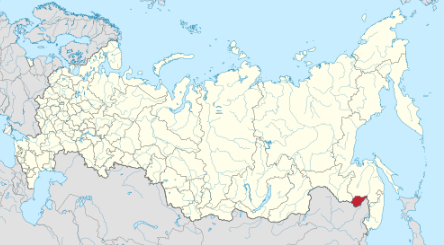
The celebration of the Jewish New Year will begin today, on the evening of September 22. The celebrations will take place throughout the Jewish Autonomous Region (JAO) bordering China in the Russian Far East. The population of the region is 144,400 people. The JAO borders mainland China.

Established in 1934, what became the JAO region had not previously been exclusively Jewish, however the re-settlement of Jews in Birobidzhan, the capital city, coincided with the intensification of anti-Semitism and repression in Nazi Germany. The Jewish Autonomous Region is the only region in the world where Yiddish has the status of an official language.

The JAO economy is changing with transportation and storage facilities being developed, with cross-border trade with China is also on the rise. The fastest growing industries in the JAO are construction, real estate operations, mining, electricity, gas and steam supply, air conditioning, and information and communication activities. Promising industries in terms of economic specialization include mining, forestry and logging, metallurgical production, crop production, and animal husbandry.
Map

Transport links between the JAO and China are developing rapidly, with the region long connected to the Trans-Siberian Railway. That has been enhanced with the first railway bridge over the huge Amur River, connecting Nizhneleninskoye in the JAO with Tongjiang in the China’s Heilongjiang Province. The bridge was opened in 2021 and carries more than 3 million tons of cargo and 1.5 million passengers per year. Currently, the JAO’s GDP growth is 4.4%, which is higher than the Russian average. Interestingly, the average salary in the JAO is higher than in Israel. Among the numerous prominent Russian Jews are artists Leon Bakst, Marc Chagall, Isaac Levitan, and Chaim Soutin; musicians Rudolf Barshai, Yuri Bashmet, Samuel Feinberg, Emil Gilels, Evgeny Kisin, Artur Lurie, David Oistrakh, Anton Rubinstein, Maxim Vengerov, and many others. In Russia especially, they honor the memory of Yuri Levitan, whose voice became a symbol of hope, unity, and faith in victory over Nazi Germany.

Russia’s VTB Bank Issue Twice Over-Subscribed, Rises 5% On First Days Trading

Published on September 21, 2025

Russia’s VTB bank conducted a share issue on the Moscow Stock Exchange (MOEX: VTBR) on September 18, in the largest issuance in Russia for the past three years. It was also the largest share placement of a financial institution in Europe over the past 12 months.

The issue generated considerable interest among stock market participants, with demand generated by both institutional and retail investors twice over-subscribed.

Investors are expecting share price growth due to a reduction in the key Russian interest rate and an increase in VTB’s interest margins, as well as continued dividend payments. VTB Bank is a majority state-owned Russian bank registered in St. Petersburg. VTB is Russia’s second largest bank after Sberbank. VTB Bank and its subsidiaries form VTB Group—a Russian financial group uniting VTB banks located in different countries and offering a wide range of corporate banking services and products in Russia, the Commonwealth of Independent States, Asia, and Africa. In April 2025, VTB opened a Chinese subsidiary, which operates a branch in Shanghai and is looking at expanding into Iran. In December 2024, VTB said it would hit a record profit of US$5.5 billion for the year.

VTB First Deputy Chairman Dmitry Pianov estimated the bank’s future net profit at ₽500 billion (US$5.9 billion) by the end of 2025 and ₽650 billion (US$7.8 billion) in 2026.

The issue was set at 1.264 billion shares, representing 23.5% of the outstanding common shares. More than 14,000 existing shareholders submitted pre-emptive applications for 94.8 million shares, with VTB raising ₽85 billion (US$1.01 billion) through the issue.

Andrey Kostin, VTB Chairman, said “We view these results very positively. The amount of funds that we received is about ₽85 billion, and there were 180 million applications. That is, we had plenty to choose from. We didn’t have to grab any anchors; we had a wide placement. Private citizens bought 41% of the issue—that is more than 20,000 thousand people. Institutional investors bought 59% of the shares. These are also very different financial institutions, and no one received any overly large share blocks in this placement.”

According to analysts, VTB continued to attract orders, both institutional and private. “The bank was actively marketing the offer and brought in additional brokers on the last day, so I wouldn’t be surprised if up to half of the book was market demand,” a source noted. VTB had also actively encouraged its clients to participate in the placement through its own “My Investments” app.

VTB stated that orders submitted through the VTB My Investments platform amounted to about ₽50 billion (US$600 million). However, the majority 59% of the placement came from larger investors, including pension funds and investment management companies.

The share offering was oversubscribed by over two times due to strong demand from private investors. Russian investment portfolio managers have also been bullish about the bank’s potential, with one source saying, “We expect VTB’s share prices to rise due to a reduction in the key rate and an increase in the bank’s interest margin, as well as dividends. If VTB can implement its plans and pay substantial dividends in the coming years, it will theoretically be able to compete with Sberbank and Sovcombank.”

Russian investment analysts estimate that VTB’s share placement implies a positive impact on other IPOs and SPOs expected this year.

Further Reading

Russia’s VTB Bank To Expand International Financial Transfer Services Into Africa, LatAm and Asia

Russia Looking At Auto Manufacturing In The Philippines

Published on September 21, 2025

The Russian Industry and Trade Minister, Alexei Gruzdev, has said that he considers the entry of Russian commercial vehicles into the Philippine market promising, with the possibility of Russian investors localizing production in the country to service the market.

Russia’s GAZ auto is already making deliveries to the Philippines from its facility in Vietnam, he said. The next Russian automaker to enter the Southeast Asian country’s market could be Kamaz.

Gruzdev said, “From the point of view of organizing assembly, GAZ has recently been working successfully in Vietnam. And some models already produced in Vietnam have been supplied to the Philippines. Therefore, this practice can be developed, but direct supplies under various programs to the Philippines are also ongoing. GAZ is successful in this sense, and Kamaz is also considering the possibility. From the perspective of industrial cooperation, it is attractive for Russian companies to obtain ASEAN-made status for their products, as well as to participate in grant and preferential programs launched by the Philippine government. Where market conditions exist, where there will be long-term demand, it is quite obvious that our companies are ready to consider the possibility of investing, organizing either their own production or in partnership. Considering both the fairly large population of the country itself and the fact that they are members of ASEAN, the Philippines is a fairly broad market. Organizing production there would allow, with a certain level of localization, to obtain ASEAN-made status and to access the domestic market duty-free.”

The automotive industry in the Philippines is one of the largest in Southeast Asia, with approximately 441,400 vehicles sold in 2023, although it has one of the lowest vehicle manufacturing outputs in the region. The largest brand is Toyota, which controls a 38.54% market share, with other significant brands including Mitsubishi, Ford, Hyundai, Nissan, Isuzu, Mazda, Suzuki, and Chevrolet.

Further Reading

Russia, ASEAN Prepare New Five Year Partnership Agreement

Japanese and Indian Investors In Sakhalin Oil & Gas Must Follow New Participation Regulations

Published on September 20, 2025

The Russian Prime Minister, Mikhail Mishustin, signed Order 2559-r on September 18 stipulating that specific conditions must be met by Sodeco (Sakhalin Oil & Gas Development Co. Ltd., the shareholders of which are Japex, the government of Japan, Itochu, Marubeni, and Inpex) and India’s ONGC Videsh Limited.

The updated criteria for participation in the Sakhalin-1 project must be met by its Japanese and Indian participants.

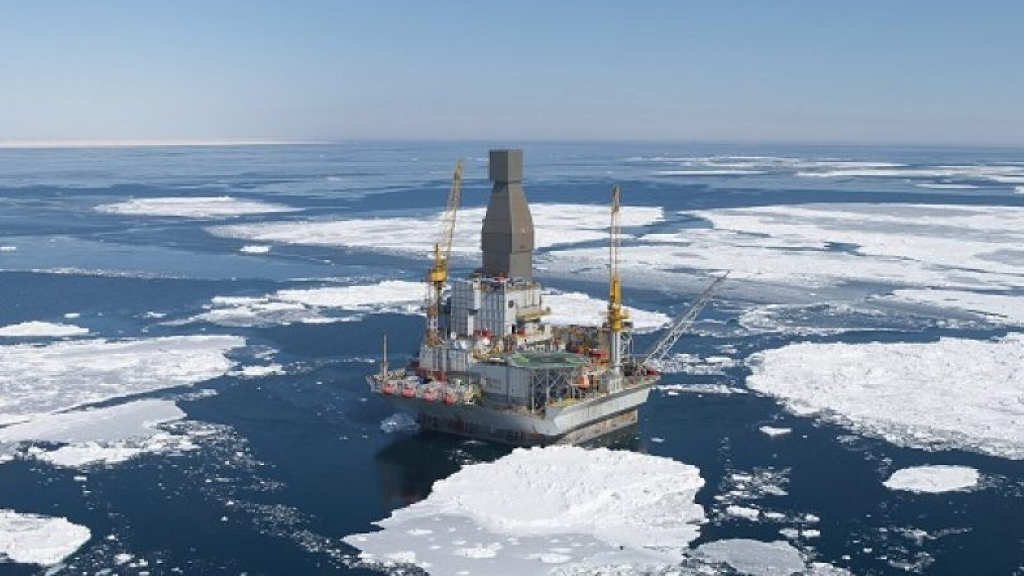
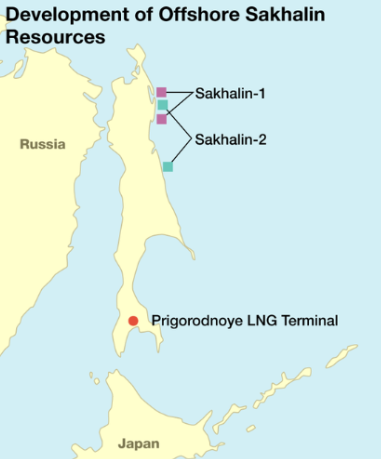
Sakhalin-1 includes three oil and gas fields: Chaivo, Odoptu, and Arkutun-Dagi off the northeast coast of Sakhalin Island. Their combined reserves are estimated at 307 million tonnes of oil and 485 billion cubic meters of natural gas. Production at Sakhalin-1 peaked at 12.96 million tonnes per year in 2019, after which it started to decline, dropping to 12.44 million tonnes in 2020 and 11.3 million tonnes in 2021. Exact production figures at the project for 2022-2024 have not yet been published.

Sakhalin Map

President Vladimir Putin issued a decree last month adding to the list of requirements for foreign participants in the project. They must enter into contracts for the delivery of foreign-made equipment and spare parts that are needed to implement the Production Sharing Agreement (PSA), as well as contracts on technical cooperation. In addition, the decree states that foreign members of the consortium must “carry out actions that lead to the lifting of political and economic sanctions imposed by foreign nations that negatively affect the execution of the PSA, including by making legal appeals if necessary.”

They must also arrange to deposit money into Sakhalin-1 LLC’s liquidation account in an amount equal to that which was previously accumulated by the relevant participant in the liquidation fund of the PSA. This is a mandatory fund for the subsequent environmental cleanup of the operations.

The wholly Russian company, Sakhalin-1 LLC, has been the operator of the PSA project since October 2022, when it acquired part of the equity from Exxon Neftegas Limited, who exited the project.  Other equity stakes were acquired by Japan’s Sodeco (30%) and India’s ONGC (20%).

However, India’s ONGC has been having problems formalizing its stake in the newly rearranged equity. It received its share of the project’s liquidation fund, about US$1.4 billion, in April 2023. However, it has been unable to transfer these funds to Sakhalin-1 LLC due to sanctions.

Should the situation not be resolved, the Sakhalin-1 project may again need to be restructured. 

Further Reading

Japan To Keep Its Stake In Russia’s Sakhalin Island LNG Project

Russia, Philippines Encouraging Participation In Nuclear, Oil and Gas Energy Sectors

Published on September 20, 2025

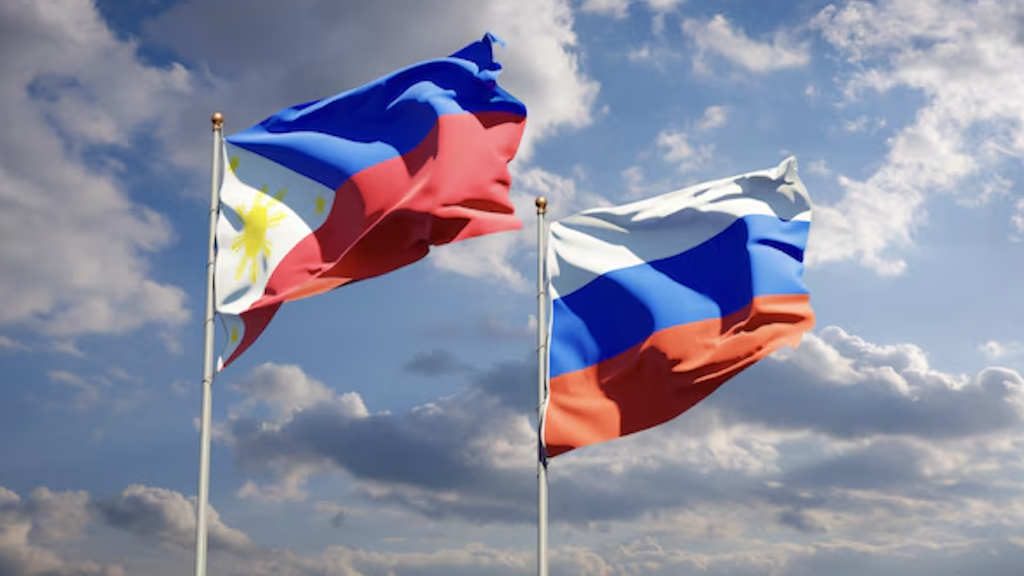
The Russian-Philippines Commission on Trade and Economic Cooperation has been meeting, with , Russian Deputy Industry and Trade Minister Alexei Gruzdev saying that cooperation between Russia and the Philippines in the energy sector could become one of the drivers for the growth of trade turnover between the two countries.

Gruzdev said “We see good prospects for increasing interaction in the energy sector, including establishing supplies of traditional energy carriers, such as liquefied natural gas [LNG] and liquefied petroleum gas [LPG]. In addition, Russia sees significant potential for cooperation in nuclear energy. Rosatom is ready to offer effective energy solutions, including construction of low-capacity nuclear power plants, as well as floating power units.”

He added that Russian companies are also interested in providing engineering services in designing hydropower facilities, creating renewable energy facilities, and supplying equipment for energy projects in the Philippines.

Currently, bilateral trade turnover is “subject to the influence of geopolitical and geo-economic factors, serious volatility in global commodity markets, which unfortunately directly affects the dynamics of our trade relations. Effort is required to improve the quality of mutual trade and diversify its structure.”

Current Russian exports to the Philippines are dominated by products from the metallurgical and chemical industries and the timber sector, as well as agricultural goods and food products.   Philippines exports to Russia include electronics, chemical industry goods and agricultural products.

Bilateral trade reached about US$650 million in 2024 and is low for Russian trade with an ASEAN member with a GDP (PPP) of US$1.733 trillion and a population of 115.8 million.

Further Reading

Post not found.

Russia, Iran, Discuss Gas Supply Volumes Higher Than Russia’s Supplies To Europe

Published on September 19, 2025

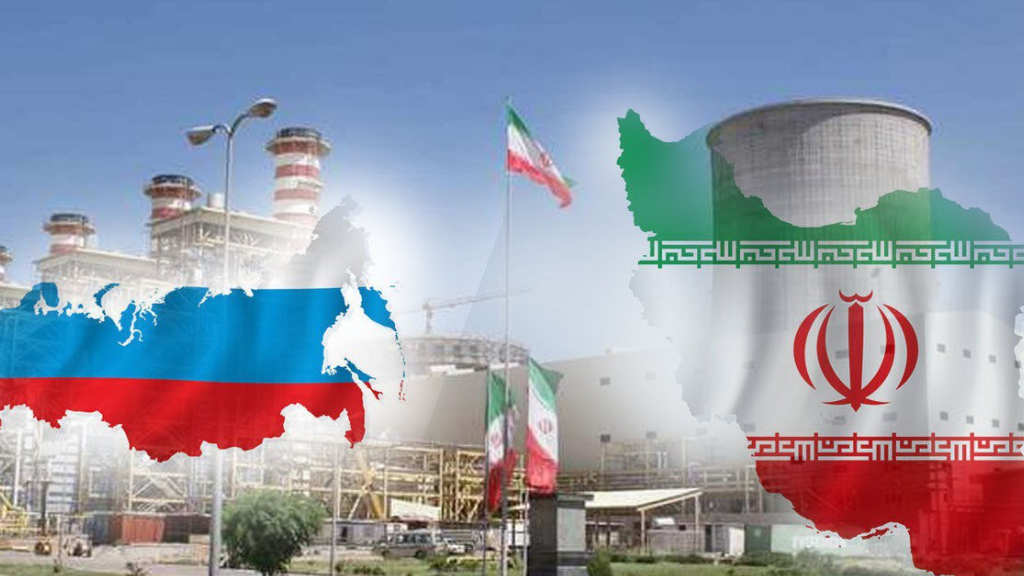
The Russian Energy Minister Sergei Tsivilev, together with Gazprom CEO Alexei Miller have held meetings with Iranian President Masoud Pezeshkian and Oil Minister Mohsen Paknejad, together with delegations from both sides.

They also met with the CEO of National Iranian Gas Company, Seyed Tavakoli. A strategic memorandum was signed with Gazprom in 2024 on exploring supplies of Russian natural gas to Iran.

The Russian Energy Ministry said that progress in implementing agreements reached following the 18th meeting of the Russia-Iran Intergovernmental Commission were also discussed. Particular attention was paid to preparations for the 19th meeting of the IGC, which will be held in Iran. Tsivilev and Paknejad co-chair the bilateral IGC.

Tsivilev said that supplies to Iran could begin as early as later this year. At the first stage, using existing infrastructure, they could reach up to 1.8 billion cubic meters per annum. The potential for Russian gas supplies to Iran is estimated at 55 billion bcm per year.

To put that into context, Russia sold 35 billion bcm of gas to the European Union in 2024, which positioned Russia as Europe’s largest gas supplier. Gas has not been subjected to EU sanctions, although the EU has stated it wishes to cut off all Russian gas supplies by 2027. Iran’s gas consumption potential can more than make up the difference and is also likely to spur Iranian industrial development.

Further Reading

Iran To Become Regional Gas Transit Hub For Russian LNG

Uzbekistan Joins The Eurasian Development Bank

Published on September 19, 2025

The Uzbekistan President, Shavkat Mirziyoyev has signed a decree for the country’s accession to the Eurasian Development Bank (EDB), with the country purchasing 777,777 shares in the EDB’s charter capital with a nominal value of US$1,000 each. Of these, 168,411 shares (21.7%) are paid-in, and 609,366 shares (78.3%) are to be paid upon demand. The total investment by Uzbekistan into the EDB will be US$168.411 million.

We originally predicted this would happen last year. 

The EDB is an international development bank with a chartered capital of US$7 billion. The shareholders are Armenia, Belarus, Kazakhstan, Kyrgyzstan, Russia and Tajikistan.

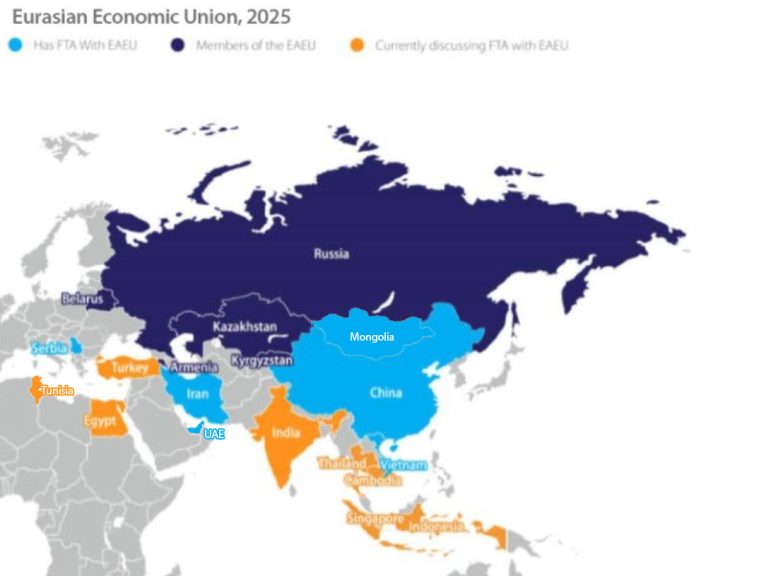
The acquisition of EDB equity by Uzbekistan is significant as the EDB effectively operates as the policy bank for the Eurasian Economic Union (EAEU), which includes the same shareholders as above with the exception of Tajikistan. Uzbekistan is not a full member of the EAEU; but has held observer status in it since 2020. The move to acquire equity is indicative that full membership may be on the horizon.

EAEU Map

The EAEU has been busy in recent years and has established Free Trade Agreements with Iran, Mongolia, and the UAE. It already has FTA with Serbia, China and Vietnam, and is rapidly developing substantial trade strength throughout the Eurasian region. Uzbekistan has also recently shown interest in the EAEU unified customs transit system which simplifies trade between members and third party countries.

An overview of the EAEU can be seen here. It has a GDP of about US$5 trillion and is expected to show GDP growth of around 3% this year.  

Further Reading

International Commodity & Futures Exchange Combining Russia, Kazakhstan, Uzbekistan, India, Iran & China Launched

Russia, Pakistan To Trade Wheat & Rice on the St. Petersburg Commodities Exchange

Published on September 19, 2025

The St. Petersburg International Mercantile Exchange (SPIMEX) and Pakistan-based KMAK Group have signed a memorandum of understanding on the development of exchange trading, SPIMEX has stated, following a meeting of the Russia-Pakistan Intergovernmental Commission for trade and investment.

SPIMEX stated that “Wheat is being considered as the Russian export commodity for the first transactions, and rice is being considered as the Pakistani import commodity. In addition, energy resources, other agricultural products, mineral fertilizers, forest products, and primary metallurgical products are interesting as potential exchange commodities for Russia-Pakistan cross-border trading.”

SPIMEX vice president Dmitry Chernyshev added, “The St. Petersburg exchange expects to become a channel for stable supplies of raw materials and products of Russian and Pakistani origin, establishing a foundation for settlements in national currencies.”

Pakistan’s KMAK Group is now going through the accreditation process on SPIMEX. It will take the role of non-resident broker for representing the interests of Pakistani businesses with which exchange transactions are expected to be made.

SPIMEX organizes exchange trading for oil products, crude oil, petrochemicals, natural gas, LPG, metals, forest products and construction materials, mineral fertilizers and agricultural commodities, as well as derivatives.

KMAK Group is an international conglomerate that works in key sectors of the economy, including real estate, construction, infrastructure development, mining, agriculture, and international trade. The group operates in South and Southeast Asia, the Middle East, North America, and Africa.

Pakistani businesses have also been discussing the conclusion of cross-border transactions on the Russian exchange and their execution with pertinent Russian and Pakistani financial authorities.

Further Reading

Russia-Pakistan Bilateral Relations: September 2025 Update

Russia, Bahrain, To Discuss Double Tax Treaty

Published on September 19, 2025

The Russian Finance Ministry is to hold negotiations in response to a request from Bahrain to conclude a Double Tax Treaty Agreement (DTA), according to Deputy Finance Minister Alexei Sazanov. Bahrain made the request in June.

DTAs are useful when trade, especially in services and investment, is developing between two countries when their respective tax regimes are different. They avoid the scenario where, for example, a Russian national working in Bahrain is taxed on his salary and then taxed again on the same salary because he is a Russian national (hence the name “double tax”).

They are also useful, especially in the services industry sector, as they typically provide mechanisms to reduce profits taxes by allowing the charging of withholding tax, which is typically lower, on items such as fees for patents and trademark use by a subsidiary. They can also include preferential tax benefits in certain industry sectors depending upon bilateral negotiations.

We showcase the differences between Russia and Bahrain in Corporate Income Tax (CIT), Individual Income Tax (IIT), and Withholding Tax (WT) below:  

CountryCITIITWT
Bahrain0*0 0
Russia25%13-22% 15%

*excepting certain hydrocarbon sectors where the CIT rate is 46%.

In the Bahrain case, the DTA mechanism will be of more use to Russian energy companies as opposed to individuals, as they may offset part of their 46% CIT taxable income against the zero-rated withholding tax fee by having the Russian parent company charge its Bahrain subsidiary for the use of trademarks and patents. This implies that Bahrain wishes to attract more Russian investment into its energy sector.     

The proposed Russia-Bahrain DTA may also include specific preferential tax treatment in other industry sectors, such as agriculture. 

Further Reading

Russia and Bahrain Discuss Oil Energy Stability And OPEC+ Production Agreements

Russia Starts Work On Europe’s Fastest And Largest Railway Network

Published on September 18, 2025

Russia’s Prime Minister, Mikhail Mishustin, has announced plans for a massive high-speed rail (HSR) network. It is set to be the largest in Europe, spanning more than 4,500 km, and will use domestically built trains capable of reaching 400 kilometers per hour (kph).

Mishustin said the new line will cut travel time between Moscow and St. Petersburg from four hours to just over two. The network will also connect Moscow with Minsk in Belarus, Adler on the Black Sea, Ekaterinburg in the Urals, Ryazan, and other cities. He said that “Travel between cities should be not only safe and comfortable but also not too time-consuming. In the modern world, time is becoming increasingly valuable. Because of that, we are mastering technologies for faster travel and are working on a development scheme for high-speed rail infrastructure.”

He noted that the project has been approved by President Vladimir Putin and will be finalized within the next six months.

Mishustin said construction of the first HSR line between Moscow and St. Petersburg is already underway. The 679 km route will be the first to feature the new generation of high-speed trains.

While he gave no details about the train’s specifications, media reports suggest that the name could be chosen in a public vote, with options including ‘Luch’ (Russian for ‘Ray of Light’). The current line between the two cities, the fastest in Russia, operates Siemens Velaro Sapsan trains with a top speed of 250 kph. Due to European sanctions, Russia will not be using any European equipment and is developing its own capabilities.

Once completed, Russia’s HSR network will be more extensive than Spain’s 3,970 km system, which is currently the largest in Europe and second worldwide after China. The new Russian trains will also outpace Europe’s fastest, the French TGV, which runs at up to 320 kph and covers the London-Paris route in three hours.

China remains the global HSR leader, with more than 64,000 km of lines in operation. It also has the world’s fastest commercially viable HSR train, the CR400 Fuxing Hao, which can reach 350 kph.

Further Reading

Russia Looking To Export High-Speed Rail Technology To The Commonwealth Of Independent States: Implications

Russia Wants To Produce Sunflower Oil In Egypt For Resale To African Markets

Published on September 18, 2025

Russia is interested in setting up production of sunflower oil in Egypt, with the issue raised during a Russian delegation’s visit to Cairo, according to Russian Deputy Prime Minister Alexei Overchuk, who led the delegation.

He said that “We have very active cooperation in agriculture with Egypt, which buys ours, and we’re discussing setting up sunflower oil processing here.”

On Tuesday, September 16, Overchuk held meetings with Mostafa Madbouly, the Egyptian Prime Minister; Kamel Al-Wazir, the Deputy Prime Minister for Industrial Development and Industry; and Hassan El-Khatib, the Foreign Trade Minister.

Russia exported more than US$3 billion worth of agricultural products to Egypt in 2024, 20% more than in the previous year, according to Russia’s Agroexport Centre. The main export commodity was wheat, which accounted for 84% of these exports. Sunflower oil made up 13%, soybean oil 2%, and dried lentils and chickpeas each made up less than 1%.

Egypt’s role as a logistics and investment hub in North Africa and the Middle East is very important for Russian foreign trade, as Egypt is part of the African Continental Free Trade Agreement (AfCFTA), which gives free trade access at zero or significantly reduced intra-African trade tariffs. Sunflower oil is used extensively in African cooking; however, the continent does not produce enough to meet demand. Russia is one of the world’s largest producers and has extensive sunflower farming and oil production capabilities. Rather than ship the finished product to Africa, where it would be subjected to import duties, it makes more commercial sense to produce it in Africa and then access continental markets directly.    

Egypt is also in the process of commencing negotiations for a free trade agreement with the Eurasian Economic Union. 

Further Reading

Moscow Assessing Options For Russian Industrial Zone At Egypt’s Suez Canal