News

Russia – China Rail Freight Grows 9.3% In 2M 2025   

Published on March 23, 2025

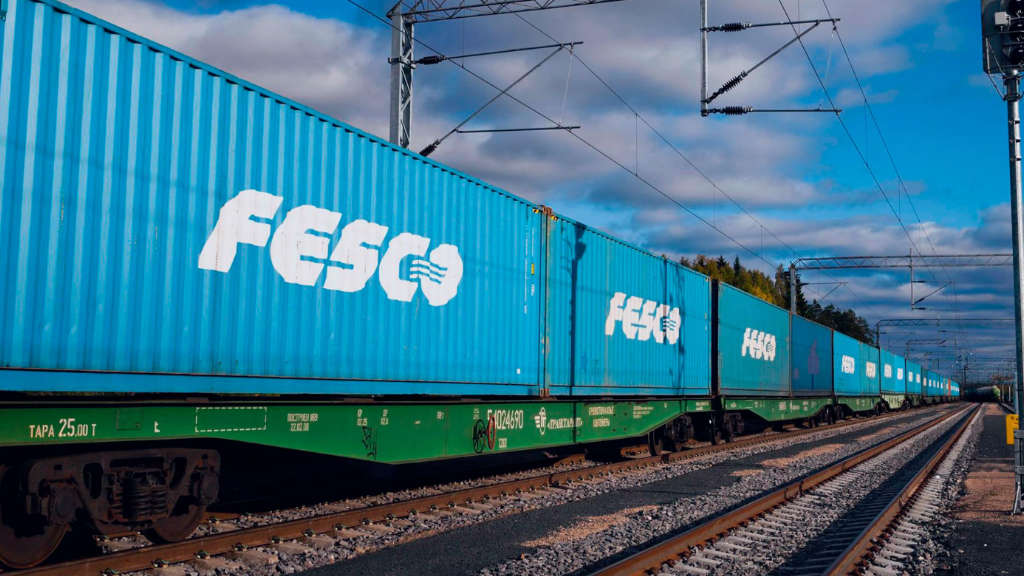
Russian freight traffic to China via the Russian Railways network continues to grow, according to Sergey Pavlov, the first deputy head of Russian Railways. He was speaking at the TransRussia conference last Friday (March 21) in Moscow.

According to Pavlov, in January-February 2025, more than 30 million tonnes of cargo were transported via Russian Railways network to China. This is 9.3% more than in the same period of 2024.

Pavlov also said that “The growth of international traffic in the eastern direction is also ensured by joint efforts with our Eurasian partners, primarily the Belarus and Kazakhstan railways, while Mongolia’s role as an important transport artery for Eurasian cargo flows is also increasing.”

Russian Railways maintains a shareholding in the Russian-Mongolian joint venture Ulaanbaatar Railway. In 2024, cargo transportation on the Ulaan Baatar-Novosibirsk (UBZhD) network reached a record high of 33.4 million tonnes. By 2030, this is planned to increase 1.5 times, to 50 million tonnes.

Further Reading

Eurasian Economic Union, Mongolia, Agree On Temporary Free Trade Agreement

Russia Incentivizes Exports To Friendly Countries By Offering 50% Transport Discounts   

Published on March 23, 2025

Russian exporters can now receive subsidies of up to 50% to compensate for transportation costs when exporting their products to friendly countries, according to Dmitry Kuskov, Director of the Department of International Cooperation and Licensing for Foreign Trade of the Russian Ministry of Industry and Trade. Kuskov announced this at the plenary session of the transport and logistics congress TransRussia on Friday, 21 March.

According to Kuskov, a project to support companies using complex and long-distance logistics routes (for example, to Latin America) is under approval by the Ministry of Transport. The support mechanism will work on a competitive basis and should be launched in the next few months. Russian logistics operators will be able to provide discounts to exporters on funds they receive from the federal budget.

Kuskov said “This measure is designed to ‘roll out’ new routes. It is possible to apply for the tender throughout March, with each transport corridor allocated ₽500 million (US$6 million). The subsidies will affect transportation to countries such as Tanzania, Brazil, Cuba and other friendly states.”

In February this year, the Ministry of Industry and Trade announced the launch of a new subsidy program designed to roll out new routes to which Russian logistics had shifted with the imposition of sanctions and which, until recently, were considered economically unjustified due to their considerable length. This year, these priority areas include African and Latin American countries as Nicaragua, Senegal, Venezuela, Brazil, Cuba, South Africa and Tanzania.

Maritime operators that provide container transportation services from Russia’s Baltic Sea and the Azov-Black Sea Ports can also apply for subsidies, and they will provide a discount on the delivery of non-energy exports.

Russia is also planning to build at least six transport and logistics centres in other countries by 2030 to support Russia’s export logistics. These are expected to include Egypt and Tanzania in Africa, Turkiye and Qatar in the Middle East, and Indonesia in Southeast Asia.  

Further Reading

Russian Shipped Agricultural Exports To 45 Countries In 2024

Russia, Qatar Developing Regional Rail, Road and Port Infrastructure

Published on March 23, 2025

Russia and Qatar are negotiating a draft intergovernmental memorandum on cooperation in transport and transit, the Russian Ministry of Transport has stated. It is another example of Russia’s own version of the Belt & Road Initiative. 

The two countries have been holding their fifth meeting of the joint Russian-Qatari commission on trade, economic and technical cooperation, during which they discussed issues of bilateral cooperation in the fields of industry, trade, investment and finance, transport and digital technologies.

During these discussions, Qatar’s potential for the development of bilateral multimodal transport was noted. The potential of railway, road and port infrastructure construction projects within the countries was discussed, as well as the prospects for implementing joint projects in third countries.

Qatar Map

The importance of organising sustainable logistics services, opening shipping lines and creating joint terminals was emphasised with Russia looking to invest in order to diversify its presence in the Gulf and improve its export capabilities. Qatar meanwhile wants to develop as a regional transit hub.

Qatar has already stated it wants to become part of the INSTC multimodal network between south Asia and Russia, which also spins off into Turkiye and Central Asian markets.

Talks has also been ongoing about Russia establishing a Halal certification and food processing facility in Qatar. 

Further Reading

Russia-Qatar 2025 Trade & Investment: Update

Mongolian Extension Of Power of Siberia 2 Pipeline Completing Environmental Assessment 

Published on March 22, 2025

Mongolia is completing its environmental assessment of the Soyuz Vostok natural gas pipeline from Russia to China, according to Sergey Tsivilyov, Russia’s Energy Minister. He was speaking after a meeting with Zandaakhuugiin Enkhbold, Mongolia’s special envoy on Friday (March 21).

Tsivilyov said that “The discussion focused on the construction of the Soyuz Vostok natural gas pipeline through Mongolia, a continuation of the Power of Siberia 2 pipeline. After talks with Mongolian President Ukhnaagiin Khurelsukh in September 2024, Russian President Vladimir Putin said that Russia was considering not only its gas transit through Mongolia but also a possibility of supplying the fuel for Mongolian consumers. Now, engineering surveys are complete; and the process of assessing the environmental effect of the project is nearing completion.”

Mongolia Map

Soyuz Vostok is a trunk gas pipeline that is an extension in Mongolia of the Power of Siberia-2, the western gas supply route to China.

The Power of Siberia-2 MGP is capable of supplying up to 50 billion cubic metres of gas per year from Western Siberia to China via Mongolia. The project completion date depends on the conclusion of a contract between Gazprom and China’s CNPC, which is still under negotiation.

There are plans to use part of the supply to provide a new energy source for Ulaan Baatar, the Mongolian capital city, which is powered by elderly coal fired plants that heavily pollute the city during the winter months. Russia and Mongolia are also discussing joint projects to reconstruct a thermal power plant in Mongolia, as well as introduce the application of Russian sector-specific standards in joint projects.

Further Reading

Russia-Mongolia-China Economic Corridor To Be Developed

Russian Parliament To Ratify Republic of Congo Oil Pipeline

Published on March 22, 2025

The Russian government has submitted an intergovernmental agreement with the Republic of the Congo on cooperation on the construction of the Pointe-Noire – Loutete – Moluko – Tresho oil product pipeline in the Congo to the Russian State Duma for ratification.

The agreement (No. 870793-8), which was signed in Moscow on September 28, 2024, has been posted in the lower house of parliament’s document database. The State Duma is the lower chamber of the Federal Assembly of the Russian Federation and adopts federal laws, including on the ratification of international treaties. Federal laws adopted by the State Duma on the ratification of international treaties of the Russian Federation are subject to mandatory consideration by the Federation Council, the upper house of the Russian parliament. The adopted federal law is sent to the President of the Russian Federation within five days for signing and implementation.

The Russian ambassador to Congo, Georgy Chepik said earlier that the pipeline will run between the country’s two largest cities, Pointe-Noire and the capital Brazzaville.

Under the proposed Republic of Congo pipeline agreement, the two parties involved are Zakneftegazstroy-Prometei LLC and the National Petroleum Company of Congo (SNPC). The intent is to form a joint venture to carry out the project, with the Russian side owning a 90% stake and the Congolese side 10%.

Congo Map

A build-own-operate-transfer concession agreement will be signed with the joint venture to build and operate the pipeline for 25 years, with a guaranteed price for transport that will ensure the utilization of the pipeline and a return on investment in the project. The agreement states that disputes will be resolved at the option of the Russian party in Dubai (UAE), by the Dubai International Arbitration Centre (UAE).

When operational, the pipeline will help power Brazzaville, the Congolese capital, with oil from its own offshore oil fields and reduce dependence on imports.  

Further Reading

Post not found.

Russia To Audit Ecuador’s Banana Certification System

Published on March 22, 2025

The humble banana is a point of trade interest between Russia and Latin America’s Ecuador, with the south americans providing 16% of all bananas consumed in Russia. There have been some inconsistencies in product, leading to experts from Russia’s plant and animal health watchdog Rosselkhoznadzor to conduct an audit of Ecuador’s banana certification system in April, according to the agency. This is to assist Ecuador maintain its QC standards.

Rosselkhoznadzor and the Ecuadoran Agriculture Ministry’s agricultural produce quality control agency Agrocalidad, have issued a statement saying that “This step is aimed at ensuring compliance with international and Russian phytosanitary requirements, as well as improving the quality of exported product.”

Ecuador Map

A significant part of Russian exports from Ecuador is made up of products subject to phytosanitary quarantine control. These include fresh bananas, whose total imports in 2024 will amount to 1.3 million tonnes, and flowers, whose direct imports tripled over the year to 50 million units. Imports of Ecuadorian cocoa beans to Russia also increased 40-fold to 4,700 tonnes last year.

Russia and Ecuador have also signed agreements in plant quarantine and protection, with Rosselkhoznadzor saying “The signing of the agreements will make it possible to strengthen bilateral cooperation in the area of phytosanitary control, increase the safety of shipped products, and open up additional prospects for joint initiatives.”

Further Reading

Russia-Ecuador 2025 Trade & Investment Analysis: Update

Eurasian Economic Union, Mongolia, Agree On Temporary Free Trade Agreement

Published on March 21, 2025

The Eurasian Economic Union (EAEU) and Mongolia have agreed on the remaining issues concerning a temporary free trade agreement, according to the Eurasian Economic Commission (EEC). This follows a meeting between EEC Trade Minister Andrei Slepnev and Gantumur Luvsannyam, the Mongolian Economic and Development Minister.

Slepnev said “We have conducted productive talks, in which we discussed in detail all remaining issues concerning the draft temporary trade agreement between the Eurasian Economic Union and Mongolia. We reaffirm our commitment to further develop interaction with Mongolia as a close neighbour and a friendly country, with which we traditionally have warm relations.”

Mongolia Map

The talks on the conclusion of a temporary trade agreement between the EAEU and Mongolia are being conducted in line with the decision made by the Supreme Eurasian Economic Council on May 8, 2024. According to earlier reports, the temporary free trade agreement with Mongolia will be for three years and will affect 375 commodity items on each side, for which customs duties will be reduced.

The Eurasian Economic Union includes Armenia, Belarus, Kazakhstan, Kyrgyzstan and Russia.

Further Reading

Russia – Mongolia Bilateral Trade Up 21% In 8M 2024

Belarus Allows Citizens of 67 Countries To Use E-visa Applications

Published on March 21, 2025

In stark contrast to the policies of the European Union towards Belarussian nationals, the Belarusian Foreign Ministry has stated that foreign citizens will be able to enter Belarus on an electronic visa from March 20. 

The Ministry’s statement read “Starting from March 20, 2025, foreign citizens will be able to enter Belarus on an electronic visa. The new option is available to ordinary passport holders from 67 countries, including the United States, Canada, all EU countries, Australia, New Zealand, Japan, the United Kingdom and others.”

The new e-visas will be single-entry individual visas with a validity period of up to 30 days. Depending on the purpose of travel, the following categories of e-visas are available: visas for business trip, for participation in sport, cultural, scientific, educational events and internships, for private trips and tourism.

Belarus Map

E-visas will be issued automatically. Applicants will not have to visit Belarusian consulates and present visa support documents. The consular fee for an e-visa is the same as the fee for a conventional visa. In addition to the consular fee, applicants also need to pay a service fee of €6.

According to the Ministry, all current visa-free relations remain in effect. Russia has a similar e-visa programme in place although does not include all the countries that Belarus does. 

Further Reading

Russia–Belarus Bilateral Trade Up 107.4% In 2024

Russia, South Korea To Establish Multimodal Transport Services

Published on March 20, 2025

In signs of a thawing between Russia and US backed economies, Russia’s multimodal transport operator Ruscon and South Korean logistics company Sunsko S&T plan to develop multimodal transportation between the Far East and Asia.

A memorandum of cooperation in the field of transport and logistics services was signed by Ruscon First Vice President Andrei Chernyshev and Sunsko S&T Co CEO Pele Zhang at the TransRussia international exhibition in Moscow this week.

The agreement is aimed at developing multimodal transportation using containers, as well as routes between Asia and the ports of the Far East. The expansion of transportation geography and the opening of new routes to accelerate cargo delivery are planned.

South Korea Map

Ruscon stated that “We expect that the agreement will be an important step towards developing a platform for sharing experience and best practices in transport logistics, opening new horizons for business and contributing to stable logistics for foreign trade.”

Ruscon operates three container terminals located in Novorossiysk, with a capacity of 110,000 twenty-foot equivalent units (TEU), Moscow (80,000 TEU) and the Volgograd region (30,000 TEU).

Further Reading

Russia’s FESCO Adds Vladivostok Shipping Capacity To South Korea’s Gwangyang Port

Russia Expands Mineral Water Exports To Thailand   

Published on March 20, 2025

Russia’s Aqua Holding LLC, producer of mineral water brands Essentuki No. 4, Essentuki No. 17 and Narzan, has delivered its first shipment of mineral water to Thailand, the company has stated.

These mineral waters are bottled in the Russian Caucasus and considered therapeutic treatments for gastro-intestinal problems.

Aqua Holdings has worked with water for local food producers under proprietary brands. It exported 750 million litres of its products to 19 countries in 2024, increasing exports by 35%.

Aqua Holdings is a full-cycle enterprise for the extraction, bottling and distribution of mineral water, including brands which are popular on the Russian market – Essentuki No. 4, Essentuki No. 17, and Narzan. The brand range also includes mineral water GORJI, ‘Ice Pearl’ and natural drinking water ‘Arkhyz VITA’. The company is among the top 2 mineral water producers in Russia.

Further Reading

New Russia-Thailand Shipping Route Connects Novorossiysk With Bangkok

Russian Meat Exports To Asia To Increase In 2025

Published on March 20, 2025

Russia’s Cherkizovo Group, one of the countries leading meat producers, shipped approximately 46,000 tonnes of its products to Southeast Asia in 2024, up 10% compared to the previous year, the company has said.

The bulk of exports consists of chicken products, but shipments of turkey, pork and sausages to the region are also growing. The exports of turkey meat to China increased 70% last year. Buyers of Cherkizovo’s products in the region include local meat processors and retail operators.

As part of the expansion of supplies, the group has agreed with logistics operator Refagrotrans to deliver an additional 13,500 tonnes of products to Southeast Asia by the end of 2025, it said.  

This is outlined in a memorandum of long-term cooperation in international transportation of low-temperature goods, which the companies signed at this months’ TransRussia  exhibition in Moscow.

For these shipments, 510 refrigerated containers will be used. Loading will take place at the Selyatino agrohub in the Moscow region. The main volume of products will be sent via a multimodal route through Vladivostok. At least 1,500 tonnes will be delivered by rail to Chengdu, in central China.

“Cherkizovo Group companies have been increasing their export shipments to South-East Asia year on year. Last year alone, our cargo traffic on the Selyatino-Vladivostok route totalled more than 1,000 refrigerated containers. To maintain the stability and rhythm of shipments and provide our customers with quality products, we cannot do without reliable partners such as Refagrotrans, with whom we have signed a memorandum of long-term co-operation,” said Evgeny Subbotin, Cherkizovo Group’s Director of Procurement, Logistics and Supply Chain.

Refagrotrans is a logistics operator specializing in the delivery of temperature-sensitive goods. It is developing export-import routes between Russia, China, Mongolia, the Commonwealth of Independent States (CIS) and Southeast Asia.

Cherkizovo Group is Russia’s largest meat producer and one of the top three producers of chicken, turkey and processed meat products. The Group operates 15 poultry complexes (including turkey), 20 modern pork complexes, 13 meat processing plants, as well as 13 feed mills, 14 grain elevators and approximately 360,000 hectares of agricultural land. The Company exports its products to more than 20 countries.

Further Reading

Russian Meat Exports Increased 27% In 2024