News

Russia, Morocco, Sign Fishing Agreement To 2029

Published on March 17, 2025

Russia and Morocco are to sign another four-year fishing agreement, according to Ilya Shestakov the head of Russia’s Federal Fisheries Agency. He said that “We have submitted a draft order to the government on the signing of a new agreement with the Moroccan side for four years and with the option of extension for another four years. After the signing, we’ll be able to catch 80,000 tonnes of fish in Morocco’s exclusive economic zone this year.”

Shestakov said all issues related to this have already been discussed and agreed in principle.

Russia primarily catches sardines, sardinella, mackerel and anchovies in Morocco’s economic zone. Russian fishermen also operate in Mauritania’s economic zone.

Shestakov said it could significantly increase Russia’s catch as a result of the Great African Expedition, which began in August 2024. The research expedition is doing a study of fish stocks in the exclusive economic zones of 19 African countries. The first phase of the expedition surveyed the waters of Morocco, Mauritania, the Republic of Guinea and Guinea-Bissau.

“As a result of the estimate of stocks we hope that we’ll get the right to fish in the zones of other African countries,” Shestakov said. Russia could also secure larger fishing quotas for various types of fish.

Further Reading

Post not found.

Russia, Qatar Discuss Regional Halal Agri-Industrial Hub

Published on March 17, 2025

Russia is considering the establishment of an agro-industrial hub in Qatar and it is ready to increase supplies of halal agricultural products there, according to Denis Manturov, the Russian First Deputy Prime Minister. He was speaking at the fifth meeting of the joint Russian-Qatari commission on trade, economic and technological cooperation in Doha.

Manturov said “Our trade is already dominated by grains, primarily, wheat and barley. We stand ready to increase shipments of agricultural products, including halal ones. We mean not only to ensure Qatar’s food security, but also to set up a regional agro-industrial hub in your country. Beef, poultry meat, sunflower oil and confectionery products are also among the promising export goods.”

Qatari Prime Minister and Foreign Minister Mohammed bin Abdulrahman bin Jassim Al Thani also attended the intergovernmental commission meeting from Qatar’s side.

Russia and Qatar discussed bilateral cooperation in trade, investment and finance, transportation and digital technologies, as well as in humanitarian projects, including culture, sports, and education, and focused on industrial cooperation in such sectors as pharmaceuticals, shipbuilding, energy engineering, including renewable energy.

Russia is considering the localization of production in Qatar with the transfer of corresponding technologies, along with the supply of medicine to Qatar. Advanced domestic developments in shipbuilding, specifically hydrofoil passenger vessels and environmentally friendly noiseless electric vessels, which are currently operated in Russia, are potential exports for use in Qatar.

Manturov also noted the potential for cooperation in digital technologies, saying that “Russian companies have unique developments in the area of artificial intelligence, the Internet of Things and information security solutions. I will emphasize the opportunities for cooperation between Moscow and Doha in such a topical area as smart city technologies.”

Further Reading

Post not found.

Russia’s Foreign Trade Up 4.6% In January 2025

Published on March 16, 2025

Russia’s foreign trade for January amounted to US$50.7 billion, 4.6% more than in the same period last year. Exports increased by 3.2% to US$29.3 billion, and imports by 6.6% to US$21.4 billion, according to the Federal Customs Service (FCS) of Russia.

Traditionally, mineral products have formed the basis of Russian exports. Their share in the commodity structure of exports amounted to 61.4% of Russia’s total exports. In value terms, their shipments to world markets in January 2025 fell slightly by 0.6% to US$18 billion.

As concerns imports, machinery, equipment and other goods accounted for the largest share and amounted to 50.8%, increasing 8.1% and worth about US$10.9 billion.

Further illustrating Russia’s shift to developing supply chains away from the west, Russia’s main trading partners in January were in Asia, with Russia exporting goods worth US$22.4 billion (+3%) and importing goods worth US$15.5 billion (+13.1%).

Goods worth US$4.6 billion (-2.6%) were shipped to European countries, and US$4.5 billion (-11.1%) were imported. Exports to the Americas amounted to US$0.9 billion (-3.3%), and imports US$1.1 billion (+7%). With Africa, Russia exported US$1.4 billion (+42.1%) and imported US$0.3 billion (+18%), respectively, showing the largest overall increases in Russia’s global trade performance. Russia now trades more with Africa than it does with Germany.   

The value of Russian exports in 2024 increased by 2% compared to the previous year and amounted to US$433.9 billion. Imports decreased by 0.8% to US$283 billion, partially due to sanctions issues but also due to Russia’s own push to localisation. Overall, Russia’s foreign trade amounted to US$716.9 billion for 2024, up 0.9% from 2023.

Further Reading

Russia’s Busiest Road Crossing Border In 2024 Wasn’t With China  

Russia’s Rusal Acquires Indian and Chinese Aluminium Manufacturers

Published on March 16, 2025

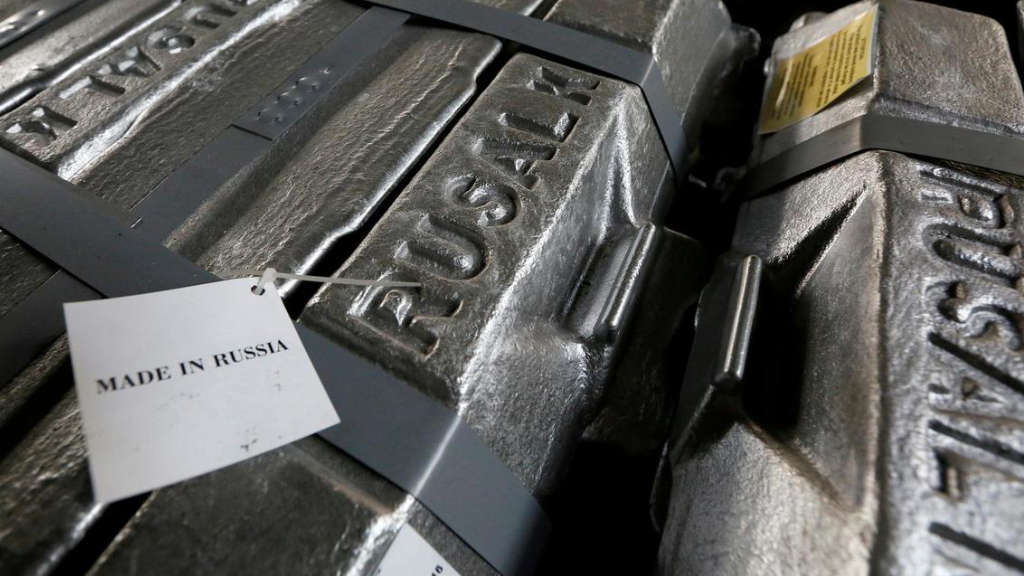
Moscow based Rusal has signed an agreement with India’s Pioneer and KCap to purchase the Pioneer Aluminium Industries Limited alumina refinery, with capacity to produce 1.5 million tonnes per year, the Russian company said. Rusal are the world’s second largest aluminium manufacturer, accounting for almost 9% of the world’s primary aluminium output and 9% of the world’s alumina production.

Rusal will acquire up to 50% of Pioneer in three stages, including 26% at the first stage for US$243.75 million plus adjustments for the company’s working capital and debt. All subsequent stages of the transaction will be paid pro rata. The sellers and Rusal intend to supply bauxite to Pioneer and receive alumina from it in proportion to their respective stakes.

Pioneer owns an alumina refinery with capacity of 1.5 million tonnes per year, which could expand to 2 million tonnes, in the state of Andhra Pradesh, near the ports of Visakhapatnam, Gangavaram, and Kakinada on the southeast Indian coast, near to major ASEAN markets.

The acquisition by Rusal of a 30% stake in Chinese alumina producer Hebei Wenfeng New Materials Co. (HWNM) has risen to US$316 million, with the valuation process still ongoing. The consideration for the stake was initially US$264 million, however the terms of the transaction could be adjusted within twelve months of the transaction date. All rights attached to the interest acquired were transferred to Rusal in April 2024.

Rusal acquired its stake in HWNM to solve its problems with access to alumina, which worsened in 2022 after it lost access to the Nikolayev Alumina Refinery and alumina supplies from Australia in 2022. These sources together accounted for about 40% of alumina consumption. The purchase of HWNM has instead enabled Rusal to boost alumina output 25% to 6.43 million tonnes in 2024.

The supply chain disruptions caused by Western sanctions – in Rusal’s case supplies from Australia – has led Russian businesses with overseas supply chains to make investments in more friendly countries and to boost production instead in these markets. Australia imposes 35% tariffs on all trade with Russia, leading to it relocating trade and investment elsewhere. Australian exports to Russia have subsequently decreased by 67%.  

Further Reading

Russia Proposes Small Nuclear Modular Reactors For India NPP Development  

China Wants To Invest In Arkhangelsk Deep Water Port

Published on March 16, 2025

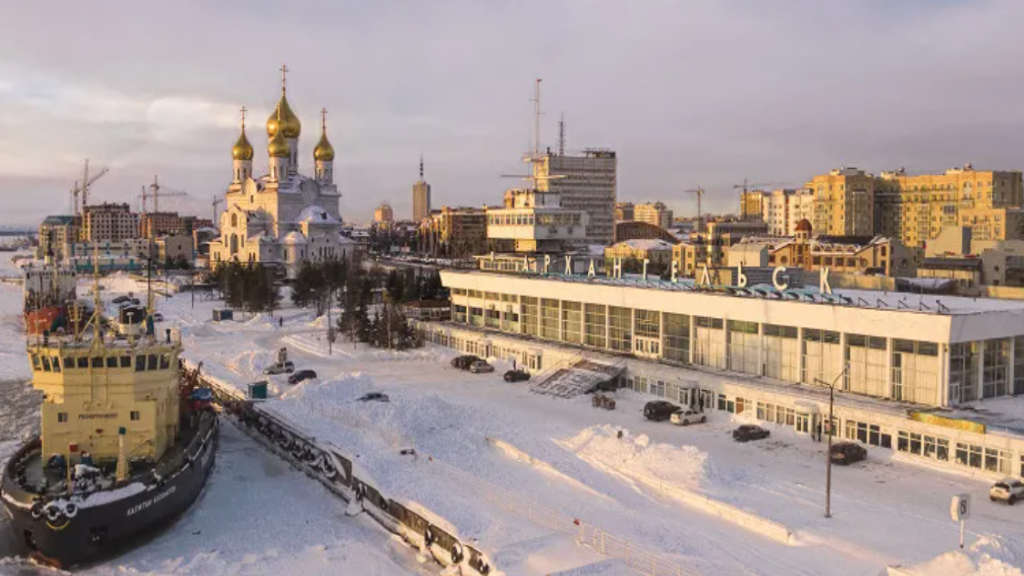
Alexander Tsybulsky, Governor of the Arkhangelsk Region, has stated that Chinese companies are interested in participating in the creation of a deep-water area of Arkhangelsk seaport. He was discussing the issue during a working meeting with Russian President Vladimir Putin.

Tsybulsky said “We have done a lot of work with our main partner, Rosatom State Corporation, for almost a year and a half. They are interested in this project. A declaration of intent is already being released, including Chinese investors to participate in this project. As soon as we finally configure the conditions under which they are ready to participate in this project, then I will ask separately for the opportunity to report to you about it.”

Arkhangelsk Map

Tsybulsky said that Arkhangelsk has already been fruitfully cooperating with Chinese companies in cargo transportation: “We have rolled out a container route with the Chinese. We have not had such a route for 40 years, for the first time in 2023 there was one Shanghai-Arkhangelsk ship call. Last year, there were already ten ship calls, and this year we plan up to 20 ship calls. Arkhangelsk port is starting a completely new competence in container cargo transport.”

The construction of a deep-water port at Arkhangelsk seaport includes a maximum allowable draft of 14.5 metres and is a flagship investment for Arkhangelsk. The potential cargo flow of import-export cargoes in containers could reach 300,000 containers (4.45 million tonnes) by 2030, and 600,000 containers (almost 9 million tonnes) by 2040.

United States Wants To Collaborate With Gazprom In The Arctic 

Published on March 16, 2025

Moscow and Washington are currently in talks over the possibility of future cooperation with Gazprom on international projects, including in the Arctic region, according to Bloomberg, citing Russian and European officials. The news comes as the United States seeks to normalize relations with Russia and gain access to the economically important region.

The Arctic has drawn increasing global attention due to its vast untapped energy and mineral resources, as well as its strategic trade routes. Russia has been developing its Northern Sea Route, the shortest shipping route between Western Eurasia and the Asia-Pacific, running through its Arctic and Far East regions. The route has been extensively modernized over the past years, with investment also from India and China, which hold stakes in several Arctic energy projects.

Gazprom could offer the US involvement in ventures in the Arctic region and some offshore projects such as the Sakhalin liquefied natural gas project if sanctions restricting foreign investment are overturned. Talks between US and Russian representatives on potential collaboration with Gazprom are at the stage of “preliminary contacts.” It is currently unclear who is leading the reported discussions or whether officials from the administration of US President Donald Trump are directly involved.

Artic Map

US-Gazprom cooperation could involve joint projects in Europe and Asia, several sources said, adding that it could be part of Washington’s broader push to weaken Russia’s ties to China and Iran. Bloomberg noted that the step could also promote business opportunities following a peace deal to end the Ukraine conflict, which Trump sees as a top priority.

Earlier this week, German news outlet Correctiv reported, citing its own investigation, that Russia and the US were negotiating a major deal that would allow the resumption of Russian energy exports. The months-long discussions could reportedly involve US companies buying parts of the Nord Stream pipeline infrastructure and stakes in three German refineries owned by a subsidiary of Russian energy giant Rosneft.

Neither the Kremlin nor the White House has officially commented on the reports. President Vladimir Putin said on Thursday that Russia could resume gas exports to Europe through the undersea pipeline once Moscow and Washington reach an agreement on energy cooperation.

‘Nord Stream’ is an underwater gas trunk line running from Russia to Germany, from where it could be transported to Denmark, the Netherlands, Belgium, the UK, France and other countries via two branch pipelines (OPAL and NEL). It consists of two phases – Nord Stream -1 and Nord Stream 2. In September 2022, both branches were destroyed by explosives at the bottom of the Baltic Sea near the Danish island of Bornholm. Russian President Vladimir Putin said on 30 September that the explosion was a sabotage aimed at destroying the pan-European energy infrastructure.

Further Reading

17% Of Russian GDP Is Now Arctic Generated

Head Of Russia’s Sovereign Wealth Fund Suggests Joint US-Russia Mission To Mars

Published on March 16, 2025

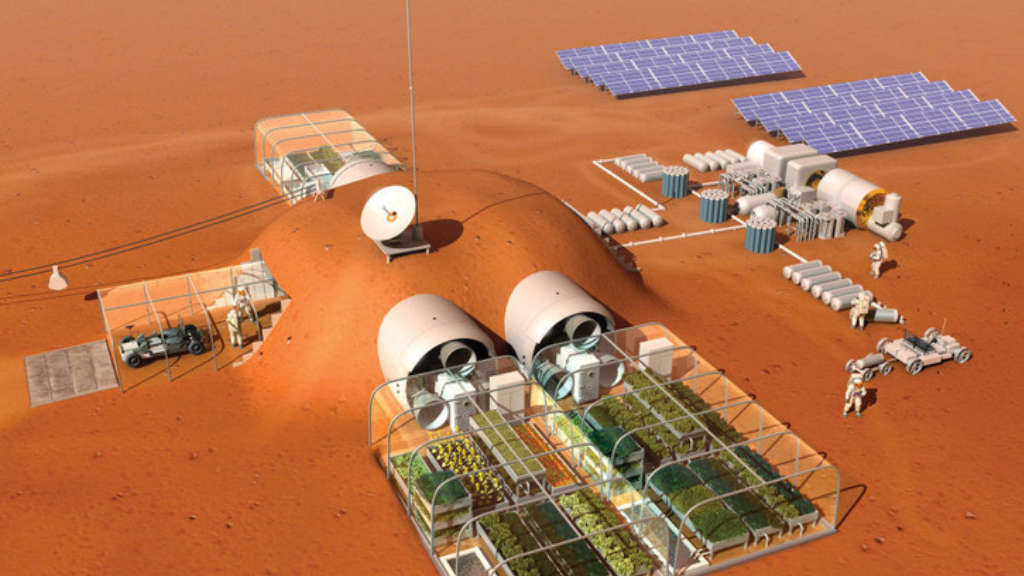
Kirill Dmitriev, the head of Russia’s sovereign wealth fund, has pitched a US-Russia partnership for Mars exploration to Elon Musk. Dmitriev has taken on the role of chief economic envoy in the US-Russia talks.

Dmitriev’s remarks came in response to Musk’s announcement of a planned 2026 Mars mission. The SpaceX founder stated that the company’s Starship spacecraft is set to depart for Mars next year and will be carrying a Tesla humanoid bot called Optimus. Musk also suggested that human landings on Mars could begin as early as 2029.

Dmitriev wrote on X “Shall 2029 be the year of a joint US-Russia mission to Mars, @elonmusk? Our minds & technology should serve the glory of humanity, not its destruction.”

He also noted that 2025 marks the 50th anniversary of the Apollo-Soyuz Test Project, the first crewed international space mission carried out jointly by then-spaceflight rivals, the US and the Soviet Union, in July 1975. Musk has not yet publicly responded to Dmitriev’s proposal, which comes amid a thaw in relations between Moscow and Washington following years of tensions over the Ukraine conflict. Dmitriev was part of the Russian delegation at the high-level US-Russia talks in Saudi Arabia last month, which marked the first direct diplomatic contact between the two states since 2022. The meeting ended with both sides signalling a readiness to restart economic and diplomatic cooperation and join forces in resolving the Ukraine conflict.

Despite the conflict and Western sanctions imposed on Moscow, space cooperation between the US and Russia has not been severed. For instance, NASA and the Russian space agency Roscosmos recently extended their agreement on cross-flights to the International Space Station through 2026.

Last month, Russian President Vladimir Putin suggested that domestic companies should collaborate with Musk once the billionaire shifts his focus back to science from US government reform.

Further Reading

Russia, India Cooperating In Space and Upcoming Moon, Mars Exploration

Russia, China & Iran To Cooperate More In BRICS, Shanghai Cooperation Organisation Amidst Nuclear Talks

Published on March 15, 2025

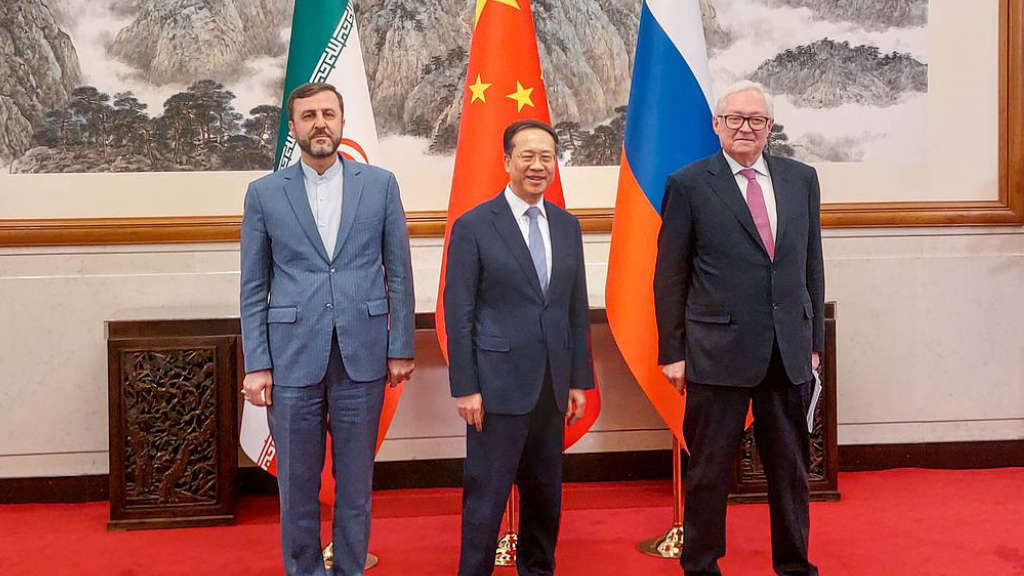
China, Russia and Iran have agreed to boost coordination within the BRICS and the Shanghai Cooperation Organization (SCO), the three countries’ diplomats said in a statement following a meeting in Beijing to discuss Iran’s nuclear issues.

China’s Deputy Foreign Minister Ma Zhaoxu stated that “The parties agreed to support and strengthen coordination on multilateral platforms and within international organizations such as BRICS and the SCO.” Russia was represented by Deputy Foreign Minister Sergey Ryabkov, while Deputy Foreign Minister Kazem Gharibabadi represented Iran.

The trilateral meeting follows a series of overtures from US President Trump to resume nuclear talks with Tehran. The US president sent a letter this week to Iran’s Supreme Leader Ayatollah Ali Khamenei calling for new talks but also warning that the US was within its rights to take military action against the country’s nuclear programme.

Iranian President Masoud Pezeshkian then responded that he would not negotiate with the US while being “threatened”, and Iran would not bow to US “orders” to talk. Ayatollah Khamenei maintains Tehran does not have or want nuclear weapons, but a recent report from the International Atomic Energy Agency said Iran’s stockpile of enriched uranium was close to the requirements for a nuclear bomb. US estimates suggest that Tehran could manufacture such a device within a week.

China’s Foreign Ministry stated “In the current situation, we believe that all parties should maintain calm and restraint to avoid escalating the Iran nuclear situation, or even walking towards confrontation and conflict.” The trilateral meeting is the latest attempt to broach the matter and an attempt to jumpstart talks between Iran and the United States on a level playing field and without disruptive rhetoric. With the recent trilateral Navy exercises in the Gulf of Oman also taking place this week, Russia and China are displaying their support for Iran and possible military reaction if the United States were to launch a pre-emptive strike.

Further Reading

Russia, Iran, Looking At Nuclear Power, Aviation and Auto Manufacturing Investments

Russia Sets Up Supply Chain Reach To Laos

Published on March 14, 2025

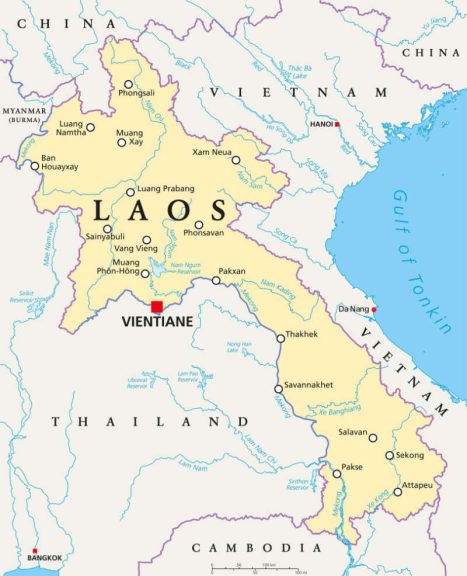
Russia’s FESCO transport company is launching intermodal container transport to landlocked Laos in southeast Asia, via the Vietnamese port of Da Nang as part of its efforts to expand logistics operations into the region. The transit time for deliveries between Russia and Laos via Vladivostok and Da Nang is about 35 days.

Loading and dispatch of containers takes place in ten major locations in Laos. From there, cargo will be shipped by road to Da Nang within 24 hours and packed into feeder vessels bound for Ho Chi Minh in Vietnam or China’s ports. The containers are then sent via regular shipping lines to Vladivostok, Novorossiysk and St. Petersburg. When exporting to Laos, the same routes will be used in reverse.

Russia-Laos bilateral trade is small at about US$500,000 however the two countries have long diplomatic ties going back to the Cold War era. Laos is landlocked, hence trade volumes are small. Laos is a member of ASEAN, which gives it free trade access to Brunei, Cambodia, Indonesia, Malaysia, Myanmar, Philippines, Singapore, Thailand and Vietnam. It also has FTA with China and India. Laos has a population just under 8 million, and a GDP of US$74 billion.

Laos does pick up some manufacturing investments from neighbouring countries such as Thailand and China, and it also has a developing tourism industry. What trade there is, is typically energy produce from Russia and agricultural products such as fruits from Laos. The country is also quite mountainous which has created additional connectivity issues.

Last year, the Russian Minister of Transport, Roman Starovoit held discussions with a Laos delegation attending the BRICS conference in Kazan. There may be opportunities for Russian Railways to provide rolling stock to the country, which is looking to improve railway connections through to China.

Bilateral Central Bank discussions also took place, and imply the potential use of Russian MIR cards in Laos, or to formalise Ruble-Kip trading and move to sovereign currency use in trade relations.  

Further Reading

Laos Applies To Join The Shanghai Cooperation Organization

Russia House To Be Set Up In Ghana: Current President An Alumni  

Published on March 14, 2025

Natalia Krasovskaya, the executive director of the Russian Centre for Public Diplomacy, has announced that Moscow is preparing to open a Russia House cultural and education centre in Accra, Ghana’s capital city. Ghana is the first English-speaking African country to join the Russian House partnership list.  

On Monday, 10 March, Krasovskaya said that an agreement had been signed allowing the ‘Centre for Public Diplomacy’ to establish a Russian House in Ghana with the support of Rossotrudnichestvo. She noted, ‘We met with representatives of several regions of the country, and they all indicated that their universities are waiting for us and looking forward to us, so I think that educational work, the very soft power of Russia, will spread quickly in Ghana, and I think that our universities will be happy about this partnership.’

Rossotrudnichestvo said in a statement that the network of partner Russian Houses now covers 17 countries. The key areas of work of the Russian Partnership in Ghana will be holding events dedicated to national Russian holidays, Russian language courses, preparing Ghanaian students to enter Russian universities, as well as holding lectures, exhibitions and film screenings about Russia.

Russian House is an informal name for Rossotrudnichestvo’s foreign representations, which are engaged in ‘strengthening Russia’s humanitarian influence in the world’. The programme to create a network of partner Russian Houses is conducted by Rossotrudnichestvo in order to expand the Russian cultural and humanitarian presence abroad.  Earlier, the head of Rossotrudnichestvo, Yevgeny Primakov, said that the agency welcomes and supports initiatives to open partner Russian Houses abroad. New partner Russian Houses are appearing not only in countries where there was no Rossotrudnichestvo presence, but also where there are Russian Houses, where representatives of the federal agency work as part of Russian embassies. ‘These are private and public initiatives that we certainly support, we can rely on these people. The more we have such partners and friends, the better,’ Primakov said. Rossotrudnichestvo is currently represented by 86 foreign missions around the world.

During the 2023 Russia-Africa summit, President Putin proposed establishing Russian language centres across the African continent, citing education as a “traditional area” of cooperation between Moscow and Africa. In November, Rossotrudnichestvo said students from the continent are leading in applications to Russian universities, with over 14,000 submissions for the 2024–2025 academic year alone.

An example is Ghana’s current president, John Dramani Mahama, who obtained his postgraduate degree in social psychology from the Institute of Social Sciences in Moscow in 1988.

In February 2024, Russia’s People’s Friendship University in Moscow announced a five-year scholarship initiative to allow hundreds of students from Ghana to study for degrees in agriculture, information technology, waste management, and climate change. 

Further Reading

Russia To Develop ‘Russia House’ Educational Facility In Central African Republic 

Putin Discusses OPEC Production With Saudi Crown Prince

Published on March 14, 2025

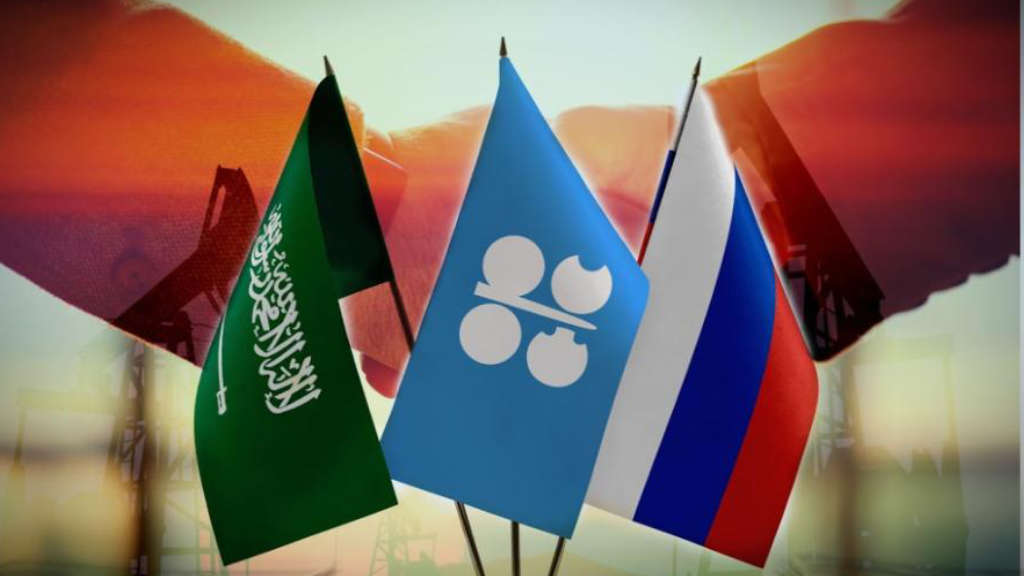
The Russian President Vladimir Putin held discussions with the Saudi Crown Prince Mohamed bin Salman Al Saud on Thursday (March 13) following the US bilateral talks with Ukraine which the Prince hosted. In addition to no doubt discussing the content of the talks, the two also discussed collaboration within the OPEC+ platform, which regulates oil supply and prices. This could imply that some issues as concerns Russian supplies onto the international markets could shortly be changing.

A statement issued afterwards said that current issues in “Russian-Saudi cooperation in ensuring the stability of the global oil market were discussed, in order to maintain a balance between supply and demand in the interests of both producers and consumers.”

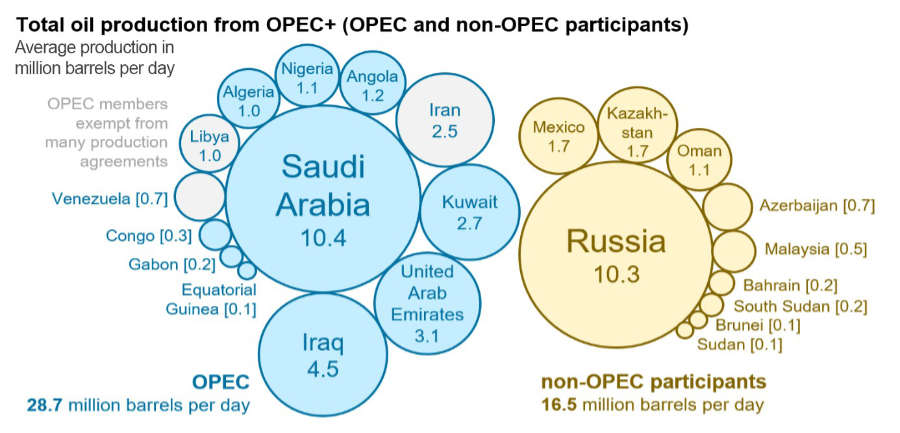
Graphic

OPEC+ is a loosely affiliated entity consisting of 12 OPEC members and 10 of the world’s major non-OPEC oil-exporting nations. OPEC+ aims to regulate the supply of oil to set the price on the world market. OPEC includes Algeria, Angola, Ecuador, Iran, Iraq, Kuwait, Libya, Nigeria, Qatar, Saudi Arabia, United Arab Emirates, Venezuela, and Indonesia, while OPEC+ adds Azerbaijan, Bahrain, Brunei, Kazakhstan, Malaysia, Mexico, Oman, Russia, Sudan and South Sudan.

Neither the United States nor the European Union are involved in OPEC or OPEC+.

Further Reading

Venezuela Suggests Transferring Its US Energy Contracts To The BRICS Countries