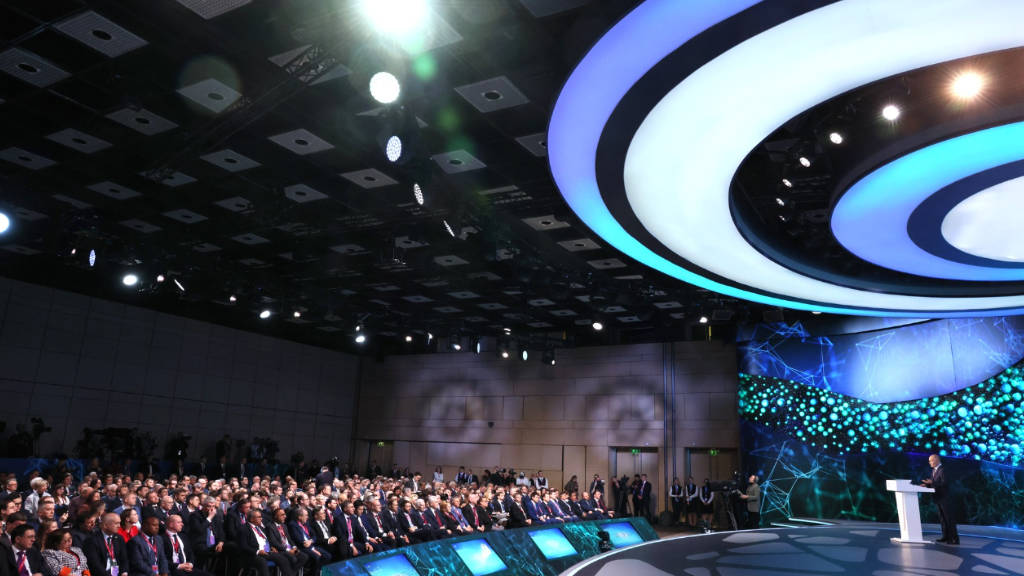
The Third International Future Technologies Forum held February 20 and 21 in Moscow, which sets the stage for groundbreaking scientific exploration, where emerging ideas, still taking shape in laboratories and research centres, are discussed and refined. This year’s forum focused on chemistry and the application of new materials – cross-cutting fields that will play a decisive role in humanity’s progress, enabling engineers and designers to realise their most ambitious visions.
These areas are undergoing rapid changes, which, in turn, lay the foundation for even more revolutionary breakthroughs in healthcare, industry, microelectronics, in the creation of autonomous systems, in virtually every sector.
President Putin gave the Plenary Speech, during which he touched on several aspects of Russia’s national development strategy. We highlight what he said as follows:
VP: “It is absolutely clear that, in order to become a leader in key areas of scientific and technological development, and this is the task we have set for ourselves, we need to achieve excellence in chemistry and new materials development. This means that we must offer solutions and products that are competitive in terms of pricing and quality and, most importantly, innovative. We need to possess our own technological keys that will enable us to produce and export not just raw materials, but high-standard goods to global markets.
Let me also note that our history has shown that we can tackle such significant challenges. In the 1960s and 1970s, hundreds of advanced plants were established and specialised scientific institutes and design bureaus were created, largely due to the efforts of Leonid Kostandov. (RPA: Engineer and former Minister of the Chemical Industry of the Soviet Union). While few people may know his name today, specialists will certainly recognise it. He served as the Minister of Chemical Industry of the USSR. In terms of total production volume, the Soviet chemical industry ranked first in Europe and second in the world.
However, this heritage has been largely squandered and wasted. I am stating this with deep regret. To be honest, I feel ashamed of this when I think of the people who spent their entire lives building the Soviet Union’s chemical industry, working for the sake of future generations, stayed overnight in their offices, or working on the move, from wherever they were. They spent their lives in railway cars, moving across the vast territory of the Soviet Union, from one republic to another. They scarcely ate or slept, to establish the country’s chemical industry.
Unfortunately, after the collapse of the Soviet Union, its core facilities halted production, and some were destroyed, their equipment thrown out and cut as scrap metal. Along with the degradation of our own chemical industry, we became strongly dependent on imports, losing a significant part of our industrial and technological sovereignty. We know from our own negative experience what system-wide problems vulnerability in the chemical domain can create.”
RPA: Putin pointing out that the collapse of the USSR also led to a destruction of its industrial advancements and a developing reliance on the West. Western sanctions were partially designed to prevent a rebuild, however Russia is pressing ahead with its domestic redevelopment regardless – specifically to reduce its reliance on the West. It is increasingly apparent that Europe in particular has not yet recognised the political, investment or trade significance of this Russian policy shift.
VP: “We literally had to reassemble many technological and production chains and build new processing facilities to manufacture products with added value. For example, new facilities have been built as part of the Tobolsk Petrochemical Plant in the Tyumen Region. In 2019, a modern petrochemical plant, ZapSibNeftekhim, was launched. The construction of the Amur Gas Chemical Complex and other enterprises is underway. They will enable Russia to significantly increase the production of polymers, a key product of oil and gas chemistry, in the coming years.”
RPA: The concept of ‘added value’ in Russian manufacturing and production is relatively new, with Russian producers previously happy to sell raw materials and allow other countries, such as China to do the more technical work of processing them – and adding value. That mentality has been replaced instead with a more assertive self-dependence in value add throughout the Russian supply chains. Again, this was partially created by the West imposing sanctions upon many of Russia’s key industrial areas. What that prompted instead, has been a dramatic shift away from previous production laziness to dynamic production and added values. This represents a significant change in Russia’s export capabilities, competitiveness and drive up the added value supply chains on a global basis.
VP: “I would also like to add that after cleaning up and reclaiming territory in Usolye-Sibirskoye, Irkutsk Region, we plan to create a modern federal centre for small- and medium-scale chemical production there. This refers to the production of small volumes of indispensable chemical products – resins, solvents and others – which are critical for the development of microelectronics, pharmaceuticals and many other critical areas.”
RPA: It is worth noting that this region is close to China, and to other export markets in Asia, where these products are very much in demand as global production continues a shift towards the Asian region.
VP: “Catalysts also represent a cross-cutting priority. These are indeed the very foundation of chemistry – substances that determine reaction rates. It is imperative to ensure not only their development, but also subsequent testing, pilot production, and ultimately the broad industrial utilisation and scaling-up of domestic solutions.
To support such endeavours, a dedicated scientific and technological cluster is already being established at the renowned Boreskov Institute of Catalysis in Novosibirsk. This constitutes a significant stride in advancing the entire Siberian scientific agglomeration as one of the key centres for creating future technologies in the field of chemistry.”
RPA: The Boreskov Institute of Catalysis is part of the Russian Academy of Sciences and is the largest in the world specialized institute working in this field. Catalysis is ubiquitous in chemical industry of all kinds. 90% of all global commercially produced chemical products involve catalysts at some stage in the process of their manufacture. The Boreskov Institute has undergone research into converting algae into fuel amongst many other applications.
VP: “To keep pace with the dynamics of progress and global competition, we must exponentially enhance the potential of our domestic chemical industry and adjacent sectors, establishing a full cycle – from the exploration and development of new deposits, including rare and rare-earth metals, to the extraction and deep processing of mineral resources, through to the production of high-tech goods with substantial added value.
There is much work to be done here. In principle, we possess all that is required. What is needed is purposeful focus: creating conditions for businesses, investing in infrastructure. We still do not extract lithium. But how can we manage without it? This is self-evident to specialists. Yet we are capable of doing so. And we should have begun doing it 10–15 years ago.”
RPA: Media has been noisy as regards Ukrainian rare earths over the past few days, however the largest global rare earth reserves according to Statista are in China, with Brazil in second place, India in third, Russia fifth and Vietnam sixth. All are BRICS signatories. 95% of all rare earth supplies are currently met by China, with Putin obviously keen to increase Russia’s involvement in the global rare earth supply chains. Russia has an estimated 3.8 million tonnes of rare earths. Rare earths are key ingredients for manufacturing glass, lights, magnets, batteries, and catalytic converters, and used in everything from cell phones to cars. For example, to make the magnet for one wind turbine – with these a key part of the green energy industry – about 300 kg of neodymium is required.
In terms of Lithium, a key component in EV batteries, Russia has the world’s 12th largest reserves, but is not mining it, a situation Putin wants to change. Lithium is found in the largest quantities in Latin America, with Bolivia containing 22% of global reserves. It is partially for this reason that it has become a BRICS partner state.
VP: “These tasks must be addressed at an entirely new technological level, leveraging advancements in artificial intelligence and robotics, alongside other tools aimed at enhancing labour productivity – including within research. A major competitive advantage will be our access to affordable energy from one of the world’s largest networks of atomic, hydro, and thermal power stations, enabling the establishment of production facilities across numerous regions of our nation. Naturally, this must be implemented in strict compliance with the most rigorous environmental standards, employing modern, ecologically safe solutions.”
RPA: Putin again pointing our Russia’s main advantage – it has inexpensive energy resources meaning its production of rare earths and other minerals will be globally competitive. When viewed in this context, US President Trump’s apparent decision to treat Russia as a strategic partner rather than as an adversary makes more sense. There have been basic-level discussions about potential US investment in Russia’s rare earths sector as the United States is relatively poor (excepting Lithium) in these minerals.
VP: “The areas I am talking about are complicated and essential. That is why a new national technological leadership project has been launched in the sphere of new materials and chemistry this year. We plan to allocate ₽170 billion (US$1.9 billion) for its implementation in 2025–2030 from the federal budget. In addition, the total investment of companies in the real sector of the economy could amount to about ₽1 trillion (US$11 billion). I believe this is quite realistic. We will support and further fine-tune mechanisms of support for private investments, including in the research and development sector.”
RPA: With state support, it is obvious that investing in this industrial sector both in terms of corporate finance and at the private shareholder level via MOEX listings could produce substantial returns.
VP: “I have said many times that external problems, sanctions, and all the challenges and difficulties we are facing played an important stimulating role for us. Russian companies are now increasingly often seeking the advice of our scientists, and they receive assistance from them. Moreover, domestic solutions often turn out to be more effective than their foreign analogues.
In order to ensure a modern legal basis for cooperation between researchers and qualified customers, the Law On Technology Policy was adopted. It comes into force this summer.”
RPA: Details about the Law On Technology Policy can be found here.
VP: “I have already said and set the task to increase the financing of science up to 2% of our GDP. This should be done together with the businesses. It is of paramount importance to forward all additional investments to support promising and breakthrough areas of scientific and technological development. In the field of chemistry and new materials, it would be short-sighted to be satisfied with simple substitution of technological processes, which have already been mastered somewhere abroad. This is important, of course – everything must be taken into account and all the achievements must be used, but it is critical to develop our own platforms.”
RPA: A spend of 2% of GDP on R&D would bring Russia up to the current level of investments in this sector made by the European Union. However, it appears that the EU may cut its R&D budgets to finance its planned increase in military spending up to 5% of GDP. If correct, this will mean Russia will almost certainly be investing more on R&D, in GDP ratio terms, than the EU. The United States currently spends about 3.75% of its GDP on R&D.
VP: “As we agreed at the meeting of the Council for Strategic Development and National Projects last December, plans must be developed in all the key areas in order to ensure Russia’s superiority, including in chemistry and modern materials science. It is important to select leading scientific organisations that will take responsibility for conducting fundamental research and companies that will be implementing technologies of the future, as well as to organise the training of personnel in chemistry to be able to cope with the tasks of technological leadership, at all levels of education – from schools to universities.
Regretfully, the number of chemistry teachers in schools is decreasing. The number of children who choose chemistry as their main basic discipline is decreasing. The percentage of chemistry teachers over 65 years of age is increasing. We need to look most thoroughly at what is happening in universities.
I ask the Russian Academy of Sciences, representatives of business, professional, scientific and educational communities to be involved in the formation of such plans as much as they can.
It is important that they continue to act coherently, as true partners, and be aware of the responsibility for the results. The implementation of all the national technological leadership projects, our plans for the Far East, Siberia, the Arctic, the development of all regions of the Russian Federation, and, of course, the solution of security issues and the improvement of the quality of people’s lives depend on them.”
RPA: What is interesting about this statement is the level of detailed planning it illustrates: Russia has thought through the entire process of its scientific development progress right down to the basic educational bottlenecks – and has identified weaknesses. That is indicative of a level of government and corporate processes operating at a high degree of coordination.
VP: “For example, the whole world is talking about the Oreshnik missile system. Look at the materials it boasts! The temperature on the warheads equals that on the surface of the sun. These are the results of working on advance materials. Many thanks go to Rosatom specialists – they made materials for both the wing and the fuselage. We did everything with our own hands, with our own heads, and everything went well. We need to work together in all other areas in the same active and creative way.”
RPA: The Oreshnik missile has not been launched with warheads but one was launched into Ukraine without them in late November 2024 to illustrate to the West the conflict was essentially over from the technological perspective. It can fly at over Mach 10. Neither the United States or EU have such weapons capability. It is worth noting that the maiden launch of the Oreshnik took place after the US elections had confirmed Donald Trump would be the new President; and could be construed as a message to the incoming administration of Russian military capabilities. It may not be co-incidence that Trump made statements about ending the conflict as soon as he took office in January.
VP: “I ask the Government to think about ways to regulate the interaction between our enterprises and those of our competitors in order to provide national producers with certain advantages. Yes, within the framework of the WTO, but nevertheless certain difficulties have been created for us, and we can regulate accordingly the return to our market of those who want to return, while offering and preserving advantages for our own producers. We need to do it in a subtle, careful manner, but it must be done without fail.”
RPA: This is an interesting statement on many levels. It illustrates that Putin, and Russia, want to work within established global trade and regulatory bodies such as the WTO and not externally from them. In contrast, the sanctions imposed on Russia by the West have been unilaterally imposed and not passed through any WTO regulations: one side is playing by agreed rules, the other is not. It also implies that Russia intends to lend its support to the WTO and uphold WTO laws when the United States and European Union have been ignoring these protocols. Putin’s statements also imply that Russia will welcome Western foreign investors back into Russia – as long as they follow WTO rules.
In the West, this may lead to some conflict between current governmental political policies and multilateral agreements and commitments made with global regulatory organisations such as the WTO. The current WTO Director-General is Dr Ngozi Okonjo-Iweala, a Nigerian politician, who will serve until 2029. It may be worth noting that Nigeria too is a BRICS Partner state. Much will depend upon how Russia and other pro-WTO nations such as China can push to have the WTO trade regulations and laws put back into place and upholding compliance as regards the recent behaviour of its Western members.
VP: “Mr Manturov, who is present here, is nodding his head. We discussed this matter with him. I have already spoken about this: just as in agriculture, when agricultural producers begged us: “Just don’t let anyone else into our market, we will do everything ourselves.” Except for bananas, of course. But they started growing bananas, too. It’s a bit expensive, though, and it’s not necessary. But in the area of industrial production, it is absolutely necessary to think everything through, to give it the most careful consideration so as not to lose the potential that was created thanks to our ill-wishers who had imposed sanctions against us.”
RPA: Denis Manturov was Minister of Industry and Trade of the Russian Federation from May 2012 in the governments of Dmitry Medvedev (2012-2020) and Mikhail Mishustin until May 2024. Since 14 May 2024, he has been First Deputy Prime Minister of Mikhail Mishustin. Putin meanwhile gives a tongue-in-cheek reference to the Russian agricultural industry enthusiasm for ‘growing everything’ and then attempting to produce bananas ‘that were a bit expensive’ as an example of thinking everything through. In fact, Ecuador is the largest supplier of bananas to Russia, with the fruit requiring tropical temperatures and plenty of rainfall to thrive. But it does illustrate that Putin’s sense of humor remains intact.
VP: “I can provide several further examples: to advance our machine and aircraft manufacturing, rocket and space programmes, we will require composite materials and alloys with unique characteristics. New plant protection agents – from an entirely different domain – in order to address food security challenges. Durable, long-term, safe systems for energy transmission and storage – for unmanned aerial vehicles, for new modes of transport. More resilient and energy-efficient materials for the construction industry, to adapt to climate change. Novel compounds, biomaterials, and prototypes of human organs and tissues – for implementing advanced medical treatments in healthcare.
I reiterate, I have cited only isolated sectors here. Yet the absence of progress even in one of these areas – and I wish to emphasise this particularly – will pull down all other initiatives. Let me recall the example of the MC-21–300 aircraft: we lacked the materials for the wings and fuselage. Consequently, the entire project stalled, and progress in other directions also decelerated.”
RPA: Putin stressing the need to properly think things through. The MC-21 aircraft is a passenger jet under development, and has had production significantly delayed due to both bottlenecks in Russian supply chains (that Putin pointed out should have been recognised as a problem) as well as an over-reliance on Western component imports that then became a critical issue following sanctions. The aircraft made its maiden flight in 2017, yet production bottlenecks and supply chain problems have meant it is still not in active service and will not meet its original performance specifications.
VP: “Across all critical technological vectors, we must establish comprehensive coordination and absolute interconnection between every step and measure. I propose instituting a supra-departmental mechanism for managing technological development and request that the Government submit corresponding structural proposals.”
RPA: Putin effectively announcing a Russian version of the Department of Government Efficiency (DOGE).
VP: “All our plans to forge solutions of the future in chemistry and materials science rest upon the immense potential of our scientific and engineering schools. Their traditions were established as early as the Russian Empire – I referenced the Soviet Union earlier, but these foundations were laid in the 19th and early 20th centuries.
I trust that participants of this plenary meeting will elaborate on how contemporary advancements in chemistry and materials science build upon achievements from space and atomic projects, as well as research into future energy systems of thermonuclear fusion.
I consider it imperative to dedicate a new Russian Science Foundation competition for leading scientists. This five-year grant will range from ₽250-500 million (US$2.8 to 5.6 million). Large Russian domestic corporations will co-finance these grants and serve as direct customers for breakthrough technologies.”
RPA: Putin announcing significant, industry-sponsored grants to help develop the next generation of Russian scientists and better coordinate links between academic research and the corporate manufacturing sector.
VP: “As for the areas of support, they will change every year. This year, I propose to announce a competition for the creation of unique materials and products made of them for autonomous energy sources, power and energy plants, as well as for devices and information processing systems necessary for the development of artificial intelligence.
Quite obviously, this technology is already determining the development of all spheres, producing a real revolution, including in chemistry and materials science. Thanks to the introduction of artificial intelligence and computer modelling, our country needs – and it is quite realistic – to reduce the time of designing and introducing new materials to 5–10 years, and in the future to 2–3 years.
For this purpose, researchers and engineers should have a necessary array of data on existing materials and their components. We should also build mechanisms of legal regulation of their circulation, including collection, storage, processing, transfer and use.”
RPA: Putin outlining the immediate areas of development interest. We contrast Putin’s comments with comments made this week by the French President, Emmanuel Macron and by the EU Foreign Policy head, Kara Kallas to illustrate how far apart Russia’s development policies and the EU’s development policies are becoming.
VP: “I would like to add that huge amounts of data and advanced knowledge about new elements and materials will be obtained in the course of research at domestic megascience facilities. They make it possible to study matter – experts know this – literally at the atomic level.
I would like to emphasise that some of the complexes in our country, such as NICA in Dubna or PIC in the Leningrad Region, are unique and have no peers. In the near future we are planning the technological launch of another powerful facility – SCIF. It will significantly expand the functionality and the range of possibilities of the Russian research infrastructure. We certainly invite foreign scientists to collaborate. When I was in the Leningrad Region a few years ago, specialists from Europe were already working there, and from those countries where the use of nuclear energy was being phased out, and, accordingly, research in those areas was also being phased out, and they were happy to work with us. We hope that this practice will continue. Our doors are open and we are always happy to welcome our friends and colleagues.”
RPA: The NICA (Nuclotron-based Ion Collider Facility) is a particle collider complex being constructed by the Joint Institute for Nuclear Research in Dubna, Russia to perform experiments such as Nuclotron ion beams extracted to a fixed target and colliding beams of ions, ions-protons, polarized protons and deuterons. The PIC is a similar site. Over 350 Russian scientists were expelled from the EU’s particle-accelerator (CERN) in November 2024. The technology being uncovered at facilities such as these are likely in the future to hasten the development of massive energy resources as an alternative to fossil fuels.
VP: “I wish to emphasise that we fully recognise equitable and open international exchange in the scientific domain as one of the principal factors in fortifying a multipolar world. We will persist in advocating for the unification of efforts among researchers and engineers from Eastern and Southern nations to tackle large-scale experimental, theoretical, and, undoubtedly, practical challenges. Today, the BRICS group has effectively become a platform of global stature for social, economic, and technological development. Concurrently, we have no intention of establishing barriers to collaboration with Western scientists. We hope that Western politicians, too, will come to understand the detrimental effects of policies that constrain cooperation in the fields of science and education.”
RPA: Putin again stressing the preference for multilateral cooperation, even at a time when the EU is talking almost exclusively about conflict.
VP: “It is imperative that global development remains equitable and balanced. To this end, we must pursue further industrial and technological progress while simultaneously mitigating adverse environmental impacts, preserving the planet’s delicate ecosystem, and its flora and fauna. We will, of course, proceed from the necessity of applying precisely such technologies. It is no coincidence that advanced solutions in genetics, bio- and nature-like technologies, as well as the creation of materials replicating processes within living systems, now occupy a central focus of our attention.
In essence, we speak of the formation of an entirely novel phenomenon, a new reality – that of the bioeconomy. This subject is of paramount importance, a key determinant in the quality of global growth. I propose dedicating the next Future Technologies Forum to the bioeconomy, should our colleagues deem this feasible and worthwhile. We extend an invitation to representatives of science, education, and business from across the globe to participate. We remain open to cooperation.”
RPA: Putin again stressing that global problems require global, cooperative solutions.
VP: “I am sincerely gratified that our nation is fostering candid and profound discussions among scientists, engineers, and business representatives. This testifies both to Russia’s openness and, unquestionably, to our steadfast commitment to issues of scientific and technological advancement.
It is safe to say that no expert would dare to predict the novel solutions that will emerge or be invented even in the near future. Yet there exists something we can assuredly accomplish: ensuring our substantive support for key technological avenues of critical importance and utility to citizens, society, and economic growth. It is precisely within this framework that we intend to proceed. I am confident that your discussions at today’s events are conducted in this spirit.”
RPA Summary: Putin’s speech concentrated on developing Russian predominance in chemistry and in creation of new materials and focused not just on competitive solutions and products in terms of price and quality, but that they must be innovative. In doing so, he re-emphasized key elements of Russia’s National Development Strategy, illustrating that the country has very specific goals in science and future product and technical development.
Tellingly, he also pointed out where bottlenecks have held up Russia in the past and is instigating a new government department to ensure connectivity between key areas – such as the link between manufacturing new technologies and education. This is also being financially incentivised with significant grants being made available from the private and corporate sectors.
What was also telling was Putin’s advice that Russia’s door remains open to all foreigners involved in these scientific developments and research, and that national spending would be increased to help develop this sector. We also cannot help but contrast Putin’s comments with those coming from Europe at present, which seems to be on a completely different trajectory.
Although technical in nature, it appears that Russia is set on a course for national academic and scientific progress in the technologies required to live successfully in tomorrow’s future – and that the guidelines and directions laid down in this speech are well-thought through, analytical and detailed. Russia’s future technological direction appears to be well defined.
Further Reading
Putin Calls For Russia-China Artificial Intelligence Alliance

 Русский