News

New Dagestan Grain Terminal To Be Built To Service Central Asia & The Middle East   

Published on February 4, 2025

Makhachkala Seaport

A new grain terminal with a capacity of 1.5 million tonnes per year is to be built in Makhachkala Port (Dagestan) during 2025, according to Dzhambulat Salavov, the Dagestan Minister of Transport and Road Management. He was assessing the department’s tasks for 2025.

In addition, major repairs, reconstruction of existing berths and construction of an access road to the port are planned for 2025.

Dagestan Map

When completed, the capacity of the Makhachkala seaport will increase from 8.3 million tonnes to 11 million tonnes, including 3.1 million tonnes of dry cargo and 7.9 million tonnes of bulk cargo.

Makhachkala Port is the only Russian ice-free and deep-water port in the Caspian Sea. It is part of the transport system of southern Russia and the states of Central Asia, Iran, Transcaucasia and the INSTC.

The Republic of Dagestan covers 50,270 km2 and has a population of about 3.2 million. It’s economy is based on oil production, engineering, chemicals, machine building, textile manufacturing, food processing and timber. Oil deposits are located in the narrow coastal region, while Dagestan’s natural gas production goes mostly to satisfy local needs. Agriculture is varied and includes grain-farming, viniculture and brandy production, sheep-farming, and dairy. Dagestan’s Caspian Sea coastline has several commercial ports, with the potential to play a greater role in linking Russia’s North Caucasus via the INSTC to markets in Central Asia and south to Iran.

Further Reading

Post not found.

This guide provides an update and overview on the multilateral operations of the International North-South Transport Corridor, which links Russia to the Persian Gulf and Central Asia. The Caspian Sea is also a European Gateway to Central Asia. We examine the overall Caspian developments, including those undertaken by Russia, Azerbaijan, Kazakhstan, Turkmenistan and Iran, and look at developments in the energy sector, transport infrastructure, resolving trade bottlenecks, and the emergence of shipbuilding and cruise ship operations within the Caspian Sea itself.

It will be of interest to anyone involved in Caspian, European and Central Asia geopolitics and trade, including academics, analysts, politicians, trade representatives, logistics operators, regional tax specialists and investors.
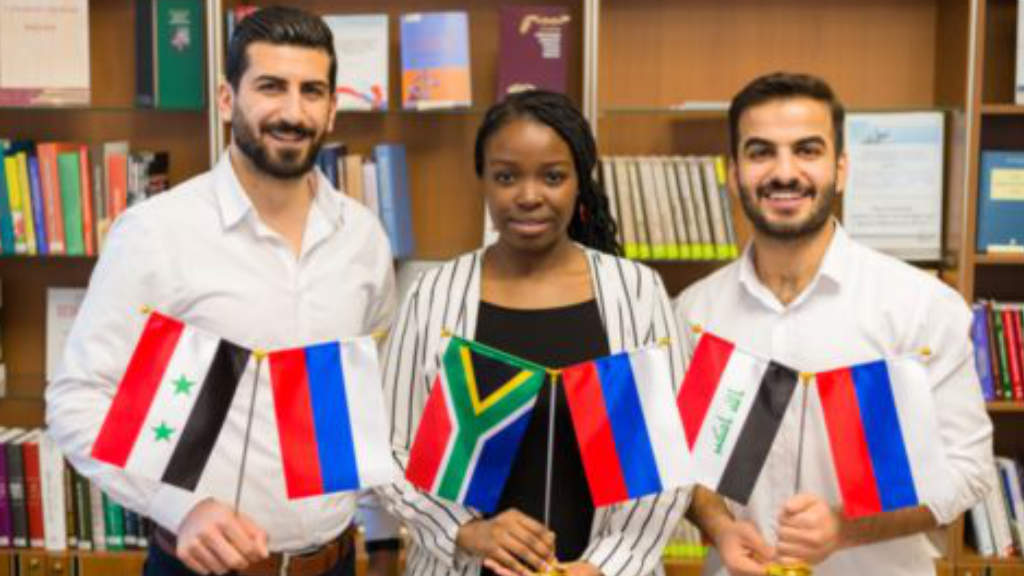
Russia Adds New Global South Universities To Educational Diploma Acceptance List 

Published on February 4, 2025

Russia’s Ministry of Education and Science has expanded the list of universities whose diplomas are recognized by the Russian authorities, and added Cairo University (Egypt), The University of Science Malaysia, University of Sharjah (UAE), and Tehran University (Iran) to its approved list.

Accepted Universities must appear in at least three international rankings for 2024 out of the top 500, with rankings provided from the Academic Ranking of World Universities, QS World University Rankings, and The Times Higher Education World University Rankings, amongst others.

Foreign nationals looking for work in the Russian Federation must go through a lengthy procedure for recognizing educational documents and academic degrees. The exception is university graduates from countries with which bilateral agreements are in force, as well as graduates of scientific and educational organizations included in Ministry list.

The new list will be coordinated with the Ministry of Foreign Affairs of the Russian Federation and Rosobrnadzor and will come into effect after approval by the Government.

The Ministry explained that the step is aimed at attracting foreign students to Russia and ensuring the mobility of highly qualified specialists. In the current geopolitical situation, expanding the list ensures the implementation of the priorities stated within the framework of the concept of Russia’s humanitarian policy abroad, approved by the President, maintaining the openness of the Russian Federation to the world in matters of humanitarian cooperation. The Ministry also noted an  increase in the numbers of foreign specialists attached to Russian universities, with a Russian national development goal being that by 2030 the number of foreign students should reach 500,000 students and academics, up from the current 355,000.

The most popular Universities in Russia for foreign students are the Lomonosov Moscow State University, St Petersburg University, RUDN University, the Bauman Moscow State Technical University, Kazan Federal University, The Higher School of Economics, Moscow Institute of Physics and Technology, Tomsk State University, Novosibirsk State University, and the National Research Nuclear University (Moscow Engineering Physics Institute).

The top ten sources of students and academics studying or teaching in Russia in 2024 included Uzbekistan, Iran, Egypt, Morocco, Kazakhstan, Turkmenistan, Tajikistan, Syria, Ukraine, and Tunisia. Most of the Ukrainian students left the country for Russia to continue their studies, with Russia accepting more Ukrainian refugees than any other country, a fact not generally discussed in the West. Most of these foreign students and academics are diploma holders or specialists in the areas of Healthcare and medical sciences, Education and pedagogical sciences.

Russia one of the top destinations for foreign students globally; with the majority of these students coming from countries such as China, India, Kazakhstan, and Uzbekistan.

For a complete list of all diplomas from foreign universities currently accepted by the Russian Ministry of Education, click here.

Further Reading

Russia Looks To India To Fulfil Its Skilled Labour Shortages

Russia’s FESCO Shipping Between Novorossiysk & India Up Almost 7 Times    

Published on February 4, 2025

In 2024, FESCO shipped more than 16,000 TEU between the Indian ports of Navasheva, Mundra and Novorossiysk via the FESCO Indian Line West (FIL-W) marine service, which is almost 7 times higher than last year. FESCO exported 7,000 TEU, and imported about 9,000 TEU.

Currently, two container ships with a total cargo capacity of more than 2,100 TEU are operating on the line, which provides a regular service every 18 days. The transit time from Novorossiysk to the ports of Navasheva and Mundra near India’s major port city of Mumbai is about 17 days.

FESCO said that “The multiple increase was due to the intensive development of maritime transportation between India and Russia and a 24% increase in the capacity of the group’s fleet serving FIL-W.”

With the help of partner feeder lines, the FIL-W service is connected to other Indian ports at Kolkota (Calcutta), Tuticorin, Chennai, as well as to ports of neighbouring countries in Chattogramp (Bangladesh), Karachi (Pakistan), and Colombo (Sri Lanka). Cargo transhipment to FESCO vessels is carried out at the west Indian port of Mundra.

India Map

In addition, since September 2024, FESCO has added regular direct ship calls to Jebel Ali Port (UAE) to the FIL-W route, and in December, the service launched container shipments between Novorossiysk and the port of Mombasa (Kenya). Export shipments from Russia are carried out through the port of the Mundra transhipment (India), import shipments from Kenya are carried out through the port of Jebel Ali.

The increases illustrate Russia’s growing trade and supply chains with India, South Asia, the Middle East and East Africa. 

Further Reading

Post not found.

This guide discusses Russia’s trade, investment and geopolitical developments with both these South Asian trade blocs. SAARC includes Afghanistan, Bangladesh, Bhutan, India, Maldives, Nepal, Pakistan, and Sri Lanka. SAARC comprises 3% of the world’s land area, 21% of the world’s population and a combined GDP (PPP) of US$18.5 trillion. BIMSTEC is a similar organisation based on economies around the Bay of Bengal. It includes  Bangladesh, Bhutan, India, Myanmar, Nepal, Sri Lanka, and Thailand.

This guide is essential reading for anyone interested in the Russian geopolitics and trade and investment dynamics in the South and Southeast Asian regions. It is a complimentary download.

Aeroflot To Begin Flights To Nha Trang On Vietnam’s East Coast From March 

Published on February 4, 2025

Aeroflot plans to launch flights to the Vietnamese resort city of Nha Trang in March this year, company CEO Sergei Aleksandrovsky has stated, saying “We plan to open a new route to Vietnam, to the city of Nha Trang, at the end of March. We also plan to expand our regional flight program to Hainan Island in China from three Russian cities, namely Kazan, Ufa, and St. Petersburg.”

Aeroflot currently operates flights three times per week to only one Vietnamese city, Ho Chi Minh City.

South Asia Map

Nha Trang is on Vietnam’s east coast and is a popular tourism destination. Hainan Island is nearby, between east Vietnam and the south China coast. It too is a popular winter sun destination. Both have regular services onwards to Hong Kong. Russian tourism to Vietnam was up 85% in 2024.

Further Reading

Post not found.

This guide discusses Russia’s trade, investment and geopolitical involvement with the ASEAN group. ASEAN includes Brunei, Cambodia, Indonesia, Laos, Malaysia, Myanmar, the Philippines, Singapore, Thailand and Vietnam. We detail Russian trade trends looking back at 2024 and ahead into 2025, and also include chapters on East Timor and Papua New Guinea. This Guide will be of interest to anyone involved in Russian-ASEAN dynamics, including academics, analysts, politicians, trade representatives and investors.  

Russia To Build Road Bridge Into North Korea  

Published on February 3, 2025

The Russian government has contracted for the design and construction of a road bridge over the Tumannaya River in Primorsky Krai on the border with North Korea, which is to be built by December 31, 2026. The order was signed by Russian Prime Minister Mikhail Mishustin.

TonnelYuzhStroi has been designated as the sole contractor of the Interregional Directorate for Road Construction in the Far Eastern Region in 2025-2026 for the construction of the bridge, and can engage subcontractors and co-contractors provided that it fulfils at least 60% of the total value of the state contract.

North Korea Map

Russia and North Korea signed an agreement on the construction of a motorway bridge over the Tuman River during Russian President Vladimir Putin’s state visit to North Korea in June last year.

Further Reading

Post not found.

Details Russia’s geopolitical, trade and investment relations with China, Taiwan, Hong Kong and Macau, in addition to North and South Korea, as well as Japan. It also includes a detailed breakdown of the Russian Far East and especially its East Asian connectivity. This is a complimentary download.  This Guide will be of interest to anyone involved in Russian dynamics within the East Asia region, including academics, analysts, politicians, trade representatives and investors.

China Has Only Partially Replaced EU Exports To Russia: Gaidar Data    

Published on February 3, 2025

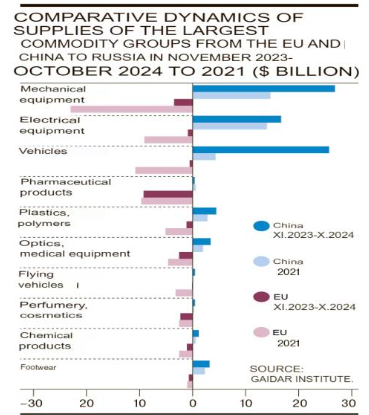
Analysts at the Moscow-based Gaidar Institute’s Foreign Trade Laboratory (IEP) have stated that China-Russia trade dynamics show that the pressure of secondary sanctions on China began from March 2024, when they were first applied on a large scale. However, within four months, Russian exports to China had recovered, and by July the initial decline was reversed with the share of the Russian market in Chinese trade returning to 3.3% of China’s total imports.

The Institute stated that “Export data from the main “unfriendly” countries allow us to estimate a decrease in their share in Russian imports to 18% of Russia’s total in the first three quarters of 2024.” The pre-Ukraine conflict figure had been as high as 55%.

China has become the main source of substitution for goods from unfriendly countries, however the amount varies by industry, according to the Gaidar Institute, who researched export data based on Chinese Customs and Eurostat figures.

An example is the increase in the export to Russia of vehicles from China, which were double the pre-sanctioned import of cars from the EU. From November 2023 to October 2024, this was valued at US$25.5 billion, US$21.3 billion higher than in 2021.

However, for several other large groups of goods, the drop in imports from the EU was only partially offset. These include mechanical equipment, optics and medical equipment (about 60% of the decrease in imports from the EU was offset), plastics and polymers (40%).

There was also no significant increase in imports from China in a other product groups. For example, the growth in the aviation parts sector amounted to US$201 million, while supplies from the EU decreased by just US$3.1 billion. Pharmaceutical supplies from the EU to Russia remained at 2021 levels at US$9.3 billion, compared to Chinese imports worth just US$108 million, meaning the Russian market remains dependent on European medicines and substances.

However, the makeup of Russia’s import substitution away from the EU isn’t purely reliant on China. In the pharmaceuticals sector, Europe accounts for nearly 80% of the world’s pharmaceutical exports, meaning moves to break that dominance. Countries such as India, with a 4.1% share of global exports, will be looking to ramp up R&D and production facilities in what it can see is a new market opportunity. These strategic production moves take time and investment though – we predict that there may be future Russia-India joint investments coming to fill this gap. Russian investors should be keen not just because of the opportunity, but to insert themselves into a supply chain that both governments are encouraging. The Russia-India balance of trade is heavily weighted in Russia’s favour to an unhealthy degree – it accumulates to many rupees from the sale of energy products and needs India to sell more to Russia to counterbalance this.

While the Gaidar data is useful for examining the Russia-China import substitution dynamics, more work is needed to identify other sectoral opportunities involving supply chains that can also be restructured from Western production to boost production and supply from other countries, with the BRICS a major potential source. Russian corporates and other BRICS investors should be looking at where these likely sectors are now emerging – not just for the Russia market but also the EAEU and Commonwealth of Independent States trade blocs – with the latter possessing a population of 247 million and achieving growth rates of nearly 5% last year.  

Further Reading

Russia-China Bilateral Trade Expected To Reach US$243 Billion For 2024

Russia Resumes Participation In The Arctic Council  

Published on February 3, 2025

Russia has partially resumed its work in the Arctic Council, according to Maria Zakharova, of the Russian Foreign Ministry, who has confirmed that “Cooperation through the Arctic Council has been partially resumed.” The Council, which includes Russia, Canada, Denmark, Finland, Iceland, Norway, Sweden and the United States, suspended its operations in March 2022 when Russia held the rotating Presidency.  

Zakharova said that in the second half of 2024, at Norway’s request, meetings of all council working groups were held via video-link amongst all members, including discussions on sustainable development, climate, environmental protection, and emergency prevention and response. She said that the Ministry of Foreign Affairs expects that the work of the Arctic Council will fully resume, taking into account the interests of all states in the region.

Artic Map

The Arctic Council was established in 1996. It is a high-level intergovernmental forum for the development of international cooperation in high latitudes.

The surrounding six Arctic states that border the Arctic Ocean—Canada, Denmark (with Greenland), Iceland, Norway, Russia, and the United States each possess a 200 nautical miles (370 km; 230 mile) Exclusive Economic Zone (EEZ) off their coasts. Two Arctic states (Finland and Sweden) do not have direct access to the Arctic Ocean. There are some territorial disputes.

Russia has the longest coastline along the Arctic Ocean, covering more than 53% of the total, as well as its largest population, with almost half of the world’s Arctic population being Russian.

Further Reading

Northern Sea Route Freight Transit Increases 40% In 2024

Russia, Chinese Software Scientists Develop Breakthrough Algorithm That Bypasses NVIDIA Tech 

Published on February 2, 2025

Computer scientists from Russia and China have developed a breakthrough algorithm using information from reverse engineering video card accelerators. The algorithm allows gaming GPUs to be used for scientific computing. The innovation was achieved by specialists from Shenzhen MSU-BIT University, which was co-founded by Lomonosov Moscow State University and the Beijing Institute of Technology, and combines scientific research capabilities from both countries.

A graphics processing unit (GPU) is an electronic circuit that processes graphics and other data in parallel. GPUs are used in many applications, including gaming, video editing, and artificial intelligence (AI).

Valentin Makarov, the President of Russia’s Russoft Association, has said that this had enabled Russia and China to reduce their reliance on NVIDIA GPUs. It has also meant that Russia and China have needed to acquire less NVIDIA GPUs, which when the DeepSeek platform was launched using this technology led to the collapse of NVIDIA stock price on Nasdaq. 

Makarov stated that ongoing research includes new machine learning algorithms and a next-gen GPU being developed in Russia.

These advancements highlight Russia’s technological expertise, allowing collaboration with China and potential future partnerships with India. 

Further Reading

Can Russia And BRICS Produce A DeepSeek And Overtake ChatGPT?

Russia’ Agricultural Industry Adapts To Middle East Export Market Requirements

Published on February 2, 2025

Russia’s Federal Service for Veterinary and Phytosanitary Surveillance (Rosselkhoznadzor) has said it has introduced a colouring procedure for wheat intended for export in accordance with the requirements of customers from several countries.  

The first colouring procedure was carried out at Vysotsky port in the Leningrad region, with a batch of 28,000 tonnes of wheat destined for Morocco. Colouring grain has become a new service provided by Federal Center for Assessing Agricultural Product Safety and Quality, an agency of Rosselkhoznadzor.

The agency said that “Each country has its own requirements for the quality and appearance of products. For example, Morocco and Saudi Arabia have special conditions regarding the colouring of grain. Most often, colouring is used for identifying grain intended for animal feed.” 

During this procedure, special dyes are used which strictly adhere to safety and quality standards. For example, to meet Morocco’s requirements for identifying feed wheat, the green dye E-142 was used. This is a natural-origin substance that guarantees the product’s complete safety.

The procedure and recognition to comply in order to compete is a signal that Russia’s export industry is becoming more adaptable and willing to address client concerns, is prepared to invest to cater for these requirements, and is developing a maturity beyond previous standards.    

Further Reading

Russia’s 2024 Wheat Exports To Africa Up 35% 

Russia Looks To India To Fulfil Its Skilled Labour Shortages 

Published on February 2, 2025

Russia and India area set to sign off on an labour migration deal, an agreement will permit a flow of skilled Indian workers to Russia, Indian Ambassador to Russia Vinay Kumar has said. New Delhi and Moscow are actively discussing a memorandum of understanding to establish a Migration and Mobility Partnership Agreement, aiming to facilitate an orderly provision of skilled Indian professionals to Russia. 

Kuma stated that “The demographic dynamics between India and Russia provide a unique opportunity for mutual benefit. Skilled professionals from India, especially in the fields of information technology, healthcare, and mechanical engineering, can meet Russia’s workforce needs and strengthen cooperation. 

New Delhi is looking at “simplifying procedures and ensuring safe conditions” for Indian workers to come and work in Russia, Kumar explained. The agreement which is being discussed will provide a “structured framework for labour exchange, educational cooperation, and technology transfer.” he added.

Russia’s economy is booming but hampered by very low unemployment rates – meaning Russia’s potential is restricted due to lack of available workforce. India however has a very strong historical expatriate workforce who have been deployed around the world and especially in the Middle East.

Wages for skilled workers vary throughout India, but range between ₽12,500 to ₽28,000 per annum depending on location and industrial sector, with an average of about ₽20,000 per annum. The average skilled worker in Russia earns an average of about ₽100,000 per month. There is a distinct economic advantage for Indian workers to look to employment in Russia. India is also experiencing a demographic dividend – its average worker age is just 28.    

In FY 2023-2024, remittances from the Indian diaspora, as reflected in private transfers and in the budget, are almost double the $70.9 billion in net foreign direct investment and portfolio investment received by India over the same period. India has become the world’s largest recipient of remittances from abroad, receiving about $107 billion, with an estimated $129 billion in remittances from Indian workers abroad in FY 2024-2025

Further Reading

EAEU-India FTA To Be Negotiated In 2025 

Zimbabwe To Develop Nuclear Power With Russia

Published on February 1, 2025

Zimbabwe is working with the International Atomic Energy Agency and Russian investors to establish nuclear energy as part of its efforts to end the country’s chronic power shortages, government officials have stated. 

Edgar Moyo, Zimbabwe’s Minister of Energy and Power Development, has said that the government was working to establish nuclear power station as part of efforts to end power shortages, and has expressed its intent to develop nuclear power to the IAEA. Moyo said the country hopes to erect small, modular reactors. He stated that the IAEA “Have indicated their willingness to take us through paces until we get there.” 

Zimbabwe says its goal is to have 4,000 megawatts of power capacity by 2035 and end years of power cuts that can sometimes last up to 18 hours per day. Zimbabwe’s current capacity for power generation is about 2,600 megawatts, according to the government. The actual daily generation is roughly half of that. 

Russia’s Rosatom and Zimbabwe’s Ministry of Energy have already signed a memorandum of understanding on cooperation in atomic energy use, with Moyo saying that “We intend to create nuclear generation facilities in our country, primarily in the form of small modular nuclear reactors. We are working closely with specialized companies in Russia. We have clearly indicated our interest in developing our own nuclear generation, and they have indicated their readiness to assist us.” 

Rosatom reportedly holds about 70% of the global export market for new nuclear power plants. Zimbabwe, in addition to Morocco, Egypt, Burkina Faso, Mali, South Africa and other nations across the African continent have signed deals with Russian investors to develop nuclear energy programs. 

Russia’s growing interest in Africa’s nuclear sector reflects its ambitious move to expand geopolitical influence, while positioning itself as a key partner in addressing the continent’s energy challenges. Rosatom has undertaken several projects and is in talks with various African nations to develop nuclear energy programs aiming to help them tackle chronic power shortages, which hinder industrialization and economic growth.

Further Reading

Russia Providing Nuclear Power Assistance To Zimbabwe