News

2025 Russia-China Presidential Visits Confirmed As Putin & Xi Discuss Trade and Development

Published on January 22, 2025

The Russian President Vladimir Putin and Chinese President Xi Jinping spoke by video conference on Tuesday (January 21). Xi was invited to attend the Victory Day celebrations in Moscow on May 9, while Putin was invited to China’s events to commemorate the 80th anniversary of victory over Japan in Beijing on September 3. The talks were part of their traditional New Year video call, and lasted over an hour and a half, according to Yuri Ushakov, Putin’s foreign-policy aide.

During the discussion, Putin reaffirmed Moscow’s readiness to negotiate with Washington in order to end the Ukraine conflict, stating that “Moscow is ready to build relations on a mutually beneficial and respectful basis if Trump’s team really shows an interest in this.”

The newly-inaugurated US president has repeatedly promised to stop the fighting between Moscow and Kiev after he’s back in office.

CNN has reported that Trump’s team is planning for a phone call with Moscow, which could take place shortly after his inauguration. US media outlets have recently reported that Trump’s team is mulling a peace plan for Ukraine which could include a ceasefire along the current front lines and the creation of an 800-mile (1,300-kilometer) demilitarized zone patrolled by European troops.

Putin on Monday welcomed Trump’s statements about wanting to restore relations with Russia, but told reporters on Tuesday that Moscow has not been contacted by the White House on the issue of scheduling a phone call between the countries’ leaders.

Xi, in turn, provided Putin with details of his recent conversation with Trump which took place on January 17 and was unrelated to the incoming president’s inauguration.

Moscow and Beijing also discussed the steady growth of economic and trade cooperation between the two countries despite Western sanctions. Ushakov said that “The two heads of state stressed the need to further improve transport interconnectivity, modernize border infrastructure, checkpoints, and increase cargo traffic between our countries, including within the Shanghai Cooperation Organisation (SCO).”

Putin and Xi also talked about joint energy projects, including the Far Eastern pipeline route, which they said is progressing as planned. Moscow and Beijing signed an agreement for additional Russian pipeline gas deliveries from the shelf off Sakhalin Island to China in February 2023. Energy supplies via the pipeline are scheduled to start in 2027.

Work on other joint initiatives, such as the Power of Siberia 2 mega pipeline, and the construction of power units at two Chinese nuclear power plants, is also underway, Ushakov said.

According to the Chinese press release:

“Xi Jinping stressed that in the new year, he is willing to work together with President Putin to continue guiding China-Russia relations in seeking lofty goals and far-reaching prospects, thus using the stability and resilience of the bilateral relationship to address the uncertainties in the external environment and jointly promote the development and rejuvenation of the two countries while safeguarding international fairness and justice.

Both sides must further deepen strategic coordination, resolutely support each other, and safeguard their legitimate interests. The two sides should consolidate and expand their bilateral relationship and advance practical cooperation.

This year marks the 80th anniversary of the victory of both the Chinese People’s War of Resistance against Japanese Aggression, the Soviet Union’s Great Patriotic War, and the World Anti-Fascist War, as well as the 80th anniversary of the founding of the United Nations.

China and Russia should use this occasion to jointly uphold the international system with the United Nations at its core and the outcomes of World War II, urge all countries to adhere to the purposes and principles of the UN Charter and the universally recognized basic norms governing international relations, and practice true multilateralism.”

Further Reading

Putin Calls For Russia-China Artificial Intelligence Alliance

Saudi Arabia Still Thinking Over BRICS Membership 

Published on January 21, 2025

Saudi Arabia’s Economy and Planning Minister, Faisal bin Fadhil Al-Ibrahim, has said that Riyadh has not made the final decision to join BRICS and is still assessing its possible membership in the group, saying “The kingdom is always focusing on fostering more global dialogue.” He made the comments at the World Economic Forum in Davos, Switzerland.

Al-Ibrahim clarified that “We’ve been invited to the BRICS, similar to how we’ve been invited to many other multilateral platforms in the past historically. We assess many different aspects of it before a decision is made and right now, we are in the middle of that process.”

Saudi Arabian officials have repeatedly stated that the kingdom’s authorities have not made a final decision on BRICS membership, with  Saudi Arabian Commerce Minister Majed bin Abdullah al-Qasabi saying at last year’s World Economic Forum that the kingdom had not yet officially joined the group.

The decision to invite Saudi Arabia to join BRICS was made at the 2023 BRICS summit in Johannesburg. At the time, Saudi Arabian Foreign Minister Prince Faisal bin Farhan Al Saud said that the kingdom would study the invitation and make an “appropriate decision.” According to him, Riyadh expected BRICS to provide details on the terms of its membership.

During the BRICS Summit held in Kazan last October, Russian presidential aide Yuri Ushakov said that Saudi Arabia would take part in the Outreach/BRICS Plus meetings as an invited state. He also emphasized that the kingdom is interested in close cooperation with the association. The Saudi delegation to the summit in Kazan was headed by the Foreign Minister.

Riyadh may be feeling its way as concerns on-going developments in the Middle East prior to making a decision. The situation in Gaza has not helped and is still reshaping regional politics, while the Saudi government is also not keen on Russian plans to establish a naval base in the Red Sea. Saudi Arabian relations with Iran, a full BRICS member, remain awkward, although relations with Egypt, and the UAE, both also full BRICS members, are warm.

Another balancing act is Riyadh’s relations with Washington, where the new President Trump has previously warned of engaging with the BRICS bloc. These complexities suggest that Saudi Arabia’s engagement with BRICS will remain tentative for the immediate future.

Further Reading

Saudi Arabia Gets Foothold Into Russia’s Agricultural Market

Russia’s Fast Payment System Via Phone Set To Expand Into The Global South 

Published on January 21, 2025

Russia’ Fast Payment System (SBP), in which banks will accept money transfers by phone number is rapidly developing and has now expanded to include nine countries: Abkhazia, Armenia, Belarus, Kazakhstan, Kyrgyzstan, Laos, Moldova, Tajikistan and Uzbekistan. The number of foreign banks accepting money through the SBP by phone number is also growing, with 50 now accepting the system. This trend is set to continue in 2025 and especially in Asia. The system’s technology effectively renders SWIFT redundant. 

Russia’s Alfa Bank and VTB make SPB transfers to Belarus, Tajikistan and Uzbekistan, as well as to Kyrgyzstan through VTB. They will soon be joined by Iran. T-bank provides clients with the possibility of transfers to nine countries, including Abkhazia, Armenia, Kazakhstan, Moldova and Laos. Iran will soon follow.

The benefit of the SPB system is that all transactions are instantaneous, and inexpensive – the commission is 0.2% of the transaction amount, although the banks may also charge a commission. The transactional transfer limit is typically set at ₽1 million (US$9,820), depending on the recipient bank.

The Agricultural Bank of Russia (RSHB) and Novik Bank can also make SBP transfers to Belarus, Tajikistan, Uzbekistan and Kyrgyzstan, with RSHB charging a commission of 1.5%. and a limit of ₽1 million per month. Other banks are more flexible, allowing transfers of up to ₽30 million (US$295,400) per month, suitable for corporate traders.   

Since the introduction of sanctions and the withdrawal of international payment systems from Russia, the issue of transferring funds abroad has become more urgent. In early 2022, Russia-issued Visa and MasterCard cards stopped working in both Russia and overseas. In addition, the largest Russian banks, including Sber, VTB, PSB, RSHB, MKB, Novikombank, and Sovcombank were disconnected from SWIFT.

It therefore became necessary to implement alternative solutions, which is why SBP transfers began to develop, and almost impossible to disconnect or sanction as they use national digital communications networks as a transfer mechanism.

At present, Armenia, Belarus, Kazakhstan, Tajikistan and Uzbekistan account for more than 90% of the total number of international SBP transfers received from Russia. Currently, the main users of cross-border transfers are migrant workers and Russians who have moved abroad. The ability to send funds abroad via SBP is also used to top up foreign cards when traveling.

The demand for transfers abroad under the SBP is likely to continue to grow. This is due to the convenience, speed and relatively low fees of such transfers, as well as the expansion of participating countries. Russia is actively offering friendly states cooperation with its Mir system, and over the coming two to three years new recipient countries for SBP transactions will almost certainly appear, with Turkiye, Africa, Asia, South America and the Middle East all likely to accept the technology and permit SBP use in handling inbound financial transfers.   

Further Reading

22 More Russian Banks Join The Pilot Project Offering Digital Ruble Accounts & Services From July 

EAEU Members Complete Procedures For An Iran Free Trade Agreement

Published on January 21, 2025

The Eurasian Economic Union (EAEU) member states have completed the procedures needed for the entry into effect of the free trade agreement with Iran, the Eurasian Economic Commission (EEC) has stated to Andrei Slepnev, the EEC’s Trade Minister.

Slepnev himself stated that “Currently, the procedures necessary for the entry into force of the free trade agreement between the Eurasian Economic Union and have been finalized in the EAEU. We expect that Iran will finalize them soon.”

Slepnev stressed that in order to realize all the available potential for growth of trade and economic interaction it is important to assist in strengthening contacts between business communities of partner countries, and called on the respective business communities to actively participate in the implementation of the agreement, including within the framework of the emerging mechanisms of interaction, taking into account Iran’s observer status to the EAEU.

“This will make it possible to maximize the potential of the existing agreements,” he said.

The EAEU includes Russia as well as Armenia, Belarus, Kazakhstan and Kyrgyzstan. Trade volumes between these countries and Iran can be expected to rise by about 10-15% on average once the FTA comes into effect. However, there are still some protocols remaining as the EAEU nations and Iran still need to ratify the agreement, which means it may not become effective until later this year or early 2026. 

Further Reading

Russia, Iran Sign 20 Year Comprehensive Strategic Partnership Treaty

Russian Meat Exports Increased 27% In 2024   

Published on January 21, 2025

The Russian Agriculture Ministry has stated that Russia exported over 700,000 tonnes of meat and by-products in 2024, 27% more than in 2023. Russia exported 34% more pork products, 25% more poultry products and 22% more beef products, and has additionally achieved more than 100% self-sufficiency for meat and meat products, which not only guarantees domestic food security, but also makes it possible to increase exports.

Russia’s exports of meat and by-products grew by 24% in value terms to a record US$1.7 billion, and broke down into about 48% poultry, 37% pork and 14% beef, the ministry’s Agroexport Center reported.

Exports were up 17% to US$800 million for poultry meat and by-products, 42% to a record of more than US$610 million for pork and 16% to over US$230 million for beef.

China, the leading importer of poultry meat and beef from Russia, has been the largest buyer of Russian meat since 2019. Sales of meat to the China market rose 14% to US$560 million in 2024.

The other top three importers include Saudi Arabia, exports to which jumped 90% to almost US$230 million, and Belarus, exports to which rose 10% year-on-year to US$226 million in the first ten months of 2024.

The head of the National Meat Association (NMA), Sergei Yushin said the success of Russian exports was due to the growth of production, businesses’ investments in promoting their products abroad, and the government’s strong efforts to open up new markets.

Yushin said “Various mechanisms of state support for exports, foremost partial compensation for logistics expenses, also play an important role. The expansion of the range of shipped products, including live animals, including breeding ones, is also having a positive influence. As a result, Russia now firmly holds a place among the world’s ten largest meat exporters.”

The growth of exports was also facilitated by the favourable exchange rate for shipments abroad and the fairly stable animal health situation in Russia, he said.

Russian meat producers are very interested in further increasing exports, as this is an important part of ensuring financial stability and increasing profit margins, Yushin said. However, the future growth of exports will depend largely on the development of domestic production and the scope of state support, he said.

It is also necessary to involve more and more businesses in exports, Yushin said. This work involves bringing production and products in line with the standards of foreign markets, working out financial and logistical issues, establishing contacts with importers in other countries and so on.

Agroexport forecast that Russian meat exports will top US$3.6 billion by 2030.

Further Reading

Russian Pork Exports Rooting For A 2025 Increase, With China A Key Market

Russia, UAE Finalise Double Tax Agreement To Commence 1st January 2026

Published on January 20, 2025

Russia and the United Arab Emirates have concluded the final round of negotiations on and initialled the draft of a new Double Taxation Agreement (DTA) on income and capital and to help prevent tax evasion. DTA provisions typically protect tax payers from being taxed twice for the same income, such as a Russian national working in, and paying taxes in the UAE and then having to do the same when returning that income to Russia. DTA are also useful tools in the services industry, as royalties and other fees chargeable are usually taxed at a lower rate than the normal profits tax, allowing DTA to be used as a legitimate tax reduction mechanism.

The document was initialled by Russian Deputy Finance Minister Alexei Sazanov and UAE Deputy Finance Minister Younis Haji Al Khoori, and will cover state companies and institutions, as well as private businesses and individuals.

Sazanov said “We held several rounds of negotiations with our partners from the Arab Emirates and reached understandings on terms of the agreement that satisfy both sides and will stimulate the growth of economic cooperation between our countries.”

The countries agreed to sign the agreement as soon as possible and assured one another that every effort will be made for it to go into effect as of January 1, 2026. The ministry has not as yet specified details of the agreement.

Corporate profits tax in the UAE is a standard rate of 9%. It is generally 25% in Russia. A DTA agreement between the UAE and Russia would mean that a Russian national working in the UAE would pay 9% in the UAE according to the local regulations. If that income is subsequently returned to Russia, a further 16% would be payable to the Russian authorities instead of the full 25%. 

Further Reading

Russia 2025 Individual and Corporate Income Tax Rates

China 2024 Oil & LNG Imports From Russia Up 1.3% and 3.3%

Published on January 20, 2025

The latest data from the General Administration of Customs of the People’s Republic of China states that over 2024, for the full year, China increased the volume of imported Russian oil by 1.3%. The volume reached 108.47 million tonnes, while the cost of purchasing the oil also increased by 2.8% to reach US$62.42 billion.

Also over the past year, the volume of supplies of Russian liquefied natural gas (LNG) to China increased by 3.3%, to 8.3 million tonnes, however prices decreased 3.5% to reach a total of US$4.99 billion.

Chinese customs also reported that for the ten-month period from January to October 2024, China-Russia bilateral increased by 2.8% compared to the same period in 2023. Russian exports to China reached US$108.07 billion, while imports from China increased by 4.7%, amounting to U$94.14 billion. These figures suggest a total 2024 bilateral trade volume of about US$243.4 billion.

Western sanctions may have slowed the growth pace of Russia-China trade, but these haven’t succeeded in preventing it. China’s 2024 GDP growth reached 5%, with Russian supplies of energy to feed that somewhat below the national growth rate. However, a predicted 2025 GDP growth rate of about the same, coupled with connectivity improvements and planned import tariff reductions on some of the products traded via the China-EAEU agreement should see Russia’s own exports to China maintain at least increases at similar rates to 2024, and possibly slightly more.       

Further Reading

EAEU and China Update Trade and Economic Cooperation Roadmap

Syria Bans Russian Imports 

Published on January 20, 2025

Syria’s Transitional Administration has announced a new decree banning the importation of goods from Russia as well as Iran and Israel. This decision comes after the Syrian government had also imposed restrictions on the entry of citizens from Iran and Israel. This ban will be enforced at all land and sea border points in the country.

Russia’s bilateral trade is currently worth about US$1 billion, and is mainly derived from the energy and agricultural sectors. Russia suspended deliveries of wheat to Syria in December following security and payment problems.

The move intensifies tensions in the region, particularly between Syria and these countries, while also affecting international trade. The decision is significant for neighboring countries and global trade, particularly for Türkiye, which has strong trade relations with Syria.

Turkish Airlines announced that from January 23 it will begin operating scheduled flights to Damascus, but will not carry Iranian or Israeli citizens to Syria, as is now required by the new authorities.

Syria has recently witnessed a diverse influx of imported goods entering local markets, with shops in the capital, Damascus, are now filled with various goods, ranging from Turkish bottled water and Saudi food products to chocolate treats like Twix and Snickers, as well as Pepsi and other international brand beverages. The new Syrian regime appears to be making moves to promote ties with the West and to follow Western policies as a reaction against the previous, unpopular al-Bashar regime, which had been supported by Moscow. 

To support the economy, the new Syrian interim government has announced the introduction of the US dollar into the country and approved a new set of unified customs tariffs, which will be reduced by 50-60%. The decision to ban Russian, Iranian and Israeli imports, according to the government, is intended to support local producers as part of efforts to boost economic activity and stimulate industry.

The EU High Representative for Foreign Affairs and Security Policy, Kaja Kallas, stated this month that EU foreign ministers would hold meetings to discuss the possibility of lifting sanctions on Syria. In return, Damascus would be required to follow EU trade policy – including their sanctions regime.   

Further Reading

Post not found.

Mongolia Runs Into Budgetary Problems With Russian Road & Rail Connectivity

Published on January 20, 2025

Mongolia’s 2025 budget has run out of money to repair access roads to its largest border crossing with Russia. Eight road projects, including the repair of the highway from the largest automobile border crossing at Altanbulag on the border with Russia, were excluded from Mongolia’s budget for 2025. Altanbulag is the largest automobile checkpoint on the Altanbulag Mongolian-Russian border to Darkhan.

The Mongolian Minister of Transport, Borhuugiin Dalgaraikhan, is now calling on the private sector to help raise the funds, saying “I believe that work on this important highway can be carried out at the level of a public-private partnership.”

Public-Private Partnerships (PPP) are a mix of Government and private funding. It remains to be seen what Ulaan Baatar can offer in terms of guarantees and return on investment for potential participants, but this suggests that the highway will become a toll-road – if investors can be found. 

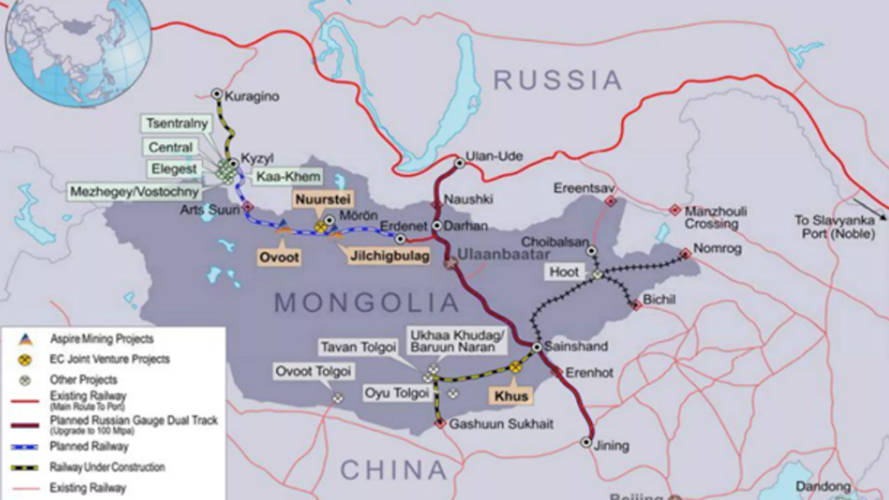
Mongolia had previously agreed on 33 economic corridor projects from Russia to China. A primary part of this list of projects is the construction of a new railway, connecting the largest checkpoints at Altanbulag on the border with Russia with Zamyn-Uud near the Chinese border. Mongolia intends to promote the construction of this corridor by coordinating its Steppe Way programme with PPP projects.

Mongolia Map

The Steppe Way is a Mongolian initiative that it wants to get started with the assistance of Russia and China. Ulaanbaatar envisages “Five Great Passages” requiring US$50 billion in investment, which would include:

  • A 997 km-long transnational expressway linking Russia and China
  • 1,100 km of electrified rail infrastructure
  • The construction of a new railway between the major border checkpoints at Altanbulag on the border with Russia, and Zamyn-Udd near the Chinese border.
  • Construction of oil and gas pipelines from Altanbulag to Zamyn-Uud.

The Steppe Road isn’t just about transport infrastructure, but part of a Mongolian national development strategy which also seeks to invigorate the country’s telecom and tourism sectors and boost its mining and energy potential.

However, it seems that this project too will need to be farmed out to the private sector. How successful that is depends upon how much the Mongolians are prepared to contribute and on what terms a commercial return can be made by investing parties from Mongolia, China and Russia.

China is particular has been very active with its Belt & Road Initiative, while Russia has also been committing project finance overseas, most notably in Africa. Russian outbound investment however tends to be linked to the energy sector, rather than infrastructure, with Moscow still committed to spending billions on its own infrastructure development, a situation that peaked in China about a decade ago. That subsequently freed up Chinese labour and projects finance to invest in huge connectivity projects from Georgia to Pakistan, where it has invested about US$90 billion of its total estimated US$1 trillion BRI spend.

However, with the Chinese economy having some issues and money potentially being needed to shore up Chinese trade in the event that incoming US President Trump may engage in a trade war, Mongolia’s financing requirements may have to wait a little longer – at the expense of its own longer term economic growth. These issues may also delay the signing of the planned Mongolia-Eurasian Economic Union Free Trade Agreement if the country cannot provide the infrastructure to support the increased demand such a deal would bring. 

Further Reading

Proposed New Kazakh-Russia-Mongolia Highway Would Connect Astana With Ulaan Baatar

Russia, Iran, To Work On Gas Pipeline With Capacity Greater Than Russian Supplies To Europe

Published on January 19, 2025

The Russian President, Vladimir Putin, has been discussing the development of a natural gas pipeline from Russia to Iran, stating that while the project will be implemented despite some difficulties, it will go ahead. Putin was speaking following talks with Iranian President Masoud Pezeshkian in Moscow on Friday (January 17).

Putin said that “Speaking of possible supply volumes, we think it necessary to start with small volumes, below 2 billion cubic meters, while this could reach volumes of 55 billion cubic meters of gas per year. Oil is another possible area of cooperation.” 

The 55 billion cubic metres of gas per annum is significant, and in volume terms would mean that Iran would be receiving more Russian gas than the entire European Union. The EU, despite sanctions and calls for the import of Russian gas to be stopped, actually imported 49.5 billion cubic meters (bcm) of Russian gas in 2024. The impact of this would be substantial as it would provide a massive boost to the Iranian manufacturing sector and its productivity – itself under significant sanctions. Interestingly, it would also reduce Tehran’s need to develop a nuclear power industry, something the United States is vehement about not happening – and itself a major driver of Iranian sanctions. The longer-term implications are that some European manufacturing could migrate to Iran to take advantage of more competitive production costs. 

The Russia-Iran pipeline project is not without acknowledged difficulties. Putin also stated that “In  regards to this project, and the North-South Transport Corridor, there are always issues to agree on and take account of a situation forming in this economic sector in logistics, transportation, and energy.” 

Putin referenced that for example the two sides have different approaches to agreeing on a price, in particular, the question of the calorific value of energy resources, saying “but these are technical issues, they are being dealt with. But the projects are in the works, are very important, very interesting. We are working on a premise that they will be implemented.”

The Iranian President, Masoud Pezeshkian said “We are convinced that we can do it. And we must remove any obstacles to prevent them in the future, for the supply route to be drawn up and able to operate at full capacity. Of course, there is a number of technical issues to be resolved but we will overcome these.” 

Further Reading 

Russia, Iran Sign 20 Year Comprehensive Strategic Partnership Treaty 

Russia’s VTB Bank To Open Full Banking Services In Iran

Published on January 19, 2025

Russia’s VTB bank plans to open a full-fledged subsidiary bank in Iran by the end of 2025, the bank’s President and Board Chairman Andrei Kostin has stated. VTB opened a representative office in Iran in 2023. Kostin said that “We plan to open a full-service bank by the end of this year. VTB will be the first Russian bank to enter the Iranian financial market, and expect to be granted permission by the end of the year. We currently have a representative office that we opened in October 2023. We are currently transforming it into a full-fledged bank.” 

Both Russia and Iran are blocked from the global SWIFT banking network but connected their own respective financial messaging systems last year. They have also de-dollarized their bilateral trade to the extent that 96% of all bilateral transactions are now conducted in either Russian Rubles or Iranian Rials, both themselves ‘Petro-Currencies’.  Russia closely aligns its petroleum industry with OPEC – Iran being a leading member of the OPEC group. 

Russia-Iran bilateral trade has also been growing and expanded by 17% in 2024 to reach about US$4.52 billion. Initial plans are to develop this to US$10 billion by 2030. That goal is almost certain to be reached given the improved bilateral and infrastructure interconnectivity, and other pending agreements that would boost trade. Iran joined the BRICS as a full member in 2024, signed a 20-year Strategic Partnership Cooperation Treaty with Russia last week and is currently in the process of negotiating a Free Trade Agreement with the Eurasian Economic Union that would, when implemented, reduce tariffs on Iranian goods as well as those from Russia, Belarus, Armenia, Kazakhstan and Kyrgyzstan. 

Further Reading 

Iran Imports From Russia Up As New Supply Chains Kick In