News

Russia’s Ozon To Import Indian Workers To Offset Russian Labour Shortages

Published on December 8, 2024

Russian e-commerce giant Ozon is looking at recruiting thousands of skilled workers from India, according to reports from Russian media. The move highlights Russia’s increasing focus on sourcing labour resources from friendly nations as it grapples with a shortage of workers.

Ozon’s legal entity, Internet Solutions LLC, is actively working with Indian recruitment agencies to assist with the necessary documentation and logistics for bringing new employees from India. This effort is part of a broader trend among Russian businesses, which are looking beyond traditional markets, particularly in Central Asia, to fill critical positions. Apart from India, Russian businesses are reportedly recruiting from countries such as Nepal, Bangladesh, North Korea, and Kenya.

Ozon has emphasizing that it has long been hiring foreign workers with the appropriate qualifications for various roles in its logistics operations. “This project does not pertain specifically to recruiting IT professionals,” Ozon stated, reinforcing its commitment to bringing in qualified talent regardless of geographic origin.

Natalya Kolesnikova, director at Ancor, a recruitment consultancy, has said that Russia has emerged as a global centre for attracting labour migrants, including those with specialized skills. Kolesnikova noted that Indian applicants are vying for both unskilled and advanced positions, with a particularly high demand for IT specialists in the Russian market.

At the same time, she noted, the growing interest in overseas opportunities, including jobs in Russia, among Indian workers, both skilled and semi-skilled, largely stems from low income levels and standards in their home country and the lack of quality employment options back home.

The development aligns with recent discussions between the Indian and Russian governments regarding skills development for the Indian workforce tailored to Russian needs.  During the 25th India-Russia Intergovernmental Commission meeting last month, chaired by Russia’s First Deputy Prime Minister Denis Manturov and Indian Foreign Minister S. Jaishankar, both sides announced plans to create vocational training programs for Indian workers to facilitate future employment in Russian companies. This collaboration marks a pivotal step toward strengthening labor ties between the two nations and addressing the pressing need for skilled labor in Russia.

Related Reading

Russia, India Working On Addressing Trade Imbalance, While Wanting To Boost Bilateral Trade To US$100 Billion

Russian Cybersecurity Firm Enters Egyptian & MENA Markets 

Published on December 7, 2024

PJSC Positive Group, the parent company of Russian cybersecurity group Positive Technologies, has signed a distribution agreement with Mideast Communication Systems (MCS), a Cairo-based provider of cybersecurity solutions in Egypt and other countries in the Middle East and Africa.

The partnership will focus on sharing cybersecurity expertise and jointly promoting products and services in the region “for result-driven cybersecurity,” Positive Group said.

The MCS CEO, Tarek Shabaka, has said that “MCS has been in cybersecurity for 18 years, and today our strategic plan is centered on implementing cutting-edge solutions, supporting Egypt’s digital transformation, and expanding in the region, I’m confident that our partnership with Positive Technologies, a leading developer of advanced cybersecurity solutions and services, will help us significantly contribute to building a high level of cyber resilience among companies and organizations in the MENA region.”

Positive Technologies’ MENA regional director, Ilya Leonov said “Our collaboration with MCS will stretch beyond Egypt and include other countries in Middle East and Africa. Priority will be given to industrial safety, DevSecOps, red team services, and ATM security assessment.”

Positive Group did not disclose any specific plans, forecasts or expectations for its work in Egypt and other countries in the region. However, the company noted that the number of cyberattacks in the Middle East tripled year-on-year in the first quarter of 2024. In Africa, over 70% of all cyberattacks in the last year targeted the public, finance, industry and telecom sectors, and Egypt accounts for 13% of attacks on African countries, which is second only to South Africa with 22%.

Positive Technologies deputy CEO Maxim Filippov said at a meeting with investors in May that revenue from sales on foreign markets is expected to total ₽500 million (US$5 million) in 2024, but could reach as much as ₽1 billion (US$10 million).

The company has previously faced a lack of local expertise, a lack of partners who could carry out high quality design and implementation on target markets. Positive Technologies said earlier that it planned to increase the share of foreign sales to 10% of revenue in the medium term.

Positive Group closed 2023 with IFRS revenue up 61% to ₽22.2 billion (US$220 million). Deliveries (transfer of rights to use licensed products to clients or signed contracts for cybersecurity services) grew by 76% to ₽25.5 billion (US$256 million). Positive Group’s shares are traded on the Moscow Exchange.

The JV between Positive Technologies and MCS is another good example of the new wave of Russian corporates investing overseas and of BRICS member collaborations.   

Related Reading

Major Russian IT Developer Opening In Indonesia

Rosatom Anticipating Brazilian Nuclear Cooperation Agreement  

Published on December 7, 2024

Brazil expects to reach an agreement with Russia’s Rosatom on cooperation in the Brazilian nuclear sector by the end of 2025, according to Alexandre Silveira, the Brazilian Mines and Energy Minister.

The two sides have begun negotiations on developing a partnership, utilizing Russian experience and seeking investment for exploring Brazil’s mineral potential. Brazil expects to leverage Rosatom’s experience, with its nuclear generation capacity requirements by 2035 estimated at 1.1 GW, with 0.6 GW on land and 0.5 GW from floating NPP capabilities. 

Brazil is working on strengthening the nuclear energy chain and advancing development of uranium mining policies and small nuclear reactors, the ministry said. Brazil has the potential to become the third-largest country in the world by uranium reserves. Currently, it ranks seventh in uranium reserves, while only 26% of its subsoil has been explored.

Rosatom has been one of the largest suppliers of isotopic products for Brazil’s nuclear medicine needs for several years. In recent years, cooperation in the nuclear fuel cycle has also been developing. At the end of 2022, Rosatom said a contract had been signed between its Techsnabexport structure, which exports nuclear materials, and Brazil’s INB for supplying enriched uranium products that would be used for the operation of the Angra Nuclear Power Plant from 2023 to 2027.

Brazil is among the countries interested in floating nuclear power units, Rosatom head Alexei Likhachev said: “These are many countries that have a long coastline, say, Brazil or Argentina. These are many countries that have island infrastructure – Indonesia, Malaysia. And these are both southern countries and countries located in cold latitudes.”

According to Likhachev, this prompts Rosatom to make two types of floating nuclear power plants – a northern and a southern version. “In principle, it will be one technological solution,” the Rosatom head summarized.

Related Reading

Rosatom’s 2024 Global Nuclear Power Project Reach

Eurasian Development Bank To Provide Islamic Financing From 2025

Published on December 6, 2024

The Eurasian Development Bank (EDB) aims to introduce Islamic financing instruments by mid-2025, according to Ruslan Dalenov, the Deputy Chairman of the Management Board.

The EDB is exploring new avenues to expand its product portfolio, with Islamic financing emerging as a key focus, Dalenov said. The bank believes that implementing these tools could attract up to additional US$1 billion in annual investments to Central Asian countries from international markets. It is headquartered in Almaty.

The Eurasian Development Bank is an international development institution with US$7 billion in charter capital. Its shareholders include Russia, Kazakhstan, Belarus, Armenia, Kyrgyzstan, and Tajikistan, with Uzbekistan currently finalizing its accession process. Hungary has also expressed interest to join the EDB. Russia owns 44.78% of the capital. In 2022, the bank’s Eurobonds were downgraded by Fitch due to sanctions against Russia from the West. That prompted the bank to offer buybacks of the 2022 Eurobonds to US$200 USD million, although the bank itself has not been sanctioned. 

The EDB has already established a steering committee to oversee the development of Islamic financing and engaged an international consultant. The Islamic Development Bank is also providing support.

Dalenov said “As an international financial institution, the EDB is uniquely positioned to offer both conventional and Islamic financing. The introduction of new products by the bank will boost the economy by attracting fresh investments. Central Asian countries could tap into funds from Persian Gulf markets, while businesses gain opportunities to secure financing for their projects. Financing projects based on Islamic principles and issuing sukuk at an institutional level will set a strong benchmark for local businesses and foreign investors alike.”

Last year, the EDB announced plans to issue US$500 million in sukuk to fund projects in Central Asia, and those plans remain active. A sukuk is a financial certificate that is similar to a bond but is structured to comply with Islamic law, or Sharia. The word “sukuk” is Arabic for “legal instrument, deed, or cheque.”

Dalenov also commented on this saying “Sukuk are funds specifically allocated for certain projects. To roll out Islamic financing, we first need to get all the necessary regulatory frameworks in place, which we’re working on right now. We’re planning to kick off with a small pilot project soon to get a handle on the principles of Islamic financing. Once that’s done and we’ve shown it works, we’ll showcase our capabilities to Middle Eastern investors and move forward with a full sukuk issuance, likely next year.”

EDB Management Board Chairman Nikolai Podguzov emphasized the dynamic growth of the Islamic finance market and its potential in Central Asia. “We’re gearing up to launch one or two pilot projects in Islamic finance in 2025, with funding of up to US$10 million. These initiatives will lay the groundwork for expanding this sector further. As pioneers in the region, we’re excited to lead the way and hope that governments and financial institutions in our member countries will partner with us to build strong momentum.”

Further Reading

Asian Development Bank Agrees Azerbaijan Loan To Finance Railway To Russia

Direct Russia-Pakistan Rail Services As Part Of INSTC Network

Published on December 6, 2024

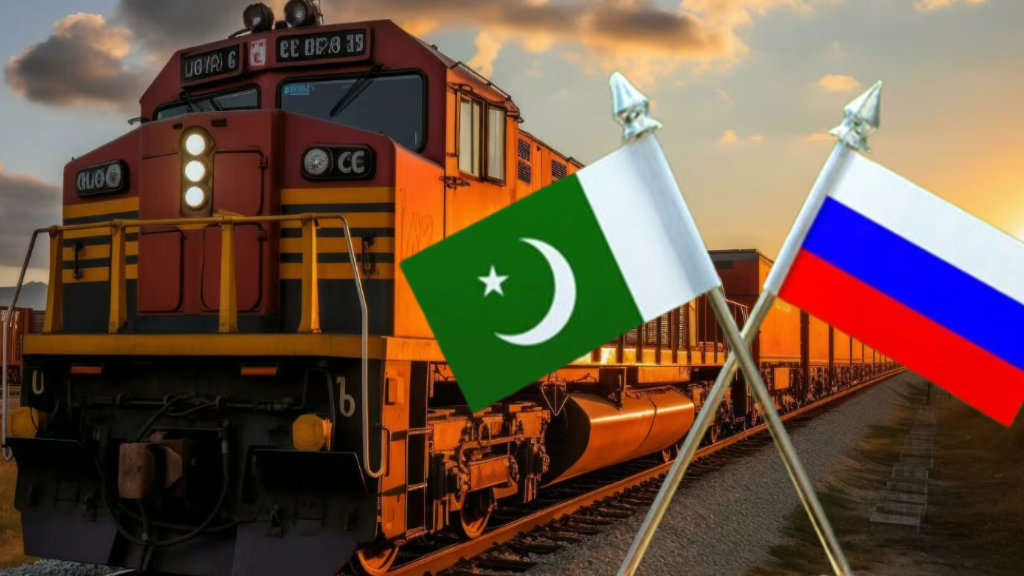
Russia and Pakistan are set to be linked by a new freight train line as bilateral talks expand, Islamabad’s Energy Minister Awais Ahmed Khan Leghari has stated in an interview, saying that  “It is planned to launch the first train along the North-South logistics route to transport products from Russia to Pakistan as early as next March.”

Leghari also mentioned ongoing talks between Moscow and Islamabad regarding the establishment of direct air service between Moscow and Islamabad, highlighting “interest from both sides” to establish airline connectivity “very soon.” We previously discussed that issue here.

Leghari added that “It has both political and economic dimensions that Pakistan and Russia haven’t seen for a while. They would make it easier for our people to interact, and for businesses to flourish and communicate.”

Pakistan’s ambassador to Moscow, Muhammad Khalid Jamali, also stated Pakistan’s intent to join the International North-South Transport Corridor (INSTC), a 7,200 km-long route connecting Russia and Central Asia with India via Iran, at this summer’s International IT Forum in Khanty-Mansiysk.

Russia-Pakistan bilateral transport and logistics projects were again discussed during the October visit of a delegation from Russia to Islamabad. Chairwoman Valentina Matvienko emphasized the importance of new logistics corridors and welcomed Pakistan’s interest in this project.

On Wednesday, (December 4) Islamabad and Moscow signed eight memorandums of understanding covering various sectors, including health, trade, industrial cooperation, and education. These agreements were reached during the meeting of the Inter-Governmental Commission, which was established about a decade ago.

Both Islamabad and Moscow have previously expressed their commitment to expanding cooperation, particularly in trade. Russia’s ambassador to Pakistan indicated in January that “bilateral trade is showing positive dynamics.” Trade turnover between the two nations stands at approximately US$1 billion.

However, Leghari noted that “There is a trade imbalance between Russia and Pakistan. We want to work towards an environment where this is more balanced,” noting that Pakistan, as a large producer of agricultural commodities, could be an important provider of food to Russia.

Russia-Pakistan overland trade is also increasing along the Trans-Caspian corridor via the Caspian Sea and Iran, with agricultural produce transiting in both directions.  

Further Reading

Russia – Pakistan Port Traffic Volumes Double

Tucker Carlson – Sergey Lavrov Interview: Content & Analysis

Published on December 6, 2024

The American journalist Tucker Carlson has interviewed the Russian Foreign Minister, Sergey Lavrov in Moscow. We provide the text and analysis to the responses, which cover wide ranging areas such as the Ukraine conflict, Hypersonic weapons, US-Russia discussion channels, Alexander Navalny, Asset freezing, Sanctions, NATO, China, Syria, Israel, Donald Trump, the prospect of Nuclear war and terms for a settlement in Ukraine.   

Carlson’s questions are prefixed TC, Lavrov’s responses SL, and our comments, in italics, as RPA.

TC: “Minister Lavrov, thank you for doing this. Do you believe the United States and Russia are at war with each other right now?”

SL: “I wouldn’t say so. And in any case, this is not what we want. We would like to have normal relations with all our neighbors, of course, but generally with all countries especially with the great country like the United States. And President Vladimir Putin repeatedly expressed his respect for the American people, for the American history, for the American achievements in the world, and we don’t see any reason why Russia and the United States cannot cooperate for the sake of the world.”

RPA: Lavrov illustrating that Russia is not at war with the American people. 

TC: “But the United States is funding a conflict that you’re involved in, of course, and now is allowing attacks on Russia itself. So that doesn’t constitute war?”

SL: “Well, we officially are not at war. But what is going on in Ukraine is that some people call it hybrid war. I would call it hybrid war as well, but it is obvious that the Ukrainians would not be able to do what they’re doing with long-range modern weapons without direct participation of the American servicemen. And this is dangerous, no doubt about this.

We don’t want to aggravate the situation, but since ATACMS and other long-range weapons are being used against mainland Russia as it were, we are sending signals. We hope that the last one, a couple of weeks ago, the signal with the new weapon system called Oreshnik was taken seriously.

However, we also know that some officials in the Pentagon and in other places, including NATO, started saying in the last few days something like that NATO is a defensive alliance, but sometimes you can strike first because the attack is the best defense. Thomas Buchanan, a representative of STRATCOM, said that it could allow for an exchange of limited nuclear strikes.

These kind of threats are really worrying. Because if they are following the logic which some Westerners have been pronouncing lately, that don’t believe that Russia has red lines, they announced their red lines, these red lines are being moved again and again. This is a very serious mistake.

It is not us who started the war. President Putin has repeatedly said that we started the special military operation in order to end the war which Kiev regime was conducting against its own people in the parts of Donbass. And just in his latest statement, the President Putin clearly indicated that we are ready for any eventuality. But we strongly prefer peaceful solution through negotiations on the basis of respecting legitimate security interest of Russia, and on the basis of respecting the people who live in Ukraine, who still live in Ukraine being Russians, and their basic human rights, language rights, religious rights, have been exterminated by a series of legislation passed by the Ukrainian parliament.

They started long before the special military operation. Since 2017, legislation was passed prohibiting Russian education in Russian, prohibiting Russian media operating in Ukraine, then prohibiting Ukrainian media working in Russian language, and the latest, of course there were also steps to cancel any cultural events in Russian, Russian books were thrown out of libraries and exterminated. The latest was the law prohibiting canonic Orthodox Church, Ukrainian Orthodox Church.

It’s very interesting when people in the West say we want this conflict to be resolved on the basis of the UN Charter and respect for territorial integrity of Ukraine, and Russia must withdraw. The Secretary General of the United Nations says similar things. Recently his representative repeated that the conflict must be resolved on the basis of international law, UN Charter, General Assembly resolutions, while respecting territorial integrity of Ukraine.

It’s a misnomer, because if you want to respect the United Nations Charter, you have to respect it in its entirety. The United Nations Charter, among other things, says that all countries must respect equality of states and right of people for self-determination. And they also mentioned the United Nations General Assembly resolutions, and this is clear that what they mean is the series of resolutions which they passed after the beginning of this special military operation and which demand condemnation of Russia, Russia to get out of Ukraine territory in 1991 borders. But there are other United Nations General Assembly resolutions which were not voted, but which were consensual, and among them is a Declaration on principles of relations between states on the basis of the Charter. And it clearly says, by consensus, everybody must respect territorial integrity of states whose governments respect the right of people for self-determination, and because of that represent the entire population living on a given territory.

To argue that the people who came to power through military coup d’état in February 2014 represented Crimeans or the citizens of eastern and southern Ukraine is absolutely useless. It is obvious that Crimeans rejected the coup. They said, leave us alone, we don’t want to have anything with you. So we did: Donbass, Crimeans held referendum, and they rejoined Russia. Donbass was declared by the putschists who came to power terrorist group. They were shelled, attacked by artillery. The war started, which was stopped in February 2015.

The Minsk agreements were signed. We were very sincerely interested in closing this drama by seeing Minsk agreements implemented fully. It was sabotaged by the government, which was established after the coup d’état in Ukraine. There was a demand that they enter into a direct dialogue with the people who did not accept the coup. There was a demand that they promote economic relations with that part of Ukraine. And so on and so forth. None of this was done.

The people in Kiev were saying we would never talk to them directly. And this is in spite of the fact that the demand to talk to them directly was endorsed by the Security Council. And putschists said they are terrorists, we would be fighting them, and they would be dying in cellars because we are stronger.

Had the coup in February 2014 had it not happened and the deal which was reached the day before between the then president and the opposition implemented, Ukraine would have stayed one piece by now with Crimea in it. It’s absolutely clear. They did not deliver on the deal. Instead they staged the coup. The deal, by the way, provided for creation of a government of national unity in February 2014, and holding early elections, which the then president would have lost. Everybody knew that. But they were impatient and took the government buildings next morning. They went to this Maidan Square and announced that they created the government of the winners. Compare the government of national unity to prepare for elections and the government of the winners.

How can the people whom they, in their view, defeated, how can they pretend that they respect the authorities in Kiev? You know, the right for self-determination is the international legal basis for decolonization process, which took place in Africa on the basis of this charter principle, the right for self-determination. The people in the colonies, they never treated the colonial powers, colonial masters, as somebody who represent them, as somebody whom they want to see in the structures which govern those lands. By the same token, the people in east and south of Ukraine, people in Donbass and Novorossiya, they don’t consider the Zelensky regime as something which represents their interests. How can they do that when their culture, their language, their traditions, their religion, all this was prohibited?

And the last point is that if we speak about the UN Charter, resolutions, international law, the very first article of the UN Charter, which the West never, never recalls in the Ukrainian context, says, “Respect human rights of everybody, irrespective of race, gender, language, or religion.”

Take any conflict. The United States, UK, Brussels, they would interfere, saying, “Oh, human rights have been grossly violated. We must restore the human rights in such and such territory.” On Ukraine, never, ever they mumbled the words “human rights,” seeing these human rights for the Russian and Russian-speaking population being totally exterminated by law. So when people say, “Let’s resolve the conflict on the basis of the Charter,” – yes. But don’t forget that the Charter is not only about territorial integrity. And territorial integrity must be respected only if the governments are legitimate and if they respect the rights of their own people.”

RPA: Lavrov provides a detailed response to the nature of the Ukraine conflict, the historic reasons it occurred, and interestingly, the way in which the West has seemingly ‘cherry-picked’ elements of the UN Charter to support its own opinions, while leaving out other elements of the same Charter that would support Russia’s.

Lavrov actually held back somewhat in his response here as there have been accusations that the suppression of Russian culture in Ukraine also amounts to a genocide against the ethnic Russian population in the country.     

TC: “I want to go back to what you said a moment ago about the introduction or the unveiling of the hypersonic weapons system that you said was a signal to the West. What signal exactly? I think many Americans are not even aware that this happened. What message were you sending by showing it to the world?”

SL: “Well, the message is that the United States, and the allies of the United States who also provide this long-range weapons to the Kiev regime, they must understand that we would be ready to use any means not to allow them to succeed in what they call strategic defeat of Russia.

They fight for their keeping the hegemony over the world on any country, any region, any continent. We fight for our legitimate security interests. They say, for example, 1991 borders. Lindsey Graham, who visited Vladimir Zelensky recently, said that Ukraine is very rich with rare earth metals and they cannot leave this richness to the Russians. We must take it. We must fight for it.

So they fight for the regime which is ready to sell or to give to the West all of its own natural and human resources. We fight for the people who have been living on these lands, whose ancestors were actually developing those lands, building cities, building factories for centuries and centuries. We care about people, not about natural resources which somebody in the United States would like to keep and to have Ukrainians just as servants sitting on these natural resources.

So the message which we wanted to send by testing in real action this hypersonic system is that we will be ready to do anything to defend our legitimate interests.

We hate even to think about war with the United States, which will ultimately take on a nuclear character. Our military doctrine says that the most important thing is to avoid a nuclear war. And it was Russia, by the way, who initiated in January 2022 the message, in the joint statement by the leaders of the five permanent members of the Security Council saying that we will do anything to avoid confrontation between us, acknowledging and respecting each other’s security interests and concerns. This was our initiative.

But the security interests of Russia were totally ignored when they rejected about the same time the proposal to conclude a treaty on security guarantees for Russia, for Ukraine in the context of coexistence and in the context where Ukraine would not be ever member of NATO or any other military bloc. These security interests of Russia were presented to the West, to NATO and to the United States in December 2021. We discussed them several times, including during my meeting with Antony Blinken in Geneva in January 2022. And this was rejected.

We would certainly like to avoid any misunderstanding. And since the people, some people in Washington and some people in London, in Brussels, seemed to be not very capable to understand, we will send additional messages if they don’t draw necessary conclusions.”

RPA: Lavrov’s warnings that Russia’s messages not being received verbally or in person-to-person contacts may instead have to be underlined in intent, via the use of strategic weapons such as the Oreshsnik hypersonic missile (which was launched without warheads). He also warned that Ukraine and its natural assets were in the process of being taken by the West for their benefit rather than Ukraine’s.     

TC: “The fact that we’re having a conversation about a potential nuclear exchange and it’s more real than I thought I’d ever see. And it raises the question, how much back-channel dialogue is there between Russia and the United States? Has there been for the last two and a half years? Is there any conversation ongoing?”

SL: “There are several channels, but mostly on exchange of people who serve terms in Russia and in the United States. There were several swaps.

There are also channels which are not advertised or publicized, but basically the Americans send through these channels the same message which they send publicly. You have to stop, you have to accept the way which will be based on the Ukrainian needs and position. They support this absolutely pointless ‘peace formula’ by Vladimir Zelensky, which was additioned recently by ‘victory plan’. They held several series of meetings, Copenhagen format, Burgenstock. And they brag that first half of next year they will convene another conference and they will graciously invite Russia that time. And then Russia would be presented an ultimatum.

All this is repeated through various confidential channels. Now we hear something different, including Vladimir Zelensky’s statements that we can stop now at the line of engagement, that the Ukrainian government will be admitted to NATO, but NATO guarantees at this stage would cover only the territory controlled by the government, and the rest would be subject to negotiations.

But the end result of these negotiations must be total withdrawal of Russia from Russian soil, basically. Leaving Russian people to the Nazi regime, which exterminated all the rights of the Russian and Russian-speaking citizens of their own country.”

RPA: Lavrov rejecting the possible peace proposals thus far sent from the West, and which are apparently changing.  

TC: “If I could just go back to the question of nuclear exchange. So there is no mechanism by which the leaders of Russia and the United States can speak to each other to avoid the kind of misunderstanding that could kill hundreds of millions of people.”

SL: “No. We have this channel which is automatically engaged when ballistic missile launch is taking place. As regards our Oreshnik hypersonic mid-range ballistic missile, we sent a message 30 minutes in advance of the launch to the United States. They knew that this would be happening and so they didn’t mistake it for anything bigger and more dangerous.”

TC: “I think that system sounds very dangerous.”

SL: “Well, it was a test launch.”

RPA: Lavrov being slightly disingenuous here. However, the message is that a warning system is in place between Moscow and Washington and that it apparently works.

TC: “I just wonder how worried you are that, considering there doesn’t seem to be a lot of conversation between the two countries. Both sides are speaking about exterminating the other’s populations. That this could somehow get out of control in a very short period and no one could stop it. It seems incredibly reckless.”

SL: “No, we are not talking about exterminating anybody’s population. We did not start this war. We have been, for years and years and years, sending warnings that pushing NATO closer and closer to our borders is going to create a problem.

In 2007, Putin started to explain to the people who seemed to be overtaken by the ‘end of history’ and being dominant, no challenge, and so on and so forth.

And of course, when the Maidan coup in Kiev took place, the Americans did not hide that they were behind it. There is a conversation between Victoria Nuland and the then American ambassador in Kiev when they discuss personalities to be included in the new government after the coup. The figure of US$5 billion spent on Ukraine after independence was mentioned as the guarantee that everything would be like the Americans want.

We don’t have any intention to “exterminate” Ukrainian people. They are brothers and sisters to the Russian people.”

TC: “How many have died so far, do you think, on both sides?”

SL: “The Ukrainians do not disclose these figures. Vladimir Zelensky was saying that it is less than 80,000 persons on the Ukrainian side. We think it is much higher.

But there is one very reliable figure. In Palestine during one year after the Israelis started their operation in response to this terrorist attack, the number of Palestinian civilians killed is estimated at 45,000. So it is a tragedy in Ukraine. It’s a disaster in Palestine, but we never, ever had as our goal killing people.

But the Ukrainian regime did. The head of the office of Vladimir Zelensky once said that we will make sure that cities like Kharkov, Nikolaev will forget what Russian means at all. Another official stated that Ukrainians must exterminate Russians through law, and if necessary, physically. Pyotr Vrublevsky, Ukraine’s former ambassador to Kazakhstan reached fame when giving an interview and looking into the camera (being recorded and broadcast) he said: ”Our main task is to kill as many Russians as we can so that our children have less things to do”. And statements like this are all over the vocabulary of the regime.”

RPA: Lavrov’s explanations of the situation within Ukraine and its attitudes towards the Russian people may appear shocking in the West, however are well known in Russia.  

TC: “How many Russians in Russia have been killed since February of 2022?”

SL: “It’s not my role to disclose this information. In the time of military operations special rules exist. Our Ministry of Defense follows these rules.

But there is a very interesting fact that when Vladimir Zelensky was playing at his Comedy Club before he was President – and there are videos from this period – he was defending the Russian language. He was saying: “What is wrong with Russian language? I speak Russian. Russians are our neighbors. Russian is one of our languages”. And get lost, he said, to those who wanted to attack the Russian language and Russian culture. But when he became President, he changed very fast.

Before the military operation, in September 2021, he was interviewed, and at that time he was conducting war against Donbass in violation of the Minsk agreements. And the interviewer asked him what he thought about the people on the other side of the line of contact. He answered very thoughtfully there are people and there are species. And if you, living in Ukraine, feel associated with the Russian culture, my advice to you, for the sake of your kids, for the sake of your grandkids, leave Ukraine and go to Russia.

And if Zelensky wants to bring Russians and people of Russian culture back under Ukraine’s  territorial integrity, it shows that he’s not adequate. And the people don’t want to live under such a regime.”

TC: “So, what are the terms under which Russia would cease hostilities? What are you asking for?”

SL: “Ten years ago, in February 2014, we were only asking for the deal between the Ukrainian President and the opposition to have Ukrainian government of national unity, to hold early elections and for this to be implemented. The deal was signed. And we were asking for the implementation of this deal. They were absolutely impatient and aggressive. And they were, of course, pushed, I have no slightest doubt, by the Americans, because if Victoria Nuland and the U.S. ambassador agreed the composition of the government, why wait for five months to hold early elections?

The next time we were in favour was when the Minsk Agreements were signed. I was there. The negotiations lasted for 17 hours. And nobody, including John Kerry, meeting with us, nobody in the West was worried about the issue of Crimea. Everybody was concentrated on Donbass. And the Minsk Agreements provided for territorial integrity of Ukraine, minus Crimea (this was not even raised) and a special status for a very tiny part of Donbass, not for the entire Donbass, not for Novorossiya at all. Part of Donbass, under these Minsk Agreements, endorsed by the Security Council, should have the right to speak Russian language, to teach Russian language, to study in Russian, to have local law enforcement (like in the states of U.S.), to be consulted when judges and prosecutors are appointed by the central authority, and to have some facilitated economic connections with neighboring regions of Russia. That’s it. Something which President Macron promised to give to Corsica and still is considering how to do this.

And then these agreements were sabotaged, first by Piotr Poroshenko and then by Vladimir Zelensky. Both of them were Presidents, running on the promise of peace. And both of them lied. So when these Minsk Agreements were sabotaged, Russia, as President Putin explained at that time, suggested these security arrangements to NATO and the United States, which was rejected. And when the Plan B was launched by Ukraine and its sponsors, trying to take the Donbass by military force, it was then that we launched the special military operation.

Had they implemented the Minsk Agreements Ukraine would be one piece, minus Crimea. But even then, when Ukrainians, after we started the operation, suggested to negotiate, we agreed, there were several rounds in Belarus, and one later they moved to Istanbul. And in Istanbul, Ukrainian delegation put a paper on the table saying: “Those are the principles on which we are ready to agree.” And we accepted the Istanbul principles in April 2022.

These included: No NATO, but security guarantees to Ukraine, collectively provided with the participation of Russia. And these security guarantees would not cover Crimea or the east of Ukraine. It was their proposal. And it was initialled. And the head of the Ukrainian delegation in Istanbul, who is now the chair of the Vladimir Zelensky government in the Ukrainian parliament, he recently in an interview, confirmed that this was the case. And on the basis of these principles, we were ready to draft a treaty.

But then the head of the Ukrainian delegation in Istanbul said that Boris Johnson visited and told them to continue to fight. And then the West began supplying Ukraine with money and weapons.“

TC: “Let’s discuss Navalny. How did he die?”

SL: “Just like we don’t have any answer to the question, where are the results of medical analysis of Alexey Navalny, who died recently, but who was treated in Germany in the fall of 2020?

When he fell ill on a plane over Russia, the plane landed. He was treated by the Russian doctors in Siberia. Then the Germans wanted to take him. We immediately allowed the plane to come. They took him. In less than 24 hours, he was in Germany. And then the Germans said that we poisoned him, and their analysis confirmed that he was poisoned. We asked for the test results to be given to us. They said, no, we will give it to the organization on chemical weapons. We went to this organization, we are members, and we said, can you show to us, because this is our citizen, we are accused of having poisoned him. They said that the Germans told us not to give it to you.

They found nothing in the civilian hospital, and the announcement that he was poisoned was made after he was treated in the military Bundeswehr hospital. So it seems that this secret is not going to be revealed. 

Meanwhile, he returned to Russia, and was convicted of embezzlement from his own political party, and he died serving his prison term in Russia. As far as it was reported, every now and then he felt not well. Which was another reason why we continued to ask the Germans: can you show us the results which you found? Because we did not find what they found. And what they did to him, I don’t know.”

TC: “What the Germans did to him?”

SL: “They didn’t explain to anybody, including us. Or maybe they explained to the Americans. Maybe this is credible. But they never told us how they treated him, what they found, and what methods they were using. And he was a citizen of Russia!”

TC: “How do you think he died?”

SL: “I am not a doctor. But for anybody to guess, even for the doctors to try to guess, they need to have information. And if the person was taken to Germany to be treated after he had been poisoned, the results of the tests cannot be secret.

We still cannot get anything credible on the fate of Skripals – Sergei Skripal and his daughter. The information is not provided to us. He is our citizen, she is our citizen. We have all the rights and the conventions which the UK is party to, to get information.”

TC: “Why do you think that Boris Johnson, former Prime Minister of the UK, would have stopped the peace process in Istanbul? On whose behalf was he doing that?”

SL: “Well, I met with him a couple of times, and I wouldn’t be surprised if he was motivated by some immediate desire or by some long-term strategy. He is not very predictable.”

TC: “But do you think he was acting on behalf of the U.S. government, on behalf of the Biden administration, or he was doing this independently?”

SL: “I don’t know. And I wouldn’t guess. But the fact that the Americans and the Brits are leading in this “situation” is fairly obvious.

Now it is becoming also clear that there is a fatigue in some capitals, and there are talks every now and then that the Americans would like to leave it with the Europeans and to concentrate on something more important. I wouldn’t guess, we would be judging by specific steps. It’s obvious, though, that the Biden administration would like to leave a legacy to the Trump administration in as bad a shape as they can.

That’s similar to what Barack Obama did to Donald Trump during his first term. Then late December 2016, President Obama expelled Russian diplomats. Just very late December. 120 persons with family members. He did it on purpose, and demanded them leave on the day when there was no direct flight from Washington to Moscow. So they had to move to New York by buses with all their luggage, with children, and so on and so forth.

At the same time, President Obama announced the freezing of Russian diplomatic property in the United States. It belongs to us, but we are not able to visit and see what is the state of this property.”

TC: “What were these properties?”

SL: “Our diplomatic properties. They have not allowed us to visits them despite of all diplomatic conventions. They just say that they don’t consider these as being covered by diplomatic immunity, which is a unilateral decision, and has not been substantiated by any international court.”

RPA: In which the freezing of Russian assets has extended to Russian diplomatic property, which is in breach of the UN charter.

TC: “So you believe the Biden administration is doing something similar again to the incoming Trump administration?”

SL: “The seizure of our property did not create a promising ground for the beginning of our relations with the first Trump administration. I think they’re doing the same now.”

TC: “This time, President Trump was elected on the explicit promise to bring an end to the war in Ukraine. He said that in appearance after appearance. So given that, there is hope for a resolution, it sounds like. What are the terms to which you’d agree?”

SL: “When President Putin spoke in this Ministry of Foreign Affaires on the 14th of June he again reiterated that we were ready to negotiate on the basis of the principles which were agreed in Istanbul and rejected by Boris Johnson, according to the statement of the head of the Ukrainian delegation.

The key principle is non-NATO status of Ukraine. And we would be ready to be part of the group of countries who would provide collective security guarantees to Ukraine.”

TC: “But no NATO?”

SL: “No NATO. Absolutely. No military bases, no military exercises on the Ukrainian soil with participation of foreign troops. And this is something which he reiterated. But of course, he said, it was April 2022, now some time has passed, and the realities on the ground would have to be taken into account and accepted.

The realities on the ground are not only the line of contact, but also the changes in the Russian Constitution after referendum was held in Donetsk, Lugansk republics and Kherson and Zaporozhye regions. And they are now part of the Russian Federation, according to the Constitution. And this is a reality.

We cannot tolerate a deal which would keep the legislation which are prohibiting Russian language, Russian media, Russian culture, Ukrainian Orthodox Church, because it is a violation of the obligations of Ukraine under the UN Charter, and something must be done about it. And the fact that the West, since a Russophobic legislative offensive started in 2017, has been totally silent and it is silent now, of course we would have to pay attention to this in a very special way.”

TC: “Would removing sanctions against Russia be a condition?”

SL: “I would say probably many people in Russia would like to make it a condition. But the more we live under sanctions, the more we understand that it is better to rely on yourself, and to develop mechanisms, platforms for cooperation with ‘normal’ countries who are not unfriendly to you, and don’t mix economic interests and policies and especially politics. And we learned a lot after the sanctions started.

The sanctions started under President Obama. They continued in a very big way under the first term of Donald Trump. And these sanctions under the Biden administration are absolutely unprecedented. But what doesn’t kill you makes you stronger, you know. They would never kill us, so they are making us stronger.”

RPA: An ironic twist that Western sanctions are a major driver behind Russia’s economic, fiscal and development policies and growth, and that Moscow is not especially concerned about their removal.   

TC: “And driving Russia east. And so the vision that I think same policymakers in Washington had 20 years ago is why not to bring Russia into a Western bloc, sort of as a balance against the rising east. But it doesn’t seem like that. Do you think that’s still possible?”

SL: “I don’t think so. When recently President Putin was speaking at Valdai Club to political scientists and academics, he said we would never be back at the situation of early 2022. That’s when he realized that all attempts for Russia to be on equal and fair terms with the West have failed.

His began after the demise of the Soviet Union. There was euphoria, we are now part of the ‘liberal world’, democratic world, ‘end of history’. But very soon it became clear to most of the Russians that in the 1990s we were treated as – at best as junior partner, maybe not even as a partner, – but as a place where the West can organize things like it wants, striking deals with oligarchs, buying resources and assets. And then probably the Americans decided that Russia is in their pocket. Boris Yeltsin, Bill Clinton, buddies, laughing, joking.

But even at the end of Boris Yeltsin’s term, he started to contemplate that this was not something he wanted for Russia. And I think this was very obvious when he appointed Vladimir Putin prime minister, and then left earlier, and blessed Vladimir Putin as his successor for the elections which were coming and which Putin won.

But when Vladimir Putin became president, he was very much open to cooperation with the West. And he mentions about this quite regularly when he speaks with interviewers or at some international events.

I was present when he met with George Bush Jr., with Barack Obama.

After the NATO meeting in Bucharest, which was followed by NATO-Russia summit meeting in 2008, they announced that Georgia and Ukraine will be in NATO. And then they tried to sell it to us. We asked: why? There was lunch and President Putin asked what was the reason for this? Good question. And they said this is something which is not obligatory. How come?

Well to start the process of joining NATO, you need a formal invitation. And this is a slogan – Ukraine and Georgia will be in NATO. But this slogan became obsession for some people in Tbilisi first, when Mikhail Saakashvili lost his senses and started the war against his own people under the protection of OSCE mission with the Russian peacekeepers on the ground. And the fact that he launched this was confirmed by the European Union investigation, which they launched and which concluded that he gave the order to start.

And for Ukrainians, it took a bit longer. They were cultivating this pro-Western mood. Well, pro-Western is not bad, basically. Pro-Eastern is also not bad. What is bad is that you tell people, either/or, either you go with me or you’re my enemy.

What happened before the coup in Ukraine? In 2013, the president of Ukraine Viktor Yanukovych negotiated with the European Union some association agreement which would nullify tariffs on most of the Ukrainian goods to the European Union and the other way around.

And we told him, Ukraine was part of the free trade area of the Commonwealth of Independent States. No tariffs for everybody. And Russia negotiated an agreement with World Trade Organization for some 17 years, mostly because we bargained with European Union. And we achieved some protection for many of our sectors, agriculture and some others. We explained to the Ukrainians that if you go zero in your trade with European Union, we would have to protect our customs border with Ukraine. Otherwise the zero tariff European goods would flood the markets and would be hurting our industries, which we tried to protect and agreed for some protection. And we suggested to the European Union: guys, Ukraine is our common neighbor. You want to have better trade with Ukraine. We want the same. Ukraine want to have markets both in Europe and in Russia. Why don’t we sit three of us and discuss it like grownups?

The head of the European Commission was Portugal’s José Manuel Barroso. He responded it’s none of your business what we do with Ukraine. We, for example, the European Union, we don’t ask you to discuss with us your trade with Canada. That was an absolutely arrogant answer.

And then the president of Ukraine Viktor Yanukovych convened his trade experts. And they agreed with our comments, that it would be not very good if we opened our border with the European Union, but the customs border with Russia would be closed. And they would be checking, you know, what is coming. So that the Russian market is not affected.

So Yanulovych announced in November 2013 that he cannot sign the deal immediately, and he asked the European Union to postpone it for until next year. That was the trigger for Maidan, which was immediately thrown up and ended with a pro-European coup.

So my point is that this either/or. Actually, the first coup took place in 2004, when after second round of elections, the same Viktor Yanukovych won presidency. The West raised hell because it was not their preferred candidate, and pressurised the Constitutional Court of Ukraine to rule that there must be a third round. The Constitution of Ukraine says there may be only two rounds.

But the Constitutional Court, under the pressure of the West, violated their own Constitution. And the pro-European candidate was chosen. At that time, when all this was taking place and boiling, the European leaders were publicly saying Ukrainian people must decide: are they with us or with Russia?”

RPA: Lavrov discussing the methodology of European democracy.

TC: “But it is the way that big countries behave. I mean, there are certain orbits, and now it’s BRICS versus NATO, U.S. versus China. And it sounds like you’re saying the Russian-Chinese alliance is permanent.”

SL: “Well, we are neighbors. And of course geography is very important.”

RPA: An interesting observation, that many Europeans struggle to understand about Russia. In fact, Russia has a 2,435km border with the EU, and a 4,300km border with China. 

TC: “But you’re also neighbors with Western Europe. And you’re part of it, in effect.”

SL: “Through Ukraine, Western Europe wants to come to our borders. And there were plans that were discussed almost openly to put British naval bases on the Sea of Azov. Crimea was discussed, dreaming about creating NATO base in Crimea and so on and so forth.

We have been very friendly with Finland, for example. Overnight, the Finns came back to the early years of preparation for World War II when they were best allies of Hitler. And all this neutrality, all this friendship, going to sauna together, playing hockey together, all this disappeared overnight. So maybe this was deep in their hearts, and the neutrality was burdening them, and niceties were burdening for them. I don’t know.”

TC: “They’re still angry about the ‘winter war’. That’s totally possible.

Can you negotiate with Zelensky? You’ve pointed out that he has exceeded his term. He’s not the democratically elected president of Ukraine anymore. Do you consider him a suitable partner for negotiations?”

SL: “President Putin has addressed this issue many times. In September 2022, Vladimir Zelensky, in his conviction that he would be dictating the terms of the situation to the West’s advantage, signed a decree prohibiting any negotiations with Putin’s government.

President Vladimir Putin is often asked why Russia is not ready for negotiations. He said, don’t turn it upside down. We are ready for negotiations, provided it will be based on the balance of interest, -tomorrow. But Vladimir Zelensky signed this decree prohibiting negotiations. To start with, why don’t you tell him to cancel this? This will be a signal that he wants negotiations. Instead, Vladimir Zelensky invented his ‘Peace Formula’. Recently, it was complemented by a ‘Victory Plan’. They keep saying, we know what they say when they meet with European Union ambassadors and in other formats, they say no deal unless the deal is on our terms.

I mentioned to you that they are planning now the second summit on the basis of this peace formula, and they don’t shy away from saying, we will invite Russia, and put in front of it the deal which we agreed already with the West.

When our Western colleagues say nothing about “Ukraine without Ukraine” in effect, this implies that anything about Russia without Russia. Because they discuss what kind of conditions we must accept.

They have already violated, tacitly, the concept nothing about Ukraine without Ukraine. There are passes, there are messages. They know our position. Russia is not playing a double game. What President Putin announced is the goal of our operation. It’s fair. It’s fully in line with the United Nations Charter. The rights: language rights, minority rights, national minority rights, religious rights, are all fully in line with OSCE principles.

There is an Organization for Security and Cooperation in Europe. And several summits of this clearly stated that security must be indivisible, that nobody should expand his security at the expense of security of others, and that, most important, no organization in Euro-Atlantic space shall claim dominance. This was last time it was confirmed by OSCE in 2010.

NATO is doing exactly the opposite. So we have legitimacy in our position. No NATO on our doorsteps because OSCE agreed that this should not be the case if it damages our security. And please restore the rights of all Russians.”

RPA: Lavrov is essentially saying that Zelensky cannot represent Ukraine in any negotiations as he is not empowered to do so.

TC: “Who do you think has been making foreign policy decisions in the United States? This is a question in the United States. Who is making these decisions?”

SL: “I wouldn’t guess. I haven’t seen Antony Blinken for years. When it was the last time? Two years ago, I think, at the G20 summit. Was it in Rome or somewhere? In the margins. I was representing President Putin there. His assistant came up to me during a meeting and said that Antony wants to talk just for 10 minutes. I left the room. We shook hands, and he said something about the need to de-escalate and so on and so forth. I hope he’s not going to be angry with me since I am disclosing this. But we were meeting in front of many people present in the room, and I said, “We don’t want to escalate. You want to inflict strategic defeat upon Russia.” He said, “No. It is not strategic defeat globally. It is only in Ukraine.”

TC: “You’ve not spoken to him since?”

SL: “No.”

TC: “Have you spoken to any officials in the Biden administration since then?”

SL: “No. Not at all.

When I met in international events one or another person whom I know, an American, some of them say hello, some of them exchange a few words, but I never impose myself.

It’s becoming contagious when somebody sees an American talking to me or a European talking to me. Europeans run away when they see me. During the last G20 meeting, it was ridiculous. Grown-up people, mature people. They behave like kids. So childish. Unbelievable.”

RPA: A pretty damning observation of how low Russia-Western political relations have fallen.

TC: “You have previously said that in December 2016, the final moments of the Obama  administration, Biden made the relationship between the United States and Russia more difficult.”

SL: “The Obama administration left a bunch of bombs, basically, for the incoming Trump administration. In the last month since the election, you have all sorts of things going on politically in bordering states in this region. In Georgia, in Belarus, in Romania, and then, of course, most dramatically in Syria, you had turmoil.”

TC: “Does this seem like part of an effort by the United States to make the resolution more difficult?”

SL: “There is nothing new, frankly. Because the U.S., historically, in foreign policy, was motivated by making some trouble and then to see if they can fish in the muddy water.

Iraqi aggression, Libyan adventure – ruining the state, basically. Fleeing from Afghanistan. Now trying to get back through the back door, using the United Nations to organize some ‘event’ where they can be present, in spite of the fact that they left Afghanistan in very bad shape and froze the Afghani assets and don’t want to give it back.

I think if you analyze the American foreign policy steps, adventures, most of them follow a pattern. They create some trouble, and then they see how to use it.

When the OSCE monitors elections, when it used to monitor elections in Russia, they would always be very negative, and in other countries as well, such as Belarus and Kazakhstan. This time, in Georgia, the monitoring mission of OSCE presented a positive report. And it is being ignored.

So when you need endorsement of the procedures, you do it when you like the results of the election. If you don’t like the results of elections, you ignore it.

It’s like when the United States and other Western countries recognized unilateral declaration of independence of Kosovo, they said this is the self-determination being implemented. There was no referendum in Kosovo – unilateral declaration of independence.

After that, Serbia approached the International Court of Justice, which ruled that when part of a territory declares independence, it is not necessarily to be agreed with the central authorities.

And when a few years later, Crimeans were holding referendum with invitation of many international observers, not from international organizations, but from parliamentarians in Europe, in Asia, in the post-Soviet space, they said, no, we cannot accept this because this is violation of territorial integrity.

So they pick and choose. But the UN Charter is not a menu. You have to respect it in all its entirety.”

RPA: Lavrov’s comment that the ‘UN Charter is not a menu to pick and choose’ is an increasingly common form of pushback against the United States in the Global South and is building up an increasingly vocal sphere of disapproval.  

TC: “So who’s paying the rebels who’ve taken parts of Aleppo? Is the Assad government in danger of falling? What is happening exactly, in your view, in Syria?”

SL: “Well, we had a deal when this crisis started. We organized the Astana process (Russia, Turkiye and Iran). We meet regularly. Another meeting is being planned before the end of the year or early next year, to discuss the situation on the ground.

The rules of the game are to help Syrians to come to terms with each other and to prevent separatist threats from getting strong. That’s what the Americans are doing in the east of Syria when they groom Kurdish separatists, using the profits from oil and grain sold, the resources which they occupy.

The Astana format is a useful combination of players. We are very much concerned. And when this happened, with Aleppo and surroundings, I had a conversation with the Turkish minister of foreign affairs and with Iranian colleagues. We agreed to try to meet this week. Hopefully in Doha at the margins of this international conference.

We would like to discuss the need to come back to strict implementation of the deals on Idlib area, because Idlib de-escalation zone was the place from where the terrorists moved to take Aleppo. The arrangements reached in 2019 and 2020 provided for our Turkish friends to control the situation in the Idlib de-escalation zone and to separate the Hayat Tahrir al-Sham (former Nusra) from the opposition, which is non-terrorist and which cooperates with Turkiye.

And another deal was the opening of M5 route from Damascus to Aleppo, which is also now taken completely by the terrorists. So we, as ministers of foreign affairs, would discuss the situation, hopefully, this coming Friday (December 6). And the military of all three countries and the security people are in contact with each other.”

TC: “But the Islamist groups, the terrorists you just described, who is backing them?”

SL: “Well, we have some information. We would like to discuss with all our partners in this process the way to cut the channels of financing and arming them.

The information which is being floated and it’s in the public domain mentions among others the Americans, the British. Some people say that Israel is interested in aggravating this situation, so that Gaza is not under very close scrutiny. It’s a complicated game. Many actors are involved. I hope that the context which we are planning for this week will help stabilize the situation.”

TC: “What do you think of Donald Trump?”

SL: “I met him several times when he was having meetings with President Putin and when he received me twice in the Oval Office when I was visiting for bilateral talks. I think he’s a very strong person. A person who wants results. Who doesn’t like procrastination on anything. This is my impression. He’s very friendly in discussions. But this does not mean that he’s pro-Russian as some people try to present him. The amount of sanctions we received under the Trump administration was very large.

We respect any choice which is made by the people when they vote. We respect the choice of American people. As President Putin said, we are, and we have been open all along to the contacts with the current administration. We hope that when Donald Trump is inaugurated, we will understand. The ball, as President Putin said, is on their side. We never severed our contacts, our ties in the economy, trade, security, anything.”

TC: “My final question is: how sincerely worried are you about an escalation in conflict between Russia and the United States, knowing what you do?”

SL: “The Europeans whisper to each other that it is not for Vladimir Zelensky to dictate the terms of the deal – it’s for the US and Russia. I don’t think we should be presenting our relations as two guys deciding for everybody else. Not at all. It is not our style.

We prefer the manners which exist in the BRICS, in the Shanghai Cooperation Organization, where the UN Charter principle of sovereign equality of states is really embodied.

The US is not used to respecting the sovereign equality of states. When the US says we cannot allow Russia to win in Ukraine because this would undermine our rules-based world order. And the rules-based world order is American domination.

NATO, at least under Biden administration, is eyeing the entire Eurasian continent, Indo-Pacific strategies, South China Sea, East China Sea, is already on NATO agenda. NATO is moving infrastructure there. AUKUS, the Indo-Pacific Four as they call it (Japan, Australia, New Zealand, South Korea). The US, South Korea, and Japan are building military alliance, some with nuclear components.

Jens Stoltenberg, the former Secretary General of NATO, said last year that the Euro-Atlantic security is indivisible from Indo-Pacific security. When he was asked does it mean that you go beyond territorial defense, he answered – no, it doesn’t go beyond territorial defense, but to defend our territory, we need to be present there. This element of pre-emption is more and more present.

We don’t want war with anybody. And as I said, five nuclear states declared at the top level in January 2022 that we don’t want confrontation with each other and that we shall respect each other’s security interests and concerns. And it also stated nuclear war can never be won, and therefore nuclear war is not possible.

The same was reiterated bilaterally between Russia and the United States, Putin-Biden, when they met in 2021 in Geneva in June. Basically, they reproduced the statement by Reagan-Gorbachev of 1987 ‘no nuclear war’. And this is absolutely in our vital interest, and we hope that this is also in vital interest of the United States.

I say so because some time ago John Kirby, who is the White House communications coordinator, was answering questions about escalation and about possibility of nuclear weapons being employed. And he said, “Oh, no, we don’t want escalation because then if there is some nuclear element, then our European allies would suffer.” So even mentally, he excludes that the United States can suffer. And this is something which makes the situation risky. It might – if this mentality prevails, then some reckless steps would be taken, and this is bad.”

TC: “What you’re saying is that American policy makers imagine there could be a nuclear exchange that doesn’t directly affect the United States, and you’re saying that’s not true.”

SL: “That’s what I said, yes. But professionals in deterrence, nuclear deterrence policy, they know very well that it’s a very dangerous game. And to speak about limited exchange of nuclear strikes is an invitation to disaster, which we don’t want to have.” 

Summary

Tucker Carlson is not an investigative journalist, but as an interviewer he does at least allow the subject to speak at length on the questions asked. While some Western interviewers sometimes wish to show that they are more knowledgeable about the answers to their own questions, Carlson at least leaves a playing field where readers, or listeners, can make up their own minds.

The only other comment that we have to make is that in 2024, with all the available technology and modern diplomatic tools, and at a global level of extreme stress along numerous issues, including several conflicts both extant and developing, the US Secretary of State has not been in direct contact with the Russian Foreign Minister for over two years. That is a shocking dereliction of duty of behalf of the Biden administration.

It will be interesting to note, when President Trump takes office, who his first Presidential, diplomatic call to another President or Prime Minister, will be to.   

Further Reading

Putin’s Annual “Russia Calling” Speech: The Russian Economy In 2024 – Analysis

Putin’s Annual “Russia Calling” Speech: The Russian Economy In 2024 – Analysis

Published on December 5, 2024

A decade-long Russian economic bull run is now underway

The Russian President, Vladimir Putin, has taken part in the annual “Russia Calling!” event, which includes an annual address by the President as well as a public Q&A session. Here we analyse what Putin had to say, in a speech that almost exclusively focused on the Russian economy. This included data on GDP growth, manufacturing productivity, inflation, corporate finance, debt, investment, the Russian stock market, Russia’s outbound investment, national insurance policies and personal tax incentives, the digital ruble, and comments concerning the development of the BRICS. 

Putin’s statements are prefixed VP, our comments are prefixed RPA and are in italics. 

VP: “Good afternoon, ladies and gentlemen, colleagues. I am delighted to welcome the heads of leading Russian and foreign companies, investors and experts to Moscow. The “Russia Calling!” forum has once again brought together representatives of business communities from dozens of countries to help them make new contacts, map out promising projects, and discuss the key trends in global markets and the Russian economy.

I would like to begin with the situation in Russia.

As you are aware, our entrepreneurs, companies and entire industries faced serious challenges in 2022 as a result of actions taken by, let me put it mildly, some countries or more precisely, their leading elites. These countries have shown themselves to be unreliable partners. Many industrial and logistics chains, as well as cooperative ties that took decades to develop, have been endangered or even disrupted.

We often hear people from the political, military, or economic fields say that these countries set the task of inflicting a strategic defeat on Russia, including in the economy and technology, to drastically weaken our country’s manufacturing industry, finance and services, to create an insurmountable shortage of goods on our market, to destabilise the labour market, and to lower the living standards of our citizens. It is obvious that these plans have failed to materialise. Following a challenging period, the Russian economy has not only fully recovered, but is also living through qualitative structural changes, which is vitally important and, perhaps, is the most important outcome of our work in the economy over the past two to three years.”

RPA: In a nutshell, sanctions have failed. 

VP: “Russia’s technological, production and logistics potential is making strides. Ties with promising partners are getting stronger.

Last year, Russia’s gross domestic product grew by 3.6%, and increased by 4.1% in January-October of this year. The growth mainly comes from the manufacturing industries and sectors with high added value. Thus, in a matter of ten months, our manufacturing industry has grown by 8.1%. The automotive sector and mechanical engineering are growing faster than other sectors. The inflow of specialists to the high-tech sector with high added value and skilled jobs is increasing as well. In September, the number of the IT employees grew by 8% year-on-year, and by 3.9% in the manufacturing industry.

There has been a fall in unemployment in regions where it was traditionally high, while growing employment rates among young people under 25 is indicative of the structural changes in the labour market. We are aware, though, that youth unemployment is a problem in many countries around the world. We used to have this problem. Today, the youth unemployment rate is below 9% although previously, it ran as high as 20–25% in some Russian regions. Overall, Russia has a record-low unemployment rate of just 2.3%. Compared to the majority of the world’s leading and developing economies, this figure is minimal.

For example, in many European nations, it stands at 7% or higher, whereas in Russia, I reiterate, it is slightly above 2%. As a comparison, to back up my statement: it is 7.6% in Italy, 7.3% in France, a little less in Canada at 5.4%, 11% in Greece, 8% in Brazil, and 7.6% in Sweden.”

RPA: We can add the leading European economies to this diverse list: In France the unemployment rate is 7.4%, in Germany it is 6% and in the United Kingdom, it is 4.3%. The United States has an unemployment rate of 4.1%. Generally speaking, unemployment rates of 5% and above are considered economically problematic. 

VP: “The economic upswing has a positive effect on the budget system. From January to October this year, the country’s consolidated budget surplus, inclusive of extrabudgetary funds, amounted to approximately ₽2.5 trillion (USD24 billion). Meanwhile, spending amounted to less than 35% of GDP, on a par with the 2021 levels. This evidences that both the Government and the Central Bank are pursuing a well-balanced strategy indeed. It means that, given the objectively increased spending on certain budgeted items, we are generally not padding public spending but working instead on enhancing its efficiency and following a responsible approach to budget management.

Our goal is to hold firm to the trajectory of long-term sustainable economic development, ensuring quality investment dynamics in the real economy by upgrading industrial facilities and boosting labour productivity. This is, clearly, the overall strategy of our development.”

RPA: This means that the Russian economy is now more profitable than during the pre-sanctions period, with that additional capital being re-invested back into Russian infrastructure and development.    

VP: “At the same time, it is imperative to avoid any misalignment in key macroeconomic indicators and prevent sectoral imbalances, which includes the necessity of controlling inflation. As you are aware, it remains at a relatively high level, including when compared to the countries I’ve already mentioned. Russia’s inflation rate stands at 8.8% year-on-year. To achieve positive results,  coordinated joint efforts by the Government and the Bank of Russia are required. I would like to stress that this is a guide to action. The Central Bank and the Government understand this perfectly well, and coordination is in place.

It is crucial to correctly and wisely use all economic policy instruments in the fight against inflation, avoid any structural misalignments, including potential risks of increasing income disparity among citizens and reducing the revenue base of Russia’s regions.

As I have already mentioned, the primary, fundamental response to the inflation challenge would be, undoubtedly, to increase supply of goods and services on the market so that their volume meets the domestic demand, both from citizens and businesses that are planning to upgrade and expand their production, expand their capacities, invest in construction, in purchasing equipment and implementing development projects. In this regard, I would like to ask the Government to more clearly set the priorities concerning support measures for industries from the federal budget, and to continue fine-tuning the legal framework and removing excessive administrative barriers for businesses.”

RPA: Inflation in Russia has remained stubbornly high and is partially sanctions related as the costs of imported goods has risen, and along with it, overall wages. Thus far, this situation appears to have been manageable, with very little, if any, public discontent. As Russia continues to create its own industrial development and productivity to reduce reliance on imports, the inflation rate should decrease.     

VP: “All these mechanisms must primarily work to expand production, open new production facilities, and strengthen Russia’s technological sovereignty. We must remember that we are operating under the objective conditions of inflation containment, adopting tough approaches to our budgetary policy, and we must adjust our credit policy accordingly.

I would like to note that since August, the retail lending portfolio has stopped growing. At the same time, corporate lending continues to grow. In general, this is the result we have been aiming for, including when it comes to containing inflation. Corporate loans are still growing, which means that companies are implementing their investment plans, and in retail lending there has been a certain decline. And it was exactly the goal the financial and economic authorities have been trying to achieve.

I would like to ask my colleagues to closely monitor the dynamics and to work on preventing sharp fluctuations or decrease in the banking system’s loan portfolio, and also to ensure such portfolio structure, including loan terms, industries and sectors of the economy that are raising loans, that contributes to solving strategic tasks and achieving national development goals.

It is also important to pay attention to debt-laden companies with public ownership. We have been discussing this with the colleagues lately. The debt burden has significantly increased. We need to take into account the large-scale investment programmes of state corporations, as well as the social functions they perform.

I have already instructed the Government and the Bank of Russia to make a decision on managing loan portfolios of partially government-owned companies, so as to prevent an excessive debt burden and imbalance in the corporate lending market to the detriment of other industries and companies.

Please keep in mind that for many small and medium-sized companies, which are playing an increasingly prominent role in the economy, the availability of borrowed funds is crucial for investment. We have set a very specific goal – by 2030, we need to see investment in Russia rise 60% in real terms, against the 2020 level.”

RPA: Some of Russia’s State-Owned Enterprises (SOE) – mostly notably Gazprom – have been badly affected by sanctions and the withdrawal of their previous primary markets in Europe. Others have seen assets seized in Europe and subsidiaries bankrupted. These are multi-billion dollar businesses who main assets have been partially destroyed (such as the case with the destruction of the Nordstream gas pipelines). The financial impact of this is still working its way through the Russian economic system. At the same time, these SOEs also require significant funding to re-direct their infrastructure assets to new markets in the East. Accordingly, numerous Russian SOE’s have been hit twice – the loss of markets and valuable infrastructure (which the West assumed would collapse the Russian economy) coupled with the need to take on more debt to restructure their businesses to service new markets elsewhere. However, the Russian economy has been more robust than previously thought, certainly in the West.

A more interesting question is how these debt loads will be managed through the economy. At present, Russia appears to be simply waiting for a Return on Investment (RoI) when new infrastructure investment begins to generate revenue. This takes time. However, there are other debt management vehicles available to Russia, and particularly as regards friendly countries. We expect to see bond issuances and similar capital raising mechanism to appear from Russian SOEs in the near future.            

VP: “Despite current challenges, Russian businesses continue to invest in fixed assets. Their investments continue to grow for the third year in a row despite all the problems we are facing or that outside players have been trying to create for us.

I will cite a few figures. In 2022, fixed asset investment grew by 6.7% in 2023, the growth was 9.8%, and a similar pace was maintained in January-September 2024, at 8.6%.

To support businesses’ motivation to invest in development, to expand production capacities and create jobs, we will continue to strengthen the capital market and help companies list their shares on our stock exchanges. By the end of the decade, Russia’s stock market capitalisation should double and reach two-thirds of our GDP.

I would like to note that this year alone, Russian companies completed 19 initial and secondary public offerings of their shares and were able to raise ₽102 billion (USD972 million).

This is a good result,  but still insufficient on a national scale. The Russian capital market should be more actively involved in funding development projects and structural changes in our economy.

The Government and the Central Bank need to prepare a package of additional incentives for issuers of shares to make initial stock market listing a more attractive step. Among other things, it is necessary to stimulate the demand for securities, ensure effective protection of investors’ rights and companies’ information transparency.

Most of the entities entering the Russian stock markets are small companies, while many large businesses, including industry leaders, are not yet listed. This means that measures to support issuers should both take into account the needs of small businesses, promising startups, and encourage large businesses to place their shares.

For example, state subsidies or preferential loans for large businesses could be made conditional on their stock listing. This seems quite fair. Of course, we also invite investors from friendly countries to our stock market. As I have said more than once, Russia is part of the global economy, and we welcome reciprocal capital flows.

At the same time, we are making an emphasis on domestic sources of funding, so that our people and retail investors have an opportunity to invest their resources and earn money inside the country. These investments and their profitability would be no less attractive than opening bank deposits. Today, according to our analysis, over 32 million Russian citizens are interested in buying securities. The total volume of their assets exceeds ₽9 trillion (USD86 billion).”

RPA: 2024 has seen a boom in the Russian IPO market, with listings an average 5 times oversubscribed – a subject we previously discussed here.

In fact, this bull market, according to Putin, appears likely to continue – he predicted a doubling of Russian market capitalisation over the next five years – annual growth rates of 20%. This capital is being invested both in Russian domestic infrastructure and business development, as well as overseas as Russian corporates become increasingly confident in overseas markets. Prior to 2022, Russian businesses had been rather conservative, and especially when it came to Asia. Yet having seen assets seized and business models sanctioned in Europe, Russian capital is now flowing east. A good example is Softline, who are listed on the Moscow Stock Exchange, and have raised money to expand into Indonesia, Kazakhstan, Uzbekistan, the UAE and Vietnam – all during 2024. Other Russian businesses are making similar steps, as Russian outbound investment begins to heat up in what is very much a growth market.

In essence, this is following a very similar trajectory to China’s Belt & Road Initiative, where domestic infrastructure development reached saturation and the only way to re-invest – and at the same time secure supply chains – was to invest overseas. While Russia’s domestic infrastructure still requires longer-term investment, it also needs to secure new supply chains and invest in them – precisely what is happening – a trend which this website is one of the very few that follows and comments upon.

Russia, like China, has also uncovered a wealth of smaller, private household wealth – the so-called ‘under-the-mattress’ savings that remain unutilized. If Putin is correct, and assuming the relevant incentives are put in place, an additional USD86 billion of Russian private equity can be placed into supporting Russian businesses via purchasing shares on the national stock exchanges. Assuming these investments prove fruitful, Russia appears poised to enter a two decade period of national wealth development, in a similar manner to that previously experienced by China.  

VP: “In the last few years, important decisions have been made to ensure the influx of long-term money into the market and expand the range of relevant instruments. This year, a programme was launched to support voluntary long-term savings. Relevant contributions are insured and co-financed by the state, and a tax deduction can be obtained for the funds contributed. As of November 22, over 2.1 million depositors joined the long-term savings programme, bringing in ₽145 billion (USD1.4 billion).

We have a more ambitious goal set in this respect: in 2026, the total amount of funds raised under the programme has to exceed 1% of GDP, that is constitute at least ₽2.3 trillion (USD22 billion) and steadily grow onward.

I will add that Type 3 individual investment accounts were introduced this year to accumulate citizens’ funds. They can be used for long-term investment and to conduct transactions on stock market while receiving tax benefits.

I suggest expanding the functionality of this instrument for the investor to be able to choose an account for dividends on shares registered on their individual investment accounts, that is, to use the income received as they see fit and, importantly, at any time. Of course, a regulatory instrument like this will increase potential investors’ interest in this work, in this case, together with the state.

I would also like to note that co-financing of life insurance will be launched on January 1, 2025. In fact, it is a combination of conventional insurance and investment, where a citizen simultaneously invests funds in assets, in shares, receives return on them, and at the same time insures their life and health. As we agreed, it is necessary to guarantee the return of these funds and provide for (individual insurance) of up to ₽2.8 million (US$27,000, per person) to be guaranteed by the state.

In addition, tax incentives should be offered, primarily tax deductions on the amounts contributed. I would like to ask to draft relevant federal laws and adopt them in the near future.

Let me also add that there is a proposal to create a financial mechanism that would become a family savings instrument, allowing all working family members to receive a tax deduction. Accordingly, the amount of funds eligible for such a deduction should increase to at least ₽1 million (USD9,500) per year. I ask the Government and the Bank of Russia to determine the parameters for this family support mechanism and implement these decisions.”

RPA: Putin is being generous to Russian citizens here, with the introduction of a much-improved life insurance programme and a near USD10,000 annual income tax deduction to be made available –  provided Russian citizens invest their money.   

VP: “The Russian banking system and stock market are developing dynamically on the basis of modern technologies. Approximately three-quarters of our adult population now use cellphones and the internet to transfer funds from their bank accounts and access various financial services. More than 80% of payments for goods and services within our economy are conducted via bank transfers.

At the same time, the Bank of Russia is gradually introducing the Digital Ruble. As part of a pilot programme, replenishing funds and making Digital Ruble transfers between individuals and legal entities have been tested. This project already involves over 9,000 citizens and 1,200 companies, with numbers continuing to rise. As agreed, from next year, Digital Ruble settlements will be mandated for use within the federal budget system, and by July 1, 2025, it will be available nationwide.

RPA: Russia will be the first country worldwide to launch a digital version of its sovereign currency for public use on a national basis.

VP: “Here I would like to say a few words about the use of the Ruble in international settlements. We continue to develop the necessary infrastructure to facilitate these transactions, making them more efficient for businesses and reducing related costs. Among other measures, we plan to introduce an experimental legal regime that will enable banks to fine-tune methods for remote client identification, while of course ensuring full compliance with anti-money laundering regulations.

Furthermore, we will adopt a flexible approach to tax registration of non-residents, following a model already successfully employed by our banks when opening accounts for such companies. I ask the Government to speed up the drafting of the necessary documents and call on the State Duma to ensure their swift adoption in the coming months.

It is worth noting that the level of digitalisation in Russia’s financial services sector exceeds the global average, a testament to the high technological capability of this sphere of our economy. This confirms that Russia’s financial sector is forward-looking, capable of setting ambitious goals, and proactive in its approach.

Our analysts forecast that the introduction of national digital infrastructure in the financial sector will be one of the key long-term drivers of global economic growth. While some jurisdictions, such as the European Union, Australia, and Singapore, are still in the process of developing certain elements of this infrastructure, Russia has already successfully implemented all of its components, which are operating efficiently. This is not only a significant achievement for our developers and specialists, but also a substantial competitive advantage of our economy, providing a powerful lever for its development in the global context.

Russia’s leadership in financial technologies positions us well to forge flexible partnerships with foreign counterparts, promote integration projects, and leverage the complementary strengths of our respective economies. I also refer to the investment platform we are developing with our BRICS partners. This work is in its early stages, but all the parties involved agree on its potential benefits and prospects. It is expected to become an important instrument for supporting our economies and providing financial resources to the countries of the Global South and East.

RPA: Much has been made recently about the incoming US President, Donald Trump’s threats to impose 100% import tariffs on BRICS nations products if they drop their use of the US dollar. That comment was aimed at the US electorate and should not be taken seriously, as it implies that the BRICS may not use their own sovereign currencies, a somewhat absurd notion.

There has also been talk of the development of a “BRICS Currency” to replace the US Dollar, however this would be a long way off, if it ever appeared. What is already happening is the use of sovereign currencies to settle bi-lateral BRICS trade on transactions that do not include the United States in any event, rendering Trumps threats somewhat irrelevant.

A more pressing issue in Russian and BRICS settlements is the introduction of an alternative to the SWIFT global financial settlements system. There is one – mBridge – however the Bank of International Settlements has declined to authorise its use. That is a more pressing issue than Trump’s statements.

Putin wasn’t specific about developments within BRICS as concerns the digitalisation and settlement of intra-BRICS currencies, but for sure these are in the pipeline.          

VP: “The rapid development of information technologies, which Russia is currently demonstrating, alongside our advanced solutions in the financial sector, will significantly contribute to the growth of this platform and play a key role in its success, which – I have no doubt – will be achieved. This success is essential for the further development of international business cooperation, the increase of mutual investments, and the creation of new production chains.

In this context, allow me to offer a few words on the investment climate in Russia. As you are aware, the World Bank is no longer operating in our country, therefore, it is unable to assess the domestic business environment. However, other independent bodies are fully capable of doing so. We undoubtedly possess the necessary intellectual potential.

This year, the Russian Agency for Strategic Initiatives (ASI) evaluated the business climate in our country and compared the results with those of other nations. In its new ranking, the ASI used the same methodology as the World Bank did. Over 800 criteria were taken into account, ranging from the process of starting a business to addressing insolvency issues.

The study has shown that Russia is among the global leaders in terms of investment climate. Moreover, Russia is ahead of all other nations in terms of the strength of its regulatory framework and the quality of public services. In specific areas such as business registration and real estate management, the country ranks second in world rankings.

Of course, certain areas still require additional efforts. We see and understand this, and we are fully aware of the need for further work. These efforts will be necessary from the Government, regional authorities, and the business community at large, with which the Government maintains constant contact. This includes the development of labour relations, the simplification of international trade procedures, rules of international trade, and the integration of engineering infrastructure. Significant progress has already been made in these areas, but there is still work to be done. Additionally, some other issues require our special attention.

Russia is uniting the efforts of the state, society, and business to strengthen its economic sovereignty, achieve technological leadership, develop a sustainable, nationally focused banking system, and build a robust financial market. We extend an invitation to foreign partners from all countries who are interested in engaging with us in this endeavour in cooperating with us in this area. Such aspirations will, of course, be supported at all levels of government within the Russian Federation. Thank you for your attention. I wish you all the best.”

RPA: If the World Bank had been able to offer an analysis of Russia’s economic indicators, the news would have made international financial headlines. The fact that it has been pressured not to examine the Russian economy on the pretext that doing so “Would assist Russia” merely serves to obscure the fiscal reality – the Russian economy is healthy and appears to be heading for a long-term bull market. It should also be pointed out that Russia is a member of the World Bank!

In fact, earlier this year, the World Bank did issue a statement concerning Russia, saying that it recognised Russia as a high-income nation in its official global rankings.

Apart from the somewhat discredited issuance of sanctions against Russia – they have clearly failed to have the intended economic impact – this flat refusal to acknowledge any information about the Russian economy also damages the longer-term potential for Western businesses to engage. This in turn implies that the West’s attitude to Russia has shifted from trying to destroy the economy, to largely ignoring it. This is now what is meant by the West referring to “Russia’s isolation.”

Yet this too, must be taken in context. The ‘isolation of Russia’ only refers to its estrangement from Europe, a position that Europe itself, and not Russia, created. As can be seen, Russia’s engagement with other countries – on a global basis, and including powerful players within the BRICS group – means that Russia is far from isolated. In fact, it is booming and engaging with the rest of the global community.

In the pre-conflict days, President Putin often bemoaned the lack of entrepreneurial activity and general lack of interest of Russian companies to invest overseas and develop new markets. Russian wealth was largely invested in the West – the UK, Europe and the United States, with wealthy Russians content to place money in what were seen as gilt-edged investments protected by law. They were proved wrong, in the sudden imposition of sanctions and asset seizures (the legality of which continues to be questioned) aimed directly at Russian wealth and wealth creation. Suddenly, the West proved itself as completely unreliable in Russian eyes.

Ironically, this has played exactly into Putin’s hands. Instead of Russian wealth, created in Russia, flowing West, it began to behave differently. Russian overseas wealth, where it could, immediately sought refuge back in Russia – with Putin offering tax incentives to help. In addition, newly created Russian wealth began to look for opportunities in Russia, and to invest in the country of origin. Again, Putin encouraged this by offering incentives. Finally, with the need to fast track new, non-European supply chains, Russian businesses began investing overseas. Both these latter trends have been accelerating, with Russian investments now going global – with the exception of the United States, Europe, and a handful of smaller economies such as Australia, Singapore and South Korea.

Putin, in essence, achieved with the help of Western sanctions, what he had identified as a major economic development strategy several years previously. The result has been an expansion of trade, investment and the overall worldwide development of the Russian economy. With further incentives described above set to come into play, and with Russia able to sit on a massive energy resource bank to underpin it, fiscal policies laid out by Putin in his speech indicate that not only has Russia overcome Western sanctions, it is poised to enter a significant bull market that can realistically be expected to last at least a decade and possibly two. This is a very similar situation as previously occurred with China in its boom years of 2000-2020 – and is still continuing, albeit at a slower pace. (China’s 2024 GDP growth rate is 5%). If comparisons need to be made, it is that Moscow is following the same fiscal and development trajectory as Beijing did beforehand. That growth saw China rise from fifth to first place in PPP terms relating to global economic size. Russia’s turn has now arrived. That Europe wishes to ignore this development, however, is completely contra to its own economic interests and will in time, we predict, be seen as a huge strategic mistake. But for Russia, a major bull run has just begun.

Further Reading

Putin’s Plenary Speech At The Eastern Economic Forum: Analysis

Direct Russia-Pakistan Air Services Being Discussed

Published on December 5, 2024

Russia and Pakistan are discussing a regular air service between the two countries, and intend to increase the frequency of flights and broaden their geographic reach, according to Sergey Zverev, the Russian Deputy Minister of Transport. That will introduce a direct air service between Moscow and Islamabad. The statement was made after the Russia-Pakistan intergovernmental commission on trade and economic cooperation.

Direct services are expected from early 2025.

Part of the need is an anticipated increase in Russia-Pakistan economic and trade cooperation, which is seeing the potential of significant involvement for Russian energy firms   in Pakistan’s energy sector. In addition, Russia-Pakistan overland trade is also increasing along the trans-Caspian branch of the INSTC via the Caspian Sea and Iran, with agricultural produce transiting in both directions.  

Further Reading

Russia – Pakistan Port Traffic Volumes Double

Major Russian IT Developer Opening In Indonesia

Published on December 4, 2024

Russia’s Softline, a prominent, Moscow based, publicly traded IT developer, is opening a new office in Indonesia to promote its products and services, in addition to providing vendor solutions. It sees its expert knowledge as a good match for the development potential in Indonesia, a BRICS partner nation. Indonesia is also shortly to sign a Free Trade Agreement with the Eurasian Economic Union.

Softline plans to provide IT services for local customers in Indonesia, including implementation, technical support, maintenance and training. The group plans to promote cybersecurity solutions on the market as well as industry solutions based on artificial intelligence for digital transformation, including automating processes.

Softline’s international business development director, Alexander Rozhkov, has stated that “We are certain that the solutions developed by Softline for industry, retail and the financial sector will be in demand in Indonesia. We intend to work not only with local customers, but also with local integrators, ensuring a certain transfer of our technological expertise.”

Expanding into Indonesia aligns with Softline’s international growth strategy, under which the company also opened offices in Kazakhstan, Uzbekistan, the UAE and Vietnam this year.

Indonesia is the world’s largest Muslim nation, and a multi-trillion-dollar economy in its own right. It is the only G20 member state in Southeast Asia and has the largest economy in the region. Services are the economy’s largest sector and account for 43.4% of GDP, followed by industry (39.4%) and agriculture (12.8%).

Indonesia is the world’s largest producer of nickel, and a major Asian tourism destination, and especially to Bali. Indonesia is a member of ASEAN, which also includes Brunei, Cambodia, Laos, Malaysia, Myanmar, Philippines, Singapore, Thailand, and Vietnam, and also has free trade agreements with Australia, China, Hong Kong, India, Japan, South Korea, and New Zealand.

Indonesia has a population of about 283 million, a GDP (PPP) of about US$4.66 trillion, and a per capita GDP (PPP) estimated at US$16,542. 2024 GDP growth is expected to reach 4%.

Indonesia’s digital economy is among the fastest growing in Southeast Asia, projected to exceed US$130 billion in value by 2025. Indonesia has the world’s fifth-highest number of internet users.

Further Reading

Southeast Asia and the 2024 BRICS Summit: Executive Summary

Russia To Increase Involvement and Invest In Pakistan’s Oil Industry

Published on December 4, 2024

Russia’s Energy Minister Sergey Tsivilyov, has stated that Russia is exploring participation in the upgrade of oil refineries in Pakistan. He was speaking after the meeting of the intergovernmental commission on trade and economic cooperation of Russia and Pakistan, and said that “In the energy sphere, we are already supplying oil to Pakistan. We also talked about participation in the upgrade of oil refineries.”

Russia and Pakistan are also negotiating an increase in Russian oil supplies to Pakistan, Deputy Energy Minister Roman Marshavin said at the same meeting.

That potential cooperation is also being extended to Russian companies being invited to explore oil and gas on the country’s shelf, as well as to increase oil recovery, according to Marshavin. He said that “We have received interesting investment proposals from Pakistan in oil and gas exploration on Pakistan’s maritime shelf, increasing oil recovery at mature fields and in oil refining. Russian companies are ready to study these proposals. We will continue these discussions with Islamabad.”

The two countries are also looking to develop energy supplies from Russia to Pakistan, with Tsivilyov adding “We have stable supplies of Russian oil to Pakistan. All technical and financial issues are being promptly resolved by the countries. Work is underway to increase such supplies and diversify cargoes.”

In April this year, Pakistan placed an order to import 100,000 tons of Russian Urals oil. Pakistan said this was a trial, and intended to test the ability of domestic enterprises to process oil from Russia. In June, a total of 101,000 tons of Russian oil were delivered to the port of Karachi by two tankers. Its recipient was the Pakistan Refining Company (PRL).

In October 2023, the Pakistani government allowed companies to enter into commercial contracts with Russian oil exporters. Pakistan’s new ambassador to Russia, Muhammad Khalid Jamali, said that the country is interested in expanding supplies of Russian oil, and negotiations are underway with Moscow to conclude long-term contracts.

There has been unconfirmed speculation that Pakistan has reached an agreement with Russia to restart crude oil imports from January 2025 under a Government-to-Government (GtG) arrangement, with one cargo to be imported per month. The reports also suggested that PRL would import 12 cargoes of Russian crude oil annually, with a payment mechanism facilitated by the Governor of the State Bank of Pakistan.

Russia and Pakistan are also considering other opportunities for the activities of Russian companies in the gas and oil sphere in Pakistan, Tsivilyov added.

Further Reading

Shanghai Cooperation Organisation Prime Ministers Council Meeting Begins In Pakistan

Biden Thumbs a West African Nose at Putin From Angola

Published on December 4, 2024

With the US President Joe Biden on an eye-brow raising diplomatic trip to Angola, we examine the Russian position with the same country and look at where there may be similarities.

Angola has generally held a neutral position toward Russia over the years, yet the country is also highly self-interested which means that Angola would not cooperate with Russia if its commercial assets are threatened by Western sanctions. Luanda has expressed dissatisfaction with Russia’s position as concerns Ukraine – one reason for Biden’s visit as he looks to shore up African support for US policies in Africa.  

However, Angola is also seen by Moscow as a potential West African gateway for establishing closer regional political and economic relations. In the Kremlin’s view, Angola’s importance is underscored by its ports, which could serve Russia’s critical military and commercial purposes in the Atlantic Ocean. These ties fit into Russia’s broader strategy of engaging with African nations, especially with the overall trade and political move to the Global South and Africa’s general underlying dislike of older European colonial influences. However, at present much needs to be done to persuade Luanda that Moscow would be a preferable trade partner and with Biden’s visit this now appears unlikely.

Consequently, the current level of bilateral trade and investments falls far behind the levels of Russia’s trade with other African countries. The reason is two-fold: one is geographic distance and the other is Western sanctions imposed on Russia by the West, and principally Europe.

That has been further exacerbated by Russia’s diamond mining giant Alrosa, having to sell its equity stake last month in Angola’s Catoca mine, the fourth-largest in the world. Also sold were Alrosa’s shares in Angola’s Luele mine, which it held in partnership with the Angola’s state-owned Endiama. The buyers were an Omani-backed fund, with Russia ‘encouraged’ to exit its Angolan investments due to what Angola’s Minister of Mineral Resources and Petroleum referred to as “a block on the commercialization of diamonds” from these resources. Biden’s visit in part was a thank you.

There have been other Russian trade investments in Angola, including trade cooperation in agricultural products, where it was suggested, at the 2023 Russia-Africa Forum, which Angola attended, that Russia’s grain exports to Angola could grow to US$100 million over time. Russia is also interested in expanding ties with Angola in coffee processing.

In 2021, Russia’s trade turnover with Angola amounted to just US$90 million, but this has subsequently decreased to about US$20 million for 2024.

Sanctions continue to dominate Russia-Angola relations. The only bank in Africa with Russian participation is the VTB Africa Bank, with VTB Russia holding a 50.1% equity stake. VTB Africa has been under sanctions since 2014 and was disconnected from SWIFT in 2022. Excluded from international services, the bank has been deprived access to dollars and euros, and its branches have been unable to conduct international transactions now for two years. The situation has stifled business. Present in Angola since 2006, the bank has 3,700 customers, including 440 businesses, according to its latest report published in March 2023. Most of its private clients are in the mining and diamond sector. VTB are now seeking to fully exit, and will take an African development haircut in doing so. Another win for Biden, although it is doubtful Putin will lose any sleep over it.

Angola Map

Longer term, Russia’s woes in Angola will not make a great deal of difference to its overall development in Africa, while in terms of the diamond industry, it has already moved on – to cooperation with other African partners. Angola appears to be heading towards a Western development strategy, while Russia has developed its supply chains east – as have numerous other African nations – on Africa’s northern and eastern coasts. Angola’s need to remain Western focused is therefore geographic, rather than intensely political.

Yet even amongst these difficulties, Russia still has a partially open door. In October 2022, the Angolan telecommunications spacecraft Angosat-2, created by Russia’s Roscosmos, was launched into orbit. There remains potential within Angola’s oil industry for example.  Angola does not process oil on its own and only has two oil refineries, covering just 25% of the country’s needs. That has led to discussions with several Russian oil processing, petroleum product discussions, although Biden will have wanted to head off Russian potential in this area too.    

Angola’s main immediate problem may however be the incoming US President. Trump is not especially fond of Africa and does not prioritise its trade nor development. The Angolan President, Joao Lourenco, may yet want to come knocking on Moscow’s doors again should Trump decide not to follow through with Biden’s overtures. 

Further Reading

The Russia-Africa Partnership Forum: Ministerial Level Conference