A Chinese automaker is considering Novosibirsk and Irkutsk regions as possible locations for a plant, the chairman of the Russian-Asian Union of Industrialists and Entrepreneurs (RAUIE), Vitaly Mankevich has stated. He was speaking at the GlobalSibExpo-China 2024Automobile Transport, Logistics and Engineering Forum in Novosibirsk.
Mankevich said that “The construction of a Chinese automobile company’s plant with [Russian state corporation] Rostec is now being discussed. Construction of the plant is expected to start in the second half of 2025 or the beginning of 2026.”
He also said the federal authorities and Russian businesses are interested in the construction of a hub to sell Chinese auto parts in Novosibirsk Region, saying that “Various goods will be shipped to Russia, including through Mongolia.”
The only Chinese automaker that is highly localized in Russia now is Great Wall, which manufactures Haval cars at its own plant in the Tula Region under a special investment contract with Russia’s Industry and Trade Ministry. The company recently announced plans to expand the plant’s capacity from 150,000 to 200,000 vehicles per year.
China’s auto industry strategy for entering the Russian market has been to manufacture kits in China, then assemble in Russia. Moscow now wants Chinese manufacturers to at least partially manufacture component parts in Russia.
In related market intelligence, Russian Railways (RZD) has proposed to build a distribution centre in Novosibirsk for automobiles imported from China. Kenan Abasov, the deputy head of RZD’s West Siberian Corporate Transport Services Centre said at the same GlobalSibExpo-China event that “Concerning China, we have a new idea to set up a distribution centre to ship in, and import automobiles. Dealers are opening up in Western Siberia, and more and more importers in the country are selling Chinese automobiles such as Chery and Geely. We’ve found some points of contact with them.”
He said automobiles from China now “go directly to Moscow,” but if a distribution centre is built in Novosibirsk it would also serve Kemerovo Region and Eastern Siberia. This would enable Russian automobile dealers to get vehicles faster and automakers to increase sales and reduce transport costs, Abasov said, adding that RZD would increase freight car turnover in this case. There are now ten Chery and Geely dealerships in Novosibirsk and Krasnoyarsk.
Russia’s domestic sales of new passenger cars and light commercial vehicles (LCV) surged 35% year-on-year to 155.3 million vehicles in 2024 January-August this year, according to the Russian Association of European Businesses (AEB), which monitors the auto industry in Russia. That implies an annual Russian new vehicle market of about 233 million vehicles.
Rosatom has signed a contract with Ethiopia’s Ministry of Innovation and Technology to conduct a feasibility study for the construction of a Nuclear Science and Technology Center (NSTC) in the country. Rosatom is the Russian state nuclear energy company. The initial work will be conducted by a Rosatom research subsidiary. Ethiopia is a member of BRICS and the lead nation in the Common Market for Eastern and Southern Africa (COMESA) trade bloc.
According to Rosatom, they will begin assessing Ethiopia’s non-energy sector to identify how nuclear technology can address the country’s economic needs. This analysis will help compile a list of potential users of these technologies, laying the groundwork for a market for commercial products and services based on the NSTC’s capabilities.
Belete Molla, Ethiopia’s Minister of Innovation and Technology, expressed optimism about the partnership, highlighting the importance of Rosatom’s role in helping Ethiopia advance its nuclear energy and non-energy programs. He said that Rosatom “will assist Ethiopia in developing national nuclear power and non-energy programs as well as individual projects.”
Rosatom has emphasized its goal of promoting nuclear development in Africa. Ilya Vergizaev, an Executive Director, stated. “We are working with our international partners on various projects and joint solutions to develop nuclear and radiation technologies on the African continent.” He added that the agreement solidifies the long-term commitment of both nations to collaborative progress in this field.
Anatoly Bashkin, Director of the Africa Department at the Russian Foreign Ministry, highlighted Rosatom’s pivotal role in Africa’s energy development during the ‘Russia-Africa: What’s Next?’ forum at the Moscow State Institute of International Relations (MGIMO). He emphasized that Africa is increasingly attractive for investments in high-tech industries, noting Rosatom’s active promotion of projects for the peaceful use of nuclear energy. These initiatives include constructing centers based on multipurpose research reactors and, in the future, nuclear power plants, while aiming to enhance Africa’s energy security and industrial growth.
Last October, Burkina Faso signed an agreement with Rosatom for the construction of a nuclear power plant. Rosatom have also completed the fourth power unit at the El-Dabaa Nuclear Power Plantin Egypt. The project is financed jointly by Moscow and Cairo, while the Rosatom will supply nuclear fuel to the facility throughout its life cycle. A potential Ethiopian NPP would probably follow a similar structure.
Construction of a Russian Orthodox Church will begin in Yangon, the former capital city of Myanmar, from early 2025, according to Nikolay Chashin, the Patriarchal Exarch of Southeast Asia and Metropolitan of Singapore and Southeast Asia Sergius has said. Myanmar is a predominantly Buddhist country.
Father Chashin said “Last year I was fortunate enough to meet the Chairman of the State Administration Council of the Republic of the Union of Myanmar Min Aung Hlaing. As a result of the meeting, a number of issues were solved quicker than expected, including the registration of the Russian Orthodox Church in Myanmar, and the allocation of a small land plot in downtown Yangon where the church will be erected. Our plan is to start building the church in Yangon as early as in the first ten days of 2025.”
“The number of Orthodox Christians living in Southeast Asian countries on a long-term or permanent basis has been growing since the early 2000s, and we began receiving requests to open parishes of the Russian Orthodox Church from a number of countries. The church could not just ignore them.”
Myanmar is a member of ASEAN, which also includes Brunei, Cambodia, Indonesia, Laos, Malaysia, Philippines, Singapore, Thailand and Vietnam. The Philippines is the only Christian nation (Catholic) in southeast Asia.
The Eurasian Economic Union (EAEU) is expected to sign an interim free trade agreement with Mongolia before the end of this year, according to Alexei Overchuk, the Russian Deputy Prime Minister. He stated yesterday (November 26) that “We’re approaching the signing of an interim free trade zone agreement with Mongolia, we’re expecting it.”
Numerous infrastructure projects enhancing Mongolian connectivity with Russia and onto China have been taking place in anticipation of the agreement. These include the doubling of rail freight capacity, the construction of the ‘Steppe Road’ to enhance Russia-Mongolia-China road transport by building new road, rail and related infrastructure, a new road project linking the Mongolian capital, Ulaan Baatar, to Astana, the capital of Kazakhstan, via Russia, and the construction of border-region Special Economic Zones to provide tax and customs incentives to investors looking to add value to manufacturing products destined for cross-border trade.
Russia-Mongolia bilateral trade is up 21% in 2024 over 2023, while the signing of the EAEU-Mongolia FTA is expected to boost multilateral trade between the bloc and Mongolia by 25%. The EAEU also includes neighbouring Kazakhstan, as well as Russia, Belarus and Kyrgyzstan.
To date, the EAEU has signed free trade agreements with Iran, Vietnam, and Serbia. It was reported earlier that the negotiations on signing trade agreements with Indonesia, the UAE, and Egypt are in the final stage. The Eurasian Economic Commission (EEC) has indicated that these agreements with the UAE and Indonesia are likely to be signed in 2025.
The Indian Defence Minister, Rajnath Singh, is to visit Russia’s Kaliningrad shipyard next month where the Indian Navy Stealth Frigate, INS Tushil is currently being built.
The three-day visit will start on December 8, and will include talks with Russian Defence Minister, Andrey Belousov in Moscow. Singh will then travel to the Yantar shipyard located in Kaliningrad on the Baltic sea.
The INS Tushil frigate belongs to the Project 11356 class of frigates. The project’s lead frigate is the Admiral Grigorovich, and were designed in the 2010s, with six warships originally intended to bolster the Russian Navy. However, the project encountered delays due to a break-up of cooperation with Ukraine, which pulled out the project after the 2014 Maidan coup in Kiev, which installed a pro-Western government and officials into Ukraine.
Russia subsequently had to develop alternative power plants to complete three of the vessels, while considering foreign buyers for the other three ships, which were then mothballed. India signed a contract to buy two of them in 2018, with two more to be built using Russian technology at India’s Goa Shipyard Limited.
The Yantar Shipyard previously built three of the six Russia-made Talwar-class frigates currently in service with the Indian Navy, which are similar in design to Russia’s Krivak-class frigates.
The INS Tushil and the INS Tamala, made in Kaliningrad and being prepared for handover to India, use India-specific communication equipment and weapons systems. The second warship is expected to be commissioned in early 2025.
India and Russia have been cooperating in defense for decades. They are engaged in a number of joint production projects, as New Delhi seeks greater reliance on domestic manufacturing to supply its armed forces, and is actively involved in shipbuilding joint ventures with Russia, including nuclear-powered icebreakers.
Damate Group, Russia’s leading turkey meat producer, exported 8,300 tonnes of turkey and duck meat to China in the nine months between January and September 2024, double the volume exported in the same period last year, the company has said.
Damate said that their turkey meat exports to China stood at 8,000 tonnes, of which 6,300 tonnes came from the Penza region and 1,700 tonnes from the Rostov region.
Damate has been exporting turkey to China since 2019. It initially exported products only from the Penza region. It began exporting from the Rostov region in 2023. Exports of duck meat from the Rostov region were launched at the start of 2024.
Damate’s Sales & Marketing Deputy CEO, Darya Lashchenko was quoted as saying “China is a key export market for Damate Group, which was the first Russian company to receive permission to export poultry products to China.”
Damate began developing its export business in 2015. The company currently has permits for deliveries to the Eurasian Economic Union (EAEU) countries and another 34 countries worldwide.
Damate is also developing several areas of its agricultural business. In addition to turkey meat, the group produces lamb, duck and dairy products. It has production facilities in Penza, Rostov and Tyumen as well as the North Caucasus, and own 108,000 hectares of land. The group increased its total turkey meat production by 10% to reach 237,000 tonnes in 2023. In contrast, the United States exported 184,612 tonnes of turkey meat in that year.
However, in an interesting twist, the United States has also begun importing more poultry from China, to keep up with seasonal demand and lower Chinese prices. US companies such as Loblaws Supermarkets and Bass Pro Shops were at the forefront of shipping Turkey Meat from China to the United States in 2023. Some of these may have originated in Russia, where birds are grown to more US consumer standards.
Sanctions, and the subsequent need to develop eastern and southern supply chains to and from Russia, have led to a significant shift in Eurasian supply chains to and from Russia. In this article we explain these new emerging routes and their current development.
The North-South Transport Corridor
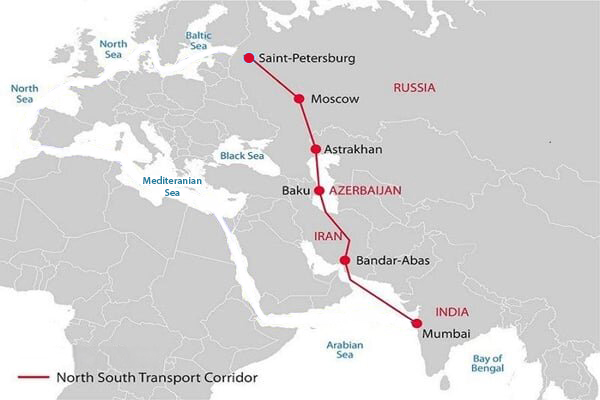
The North-South Transport Corridor (NSTC, also referred to as the INSTC) was originally devised in 1999 by Russia, Iran and India. It extends 7,200 kilometres, with one way cargo transportation, depending on the multimodal services used, taking between 15 to 25 days between Russia and India (via Iran) or vice versa. This is twice as fast as the traditional route through the Suez Canal.
Between 2000 to 2006, Belarus, Bulgaria, Turkiye, Syria, Amenia, Azerbaijan, Oman, Kazakhstan, Tajikistan and Kyrgyzstan joined the project and began cooperating on intra-route administration and customs synchronisation. A new round of sanctions against Iran in the mid-2000s slowed down the active cooperation of the countries on the project until 2012, however, after additional sanctions upon Russia were imposed in 2022, the subsequent shift in Russian logistics has meant the NSTC has received intense development.
The two main starting points of the main route are St. Petersburg in the north and the Indian port of Mumbai in the south, with the North-South NTSC using several branches for cargo transportation.
Trans-Caspian Route:
The trans-Caspian branch of the NSTC leaves Mumbai, passes through the Iranian port of Bandar Abbas in the Strait of Hormuz, then overland (by rail or road) to the north of Iran, to the Caspian ports of Amirabad, Astara, Enzeli, and Noushehr. The cargoes then travel by the Caspian Sea to the Russian ports of Olya, Astrakhan, Makhachkala, or to ports in Azerbaijan, Kazakhstan or Turkmenistan.
The capacity of Russian Caspian ports is still low, although projects are underway to expand and develop them. There is also a shortage of containers – while at present the total utilization of port facilities does not exceed 30-35% of their actual capacity, container handling capacity is insufficient, resulting in downtime.
The cargo turnover of the seaports of the Caspian basin for the 9M of 2024 reached 6.2 million tonnes, an increase of 9% over 2023. However, to compare, the cargo turnover of the Baltic basin and the Azov-Black Sea basin exceeded 200 million tonnes over the same period. While Russia’s Astrakhan port increased its transhipment volume by 7.1% to 3 million tonnes, Russia’s ice-free Makhachkala port reduced cargo turnover by 7.2% to 2.4 million tonnes.
Clearly, the shortage of containers is a major limiting factor for the Caspian basin. In addition, from the end of November, the Caspian Sea begins to freeze, the winter navigation period, which lasts on average 95 days, including 45 days a year with solid ice, icebreaker escorts are used. In addition, the beds of the Volga-Caspian and Volga-Don canals have limited depth, which does not allow large vessels to pass through.
However, the Trans-Caspian route has one significant advantage – even though existing restrictions are in place, direct passage through the multilateral Caspian Sea allows the transportation of Russian and Iranian goods that Azerbaijan and Kazakhstan do not allow through their territory due to a fear of secondary sanctions.
The overland Eastern and Western branches of the route skirt the Caspian Sea on both sides. In Iran, the western branch connects Bender Abbas, Tehran and Qazvin by direct rail, then goes to Azerbaijan, and from there either to Makhachkala and Astrakhan, or goes further west to Georgia and Turkey. This route accounts for about 70% of the cargo turnover of the entire transportation corridor.
Unfortunately, however, this path is not seamless. The 162-kilometre-long Rasht-Astara railway section is still under construction, and will not be completed until 2028. That will provide cargo traffic up to 50 million tonnes.
In the meantime, goods have to be transported by road in this section, increasing the number of overloads. The difficulty lies in the fact that overloading takes 1-2 days at each overload point. In Astara, congestion regularly occurs when the car can wait 7-10 days for loading. The storage of wagons is also a chargeable overhead, increasing the transportation costs.
Eastern Route:
The Eastern branch of the NSTC connects Russia and India through Central Asia. Cargoes from India arrive in Iran by the same route, but leave east of Tehran for Turkmenistan and then, through Kazakhstan, to Russia. Rail transportation is also limited here for the time being. Both Russia, Kazakhstan, and Turkmenistan have single-track non-electrified sections, which limits cargo traffic to 10 million tonnes. From the perspective road transportation, there are the same restrictions as on the western branch. Azerbaijan and Iran can provide passage for 40,000 cars per day, and in Russia and in some sections in Kazakhstan, no highways are operational on part of the route, and the usual two-lane highway passes no more than 15,000 cars per day. Some regional highways also run into narrow bottlenecks, which in some cases increase the rate of loading from 1-2 to 7-10 days.
In addition to understandable infrastructure constraints, the countries participating in the NSTC need to resolve the issue of the lack of uniform standards for transit documentation, which would significantly speed up the cargo clearance process.
Within the NSTC, each country is looking for the maximum benefits both from the point of view of the development of their domestic transport infrastructure, and from the point of view of strengthening geopolitical positions. It is recognised that the development of regional transport infrastructure always has a positive impact on national economies. For Russia, the NSTC is primarily the development of new growth points in international trade, strengthening cooperation with India and Iran, and direct logistics to the markets of the Persian Gulf countries.
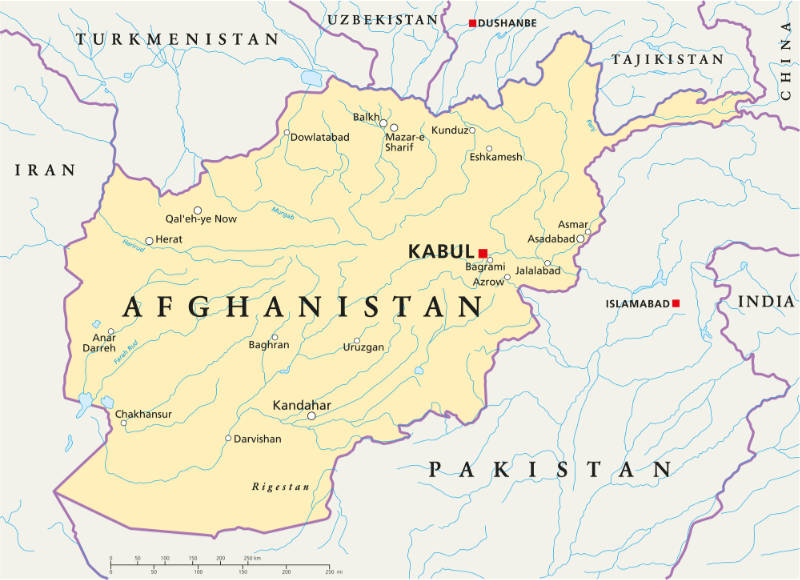
Russia intends to develop bilateral cooperation with Afghanistan in various fields, Security Council Secretary Sergey Shoigu has said, in meetings with Afghanistan’s Deputy Prime Minister Mohammed Abdul Kabir. Shoigu paid a visit to Afghanistan on Monday, (November 25) where he met with the country’s top leadership. During four rounds of talks, he discussed economic, transportation and security issues with deputy prime ministers and ministers.
Shoigu said that “We intend to develop bilateral cooperation between Russia and Afghanistan in many areas. I confirm our readiness to establish a constructive political dialogue between our countries, including for the purpose of giving impetus to the process of intra-Afghan settlement.”
According to him, Moscow is convinced that the establishment of Afghanistan as a stable and independent state is in the interests of all states in the region. Shoigu pointed out that Russia will continue to support Kabul’s integration into regional structures and associations, saying “This step will allow not only to establish an effective dialogue on the problems of countering challenges and threats to security, such as terrorism and drug trafficking, but also to intensify trade and economic cooperation.”
Afghanistan’s economy relies heavily on agriculture. Major crops include wheat, maize, rice, and fruits such as pomegranates, apricots, and almonds. The agricultural sector also includes livestock and dairy production. Additionally, Afghanistan possesses significant untapped mineral resources, including precious metals, gemstones, and industrial minerals such as talc, chromite, and nephrite. The mining sector, despite challenges, has attracted international investments, with increased involvement from the Taliban since their takeover in 2021. The textile industry, particularly the production of carpets, has historically been significant, with Afghan rugs highly valued on the global market. Afghanistan also has energy reserves, including natural gas and hydropower, though these remain largely underdeveloped due to the country’s political instability and insecurity.
Afghanistan is engaged in various regional and bilateral trade agreements to improve its economic integration. Key memberships include the South Asian Free Trade Area (SAFTA), facilitating trade with neighbouring South Asian countries, and bilateral agreements with Pakistan, China, Iran, and India. Afghanistan is also a member of the World Trade Organization (WTO), benefiting from global market access. Notably, the Afghanistan–Pakistan Transit Trade Agreement (APTTA) allows Afghanistan to import goods duty-free through Pakistani seaports, though its implementation has faced challenges. The Economic Cooperation Organization Trade Agreement (ECOTA) aims to promote regional trade.
In October 2024, China announced it would offer Afghanistan zero-tariff treatment for all Afghan exports, further strengthening their trade ties. Afghanistan has significant mineral reserves yet little infrastructure to extract them, Russia is interested in this potential and will probably recognise the Taliban as the legitimate government, however the security situation remains tense. Afghani officials have been attending Russian investment forums.
The Trans-Afghan Railway
The proposed Uzbekistan-Afghan-Pakistan railway would also help with Afghani imports and exports. Preparations are ongoing ahead of a feasibility study for a trans-Afghan railroad project, Russian Deputy Prime Minister Alexei Overchuk has said after talks with the Afghan authorities in Kabul on the same visit as Shoigu. He stated that “We view this project as key to improving connectivity in the region of Central Asia and Eurasia as a whole. We see it as an element of our large project of the North-South international transport corridor, designed to connect countries in the north of Eurasia with the Global South. Two railroads could be built here – western and eastern railroads. This is what our companies, our Transport Ministry are working on today with counterparts from other Central Asian countries. Preparations to conduct this project’s feasibility study are now in progress. We are interested in Afghanistan playing the key role in transport links that it can play. Our counterparts are also committed to joint work.”
As Afghanistan is now under the central government’s (Taliban) control, there is an opportunity to conduct transit freight shipments by road, and trucking companies from Central Asia are actively using this route today, Overchuk said.
The proposed rail routes would run north-south from Uzbekistan, bisecting Afghanistan and Pakistan to reach Pakistan’s sea ports on the Persian Gulf, with access to the Indian Ocean. A second, East-West route is also being considered from Turkmenistan, heading east across Afghanistan and again to Pakistan, where it could link up with the China-funded China-Pakistan Economic Corridor (CPEC) project that also links by rail to Pakistan’s southern ports but also provides road connectivity to China’s Xinjiang Province. China has invested an estimated US$90 billion in Pakistan’s infrastructure via its Belt & Road Initiative project, which Afghanistan has also joined.
Afghanistan’s bilateral trade with Russia has shown growth, increasing from approximately US$86.6 million in 2021 to US$170 million in 2022 and US $1 billion in 2023. As of 2024, the exact numbers for the full year are not yet available, but the ongoing trends suggest a positive trajectory, with expectations to increase trade turnover to US$3 billion by 2025 and US$10 billion by 2030.
The Asian Development Bank (ADB) and CJSC Azerbaijan Railways have signed a loan agreement for US$131.5 million to complete the reconstruction of a 166-kilometer section of a double-track railway, including civil structures and railway crossings on the Sumgait-Yalama route, to the Azeri border with Russia.
This loan is additional financing for the Railway Sector Development Program approved in 2017, aimed at modernizing railway infrastructure in Azerbaijan, ADB have stated. Under this program, the bank had already allocated US$150 million to Azerbaijan Railways for the project.
The loan is granted for a term of 22 years, including a 2-year grace period. The Azerbaijani government will contribute US$29 million to the project. The additional funding will expand the initial project to cover the modernization of approximately 333 kilometers of the main railway from Sumgait to Yalama, including civil structures and railway crossings, with the railway’s additional construction now expected to be completed by December 31, 2025.
“Upgrading and modernizing rail service will enable Azerbaijan to provide safer, cheaper, and more energy-efficient transport,” said Yevgeniy Zhukov, the ADB Director General for Central and West Asia. “At the same time, it will help Azerbaijan optimize its strategic location at the crossroads of Europe and Asia.”
The project is aligned with the transport strategy of the Central Asia Regional Economic Cooperation (CAREC) Program, which aims to contribute to regional economic development by improving rail and multimodal infrastructure and commercializing and reforming railway activities.
Under ADB’s Railway Sector Development Program, Azerbaijan Railways (ADY) implemented comprehensive reforms in 2018–2019 that strengthened its financial capacity and railway management. Since then, ADY continued efforts to improve its operational and financial performance. Between 2018 and 2022, ADY’s freight transport grew by 34%, from 14 million tons to 18.7 million tons. More than 80% of this is international or transit traffic involving Russia.
Azerbaijan has been a member of ADB since 1999. Over the past 25 years, the bank has provided the country with over US$5 billion in loans.
The Sumgayit-Yalama line is part of the North-South international transportation corridor, which crosses the territory of the country from the border with Iran in the south to the Russian border in the north. The corridor has great potential as an alternative to the sea route from India to Europe via the Suez Canal, and will further accelerate freight capacity development to the Caspian Sea region, including Iran.
Russia has increased its exports purchases of buckwheat to China 1.8-fold year-on-year to US$75.6 million in the first 10 months of the year from US$40.9 million in the same period last year, China’s General Administration of Customs (GAC) said. Russia has retained to the position as the leading supplier of buckwheat to the Chinese market. China purchased buckwheat from three countries last month, including Bolivia and Peru.
Chinese imports of Russian oats also increased 1.9-fold to reach US$43.4 million in 10M 2024 from US$23.3 million in 10M 2023, with Russia in second place after Australia.
The volumes, while relatively small, do reflect changing tastes in Chinese cuisine as these products are not typical Chinese consumer foods but are increasingly used as breakfast cereals and in biscuits, sometimes prompted by Chinese nationals returning to China from Russian tourism visits.
Over the past three years, Russia’s share in BRICS trade has more than doubled and has further potential for expansion and containerisation – but there are bottlenecks that need dealing with. During that timeframe, BRICS imports from Russia have surpassed exports to Russia by almost 4.5 times, creating a huge container imbalance. As a result, Russian companies are looking at developing sea terminals in transit countries, as well as entering into BRICS joint ventures to increase the conversion of Russian export cargoes.
Existing and potential BRICS participants export industrial and consumer goods to Russia in containers, and use these same containers to import generally low-value products. (Oil and gas are transported by pipelines, rail or ship). About 43% of Russia’s exports to these countries are pulp and paper, and timber industry products. Another 24% is food products (cereals, oilseeds, oils, meat, fish), 14% base metals, and 19% of other products of low and medium processing: rubber, polymers, acids, and so on.
This imbalance of export-import container flows in Russia can be resolved. The return of containers to China in some directions has increased in price by 2.5 times. The predominant volume of imports from the BRICS countries or 55% is formed by industrial goods. These are machines, equipment, mechanisms, products made of plastics and base metals, ceramic products, paper. Another 15% are consumer goods, which include cars, clothes, shoes, and fabrics. At the same time, the imbalance between the export and import flows of containers is increasing. For example, in 2020-2021, imports exceeded exports by only 10-14%, however by 2023 the gap had reached 59%.
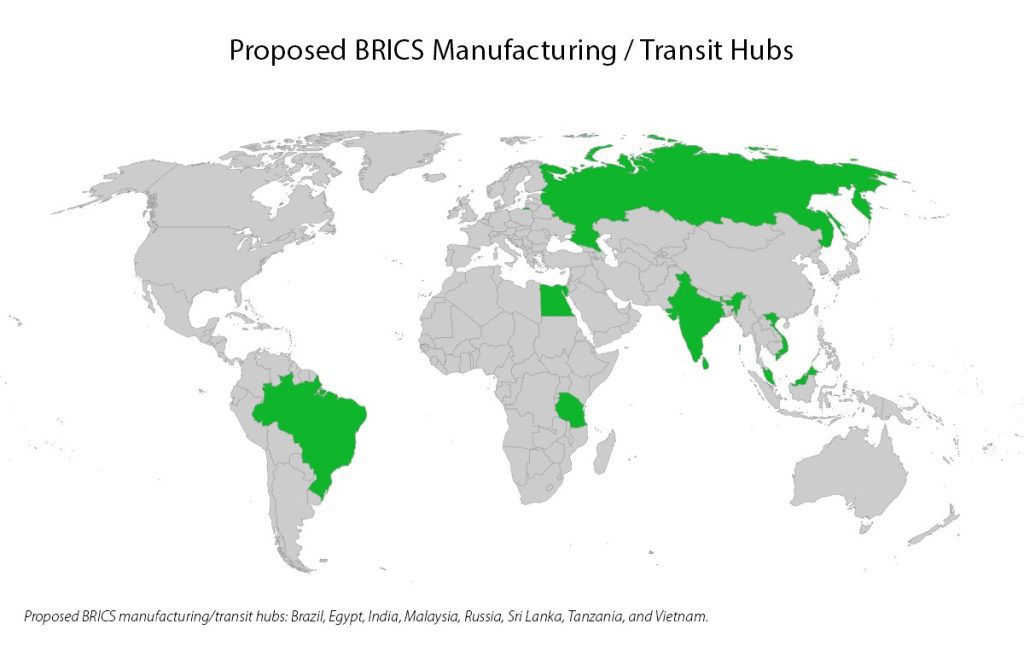
Proposals are currently being made to develop terminal infrastructure in the BRICS countries, as a presence in offshore, overseas terminals will allow Russian companies to supply goods to BRICS and other friendly markets without sanctions problems. In the BRICS transit countries or directly in the consumer countries, it is proposed to create joint production facilities for the further processing of Russian raw materials.
Alexander Iodchin, First Deputy General Director for Strategy and Development of Russia’s Delo Group, a leader in sea transshipment and rail transportation of containers, said that “From the point of view of container logistics development potential, we consider Brazil, Egypt, Tanzania, Malaysia, Vietnam, India and Sri Lanka priority countries for the implementation of terminal capacity and hub construction projects.” The opportunities for investment in these countries to facilitate BRICS trade is apparent. These countries all possess a competitive labour force, significant port facilities, free trade zones and related tax incentives.
Russia’s Pivot to Asia can provide cost analysis of the countries mentioned. For further information, please contact us at info@russiaspivottoasia.com

 Русский