News

Russian Wheat Exports to Bangladesh up 42%

Published on October 29, 2024

Russia exported around 2.7 million tonnes of wheat to Bangladesh in the 9M January-September  this year, up 42% from the 1.9 million tonnes exported in the same period last year, according to the Russia’s Agroexport Centre.

Bangladesh is the third largest importer of Russian wheat this year. Egypt is in first place, while Turkiye is second. All are BRICS nations of varying degrees. Egypt is a full member, Turkyie a BRICS Partner, while Bangladesh has an equity stake in the New Development Bank.   

The BRICS are in the process of creating an intra-BRICS grain trading platform to better regulate grain trade prices. Russia and China ae among the largest grain producers globally, but grain commodities exchanges are primarily based in the West and dominated by Western buyers who manipulate the market to their benefit.  

Further Reading 

MENA Buyers Dominate Russia’s Grain Exports

Latin America and the 2024 BRICS Summit: Executive Summary

Published on October 28, 2024

Latin America was well represented at the 2024 BRICS Heads of State Summit, with Brazil sending a Ministerial-level delegation and Bolivia and Cuba being granted ‘BRICS Partner’ status. The 2025 annual BRICS summit will be held in Brazil where further LatAm developments can also be expected. We discuss these issues on a multilateral basis as follows: 

Brazil   

Brazil Flag

Brazil is LatAm’s largest economy, and is preparing to take over the BRICS chairmanship in January 2025. The Brazilian President, Luiz Inácio Lula da Silva was scheduled to attend in person, however, was unable to travel due to illness, but participated by video conference. Brazil’s Foreign Minister for Asia Pacific Affairs, Eduardo Paes Saboia, led the delegation instead. 

Brazil is also the Chair of the BRICS New Development Bank (NDB), a position currently held by former Brazilian President Dilma Rousseff. According to the NDB rotating 5 year Chairmanship, Russia would normally appoint the next Chairman, whose term is due to start from 2025 and last until 2030. However, due to practical sanctions difficulties of having a Russian banker as head of the NDB, Moscow has nominated Rousseff for an additional five-year term. Brazil is Chair of the BRICS, as well as the G20 next year. The BRICS countries have also all endorsed a proposal for Brazil to be admitted as a permanent member of the UN Security Council.          

Based on individual country data, Brazil’s total trade with BRICS nations is estimated to be valued at about US$170 billion.

Bolivia  

Bolivia Flag

The Bolivian delegation was led by Luis Alberto Arce Catacora, the Bolivian President, who oversaw Bolivia becoming a ‘BRICS Partner’ at the 2024 BRICS Summit, partially emboldened by its rich mineral resources. The move is also likely to have positive spin-offs for Peru, as Bolivia is landlocked and its imports and exports must travel via Peruvian seaports. From there, the mainland Asian seaboard (Callao to Shanghai) is about 30 days.  

Bolivia’s current trade with BRICS nations based upon individual country declarations is valued at about US11 billion. We discussed Putin’s bilateral meeting with Catacora here.

Cuba

Cuba Flag

Cuba is a long-time ally of all the original BRICS nations, however, has been under US trade sanctions since 1962. Its economy however is enduring difficult times with much infrastructure old and decaying. It was awarded ‘BRICS Partner’ status at the BRICS 2024 summit which should go some way to alleviating its economic woes. It will also annoy the United States. Brazil has also stated it will restore trade ties with the country. Cuba’s trade with BRICS economies is probably less than US$5 billion.      

There is more on Cuba-Russia foreign trade relations here.

Venezuela

Venezuela Flag

The Venezuelan delegation was led by President Nicolas Maduro, with the country having affirmed its desire to join the BRICS bloc. Opposition to this however has come from Brazil, who has concerns about Maduro’s recent election success and have not yet recognised him as the leader of the country. Venezuela is also suspended from the Mercosur Free Trade Agreement, with Maduro apparently facing political credibility questions in South America. The country, which possesses the world’s largest oil reserves, is also heavily sanctioned by the United States. Venezuela’s estimated total trade with BRICS nations is about US$14 billion, with more than 50% of that with Russia.       

We discussed Putin’s bilateral meeting with Maduro here.

Argentina

Argentina Flag

Argentina was offered BRICS membership, but declined to join after the pro-US President, Javier Gerardo Milei, was elected in December 2023. Since then, Argentina has entered a recession. No Argentinian delegation attended this BRICS event.  

South America Map

Other Countries

Several other Latin American countries have expressed interest in joining the BRICS, including Colombia, El Salvador, Nicaragua and Peru. Other regional countries have previously participated in BRICS events, including Chile, Ecuador, Guyana, Paraguay, Peru, Suriname and Uruguay. With the 2025 BRICS summit to be held in Brazil, the opportunities for expanding the group further into South and Central America will probably become more advanced at that event.

Further Reading

BRICS “B20” Proposed As A Global Parliamentary Bloc As New Members Clamour To Join

Africa and the 2024 BRICS Summit: Executive Summary

Published on October 28, 2024

The African continent was well represented at the 2024 BRICS Heads of State Summit, with two major African economies in Algeria and Nigeria, as well as Uganda now going through a membership process. Other African nations were also present. We summarise what happened on a country-by-country basis involving Africa as follows:

South Africa

South Africa Flag

South Africa is a full member of BRICS, with President Cyril Ramaphosa attending with a large delegation including multiple other senior level energy, infrastructure, finance and trade officials. According to South Africa’s Industrial Development Corporation, South Africa’s foreign trade with other BRICS member countries reached US$63 billion in 2023, with exports expanding by 8.3% and imports by 10.2% that year. 

Following a difficult election resulting in the first coalition government in South Africa, GDP growth has been sluggish, and 2024 BRICS trade is likely to be similar. We discussed Putin’s bilateral meeting with Ramaphosa here.

Egypt

Egypt Flag

Egypt joined the BRICS group as a full member from January 1 this year, and sent a sizeable delegation led by the Egyptian President, Abdel Fattah el-Sisi. According to Egypt’s Central Agency for Public Mobilization and Statistics, Egypt’s foreign trade with other BRICS countries increased by 15% between January and August this year, reaching US$30.2 billion. This implies a 2024 total Egypt-BRICS trade value of about US$45.3 billion.

On the import side, Egypt brought in US$24.5 billion worth of goods from BRICS countries during the first eight months of 2024, marking a 17% rise. Egyptian exports to BRICS nations during the same period reached US$5.7 billion, up 7.3%. We discussed Putin’s bilateral meeting with Sisi here.

Ethiopia

Ethiopia Flag

Ethiopia joined the BRICS group as  full member from January 1 this year, and sent a delegation led by the Ethiopian Prime Minister, Abiy Ahmed. Based on individual country data we estimate 2024 Ethiopia-BRICS trade to be valued at about US$8 billion. We discussed Putin’s bilateral meeting with Ahmed here.

Nigeria

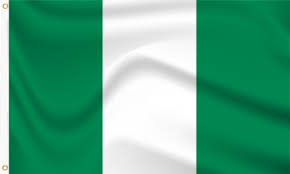
Nigeria Flag

Nigeria were present with a trade delegation and departed with BRICS Partner status, following significant capital inflows into the Nigerian economy from BRICS countries, rising 189% during the first 8M of 2024 and reaching US$1.27 billion. They are expected to become a full member in 2025. Nigeria’s trade volume with the BRICS nations is estimated to be about US$35 billion. Details of the Nigerian economy in relation to BRICS can be seen here.   

Algeria

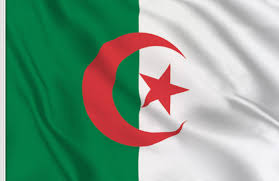
Algeria Flag

Algeria had a trade delegation at the BRICS summit and were given ‘BRICS Partner’ status. The country joined the New Development Bank as an equity partner earlier in the year, and has long sought full membership. It remains to be seen when the country would formally join the bloc as a decision was made in April to further evaluate potential and delay participation amongst negotiations. No doubt further discussions will need to take place. Algeria’s total trade with BRICS nations is estimated at being about US$12 billion.      

Details of the Algerian economy in relation to BRICS can be seen here.

Uganda    

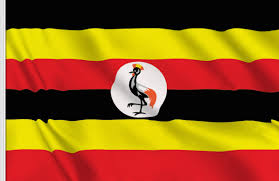
Uganda Flag

Uganda sent a small delegation to the BRICS summit and emerged with a new ‘BRICS Partner’ status. This move signals a new foreign policy era for Uganda, emphasising strategic partnerships and global integration with emerging economies. Ugandan trade with the BRICS economies is estimated to be about US$5 billion. Details of the Ugandan economy in relation to BRICS can be seen here.

Mauritania

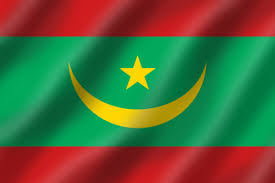
Mauritania Flag

Mauritania sent a delegation led by President Mohamed Ould Cheikh El Ghazouani. Details of his bilateral discussion with Russian President Putin can be read here.

Other Countries

Russia has been extremely active in Africa over the past two years as the continent moves from a European colonial past to what many African governments perceive as a multilateral future. This has included senior level visits by Russian officials to discuss trade, security and investment with Burkina Faso, the Central African Republic, Chad, Congo, the Republic of Congo, Equatorial Guinea, Guinea, Libya, Mali, Morocco, Niger, Sao Tome & Principe, Senegal, Sudan, Tanzania, and Zimbabwe Several of these countries have applied to join BRICS.

Russian marine biologists are currently on a six-month expedition to assess fish stocks in the African Atlantic and Indian Ocean sectors, which will eventually morph into investment, trade and naval security on the West and East African coasts. Russia is reaching out in other ways too – African cocoa is now traded on the Mocow Commodities Exchange.    

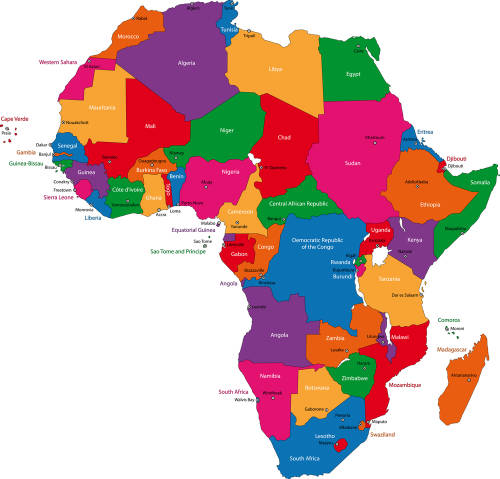
Africa Map

Summary

The BRICS nations are in favour of seeing the African continent given a permanent seat on the UN Security Council, while both China and India retain significant diaspora throughout the region. They are all, along with Russia, becoming more involved in Africa’s economic development as many of its countries begin to move away – and in some cases completely reject – the previous European colonial attitudes towards it. These moves, together with significant diplomatic efforts especially by China and Russia, coupled with African concerns over the fairness of its dealings with the West, are starting to move the entire continent towards the BRICS as a ‘multilateral group and away from European influence. There remain security concerns however, and the BRICS is not a security-related institution. This means, we suspect, that the Shanghai Cooperation Organisation may begin to become involved in African security dialogue in future. However, in trade and development terms, while there is a lot to be done in Africa, the future appears encouraging.               

Further Reading

Ethiopia Calls For Alternative BRICS Monetary System

The Middle East and the 2024 BRICS Summit: Executive Summary

Published on October 28, 2024

The Middle East was a key component of the 2024 BRICS Heads of State Summit, with considerable diplomatic engagement concerning the on-going crisis. Just one day after the Iranian delegation returned from Russia, Israel attacked Tehran. The Palestinian President was also invited to the summit as was the UN Secretary-General. However, apart from the security aspect, BRICS expansion was also on the agenda, with Turkiye, a NATO member, being granted ‘BRICS Partner’ status with a view to becoming a full member in 2025. We discuss these issues on a multilateral basis as follows: 

Iran  

Iran Flag

Iran joined the BRICS group as a full member from January 1 this year, and sent a sizeable delegation led by the President, Masoud Pezeshkian. Based on individual country analysis, we estimate that Iran’ s 2024 total Iran-BRICS trade is valued at about US$45-50 billion. Iran is a major energy supplier to China and India. We discussed Putin’s bilateral meeting with Pezeshkian here.

UAE

UAE Flag

The United Arab Emirates (UAE) joined the BRICS as a full member from January 1, and sent a delegation headed by the UAE President, Prince Mohamed bin Zayed Al Nahyan.  The UAE is among the major trading partners of BRICS nations, with non-oil trade between them amounting to approximately US$93.2 billion annually, accounting for over 20% of the UAE’s non-oil trade value. Including oil, that value jumps to about US$190 billion. UAE investors have recently taken an equity stake in the Moscow Stock Exchange. We discussed Putin’s bilateral meeting with Prince Nahyan here.

Turkiye

Turkiye Flag

Turkiye bought a sizeable delegation to the BRICS Summit, led by President Recep Erdogan. During the event it was given the status of ‘BRICS Partner’, and is expected to be confirmed as a full member in 2025. If this occurs, Turkiye will be the first NATO member to join the bloc, which Ankara has now stated offers ‘better opportunities than the European Union’. Turkish trade with the collective BRICS is valued at about US$95 billion and has been growing. That compares with Turkish trade with the EU at about US%120 billion. Turkiye has also been positioning itself as a conduit between Russia and the EU, which allows it to refine Russian oil and resell it to Europe. That trade is also increasing. Russia also wants to establish logistics centres on Turkiye’s Azov and Black Sea coasts. We discussed Putin’s bilateral meeting with Erdogan here.

Saudi Arabia

Saudi Arabia Flag

Saudi Arabia sent a trade delegation to the BRICS Summit. They are still to ratify a 2023 invitation to join as a Full Member, mainly due to the on-going Middle East crisis and concerns about Iranian involvement. However, they do participate in BRICS discussions. Based on individual country data, Saudi-BRICS trade is currently about US$170 billion.

Palestine

Palestine Flag

Palestine sent a diplomatic delegation to the BRICS summit headed by President Mahmoud Abbas, which also gave him the platform to discuss the current situation as concerns Israel with other world leaders. Much of the discussions focused on humanitarian aid, UN recognition, and post-conflict reconstruction. We discussed Abbas’ bilateral meeting with Putin here.

Middle East Map

BRICS Declaration About The Middle East Crisis   

The ‘Kazan Declaration’, signed by all BRICS Heads of State, contained substantial statements concerning the Middle East crisis, the first time that this event has significantly focused in geopolitical affairs. In this instance, it means that the BRICS intends to develop no just as a trade platform but an institution where global affairs can be freely discussed without interference from the United States or Europe. This is a significant political change, especially as the West has become more elitist in whom it considers dialogue with.

In the declaration, the BRICS leaders supported the establishment of the sovereign State of Palestine within the internationally recognized 1967 borders, and its admission to the United Nations. This is a position that places it completely opposite the Western viewpoint.    

Other Countries

Please also see our recent updates on Russia’s relations with Jordan here, the Lebanon here with Syria here and with Yemen here.

Further Reading

Russia – Gulf Cooperation Council Trade & Relations: Update

Southeast Asia and the 2024 BRICS Summit: Executive Summary

Published on October 28, 2024

Asia was well represented at the 2024 BRICS Heads of State Summit, with both China and India, the two most populous countries in the world attending, together with four ASEAN big hitters in Indonesia, Malaysia, Thailand and Vietnam now going through a membership process. Other Asian economies were also present. We summarise what happened on a country-by-country basis involving all Southeast Asian economies as follows:

China

China Flag

President Xi Jinping attended with a large delegation including China’ Foreign Minister and multiple other senior level energy, infrastructure, finance and trade officials. According to China customs data, China’s foreign trade with other BRICS member countries reached ¥4.62 trillion (US$648 billion) in the first nine months of 2024, a year-on-year increase of 5.1%. That implies a total 2024 China-BRICS trade figure of about US$864 billion. That is significantly more than its 2023 trade with the United States at US$575 billion and larger than the China-European Union 2023 bilateral trade of US$798 billion. A key regional issue was also resolved between China and India as regards a long-standing border dispute. The settlement of this should significantly boost China-India bilateral trade. 

Several Chinese banks are looking at setting up branches in Russia, while the two sides are discussing the introduction of an intra-BRICS financial settlements’ system. We discussed Putin’s bilateral meeting with Xi here.  

India

India Flg

Prime Minister Modi also attended with a large delegation including the Foreign Minister and other senior officials in the energy, infrastructure, finance and trade. India’s foreign trade with other BRICS member countries during 2024 is estimated to reach about US$250-300 billion by the year-end. This should be boosted in 2025 due to the settlement of the India-China border dispute. Modi met with China’s President Xi Jinping at the event. 

The two sides are discussing, along with other BRICS partners, the introduction of an intra-BRICS financial settlements’ system. We discussed Putin’s bilateral meeting with Modi here.

Indonesia

Indonesia Flag

Indonesia’s Foreign Affairs Minister Sugiono represented Indonesia, and made a request under the orders of the new Indonesian President Prabowo Subianto to formally apply to join the group as a Full Member. “Indonesia joining BRICS embodies the country’s active and free foreign policy,” Sugiono said in a press statement. The country has been given ‘BRICS Partner’ status while the application procedure is processed. Based on individual country data, Indonesia’s total trade with BRICS during 2024 is estimated to reach about US$180-200 billion. There is more about Indonesia’s economy as concerns its pending BRICS membership here.  

Thailand

Thailand Flag

Thailand’s Foreign Affairs Maris Sangiampongsa represented Thai Prime Minister Paetongtarn Shinawatra, and made a request under the orders of Shinawatra to formally apply to join the group as a Full Member.

The Bangkok Post has reported that Maris said “Governments worldwide recognise Thailand’s potential to contribute to multilateral sustainable development following Thailand’s participation in the BRICS Summit. Thailand hopes to join BRICS in August next year. It can contribute as a bridge to help revive a spirit of cooperation and revise the global system to be more just and equitable.  BRICS should be a voice for developing and emerging economies and serve as a force to shift the dynamics of financial governance to favour all nations.”

Thailand has been given ‘BRICS Partner’ status while the application procedure is processed. Based on individual country data, Thailand’s total trade with BRICS during 2024 is estimated to reach about US$150 billion. There is more about Thailand’s economy as concerns its pending BRICS membership here

Malaysia

Malaysia Flag

Malaysia’s Economic Minister Rafizi Ramli represented Malaysian Prime Minister Anwar Ibrahim and reiterated Ibrahim’s earlier formal request to join the BRICS group as a Full Member. He said that “Through active involvement in the summit, Malaysia could strengthen its commitment to deepen relations with the BRICS countries and face the complex global economic landscape with full resilience.”

Malaysia has been given ‘BRICS Partner’ status while the application procedure is processed. Based on individual country data, Malaysia’s total trade with BRICS during 2024 is estimated to reach about US$140 billion. There is more about Malaysia’s economy as concerns its pending BRICS membership here.   

Vietnam

Vietnam Flag

Vietnam’s Prime Minister Phạm Minh Chính, and Foreign Minister Bùi Thanh Sơn were present with a large delegation. Vietnam has been given ‘BRICS Partner’ status while the application procedure is processed. Based on individual country data, Vietnam’s total trade with BRICS during 2024 is estimated to reach about US$140 billion. There is more about Vietnam’s economy as concerns its pending BRICS membership here and more about Pham’s bilateral meeting with Putin here. Vietnamese banks are also interested in establishing branches in Russia.

Laos

Laos Flag

The President of Laos attended the BRICS summit and held bilateral discussions with Russian President Vladimir Putin. We covered that discussion in this article here. Laos-BRICS 2024 trade is estimated to reach about US$9 billion, with about 90% of this being with China.  

The Philippines  

Philippines Flag

A delegation from the Philippines attended the BRICS, with Philippines Finance Secretary Ralph Recto saying in August that applying for BRICS membership was being considered by the Finance department. Manila however is pro-US and will be weighing up options in the face of probable Washington disapproval. A Philippines-BRICS liaison seems unlikely at present.  

Singapore

Singapore Flag

No Singaporean delegation was reported to have attended Kazan, and if one was there it was very low-key. Under Western pressure, Singapore has back-tracked from Russia involvement in recent years and has rolled back its previous application to sign a Free Trade Agreement with the Eurasian Economic Union. Singapore has joined sanctions upon Russia and is now considered an ‘unfriendly nation’ by Moscow.  

Cambodia

Cambodia Flag

Cambodia also sent a delegation and has been involved in BRICS activities for some time. It is still mulling over a request to join the bloc. Kin Phea, Director General of the International Relations Institute of the Royal Academy of Cambodia, said that he believes BRICS is a very important alternative for Cambodia to consider alongside the nation’s pre-established economic relationships. Phea said that “I believe BRICS is the backbone of the global economy, especially for the Global South. So, in my perspective, I think Cambodia should consider becoming a member, if it is possible, or at least be an observer to the organization.” However, membership of BRICS may yet be some way off. The country has its trade bases covered as part of ASEAN and other Free Trade Agreements, and is a relatively small regional player.

Pakistan

Pakistan Flag

Pakistan sent a delegation and has applied for BRICS membership, however, has not yet been included as a BRICS Partner, probably due to Indian reservations. Mumtaz Zahra Baloch, Pakistan’s Foreign Office spokesperson stated that “We also hope that BRICS will move forward on Pakistan’s request in line with its commitment to inclusive multilateralism.“ However, there are some signs of improving relations between Islamabad and New Delhi with the Indian Foreign Minister paying a first senior level visit to Pakistan to attend last month’s Shanghai Cooperation Council meetings. Both China and Russia would like to see Pakistan on board, but that will have to wait until India is more comfortable with Pakistan’s involvement.   

Other Countries

Japan and South Korea have joined Western sanctions against Russia and are also highly critical of the apparent deployment of North Korean soldiers to Ukraine. Both are classed as ‘unfriendly countries’ by Moscow. North Korea typically never sends delegations to these types of events and prefers to have bilateral meetings only. Bangladesh, which has joined the BRICS New Development Bank, is under-going political changes at present, however may later emerge as a BRICS full member within the coming two years. Myanmar is currently involved in an insurrection and is governed by a highly sanctioned Military Junta, while Sri Lanka sent a small trade delegation but has just elected a new President and is concurrently dealing with a financial crisis.   

Asia Map

Summary

At the previous BRICS summit, the onus was on the Middle East / North Africa (MENA) region, with Egypt, Iran, the UAE and Ethiopia all taking full BRICS membership. Saudi Arabia was also offered the same, however is yet to ratify this while the Middle East crisis is still ongoing.

This year, the development focus has been on Southeast Asia with four ASEAN countries: Indonesia, Malaysia, Thailand and Vietnam all likely to join at some point during 2025. While intra-regional infrastructure is already well-developed amongst this for these countries and the regional giants of China and India, there may be investment needed for entering into new trade corridors. Key amongst these will be China-India, with the potential for long neglected routes such as the Nathu La Pass being regenerated. Russia is also looking to provide railway infrastructure and locomotives into the region, with South Asian connectivity to smaller countries such as Cambodia and Laos still in need of improvement.

There is also likely to be improvements in Russia-Asia connectivity, and especially port developments and increased frequency of maritime routes between the Russian Far East and Southeast Asia. That trade can be expected to increase as it appears financial settlement problems caused by the impact of sanctions upon Russia are likely to be resolved in stages as the ‘BRICS Pay’ architecture – which already exists – is rolled out across countries.

Asian trade infrastructure development and investment is also likely to expand to developing trade in Latin America, especially as LatAm markets such as Bolivia and Cuba join BRICS. Bolivia especially is a key potential resources market with the worlds’ largest Lithium reserves – a key commodity for China and India’s semiconductor industries.

BRICS 2025 will be held in Brazil, and LatAm can be expected to be the principal focus for BRICS the next time around. 

Further Reading

BRICS Invites 13 Partner States To Join: Full Details

BRICS, Russia, and the United Nations 

Published on October 27, 2024

Vladimir Putin met with Antonio Guterres, the UN Secretary-General, and invited him to the BRICS Plus Outreach Plenary Session during the 2024 BRICS Summit in Kazan. Putin also spoke about Russia’s involvement in the United Nations.

This is what Putin had to say: 

“Heads of state, Ladies and gentlemen, friends,

I am delighted to welcome all of you to the BRICS Plus/Outreach-format meeting. This inclusive platform has proven its worth by enabling the BRICS group participants to engage in a direct and open dialogue with their friends and partners.

Let me remind you that heads of many African countries and senior executives from the key regional organisations were invited to attend last year’s meeting in Johannesburg. This time, the Russian chairmanship invited Russia’s closest neighbours and friendly countries with whom we share a common past, having lived within a single state. In addition, heads of state seeking to forge closer partnership ties with BRICS or even considering joining the group are also present here. There are also countries leading major multilateral structures here. Therefore, Europe, Asia, Africa and Latin America are all represented at this table.

According to our agenda, we will discuss the most pressing issues the international community is facing today, including sustainable development, eradication of poverty, climate change adaptation, exchanging technology and knowledge, fighting terrorism and transborder crime.

We will focus particularly on the peaceful resolution of conflicts, certainly including a serious discussion of the deteriorating situation in the Middle East.

It is crucial for BRICS members to discuss all these issues with countries from the Global South and East that share our approach. All our countries share similar aspirations, values and a vision of a new democratic world order that reflects cultural and civilisational diversity. We are confident that such a system should be guided by the universal principles of respect for the legitimate interests and sovereign choice of nations, respect for international law and a spirit of mutually beneficial, honest co-operation.

The transition to a more just international system is not easy. Its development is being hampered by forces whose thinking and actions continue to be aimed at dominating everything and everyone. Under the guise of a rule-based order they are imposing on the world, they are actually attempting to contain growing competition and prevent the independent development of countries in Africa, Asia and Latin America that they cannot control.

These forces are resorting to illegal unilateral sanctions, blatant protectionism, manipulation of currency and stock markets, and relentless foreign influence ostensibly promoting democracy, human rights, and the climate change agenda. Yes, they are using these tactics as well.

These twisted methods and perverse approaches – to put it bluntly – lead to the emergence of new conflicts and the aggravation of old disagreements. This undermines regional and global strategic stability, violates the principles of equal and indivisible security, and encourages internecine strife.

One example of this is Ukraine, which is being used to create critical threats to Russia’s security, while ignoring our vital interests, our just concerns, and the infringement of the rights of Russian-speaking people. Now they are not even hiding that their goal is to inflict a strategic defeat on our country. I will say bluntly that anyone harbouring such illusory plans has no understanding of Russia’s history, of our nation’s unity and cohesion forged over centuries, or our people’s moral fibre and fortitude.

But, as agreed, our discussion will primarily focus on the situation in the Middle East. This is another cause for concern, and precisely the case I was referring to: the escalation of a long-standing conflict that has not been extinguished for decades.

The current round of the Palestinian-Israeli confrontation is probably one of the most sanguinary in the long list of conflicts. Over 40,000 people, most of them civilians, have been killed in the ongoing hostilities in the Gaza Strip. I would like to emphasise that we have always come out against the use of terrorist methods.

The hostilities that began in Gaza a year ago have now spread to Lebanon. Other countries of the region have been affected as well. Tensions between Israel and Iran have increased dramatically. Taken together, this looks like a chain reaction that could push the Middle East towards an all-out war.

The humanitarian situation is rapidly worsening. The number of refugees and internally displaced persons has exceeded 1.5 million. Massive damage has been caused to infrastructure, apartment buildings, schools, hospitals and social facilities, and destruction is ongoing.

Russia has many problems of its own, of course, which are very important and which we must address, we are addressing them and will continue to do so. At the same time, we have always tried to make a substantial contribution to stabilisation in the Middle East. That is why, since the start of the escalation, we have joined forces with our BRICS and other partners to contribute to a settlement. As you may remember, our group even held a video summit in November 2023.

The immediate task is, of course, to launch a comprehensive political process for addressing the Middle East problem in its entirety. Violence must stop, vital assistance must be provided to the affected people, and their suffering must be alleviated. A settlement must be achieved on the basis of universally recognised international law, which actually stipulates the establishment of an independent Palestinian State that will live peacefully side by side with Israel.

Mending the historical injustice done to the Palestinian people would guarantee peace in the Middle East. The vicious circle of violence will not be broken until this problem is solved. People will continue to live in an atmosphere of permanent crisis, with inevitable outbreaks of massive violence.

I would like to repeat that the main condition for restoring peace and stability in the Palestinian territories is the realisation of the two-state formula approved by the UN Security Council and General Assembly resolutions.

As for the way we assess the present-day international environment, I would like to emphasise that the countries represented in this room have immense opportunities and resources at their disposal and play a prominent role on the international stage. In fact, they have been using their standing to enhance global security and promote sustainable development around the world.

In this context, many countries among us have put forward initiatives that have proven to be quite useful. Russia advocated the idea of creating an inclusive system of equitable and indivisible security for Eurasia free from any discrimination. This initiative consists of working together to guarantee genuine and reliable stability and enable all states and nations across the continent to develop themselves in peace.

Of course, the fact that this meeting is taking place on United Nations Day is a very powerful symbol. It was on October 24, 1945, that the UN Charter came into effect. It sets forth the principles which have served as the cornerstone of interstate relations and international law for almost 80 years now.

The United Nations must retain its central role in efforts to maintain peace and security and facilitate sustainable and steady development. Meanwhile, to ensure the effective functioning of the UN in the future, we believe it is important to adapt its structures to the realities of the 21st century, expanding the representation of countries of Asia, Africa and Latin America, including those whose leaders are present here, in the Security Council and other key international bodies.

An effort to reform UN development institutions and global financial structures has long been overdue. Developing countries no longer play the role they used to have within the global economy. Everything changed over the past decades. However, this did not pave the way to any changes or shifts in the management of the International Monetary Fund, the World Bank or other multilateral development banks.

The founding fathers of the United Nations believed that its purpose was to enable nations to come together and agree on joint actions. In fact, it is only by working together that we can respond to global challenges and threats and deal with issues such as terrorism, drug trafficking, corruption, organised crime, including the criminal use of information technology, and of course foster steady economic growth for inclusive development and prosperity.

It is quite clear that the countries of the Global Majority will be the ones to bring about the next wave of global economic growth. Therefore, it is high time that we discuss the idea of setting up our own platform for unlocking the potential of our emerging economies. It must enable countries from the BRICS group, as well as those across the Global South and East, to attract more investment and focus on investing in infrastructure and technology projects.

It is essential to build alternative multilateral financial mechanisms and supply chains that are reliable and free from any dictate, to establish channels for exchanging advanced technology and expertise, to develop new international transport corridors and increase their capacity.

Russia is working together with its partners to enhance globally significant routes such as the North-South corridor and the Northern Sea Route, and we invite all interested countries to participate.

As we are well aware, climate has a special place in the sustainable development agenda. In this regard, it makes sense to focus on developing practical solutions to the problems caused by global warming. It is important to provide countries in the Global South and East with access to financing and technology, and to help them adapt to climate change.

I would like to emphasise that Russia seeks to participate in the global climate process in the most active way possible. Our country is one of the leaders in terms of its contribution to reducing greenhouse gas emissions, and its energy balance is one of the greenest in the world. The cumulative share of environmentally friendly gas, nuclear and hydro generation in Russia is 85%. Russia accounts for more than 20% of the world’s forests, which help to slow global warming by absorbing greenhouse gases.

Russia also makes a serious contribution to global food and energy security. Last year alone, we exported over 100 million tonnes of agricultural products, becoming a leading grain exporter. Russia also holds a leading position in the energy market.

We have initiated the creation of a grain exchange within the BRICS format. We believe that this mechanism will facilitate the establishment of a transparent and risk-free regime for trade in agricultural products, both among BRICS countries and with our other partners.

Mr Secretary-General said that we all must live as one big family. I can reply that this is exactly the way we have been living our lives. Unfortunately, families often have quarrels and scandals and may have to split their assets, and sometimes their disputes become physical. BRICS sees its purpose as creating the necessary cooperation mechanisms and a favourable environment within the household we share. This is what we are doing, and this is what we will continue to do, including by working closely with the United Nations.

In conclusion, I would like to reiterate that Russia, like all BRICS countries, is open to cooperation with all countries of the Global South and East to promote inclusive and sustainable development and ultimately build a better world. It will be a world where every nation’s stance and interests are taken into account, their right to sovereign development and their identity are respected, and the absolute value of all cultures, traditions and religions is recognised.

I trust that today’s discussion will be constructive and substantive and provide insights for addressing the current regional and global agenda.”

Analysis & Implications

There are several key aspects to Putin’s observations, and in particular the stand-out is the commitment that Russia puts into the United Nations. Russia wants the United Nations to be the centre of the global decision-making and regulatory structure, not Moscow, Beijing, or Washington.      

UN Reform

Interestingly, neither the United States, the European Union, nor the United Kingdom were mentioned in Putin’s speech. It was all about developing the United Nations. In this, he had several points to make concerning reform at the UN Security Council, an issue we previously discussed here. It is telling that the United States has consistently vetoed such changes, understanding that it has maneuvered itself to be the power behind the UN throne. That has now been globally recognised and is developing as an international diplomatic and moral concern and reform issue behind the scenes in New York. It remains to be seen how far and to what extent the United States will go in order to bend the Security Council to reflect Washington’s sole discretion.

The Middle East & Ukraine

Putin was adamant that the BRICS must collectively work together with the UN to resolve these conflicts. The Palestinian President, Mahmoud Abbas, was present at the BRICS summit and would have discussed the situation with attending Heads of State, including the President of Iran. Tehran was bombed by Israel almost immediately after the summit with the prospect of out and out war dangerously real. The BRICS countries concerned, and especially the Presidents of Egypt, the UAE and Turkiye were all present, as was the Saudi Arabian Foreign Minister. They, along with other regional attendees such as Lebanon, Syria, and Jordan will have discussed the developing situation alongside China and India. Having the BRICS Summit free of Western politicking may have been a welcome change. It will have certainly given the Arab and Persian groups, not always the closest, time to discuss strategy and support to prevent the conflict from developing yet further. Time will tell how successful that is.

Sustainable Development

Sustainable development is a core part of the UN’s global attempts to better balance the world’s resources and combat ecological problems. As Putin pointed out, the BRICS can help provide countries in the Global South and East with access to financing and technology, and help them adapt to climate change. The role of the New Development Bank will be a key issue here. 

Putin also pointed out that Russia is a global leader in reducing greenhouse gas emissions, and its energy balance is one of the greenest in the world, with its national cumulative share of environmentally friendly gas, nuclear, and hydro generation being 85%. Russia also accounts for more than 20% of the world’s forests, which help to slow global warming by absorbing greenhouse gases. Clearly, Russia – the largest country in the world – is part of the global solution.

Russian Humanitarian Aid       

Putin also pointed out that Russia is heavily involved in humanitarian issues, mentioning the exporting of 200,000 tonnes of free grain to needy countries, mainly in Africa. It is also involved in providing food and medicines in Palestine and elsewhere, while the BRICS is setting up a Grain Exchange which will help regulate prices and stabilize supply chains. Russia and China are the world’s largest grain exporters, while many of the BRICS nations are net importers. This move will take the emphasis on global grain trade involving emerging economies away from the West, who tend to dominate grain purchases by simply bidding higher than countries in the Global South can sometimes afford.

Guterres Involvement      

The UN Secretary-General was present as he represented the United Nations as opposed to any specific country. He had previously served as prime minister of Portugal from 1995 to 2002. As head of the UN, he attends numerous summits of differing blocs, including the United Nations itself, the UN Security Council, the World Bank, the International Monetary Fund, and important regional gatherings such as the G20, ASEAN, and so on.

In September 2023, he warned the UN General Assembly that it was “Time to stop Gamesmanship, and engage in Statesmanship.” Immediately after the BRICS summit, Guterres was scheduled to fly to Kiev to meet with Ukrainian President Zelensky to discuss the conflict and peace proposals. Zelensky canceled the meeting.  

Further Reading 

UN Secretary-General To Attend BRICS Summit As A Powerful Multipolar Group Emerges

BRICS, Russia, and Vietnam:  2024 Developments and Implications 

Published on October 27, 2024

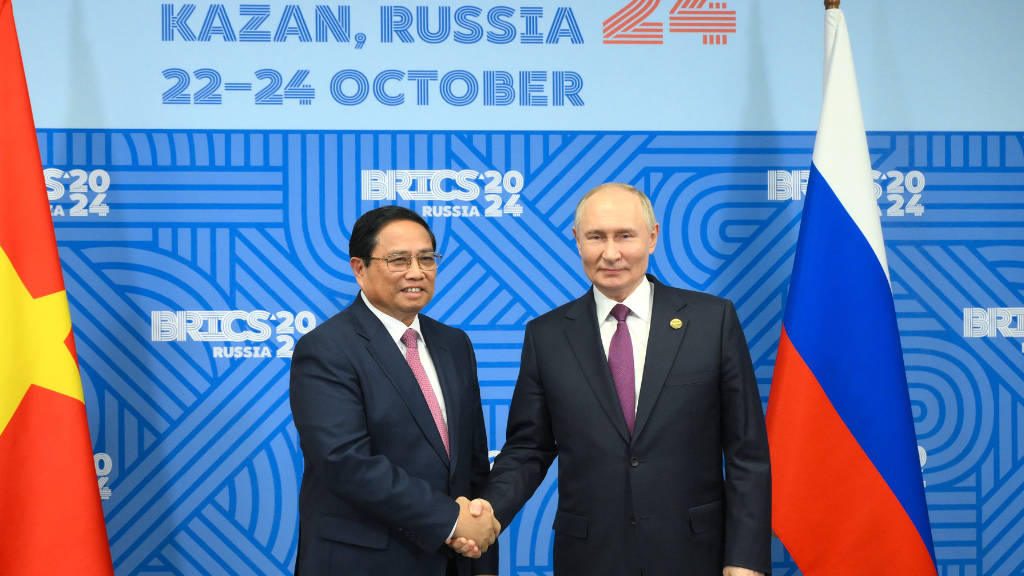
Vladimir Putin has met with, Pham Minh Chinh, the Prime Minister of Vietnam, following the 2024 BRICS Summit in Kazan.

This is what they had to say: 

Putin:

“Once again, allow me to warmly welcome you to Russia. I have warm memories from my recent visit to Vietnam and the conversation we had. It was a rewarding event for our entire delegation. We received a very warm welcome, and from the start, we felt that we were in a friendly country, in a welcoming atmosphere, among friends.

Next year will mark the 75th anniversary of the establishment of diplomatic relations. Our political dialogue is intensive and substantive, along with ongoing interaction at the level of parliaments, ministries, government agencies, political parties, and public associations.

Trade is on the rise. In 2023, we saw an 8.3% increase in mutual trade, reaching US$5 billion, and in January-August 2024, it grew by as much as 25%.

The Intergovernmental Commission on Trade, Economic, Scientific, and Technical Cooperation is working smoothly, and the agreements reached at the highest and intergovernmental levels are being consistently implemented. Russia and Vietnam are cooperating in the energy sector, industrial production, agriculture, and education. This year, we have allocated an additional quota of 1,000 state-funded places for Vietnamese students at Russian universities.

Friends, we are grateful to each of you for participating in the Kazan Summit. Thank you for your informative remarks at today’s meeting. We strongly support Vietnam’s interest in participating in the BRICS group’s multifaceted activities.”

Pham:

“Comrade Vladimir Putin, Russian colleagues, I extend my sincere gratitude for your warm words and sentiments towards Vietnam.

Comrade President Vladimir Putin, on the occasion of your birthday, on October 7, I previously conveyed my best wishes to you. Today, allow me to reiterate those greetings. I have brought you a gift as well – two dragons, one small and one large. In Vietnam and across Asia, the dragon is regarded as the supreme symbol of power. The small dragon signifies the power within Russia, while the large dragon represents your influence outside Russia, across the globe. Within our Asian horoscope, there are 12 animals, with the dragon symbolising the most significant power. I am aware that you were born under the sign of the dragon.

Allow me to also extend my congratulations to Russia. Despite encountering numerous challenges, you continue to demonstrate remarkable economic growth, surpassing the average development rate worldwide. This attests to the internal capacity and self-sufficiency of your economy, and the development opportunities within your country. Each day, you are enhancing your role, position, and reputation on the global stage.

This reflects the Russian character, Russian nature, Russian culture, and Russian values. It exemplifies your resilience in the face of difficulties, challenges, or any adversaries. This serves as an example for us.

I wish to express my gratitude for inviting Vietnam to participate in the BRICS Heads of State meeting in 2024. Let me also extend my congratulations to you on your success in organising this summit, which you are chairing this year.

Our leaders have been closely monitoring the BRICS Summit and are very pleased with your achievements and Russia’s accomplishments in organising this event. Every time I visit Russia, I feel as though I am returning home to family. We will never forget the tremendous support, impartiality, sincerity, and righteous assistance that the Russian people have extended to Vietnam during the struggle for our nation’s independence, the unification of our country in the past, and the ongoing efforts in building and developing our nation.

Witnessing the magnificent beauty, outstanding development, and significant accomplishments of Russia in all fields under your leadership, I am reminded of the profound meaning of the Soviet song ”Where the Motherland Begins“ https://www.youtube.com/watch?v=4IjAYTyDGKs I am aware of your fondness for this song.

For Vietnam, Russia has consistently been one of our primary, most important, and comprehensive strategic partners, and we regard you with respect and warm feelings. These sentiments will remain unchanged.”

Analysis & Implications

What with Gifts of Dragons, and lots of old Communist-style greetings such as calling each other ‘Comrade’, and recalling old Soviet-era songs amid an overall outpouring of personal warmth, it is clear that Russia-Vietnam ties are well-established and friendly. Vietnam has also been invited to take up the status of ‘BRICS Partner’ and will be looking to ratify this before the year end.

Vietnam also has a Free Trade Agreement with Russia via the Eurasian Economic Union, and both sides have made strides to get their bilateral trade levels back on track following a dip in 2022. In 2024, it should reach US$6.25 billion, yet still below the US$10 billion peak achieved four years ago.

Vietnam is the third ‘Asian Tiger’ economy to be considered for ‘BRICS Partner’ status. A member of ASEAN, it is one of the two Marxist–Leninist states in Southeast Asia and shares land borders with China, Laos, and Cambodia. It has maritime borders with Thailand, the Philippines, Indonesia, and Malaysia.

Vietnam has been a beneficiary of the ‘China Plus One’ concept, where rising costs in China manufacturing have seen many manufacturing investors relocate or partially relocate to Vietnam, which offers similar productivity levels but at lower cost. Vietnam has also become a major exporter of agricultural products and is the world’s largest producer of cashew nuts, the largest producer of black pepper, and the second-largest rice exporter in the world. Vietnam is also the world’s second-largest exporter of coffee. Apart from its ASEAN membership, Vietnam also has Free Trade Agreements with Australia, Chile, China, Hong Kong, India, Japan, Mexico, Peru, South Korea, and the United Kingdom, as well as with the Eurasian Economic Union, which includes Armenia, Belarus, Kazakhstan, Kyrgyzstan and Russia. Vietnam has a population of slightly over 100 million, a GDP (PPP) of about US$1.6 trillion, and a per capita GDP (PPP) estimated at about US$15,500. 2024 GDP growth is expected to reach 6.8%.    

In terms of its Vietnam trade, Russia exports coal, iron, and fertilizers, while Vietnam exports coffee and seafood. There are opportunities for Russian manufacturing in Vietnam to take advantage of its beneficial Free Trade position. Kamaz has a successful production line in the country.    

Further Reading

Vietnamese Banks Interested In Opening Branches In Russia

BRICS, Russia and Laos:  2024 Developments and Implications  

Published on October 27, 2024

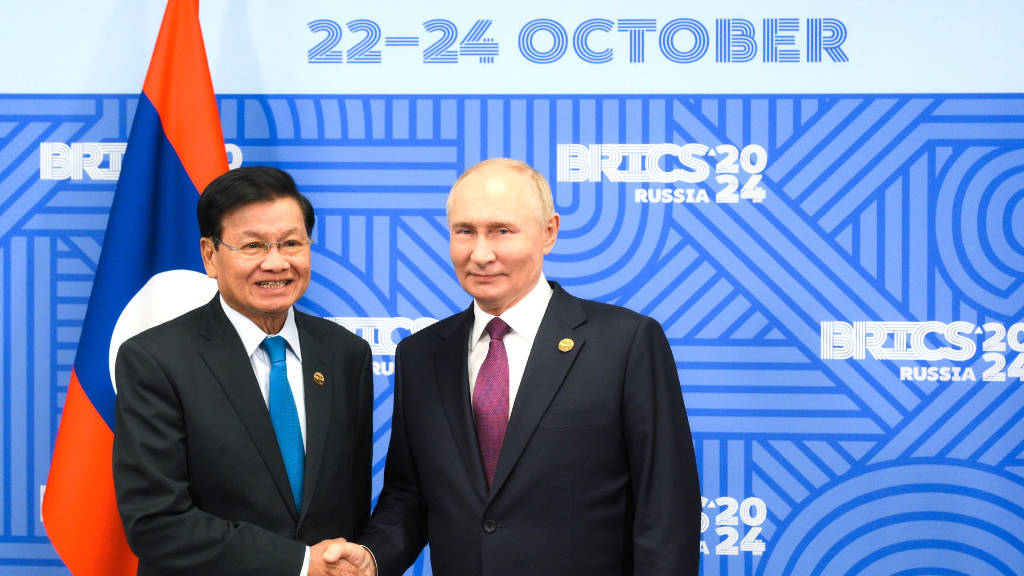
Vladimir Putin has met with Thongloun Sisoulith, the President of Laos, following the 2024 BRICS Summit in Kazan.

This is what they had to say: 

Putin:

“Once again, I warmly welcome you all and would like to thank you, above all, for your participation in the BRICS Summit. The group is a prototype of multipolarity, a structure that consolidates the Global South and East. I have warm memories of our meeting in May, when you visited Moscow to participate in the celebrations marking the 79th anniversary of Victory in the Great Patriotic War. We will be glad to see you in Moscow at the celebrations of the 80th anniversary of Victory next year.

Our relations are of a mutually beneficial nature and have already reached the level of strategic partnership. This March we celebrated the 30th anniversary of the Treaty on Amity, and next year we will celebrate the 65th anniversary of our diplomatic relations.

The absolute volumes of trade are still modest, but the trend is nevertheless very good, and it is increasing many times over.

We have close positions on most international issues. It is very important that the Lao chairmanship of the ASEAN promotes its cooperation with Russia, and we are very grateful to you for that.”

Sisoulith:

“Thank you, Mr President. It has been five months since we met, and I would like to reiterate some points of cooperation between our countries.

I think that Russia’s role will grow in the international arena after this BRICS summit. Following May’s meeting we discussed banking and financial cooperation, and our Central banks are already cooperating.”

Analysis & Implications

Russia-Laos bilateral trade is small at about US$500,000 however the two countries have long diplomatic ties going back to the Cold War era. Laos is landlocked, hence trade volumes are small and are typically routed via China. Laos does pick up some manufacturing investments from neighbouring countries such as Thailand and China, and it also has a developing tourism industry. What trade there is, is typically energy produce from Russia and agricultural products such as fruits from Laos. The country is also quite mountainous which has created additional connectivity issues. In that sense, it was interesting that the Russian Minister of Transport, Roman Starovoit was also involved in the discussions. There may be opportunities for Russian Railways to provide rolling stock.

The reference to Central Bank discussions are likely to involve the potential use of Russian MIR cards in Laos or to formalise Ruble-Kip trading and move to sovereign currency use in trade relations. Laos is a member of ASEAN, which gives it free trade access to Brunei, Cambodia, Indonesia, Malaysia, Myanmar, Philippines, Singapore, Thailand and Vietnam. It also has FTA with China and India.   

Laos is a small player within ASEAN with a population just under 8 million, and a GDP of US$74 billion, but is the current chair of the bloc.

Further Reading

Laos Applies To Join The Shanghai Cooperation Organization

BRICS, Russia, and Bolivia:  2024 Developments and Implications

Published on October 26, 2024

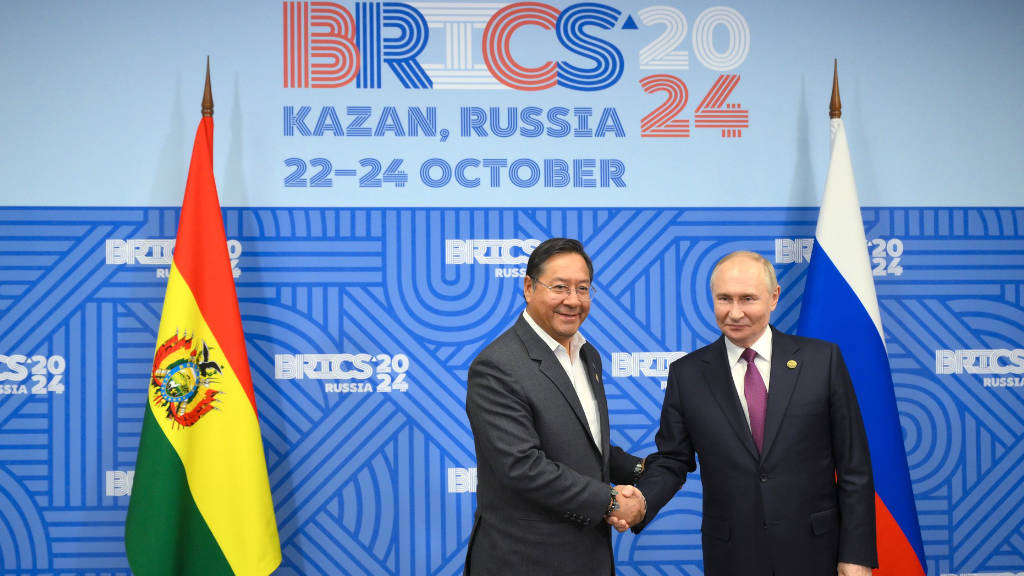
Vladimir Putin has met with Luis Alberto Arce Catacora, the President of Bolivia, following the 2024 BRICS Summit in Kazan.

This is what they had to say: 

Putin:

“I am delighted to see you in Russia again. Your visit to St Petersburg in June was very fruitful. We held substantive talks and attended the plenary session of the St Petersburg International Economic Forum.

Russian-Bolivian cooperation is based on the solid traditions of friendship and mutual respect. Our bilateral ties are developing consistently across many spheres, including politics, the economy, trade, education, and culture. Our countries have similar views on the fundamental principles of international order, and we are working jointly at the UN.

We appreciate your decision to accept our invitation to attend the BRICS Summit in Kazan. I hope you are not disappointed. During the expanded session in the BRICS Plus/Outreach format today, we heard the strong voice of Latin America, which is represented by the heads of many regional states that share the fundamental goals and principles of our group. We listened with great interest to your assessment of the current geopolitical situation, which you made during your address.

I believe that the summit was a success. We can see that the Global Majority countries increasingly see BRICS as a truly authoritative group that the international community needs.”

Catacora:

“President Putin, thank you very much for the warm reception. We are always happy to attend such events and to have the opportunity to engage in direct dialogue on various subjects with you.

The main issue of concern to us today in the context of recent news is the status of a BRICS partner country. Does this mean that we can become a full member? How are such questions considered? Also, does the BRICS modality offer access to full membership? This is the topmost question I would like to discuss with you today in light of the latest media reports.”

Analysis & Implications

Bolivia has been offered the status of a ‘BRICS Partner’ country, however, there is a new protocol to go through beforehand which Putin and his team will have explained to Catacora. Bolivia will need to ratify this process.

Bolivia borders fellow BRICS member Brazil to the north and is the largest land-locked country in South America. Seaport access is via Peru.

Bolivia has the world’s largest lithium reserves, second-largest antimony reserves, third-largest iron ore reserves, sixth-largest tin reserves, ninth-largest lead, silver, and copper reserves, tenth-largest zinc reserves, and undisclosed but productive reserves of gold and tungsten. Additionally, there are believed to be considerable reserves of uranium and nickel. Bolivia’s Lithium reserves make it a key source for future technologies, including semi and super-conductor production. Bolivia also has the second-largest natural gas reserves in South America.

It is a member of the Andean Community, and an associate member of Mercosur, with full incorporation pending. The Andean Community includes Colombia, Ecuador, and Peru, while Mercosur includes Argentina, Brazil, Paraguay, and Uruguay. Bolivia has a population of about 11.50 million, a GDP (PPP) of about US$125 billion, and a per capita GDP (PPP) estimated at US$10,340. 2024 GDP growth is expected to reach 1.6%.   

In terms of bilateral trade with Russia, current bilateral trade is running at about US$120 million per annum with Russia exporting the bulk of this. However, Moscow is on the lookout for new agricultural partners meaning Bolivian exporters now have the opportunity to increase their share.

Another key trade area likely to receive a boost is lithium carbonate, a critical component in the growing electric vehicle and renewable energy sectors. Chile, together with Argentina, last year halted lithium carbonate shipments to Russia, a move that now places Bolivia as a key supplier for Russia’s lithium needs. Bolivia has the world’s largest lithium reserves, a key component in battery manufacturing. China’s EV auto industry is already active in Bolivian lithium mining.

The main products that Russia exports to Bolivia are Vaccines, blood, antisera, toxins and cultures, Refined Petroleum, and Packaged Medicaments. The main products that Bolivia traditionally exports to Russia are Carbonates, Inorganic Salts, Coconuts, Brazil Nuts, and Cashews.

Further Reading

Russia To Build Lithium Carbonate Plant In Bolivia

BRICS, Russia, and Ethiopia:  2024 Developments and Implications 

Published on October 26, 2024

Vladimir Putin has met with Abiy Ahmed, the Prime Minister of Ethiopia, following the 2024 BRICS Summit in Kazan.

This is what they had to say: 

Putin:

“Mr Prime Minister, I am delighted to see you again. Ethiopia’s accession to BRICS is a momentous decision and yet further proof of your country’s prestige on the international stage. We will continue to assist Ethiopia’s seamless integration into the operations of our group.

Last year, we marked the 125th anniversary of our diplomatic relations, which are based on a rich history and longstanding traditions of friendship, mutual respect, and cultural and spiritual affinity between our nations.

Over the past year, we have stepped up our political dialogue and developed regular contacts between our ministries and agencies. Our countries often hold very similar views on the majority of global and regional issues. We appreciate Ethiopia’s support for the majority of Russian initiatives at the UN.

Russia is giving special attention to the development of ties with African countries. We are implementing the agreements reached at the second Russia–Africa Summit in St Petersburg, and we look forward to seeing the new Foreign Minister of Ethiopia at the first ministerial conference of the Russia–Africa Partnership Forum in Sochi this November.

Federation Council Speaker Valentina Matviyenko is ready to visit Addis Ababa in the next few months.

Our bilateral trade is growing. It may be modest in absolute terms, but there is positive dynamics with a 65% in 2023. If we continue in the same vein, we will achieve substantial results, considering that the current figures are far from the optimal mark.

We would like to strengthen interaction in healthcare and research. Rospotrebnadzor is ready to donate a mobile laboratory to Ethiopia, just as we do in relations with our partners when we provide equipment and train their personnel. We are also providing assistance to our African partners through international organisations.

We pay special attention to cultural and humanitarian cooperation. Since the 1960s, over 20,000 Ethiopians have received a higher education in Russia. About 200 Ethiopians are currently studying in Russia. The ‘Days of Russia’s Spiritual Culture’ event was held in Addis Ababa in September.

Our meeting today offers an opportunity to hold an in-depth discussion on these and other current issues of our cooperation.”

Ahmed:

“Congratulations on such a well-planned and extremely perfectly delivered summit. We are extremely happy in every second that we have spent in this beautiful city. Our meeting was very efficient, and I would like to congratulate you on such high-level delivery.

Allow me to congratulate you on maintaining economic resilience during a difficult period. This period was not easy for Russia, but under your leadership you have succeeded to maintain the economic resilience which might be exemplary for most of us.

It is a good time for most of us to come and to witness how Russia is doing on many fronts, including the economy. In our exchanges, there are areas that we can clearly see that if we work hard and continuously engage, we can increase our economic ties, diplomatic ties, and also security ties.”

Analysis & Implications

Ethiopia is a landlocked country and is currently involved in a civil war involving the creation of Eritrea, which has cut off Ethiopia’s access to the Red Sea and created trade difficulties. Eritrea is supported by the United States. This conflict is why Ahmed referenced security ties as important.

Agriculture constitutes around 85% of the Ethiopian workforce. However, the service sector represents the largest portion of the GDP. Many other economic activities depend on agriculture, including marketing, processing, and export of agricultural products. Production is overwhelmingly by small-scale farmers and enterprises, and a large part of commodity exports are provided by the small agricultural cash-crop sector. Principal crops include coffee, legumes, oilseeds, cereals, potatoes, sugarcane, and vegetables. Ethiopia is also a Vavilov centre of diversity for domesticated crops, including enset, coffee, okra, and teff. Exports are almost entirely agricultural commodities (except gold exports), and coffee is the largest foreign exchange earner. Ethiopia is Africa’s second biggest maize producer.

Ethiopia has 14 major rivers flowing from its highlands, including the Nile, and has the largest water reserves in Africa. Hydroelectric plants represent around 88.2% of the total installed electricity generating capacity in the country however some of these technologies are becoming outdated. It was therefore significant that Alexei Likhachev, Director General of Rosatom was present at this meeting. Ethiopia may be looking to develop NPP with Russia’s assistance.

Bilateral trade was US$87.12 million in 2023, up from US$52.8 million in 2022. If that 65% growth rate Putin mentioned was maintained during 2024, that should result in a bilateral trade figure well in excess of US$100 million per annum.  Ethiopia exports mainly coffee and dried vegetable products to Russia, while Russia exports mainly wheat, and grains.   

Ethiopia is a member of the Common Market for Eastern and Southern Africa (COMESA), which also includes Djibouti, Eritrea, Somalia, Egypt, Libya, Sudan, Tunisia, Comoros, Madagascar, Mauritius, Seychelles, Burundi, Kenya, Malawi, Rwanda, Uganda, Eswatini, Zambia, Zimbabwe and the Democratic Republic of the Congo. It is a member of the African Continental Free Trade Agreement. 

Further Reading

Ethiopia Calls For Alternative BRICS Monetary System

BRICS, Russia, and Mauritania:  2024 Developments and Implications 

Published on October 26, 2024

Vladimir Putin has met with Mohamed Ould Cheikh El Ghazouani, the President of Mauritania, following the 2024 BRICS Summit in Kazan.

This is what they had to say: 

Putin:

“Mr President, I am delighted to meet with you. We appreciate your decision to personally visit Kazan not only as head of state but also as chairperson of the African Union and to attend the BRICS Summit’s events.

The strengthening of cooperation with the dynamically developing African countries is one of BRICS priorities in the outreach format. Mauritania’s representatives took an active part in the group’s events organised during Russia’s chairmanship this year.

Russia has developed close and constructive relations with the African Union. We appreciate the practical activities of that organisation in politics and the economy, as well as in ensuring security on the African continent. We welcome the African Union’s decision to join the G20 as a full member. For our part, we are providing all-around assistance with this process.

Russia’s trade with Africa is growing with each passing year. It increased by over 30% in 2023 and continued to grow this year. From January to July, our mutual trade increased by another 25% year on year.

The two Russia-Africa summits, which were held with the direct and proactive assistance of the African Union, one in Sochi in 2019 and the other in St Petersburg in 2023, have given a fresh impetus to the further development of Russia’s relations with African countries. We are actively working together to implement the important documents adopted as a result of these events.

As for our bilateral relations, Russia and Mauritania developed close ties back in the middle of the 20th century, and we continue to strengthen them on the principles of friendship, mutual respect, and a balance of national interests.

This year, we will mark the 60th anniversary of our diplomatic relations. We have accumulated a wealth of positive experience in the area of mutually beneficial cooperation over that period.

We maintain regular political dialogue at various levels. Our foreign ministers keep in touch with each other. We are working consistently to strengthen the legal framework of our relationship. We have developed close ties in education. We have trained over 3,500 Mauritanian professionals. Mr President, we are delighted by the growing interest of your young people in studying in Russia.

Russia and Mauritania often take a common stance on the international stage, which helps us develop our relations on the same basis within the framework of the BRICS Plus/Outreach format.

We highly value your support for Russia’s initiatives at the UN and other multilateral forums and venues and are delighted that you attended the BRICS Summit. Thank you for coming to Kazan.”

El Ghazouani:

“Mr President, first of all, I would like to thank you and express our appreciation for inviting us to this summit and for the warm reception and hospitality accorded to us, to me personally and to our delegation upon our arrival in Russia. I would like to congratulate you on the success of the 16th BRICS Summit and to express my gratitude for this opportunity to exchange views in the expanded BRICS Plus format.

I had no hesitation in accepting your invitation, not only because it is an extremely important summit but also because I wanted to meet with you personally in order to openly discuss our bilateral relations and Russia’s relations with the African continent.

We in Mauritania believe that our relations with Russia, our historical and strategic relations are important to us, and we will spare no effort to strengthen and further develop them. In this connection, I would like to mention the historical ties of friendship that we share, which form the basis for the further development of our relations. As you rightly pointed out, our relations have been growing stronger over the past 60 years.

I highly appreciate the constant support you have provided to the development of our country since Mauritania gained independence, including by giving our young people an opportunity to study in various fields and disciplines at Russian universities.

We continue to develop our cooperation in priority spheres, in particular, fishing, higher education and trade. We highly appreciate it that our cooperation is based on trust, mutual respect and a balance of each other’s interests.

I would like to reaffirm my personal commitment to promoting cooperation with Russia. We would be delighted and would appreciate it if more Russian investors came to Mauritania, in particular, in fishing, agriculture, energy and natural resources, to make use of what we have to offer in these spheres in the interests of cooperation.

Our cooperation should be shaped within the framework of an intergovernmental commission, which will promote the strengthening and further development of our relationship in all spheres.”

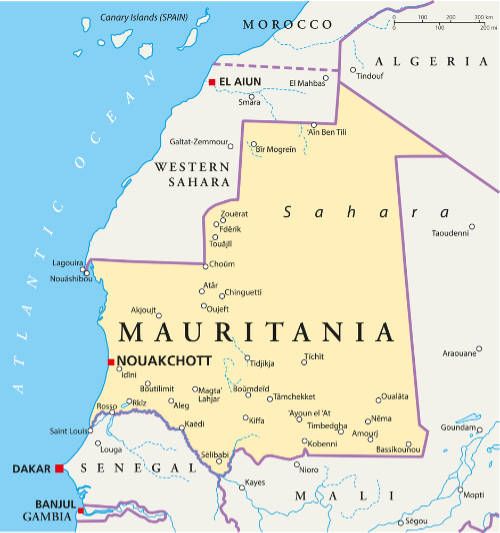
Mauritania Map

Analysis & Implications

Mauritania is a North-Western African nation with an Atlantic Ocean coastline. It has been part of the “Great African Expedition”, a six-month long Russian exploratory voyage to assess fish stocks off the West African coastline.

Recent efforts by Moscow to build closer ties with Mauritania fits into Russia’s push for greater presence, both security and economy-wise, in the African continent. With Mauritania, however, Moscow also seeks augmented presence in the Sahel and West African region of the continent.

In early 2023, for the first time in the history of bilateral trade and economic relations, Sergey Lavrov, the Russian Foreign Minister, together with a delegation of Russian businessmen paid a visit to the capital of Mauritania, Nouakchott. The program, organized as part of the Russian Business Week in North Africa, included a Russian-Mauritanian business forum, a meeting of the Russian-Mauritanian working group on interaction at the business level, bilateral meetings on business interests, as well as visits to enterprises and organizations.

Russia is interested in investing in the following areas: fishing industry (production of fishmeal and canned food), where Russian fishing vessels have been operating in Mauritania’s exclusive economic zone for 30 years. However, the Russian Foreign Minister stated that “we need to direct our main efforts to diversify our trade and economic ties, to search for new forms of cooperation”.

The two countries can also work on the development of infrastructure, agriculture (including agricultural development, and the supply of Russian machinery and equipment), tourism, and energy and raw material exploration. Mauritania’s main industry is iron ore mining, and the country boasts gold, gypsum, and oil deposits where Russia can help with geological exploration.

For the moment Russian investments in Mauritania remain low. This is not so much because of Russian inactivity as much as foreign direct investments into the African country generally stand close to zero. A low level of security, a lack of proper bureaucratic systems related to foreign investors, and most of all, the uncertain geopolitical situation in the region overall. Yet Russia has to start somewhere, as Lavrov noted, and Mauritania has a potentially useful and strategic coastline and supplies of seafood that could make an impression upon Russian imports if managed and developed correctly. Russia may begin by helping install governmental and bureaucratic structures and help Mauritania develop from there.

Further Reading

Russia Looks To Africa For Seafood Supply Chains